Megatrend · Energy
The biggest battery in the world isn't lithium — it's water and a mountain
The world's first and largest renewable source of electricity is 'water falling through a turbine' — a technology that's been around for over a century. It still supplies about 14% of all the world's power today. But its more remarkable new role is acting as a giant 'battery' — pumping water up a mountain to store it when power is plentiful, then letting it fall to generate when power is short. This system is called pumped storage, and it makes up over 90% of all energy storage on the planet — fast becoming the indispensable partner of solar and wind.
01What it is
Of all the clean energy sources, hydropower is the 'oldest' — humans have been generating electricity from water since the late 19th century, a hundred years before solar panels and wind turbines were born. And here's what many people don't realize: even today, it's still the largest renewable source of electricity in the world, supplying more power than solar or wind when you count each as a single source.
The basic principle is dead simple: take water that sits high up and let it flow down. On the way it rushes through a turbine, spinning the blades, and the turbine's shaft is connected to a generator — when the blades spin, you get electricity. That's really all there is to it. The energy comes from the 'height of the water' and the 'amount of water flowing.' The higher and the more, the more power you get.
But this node has two faces. The first is the hydropower we just described — dams making electricity. The second is the real star of this era: pumped storage hydro (PSH), which doesn't generate new power at all but acts as a giant battery.
Baseload = hydropower from dams, generating a steady, continuous supply — the 'base' of a low-carbon power system · Storage = pumped storage; it doesn't create new power but 'stores' surplus electricity to use later. Hydropower does both in a single technology — something very rare in the energy world.
On the megatrend map, this node is a sub-theme under Energy Transition & Power Demand. Its definition is 'firm low-carbon electricity, plus the ability to balance the grid and store energy for long durations' — and those last two are exactly why this old technology has become interesting again in the renewable era.
02Why it matters — the quiet backbone + the biggest battery
Start with scale. Hydropower has more than 1,400 gigawatts (GW) of installed capacity worldwide, generating about 4,578 TWh in 2024 (up 10% from the year before) — roughly 14% of all the world's electricity and nearly half of all renewable power. More than any other clean source, counted one by one.
But the more important — and most striking — number is on the storage side. The world has about 189–200 GW of pumped storage installed, and it accounts for more than 94% of all the world's long-duration energy storage. Put another way: if you piled up all the world's 'batteries' in one place, almost the whole pile would be mountain reservoirs, not blocks of lithium.
Why does this matter more and more? Because the world is pouring huge amounts of solar and wind into the grid — but both are 'unreliable.' The sun shines during the day; the wind blows in bursts. The catch is that electricity has to be produced to match exactly what's used, every second. When sun and wind swing, the system needs something to 'absorb the shock' — storing surplus power when it's sunny, then releasing it after sunset. Hydropower is what does this job best and cheapest at large scale.
03How it works (pumped storage)
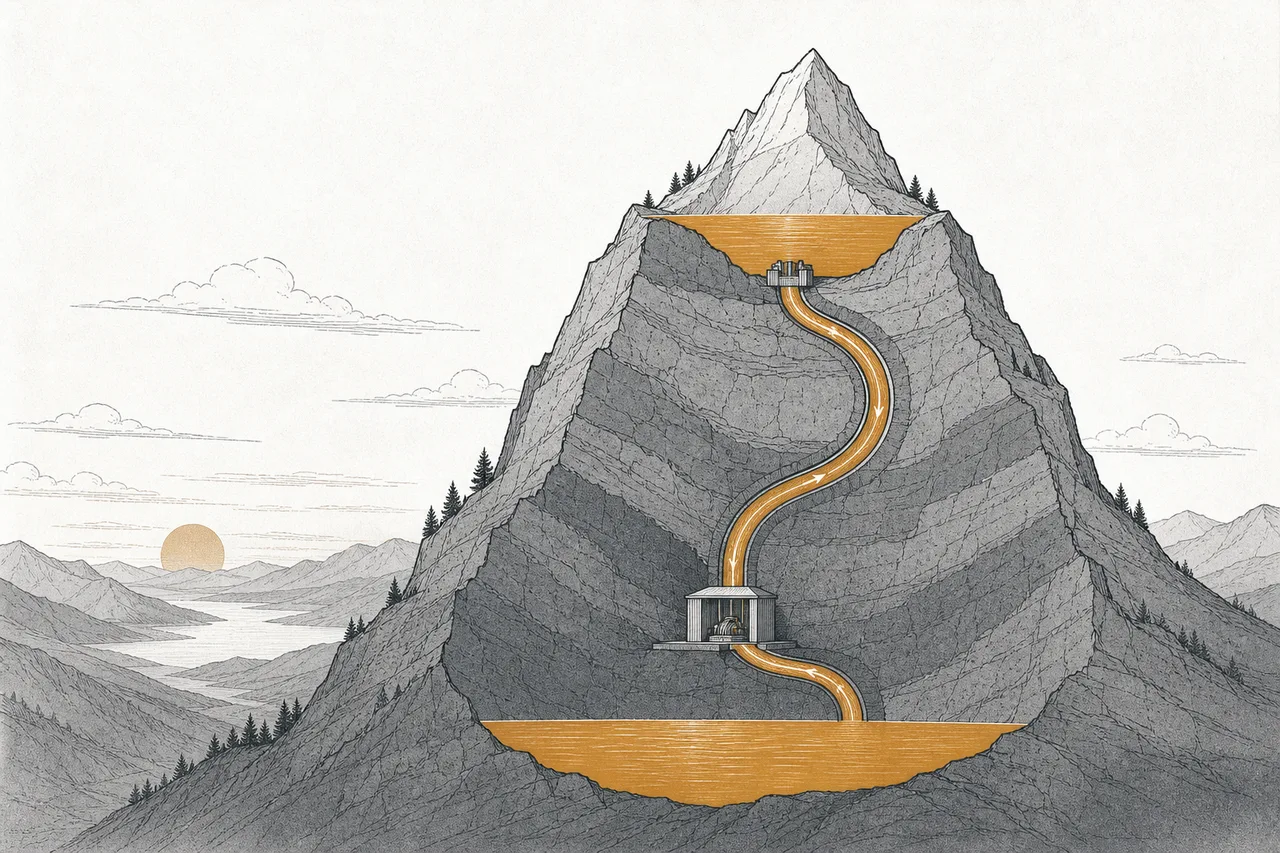
The heart of pumped storage is an idea so simple it's almost funny: use water and gravity as a battery. You need two reservoirs at different heights — an upper one and a lower one — connected by a pipe and a turbine that 'runs both ways.'
When power on the system is plentiful and cheap (say, a sunny midday, or a night when few people are using electricity), the system takes that surplus and pumps water from the lower reservoir up to the upper one — in effect 'charging' electrical energy into the potential energy of water held up high. When power is short and expensive (early evening, when everyone's home and the sun is gone), you simply let the water fall and spin the turbine, releasing electricity back into the grid.
It isn't free — every time you charge and discharge, some energy is lost to friction and pumping. The round-trip efficiency of PSH is about 70–80%, meaning if you put in 100 units of electricity, you get back about 70–80. That's a bit lower than lithium batteries (85–95%), but the decisive advantage is that it 'stores for longer and is far cheaper at large scale'.
Round-trip efficiency = the share of electricity you get back, divided by what you put in to store (PSH ~70–80%) · Long-duration storage = storage that can deliver power continuously for a long time (hours to days), which is the weakness of chemical batteries that often last only a few hours — the reason pumped storage still dominates the long-duration storage market outright.
04Where it sits in the energy world
Hydropower is one of the sub-themes of the Energy Transition & Power Demand megatrend, and its standout role is being the 'glue' that lets the grid's other sibling segments work together:
- Backs up solar and wind: this is the most important relationship. The more 'swinging' energy the world adds, the more it needs a shock absorber. Pumped storage is the partner that soaks up surplus power at midday and returns it in the evening
- The root of Energy Storage & Grid Flexibility: count the whole storage segment by real capacity, and most of it is this PSH. Lithium batteries fill in the short, fast-responding jobs; PSH handles the long ones
- Sits on Grid & Transmission: big dams are often far from cities, so high-voltage lines are needed to carry power in. Hydropower and the transmission grid are tightly bound together
- Feeds AI and data centers: AI data centers' demand for 'clean, stable, 24/7' power is making continuous-supply hydropower sought-after again — one of the few clean sources you can 'turn on on demand'
05Where it stands now + the players
Hydropower today is a 'two-speed' story. On the traditional dam-generation side, growth is slowing in the West, because the good sites (big rivers, large height differences) were nearly all built last century. New growth has moved to Asia and Africa — with China leading by a wide margin.
But the pumped storage side is clearly 'coming back to life'. Annual additions have nearly doubled in the past few years, and are expected to rise to about 16.5 GW a year by 2030. There are now around 600 GW of PSH projects in the pipeline worldwide — driven by demand to pair a 'giant battery' with the ever-growing flow of renewables.
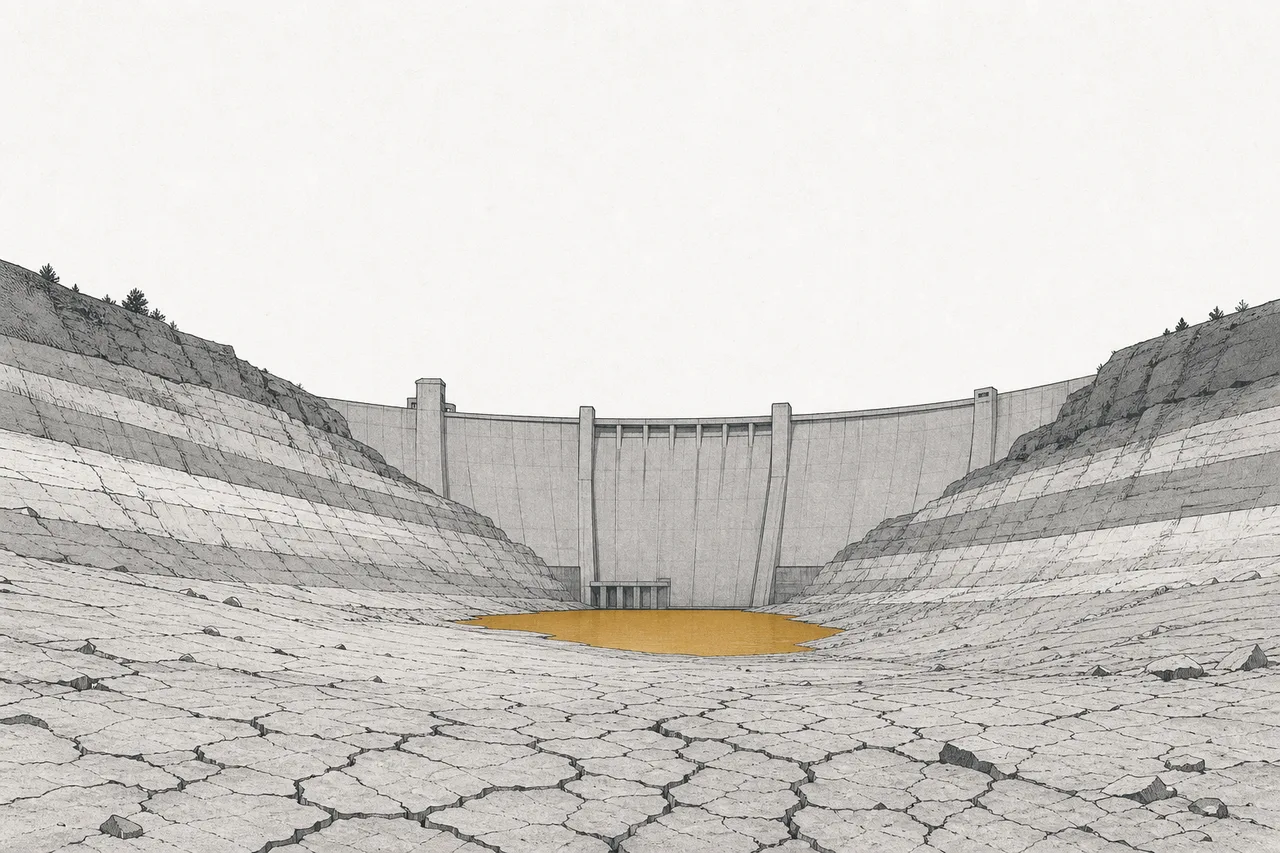
Another big drama this year is drought. In 2023, the world's hydropower generation fell by more than 100 TWh (down over 2%) because of severe drought across China, Canada, India, Vietnam, and the US — China alone generated 4.9% less. The impact was big enough that the IEA pointed to lost hydropower as the cause of about 40% of that year's rise in carbon emissions (because coal/gas plants had to be brought in to fill the gap). But in 2024 the rains returned and generation bounced 10% — a sign that its output is tied directly to the weather.
In terms of players, this market splits into two groups: those who own the dams (mostly giant utilities and state-owned enterprises) and those who build the turbines and equipment (a handful of heavy-engineering firms) — and in both groups, China and Europe play an outsized role.
06The road ahead
The first direction is the revival of pumped storage as long-duration backup. The more solar and wind on the grid, the more the world needs to store electricity 'across the peak hours' and across seasons — something chemical batteries do expensively and briefly. The 600 GW of PSH in the global pipeline is a bet that this demand grows for real. Annual additions are expected to double by 2030.
The second direction is losing the crown gracefully. In sheer generation volume, hydropower is being overtaken — in 2024 wind + solar combined passed hydro for the first time, and around 2029 solar alone is expected to overtake hydropower as the number-one renewable source. Hydropower's share of renewable electricity is slipping from over 80% twenty years ago to about 30% by 2030 — but this isn't a 'decline.' It's that the whole cake is growing much faster. Hydropower is still growing in volume; everything else is just growing faster.
The third direction is 'changing roles' from power producer to grid balancer. Many old dams in Europe and America are being upgraded to operate more flexibly — starting and stopping faster, adding pumping capability — to make money from 'buying cheap power and selling expensive power' rather than just generating. The future value of hydropower lies in its 'flexibility,' not just the units of electricity it produces.
07Challenges & risks
This old technology has weaknesses baked deep into its nature, too.
The first and most direct risk is drought and climate change. A dam's output is tied directly to the 'water flowing in,' so a dry year means less generation right away — as seen in 2023, when the world lost more than 100 TWh, and in the US, where 2024 hydropower came in 13% below the 10-year average. A more erratic climate (long droughts alternating with sudden floods) turns 'a clean source you should be able to rely on' into a variable that's harder to count on — which contradicts the very reason we want it.
The second risk is few good sites left, and harder to build. The big rivers and valleys suited to large dams in the West are nearly all built out. New projects take a decade to construct, cost a lot (PSH installation runs $1,700–5,100 per kilowatt), and face long permitting hurdles — so even when demand is high, capacity grows far slower than solar/batteries.
The third risk is environmental and social impact. Big dams change a river's flow, block fish migration, flood land and communities — and in the tropics, reservoirs with vegetation rotting underwater can release methane. So hydropower's 'clean' doesn't mean 'no cost to the ecosystem.' Environmental opposition is one of the big reasons new dam projects in developed countries have nearly ground to a halt.
In short: hydropower is the story of a hundred-year-old technology that suddenly got a new job more important than its old one — not just generating electricity, but being the 'biggest battery in the world' that makes the era of solar and wind actually possible. It may no longer be the star on the headlines, but without mountain reservoirs to absorb the shock, the low-carbon grid we're building would be far shakier.