Megatrend · Robotics & Physical AI
The robots that have already made real money for 40 years — not the one that just learned to walk
While the whole world buzzes about humanoid robots that are still burning cash, the robot arms in factories have been quietly turning a profit since the 1980s. More than 540,000 of them get installed every year, and now a new generation that's 'safe enough to stand next to a person' is opening the door to automation for the small factories that could never reach it. This is the real money-making heart of robotics — and it has a dark side: a brutal boom-and-bust cycle.
01What it is
When people hear 'robot,' they usually picture the two-legged walker from a viral clip. But the robots that have actually worked and actually made money for decades look a lot more boring — they're the robot arms bolted to the factory floor, welding, assembling, picking-and-placing, and spray-painting cars and phones since the 1980s. This node is about them.
On the megatrend map, this node sits under Robotics & Physical AI, and its definition says it plainly — it's the 'mature revenue backbone of robotics.' The opposite of humanoids, which are still a bet on the future. This is a business with profits, real customers, and numbers you can put your hands on.
It has three main parts: (1) traditional industrial robot arms — big, fast, powerful, working behind a safety fence · (2) cobots (collaborative robots) — smaller, safe enough to stand next to a person · and (3) motion control and PLCs, the 'command brain' that tells the arm when to move, where to go, and how fast.
PLC (Programmable Logic Controller) = a rugged, specialized computer that keeps a whole line of factory machines working in sync · Motion control = the system that drives motors with sub-millimeter precision. This is the 'nervous system' of automation — not as flashy as the robot itself, but without it the arm can't move at all.
02Why it matters — proven profit
The single biggest reason this node matters comes down to one thing: it already makes real money, today — not 'will make money someday.' In 2024 the world installed 542,000 new industrial robots — the fourth year in a row above 500,000, and double the figure from 10 years ago. The industrial robot arm market was worth about $17 billion in 2024, and is expected to grow to ~$29 billion by 2029.
But what makes it a 'good business' isn't just volume — it's profit. Market leaders like ABB, Fanuc, and Yaskawa earn operating margins above 20%, especially from software and after-sales service. And Keyence, the Japanese sensor/automation company, is famous for legendary-level margins in the hardware world. This is a quality of profit the whole new generation of robots hasn't reached yet.
Who's paying? The auto and electronics industries have long been the main customers, because they make huge volumes of identical products — the work where arms pay off the most. What automation replaces is 'labor that's hard to find, getting more expensive, and that nobody wants to do — the repetitive, dangerous jobs.'
03Traditional arm vs cobot — what's the difference
The single most important thing to grasp about this node is the line between two species of robot that look alike at a glance but are designed for completely different worlds.
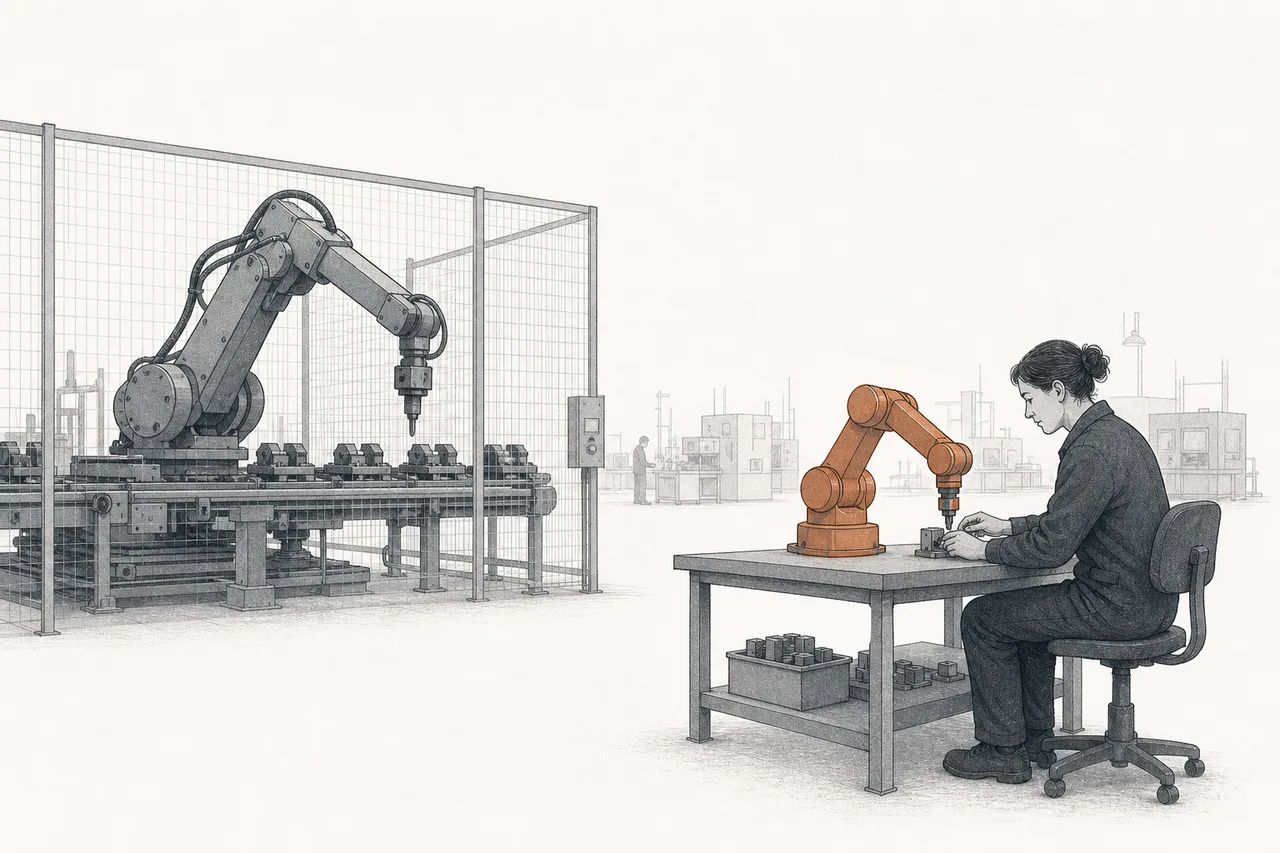
Traditional industrial robot arms are built for speed and power. They lift hundreds of kilos, move at dangerous speeds, and run a fixed, pre-set program with precision. Because they're so strong and fast, they have to be locked behind a safety fence — if a person walks in while it's running, it can be fatal. They suit high-volume production that repeats the same task for years, like welding car bodies.
Cobots, on the other hand, are designed from the opposite question: how do you make it safe enough to stand next to a person without a fence? They're smaller, slower, and weaker, but they have force sensors — the moment they bump a person, they stop. And most important of all, they're 'easy to teach': a worker can grab the arm and drag it to the spot they want, instead of writing code. This is exactly what opened the door to automation for small factories with no robotics engineer.
A robot designed to work in 'shared space' with people safely, with no fence. The key is force-limiting — it's deliberately built to be low-force and touch-sensitive, so it stops the instant it hits something. The selling point isn't 'faster,' it's 'easy to install, quick to move to another job, and no need to build a fence' — which cuts cost and time a lot.
04Why it's accelerating 'now'
Automation has been around for ages. But three forces turned the 2020s into a genuine acceleration.
One — labor is vanishing and getting more expensive. Factories everywhere are finding it harder to hire. In the US, half of skilled-trade openings go unfilled, and the labor skills gap could cost the US economy as much as ~$1 trillion by 2030. When you can't find people, robots become a solution, not an option.
Two — reshoring (bringing production home). Trade wars and supply-chain risk are pushing companies to move production back to high-wage home countries — which means 'you have to automate, or you can't compete on cost.' One survey found 95% of US manufacturers planned to install new automation within the next 3 years.
Three — AI made robots 'easier to instruct'. The biggest barrier to automation has always been that it's 'hard to program' — you had to hire specialized engineers. But now AI and new teaching methods (like ABB's lead-through, where a person grabs the arm and drags it to teach a welding job) let ordinary people set robots up themselves. By 2025, AI-using robots made up ~15% of all new installs — and this is exactly where this node connects directly to Artificial Intelligence.
05Where it sits in robotics
This node is the 'breadwinner' in the Robotics & Physical AI family, and it connects to its siblings in a logical way:
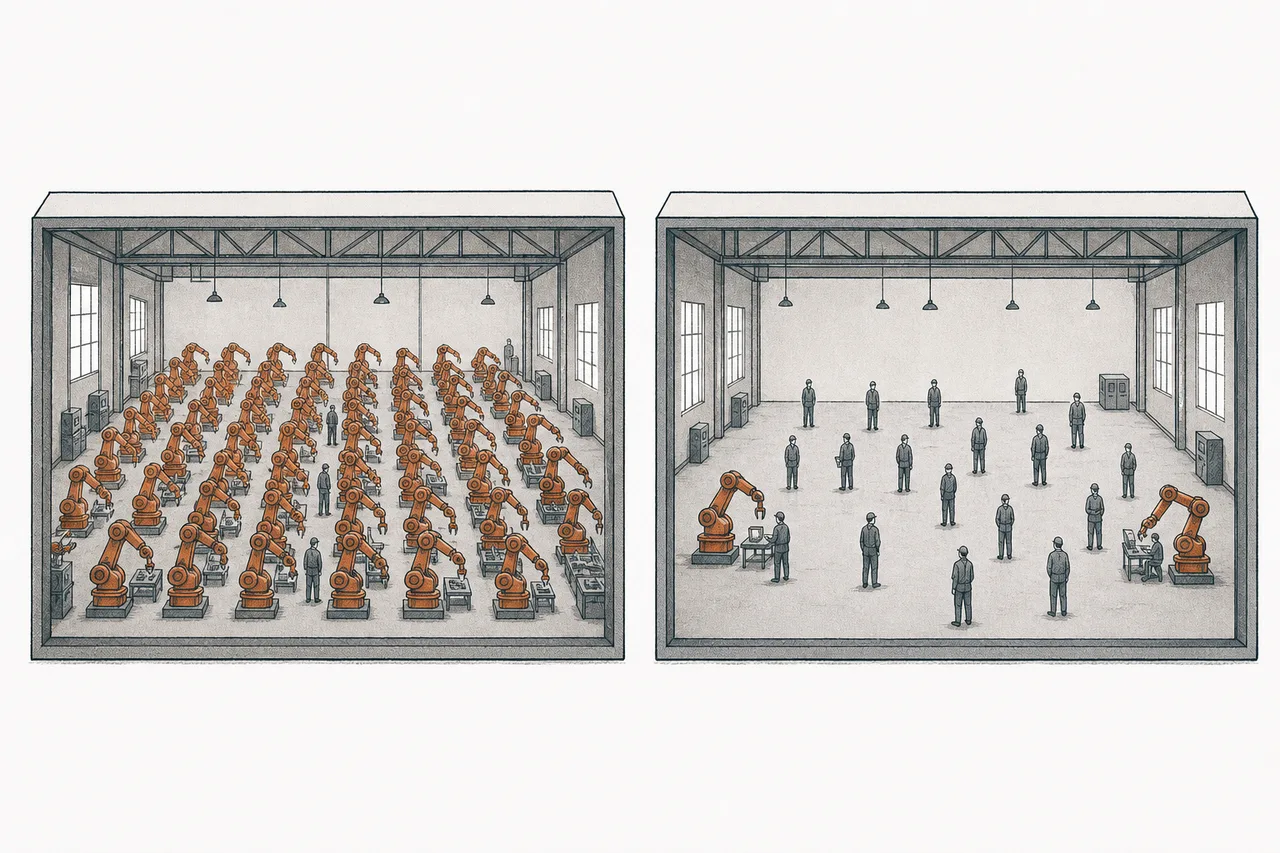
- The opposite of Humanoid Robots: humanoids are a future bet still burning cash, while Industrial Automation is proven profit today — a perfect benchmark for what a 'robot that actually makes money' looks like
- Relies on Robotics Components & Actuation as its raw materials: every arm is built from motors, reducers (harmonic/cycloidal), and force sensors — these parts are the cost and quality of the robot
- Overlaps with Warehouse & Logistics Robotics: same arm technology, same control system, just moved from the production line into the warehouse (picking, palletizing)
- Powers Electrification & Mobility: EV and battery factories are among the biggest customers for today's arms — the more the world shifts to EVs, the more entirely new automated lines it needs
Put simply, if Robotics & Physical AI is a 'family,' this node is the member with a steady job who sends money home to support the household — while the humanoid is the youngest, still in school but hugely talented.
06Where it stands now
Today's picture has two big things to understand: who controls the market, and how China is changing the game.
The heart of industrial robot arms is controlled by a group called the 'Big Four' — Fanuc (Japan), ABB (Switzerland), Yaskawa (Japan), and KUKA (Germany, now owned by China's Midea). Together these four control about 75% of global robot shipments, with Fanuc leading at ~10%, ABB ~8.3%, Yaskawa ~6.3%, and KUKA ~3.4%.
The second story is China, which is now both the biggest market and the fastest-rising producer. In 2024 China installed 295,000 new robots = 54% of the world. And more important — for the first time, Chinese makers sold more in their own home market than foreign brands. Chinese brands' domestic share jumped from ~28% a decade ago to 57% in 2024. In cobots it's even more extreme — Chinese brands hold over 92% of the home market.
What's worth noting is that Chinese challengers like Estun (#2 in China, ~9.5% share, nearly overtaking Fanuc) and Inovance are squeezing the foreign brands hard in their own home market — especially in cobots, which China almost completely dominates. Most aren't yet companies foreign investors can easily access, but they're a pressure that's changing the profit equation for the whole industry.
07The road ahead
The first direction is cobots becoming the growth engine. The traditional arm market keeps growing (~12% a year), but cobots grow much faster — from ~$1.4 billion in 2025 to ~$3.4 billion by 2030 (CAGR ~19%). Some analysts see cobots taking ~29% of the whole robot market by 2030, up from just 5% in 2019. The reason: they open the door to an entirely new customer base — small and mid-size enterprises (SMEs) that never had robots before. In 2025, over 42% of SMEs that started automating chose cobots.
The second direction is AI getting embedded deep into the robot. A 2025 report describes the industry moving from 'automation to autonomy' — from robots that follow a fixed program to robots that adapt to changing work on their own. BMW, Mercedes-Benz, and Tesla have already started trialing AI/humanoid robots in real factories. This will slowly erase the line between 'robot arm' and 'smart robot.'
The third direction is China's rise, which won't stop at the domestic market. Once Estun, Inovance, and their peers have locked down their home market, the next step is exports — which will push prices down and reshape the competitive landscape of the whole world, just as China did with solar panels and EVs before.
08Challenges & risks
Even though this node 'actually makes money,' it has weaknesses baked deep into its nature.
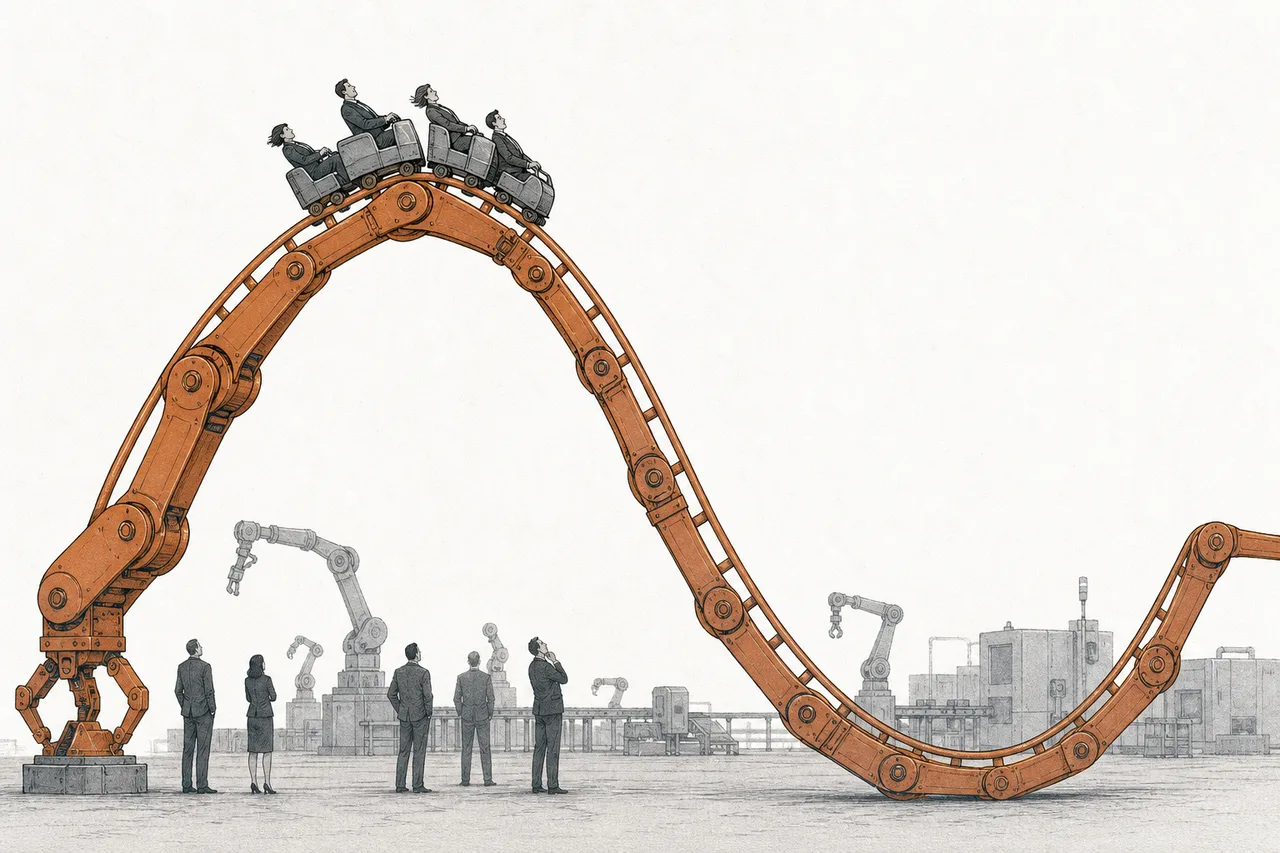
The first risk is cyclicality. Robot sales are tied to factories' capital spending (capex) on machinery — a big-ticket expense that companies can defer instantly when the economy gets uncertain. A recent real example: robot sales at Fanuc — the world's #1 — fell as much as ~16% as auto demand in China and Europe weakened. This isn't a business that grows in a straight line; it rises and falls in waves with the industrial cycle.
The second risk is competition from China. Chinese brands are eating share at home (from 28% to 57% in ten years) and starting to eye export markets. This kind of game usually ends in a price war that squeezes incumbents' margins — especially in cobots, where China already holds over 92% of its home market.
The third risk is dependence on a few industries. The industry's biggest revenue is still tied to autos and electronics. When those two slow down at the same time (like during the EV transition, when factories hold back on investment), robot sales take a hard hit. Diversifying into new customers through cobots is important both for growth and for reducing that risk.
In short: while the headlines pour into robots that can walk, the real money in robotics today still flows through the arms in factories and the cobots working next to people. This is a business that's been profitable for 40 years, is opening the door to small factories with cobots, and is being challenged by China — to understand this node is to understand what a 'robot that actually makes money' looks like, before humanoids prove themselves.