Megatrend · Robotics & Physical AI
Where robots actually 'got jobs' — by the millions, already
While humanoid robots are still tottering around in demo videos, the warehouse is where robots already do real work — Amazon alone has more than 1 million robots in its facilities, almost matching its human headcount. This is the story of robots that don't need to be brilliant, just hardworking and cost-effective — driven by e-commerce, same-day delivery, and a workforce that's harder to find every year.
01What it is (robots in the warehouse)
Every time you tap to order something online and it arrives the next day, behind it is a warehouse the size of dozens of football fields that has to find that one item out of millions in stock, pick it, pack it, and ship it out — all within a few hours. This job used to mean people walking tens of kilometers a day just to 'go fetch things.' This node is about handing that job to robots instead.
Warehouse & Logistics Robotics is the automation that stores, finds, picks, and moves goods inside warehouses and distribution centers. It's not a super-smart robot that figures everything out on its own — it's a machine doing the same task over and over in a well-controlled environment, which turns out to be exactly where robots are at their best. There are really only a few families:
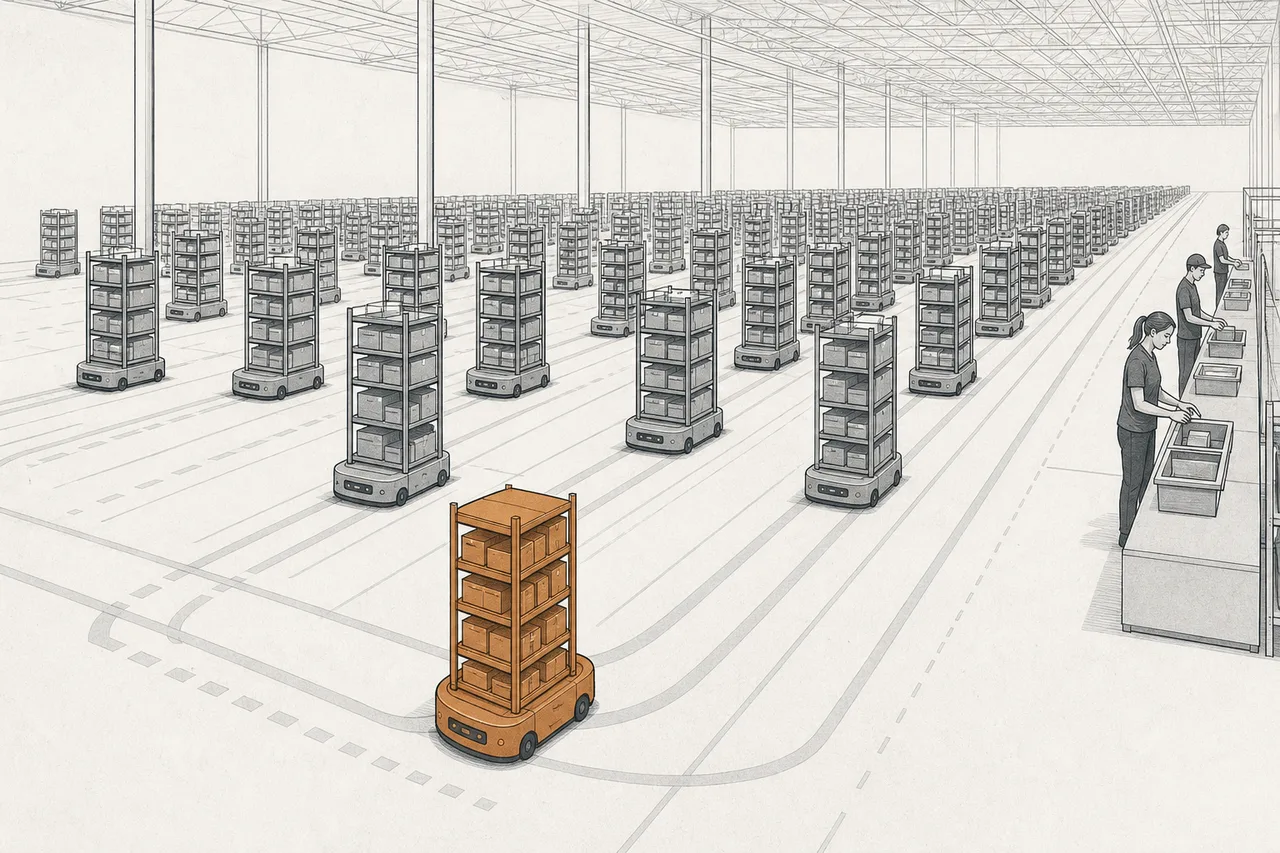
- AMR (autonomous mobile robots): low vehicles that drive around the warehouse, carrying boxes or lifting shelves from one spot to another, dodging obstacles and people on their own — the ones you see running in swarms
- AS/RS & goods-to-person (the goods come to the person): automated storage-and-retrieval systems that 'bring the product to the picker' instead of sending the picker to find it — the heart of this story (see chapter 3)
- picking robotic arms: robot arms that pick goods one piece at a time into a box — the hardest battle, and not yet fully won (chapter 4)
- conveyors & sorters (sortation): the infrastructure that moves parcels and routes them to their destinations — unglamorous, but the backbone of a distribution center
On the megatrend map, this node sits under Robotics & Physical AI, and its definition is refreshingly plain: 'automated storage-and-retrieval systems, AMRs, and order-picking systems for warehousing and distribution.' Put another way — it's the branch of robotics that already makes real money today, not someday.
02Why the warehouse is where robots win first
There's a classic question in robotics: 'Why can't robots do housework yet?' The answer is that homes are too messy — things aren't in fixed places, there are kids, dogs, stairs. A warehouse is the opposite: flat floors, steady lighting, goods in standard boxes, controlled routes. It's a robot's dream 'practice field' — and the first reason robots won here before anywhere else.
The second reason is money. Warehouse work is hard, boring, and people don't want to do it. In early 2025 the US had over 370,000 open warehouse jobs, with industry-wide turnover running 46–49% a year (Amazon's, at times, was estimated near ~150%), and replacing a single worker costs about $18,600 on average. As people get scarcer and more expensive, swapping in robots isn't about being cool — it's business arithmetic.
The third reason is e-commerce and same-day delivery. Customers expecting goods faster and faster force warehouses to move quicker and more accurately than humans can keep up with. Together these three forces drive the warehouse automation market from about $30 billion in 2026 to ~$60 billion by 2030 (CAGR ~19%) — one of the fastest-growing parts of all logistics.
And here's why its ROI is unusually clear: a typical AMR rents for about $2,000–4,000 per unit per month and can pay for itself in as little as 12 months — once you weigh it against wages, training, and the cost of turnover, the numbers line up almost too neatly to refuse.
03How it works — the goods come to the person
The single idea that changed the warehouse most wasn't a smarter robot — it was 'flipping the whole thing around': instead of sending people to find goods on the shelves, send the goods to the people. It's called goods-to-person (G2P).
In an old-style warehouse, a picker spent more than half their shift just walking empty-handed between shelves — some walked 15–20 km a day. G2P cuts all of that out: a low robot slides under a shelving rack, lifts the whole shelf, and drives it to a person standing still at a pick station. The person just grabs the item the screen points to, drops it in a box, and the next robot brings the next shelf to serve.
The most famous G2P system started with Kiva Systems, which Amazon bought in 2012 (it became Amazon Robotics). Another approach is AutoStore's cube-based system, which packs goods bins into a dense 3D grid and uses robots running across the top of the grid to pluck out the bin it needs — in 2025 alone, over 9,500 facilities had installed cube-based systems like this, and the G2P segment is growing about 14% a year, faster than the market average.
AGV (Automated Guided Vehicle) = the old generation of automated vehicle, which can only follow a 'line' or magnetic strip embedded in the floor, and is hard to reroute · AMR (Autonomous Mobile Robot) = the new generation, with built-in sensors and maps that figure out their own route, dodge obstacles and people, and let you change the warehouse layout without ripping up rails — that flexibility is exactly why AMRs are replacing AGVs.
04The last hard gate: picking
If moving goods is the war robots have already won, picking one piece at a time (piece picking) is the battle still being fought — and the reason a warehouse still needs a person standing at the end of the line.
Why is picking so hard? Because the human hand is astonishingly good — we grab a slippery shampoo bottle, a crinkly snack bag, a clear box, and a round ball without even thinking. But for a robot, items that differ wildly in shape, weight, and texture and lie jumbled together in a bin are a nightmare. It has to spot which piece is the one to grab, calculate where to grip it so it won't drop, and act — all in a fraction of a second. The industry calls this the 'holy grail' of warehouse robotics.
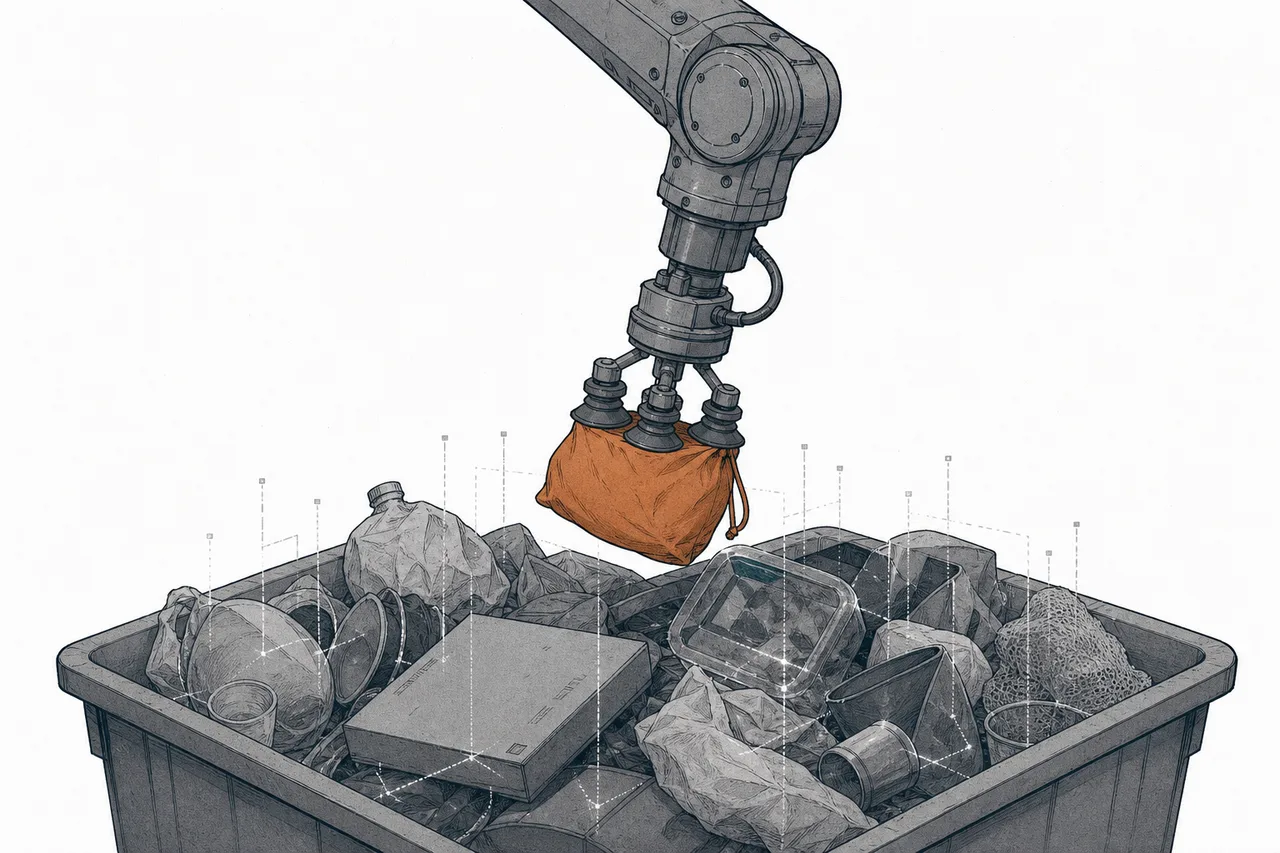
Progress comes from two directions: smarter grippers — mostly vacuum suction heads with adjustable suction, some blending in mechanical fingers — plus computer vision and AI that read a 3D image of the pile and guess the most stable grip point ever more accurately. A good arm today can grab items fast and steadily enough for real use; some systems cut 'double picks' (grabbing two items at once) by up to 99% by fusing signals from multiple sensors.
The number that tells this story best comes from Amazon: its picking arm, Sparrow, now handles about 65% of all items in the catalog — meaning that in a center using it, roughly 65% of the pick-and-stow work can already be done by robots. That's enormous progress. But it also means the remaining ~35% (odd, fragile, weirdly shaped items) still depends on human hands.
05Where it sits in the robotics universe
This node is one of the 'application' branches of Robotics & Physical AI — and the most grown-up one: warehouse robots make real money and are deployed by the millions, while many of their siblings are still in the experimental stage. Here's how it connects to those siblings:
- A different story from Humanoid Robots: the warehouse proves the 'human form' isn't needed at all — the robot that wins here is a low box on wheels, not a two-legged walker. Humanoids aim at jobs specialized robots can't do, but in the warehouse, specialized robots are still far more worth it
- Uses parts from Robotics Components & Actuation: motors, wheels, sensors, and drive units — every AMR and arm relies on this 'sell the hardware' layer
- Its brain comes from Robotics AI & Embodiment Software: the ability to see, plan routes, and guess grip points comes from this AI software side — and the smarter the AI, the higher the picking percentage climbs
- A cousin of Industrial Automation & Cobots: the arms in a factory and the arms in a warehouse come from the same technology, differing only in the job — the factory does the same thing precisely over and over, the warehouse handles a huge variety of items that are never the same
Beyond the robotics circle, this node tangles with other big trends too — it leans on Artificial Intelligence as its brain, answers the needs of an aging society where the young workforce is shrinking, and is a major customer of Electrification & Mobility, because every robot draws power and runs on batteries.
06Where it stands now + the players
The most shocking number in this field also comes from Amazon: in mid-2025 the company announced it had over 1 million robots across its warehouse network, spread over more than 300 centers worldwide, against roughly 1.5 million human workers — the robot-to-human ratio is closing in on 1:1, and over 75% of orders now pass through the hands of at least one robot.
What matters more than the count is the money saved. Amazon's newest center, in Shreveport, using the Sequoia system (AMRs + arms + a storage system combined), cut delivery costs by about 25%. Wall Street analysts estimate that the shift to robots could save Amazon $2–4 billion a year by 2027 — and that's Amazon alone.
But Amazon is both the biggest user and a developer of robots itself (Amazon Robotics is an in-house unit that sells to no one). So the field splits into two worlds: the e-commerce giants that build robots for their own use, and the companies that sell the system to everyone else. Many of the real players on the technology side are still private companies not on the stock market (AutoStore in its early days, Locus Robotics, Mujin). So we rank the players by their actual role and share in the value chain rather than by raw market cap.
07The road ahead
The first direction is the picking percentage climbing steadily. As the AI for vision and grasping gets smarter, the ~65% robots can pick today will rise — and every point gained means one fewer person standing at the end of the line. This is where progress in robot AI software converts directly into money.
The second direction is the 'Robotics-as-a-Service' model. Instead of a mid-sized business making a big upfront investment to buy a system, it rents the robots by the month — Symbotic's 'GreenBox' JV with SoftBank is a big bet on this model, which opens the door for smaller warehouses to reach automation.
The third direction is humanoids flowing into the warehouse. Several companies (Amazon included) are testing two-legged robots in their facilities, hoping they'll handle the 'in-between' jobs wheeled robots can't — like loading goods onto a truck. But for now it's experimental; in most real work, the low, cheaper specialized robot is still far more worth it.
08Challenges & risks
This pretty-looking story has several traps to watch for.
The first risk is picking isn't fully won yet. As long as ~35% of goods still need human hands, a warehouse can't truly go 'fully unmanned.' The dream of the 'dark warehouse' (pitch-black because no one's there) is still a distant goal, not today's reality — and progress in dexterity has always been slower than people expect.
The second risk is concentration in a few customers. This shows up sharply in Symbotic's case, where over 84% of revenue comes from Walmart alone — if that one big customer slows its investment or changes its mind, the impact is immediate and severe. In this field the biggest customers have strong bargaining power, and many choose to build robots themselves instead of buying (like Amazon), which eats into the system sellers' market.
The third risk is heavy capital and cyclical swings. A warehouse automation system is a big capex project that customers delay the moment the economy or e-commerce softens. We've already seen even giants pull back — Zebra acquired Fetch Robotics and ultimately had to shut it down / sell it off, and Honeywell decided to sell its Intelligrated business in 2026. The lesson: 'the trend really growing' doesn't mean 'every company survives.'
And the last, unavoidable one is the ripple on labor. Every robot added replaces part of a human job — Amazon is reportedly planning to slow its warehouse hiring by hundreds of thousands of positions over the long run thanks to robots. This is both a driver of the trend (saving labor costs) and a social-political risk that could lead to regulatory pressure down the road.
In short: of all the robotics branches, the warehouse is where the 'future' arrived first — not because the robots here are the smartest, but because they're the most worth it. Understanding where robots win first, and why, is understanding where the whole robotics industry is headed next.