Megatrend · Smart City
The road that sees you — and charges you, without you ever stopping
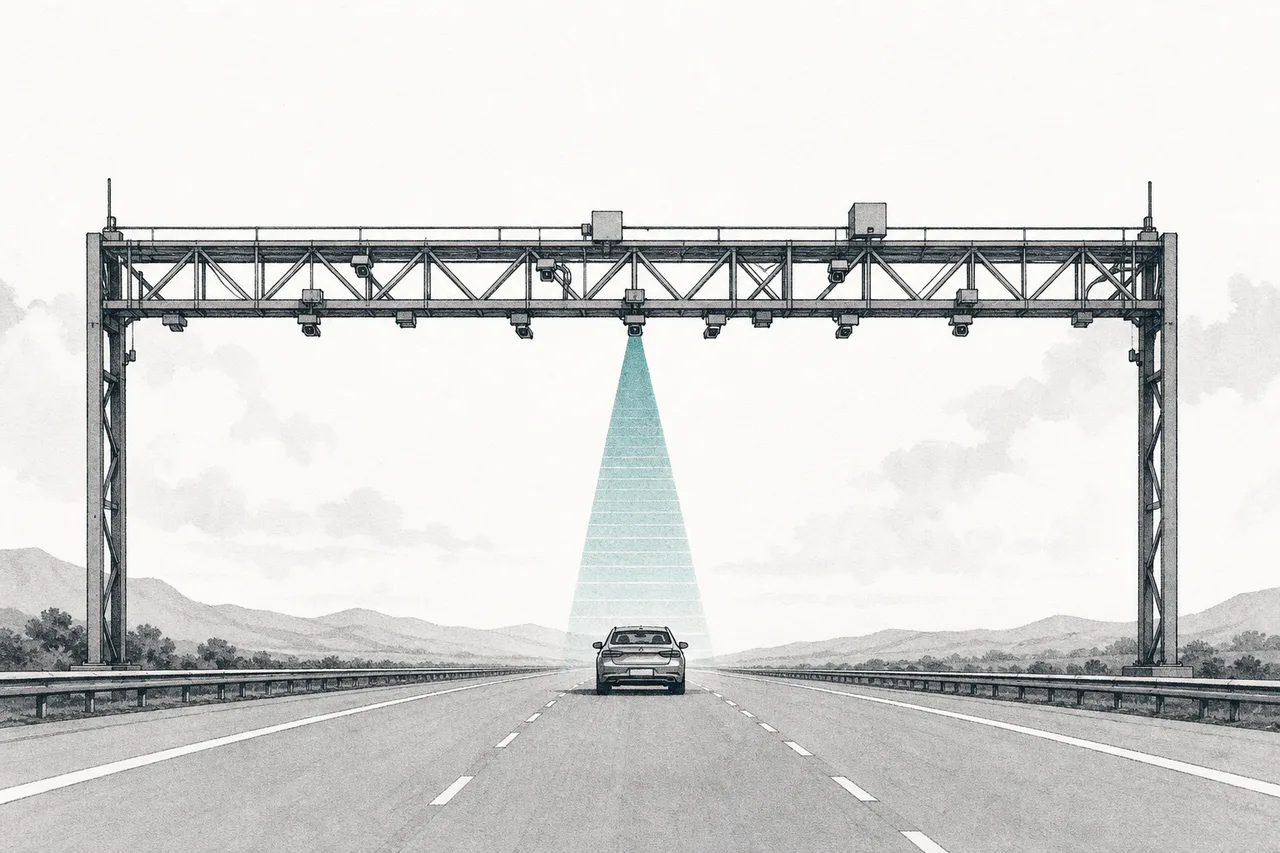
Every time you drive through a barrier-free toll point, the cameras on the steel gantry overhead read your license plate in a fraction of a second and deduct the toll automatically. This node is about the technology behind "managing" and "charging for" road use — from smart traffic lights and barrier-free tolling to the congestion pricing New York just switched on in 2025, which really did cut traffic by 11%. It's the "brain and wallet" layer of every road in the city.
01What it is
Picture all the roads in a city as a human body. If cars are the blood flowing through it, this node is the "brain and the tollgate" of the system — the part that watches where it's jammed and where it's clear, makes the lights work smarter, and collects the road-use fee without making cars slow down.
On the megatrend map, this node is a sub-branch of Smart City / Autonomous Infrastructure. Its definition: "the roadside and back-office systems that manage and charge for road use — adaptive traffic lights, V2X, automated tolling, and enforcement." Put simply, it combines two things we run into every single day:
- Traffic management: sensors + cameras at intersections and along roads feed data into a central control center to adjust light timing, detect accidents, and keep cars flowing more smoothly
- Tolling: electronic toll collection (ETC) — especially the "just flow through" (free-flow) kind with no barrier, where cars pass at normal speed and the system reads an in-car device (transponder) or the license plate and charges you later
- Congestion pricing: charging people who drive into the most congested districts during rush hour, to "push the price up" and change behavior — Singapore has done it since 1998, London since 2003, and New York only began in 2025
ANPR (Automatic Number Plate Recognition) = a camera that reads license plates automatically, the heart of collecting money and enforcing rules · ETC (Electronic Toll Collection) = collecting tolls electronically, with no cash · Free-flow / Open-road tolling = a barrier-free toll point where cars don't stop, and the system on the steel gantry reads the car as it passes at full speed
02Why it matters — collecting money + fixing traffic
This matters for two reasons that hit the sorest "pain points" of every city: traffic and the money to maintain the roads.
On the market side, intelligent transportation systems (ITS) are a business governments keep pouring money into — the global market in 2025 is estimated at around $42–60 billion (the figure varies by definition), and projected to grow about 8–11% a year for another decade. This is durable government infrastructure spending that doesn't swing with the economy the way consumer goods do.
But the thing that touches people's lives most clearly is congestion pricing — and it really works in the numbers, not just in theory. London started charging to enter the inner city in 2003, and in the first year congestion inside the charging zone fell about 30%, average speeds rose, and the number of cars entering the zone dropped about 25%.
New York followed as the first U.S. city, starting January 5, 2025, charging cars that enter lower Manhattan. First-year results: 27 million fewer cars entered the zone (averaging ~11% a day), morning rush-hour speeds rose ~23%, accidents in the zone fell 7%, and — importantly for the government — it collected about $550 million, roughly $50 million more than targeted, to invest in public transit.
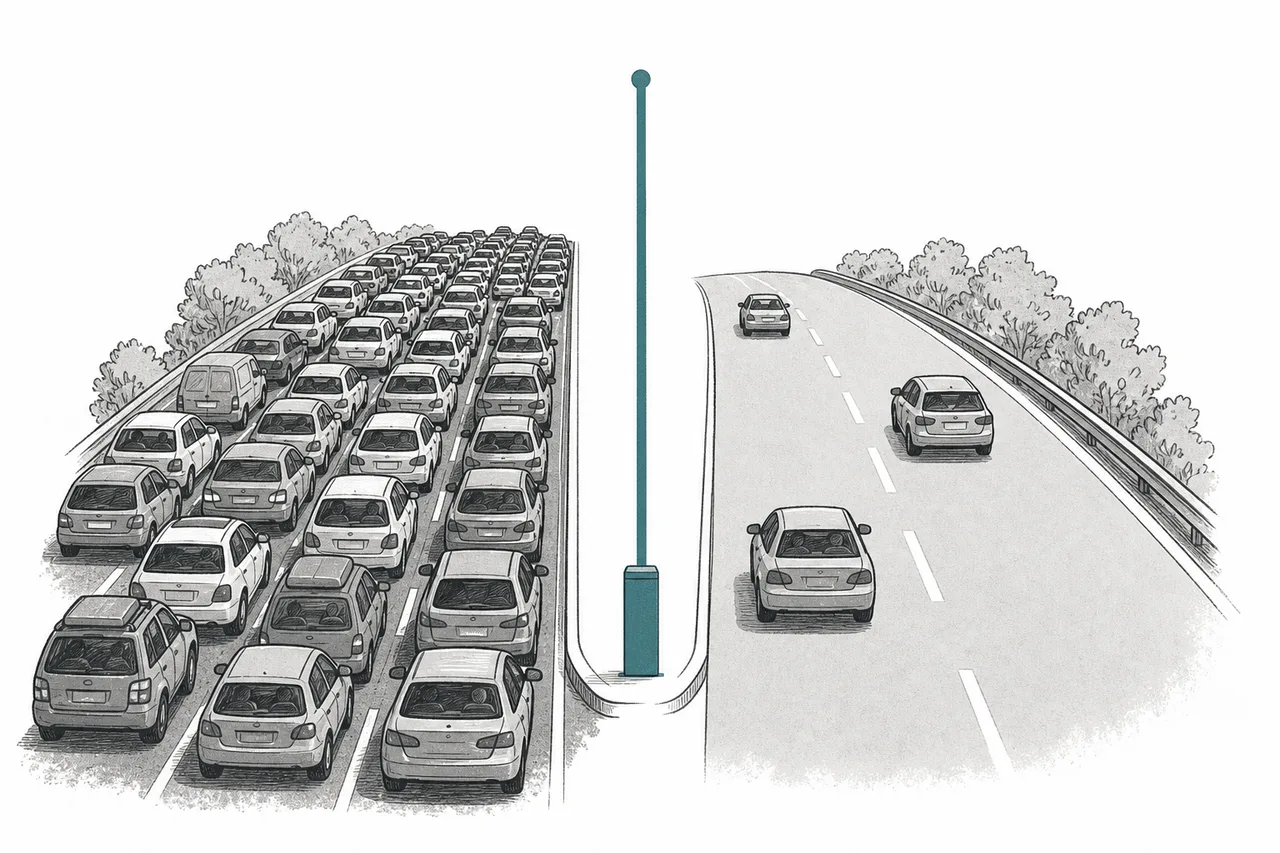
This is why this node is interesting: it's one of the few technologies that both reduces problems (traffic, pollution, accidents) and generates revenue for the government at the same time.
03How it works — the toll point you don't have to stop for
The heart of this technology is the barrier-free toll point (free-flow gantry) — a steel gantry over the road that you drive under at normal speed, without slowing, without reaching for your wallet, yet the system has already charged you. How does it do that?
Let's follow one car as it enters the gantry. Within a fraction of a second, four steps fire off one after another:
What makes it hard is "reading accurately while the car moves fast." Reading the plate alone (ANPR) has some error rate — bad light, dirty plates, cars blocking each other — so real systems usually mix several methods: a transponder (a device on the windshield) as the main confirmation, ANPR to catch cars without a transponder, plus "a human double-checking" any image the system isn't sure about, to push the error rate down.
Transponder = a small box in the car that "responds" when it passes a gantry (like E-ZPass in the U.S. or an ETC card here) · GNSS tolling = charging by actual distance traveled using satellites (GPS), without needing a gantry at every point — well suited to charging "per mile" nationwide, and a technology gaining momentum for the future (see Chapter 06)
04Where it sits in Smart City
If Smart City means using sensors, data, and AI to make a whole city run smarter, this node is the city's "road management layer" — the part that looks after how cars, people, and money flow through the roads. It's a sibling to the other layers of the smart city:
- Paired with Connected Fleet & Telematics: if this node is the "smart road," the other side is the "smart car" — trucks and fleets with boxes that send location/behavior data. When road and car can talk (V2X), traffic flows even better, and in the future cars may "pay tolls per mile" directly through the in-car box
- Sharing hardware with Urban Public Safety & Surveillance: the same license-plate-reading camera can be used for tolling, for catching red-light runners, and for safety work. This is where "charging money" and "surveillance" use the same infrastructure — and where the privacy question begins
- Part of the bigger Mobility trend: the movement of people and goods overall — this node is the "rules and tolling" layer sitting beneath all of that travel
And at the deepest level, it depends inseparably on AI and Cloud — because reading license plates millions of times a day, predicting where jams will form, and adjusting traffic lights in real time all require AI models to process images and cloud systems to crunch enormous amounts of data. So the smart road is also a major "customer" of both AI and cloud in the city.
05Where things stand now + the players
The 2025–2026 picture has two interestingly opposite currents. The cities are pushing ahead at full speed — governments are converting barrier toll points to barrier-free ones (for example, Pennsylvania Turnpike opened Open Road Tolling across its whole length in early 2025, and Kansas Turnpike went cashless in mid-2024), and New York's congestion pricing showed better-than-expected first-year results.
But the technology vendors are running into headwinds instead. Kapsch TrafficCom, one of the world's leaders in barrier-free tolling, reported in its FY2025/26 results that "the tolling market weakened severely and unexpectedly worldwide," with revenue around €430 million and very thin operating profit — reflecting how this business leans on big government projects that take a long time to bid out and can easily be delayed.
What's interesting is that the ones turning a good profit aren't those planting the steel gantries, but those doing the "back-office work" — Verra Mobility of the U.S., which is hired to manage tolls and violations for rental-car companies and fleets, connected to over 50 toll agencies across the U.S. The tolling business alone made up about 39% of the whole company's revenue in 2025 — a pure-play that captures the "cash flow" of tolling most directly.
06The future — as fuel taxes shrink, governments have to charge "per mile"
The most powerful long-term driver of this node isn't technology, it's the crisis of money to fix the roads. Look at where the money comes from: governments have always funded road repairs from the "fuel tax" — the more you drive, the more fuel you buy, the more you pay. Seems fair enough.
But the problem is that modern cars burn less fuel, and EVs don't buy fuel at all — meaning the more EVs there are, the more fuel-tax revenue shrinks. In the U.S., the road-repair fund (Highway Trust Fund) ran a $13.5 billion deficit in 2024, and is projected to run a cumulative deficit of over $270 billion from 2025–2034 if the way money is collected doesn't change.
The solution analysts see as unavoidable in the long run is charging by the actual distance driven (Road Usage Charge / VMT) — instead of charging on fuel, charge directly on the "miles driven," which is fair to every type of vehicle including EVs. In 2025, four states have already launched voluntary programs, and at least 30 more are studying it — for example, Hawaii began charging EVs $8 per 1,000 miles (capped at $50) starting July 2025.
This is where both sides of the node converge — charging per mile needs GNSS tolling (charging by distance via satellite), the in-car box (linked to Connected Fleet), and ANPR cameras as the catch-all. If this trend really takes hold, the smart-road market expands from "roads with a few toll points" to "the whole country is a tollgate" — many times bigger.
07Challenges & risks
This node is interesting, but it walks an especially bumpy road, because it touches the two things people guard most: their wallet and their privacy.
The first risk is politics. Congestion pricing and tolling are extremely sensitive — even when the result numbers are good, "paying extra to drive" makes a lot of people unhappy. New York hit countless lawsuits and delays before it could even start. Some projects were shelved entirely despite the money already spent. This political risk makes technology vendors' revenue hard to predict.
The second risk is the government's long, slow procurement cycle. These are large government contracts bid out over years that can be delayed or canceled — exactly what Kapsch just ran into with a "weaker-than-expected market" in 2025/26. It means that even when the long-term trend is clear, this business's annual revenue can lurch hard, nothing like the smooth flow of a subscription.
The third risk is privacy. A system that "reads the license plate of every car that passes" is by nature a system that tracks citizens' movements. When the same camera is used for both charging money and surveillance work (linked to Urban Public Safety), the questions of "who collects data on who drove where, how long they keep it, and what it can be used for" grow even louder — especially as it moves toward per-mile charging, which needs to know the car's location all the time.
And the last one is technical accuracy. Plate reading still has an error rate, leading to charging the wrong person, wrong bills, or wrong citations. A system that can cut errors needs "a human double-checking," which is an ongoing cost — and this seemingly boring back-office work is exactly where the winners separate from the losers.
In short: this node is the story of how the road can "see" us and "charge" us without us ever having to stop. It really does fix traffic, really does raise money for the government, and is about to get much bigger as EVs force the world to shift from taxing fuel to charging per mile — but it walks a fine line between convenience and being watched, and between the public good and political pushback. Understanding this node means understanding that "the road is quietly becoming a system that senses and bills" — beneath our wheels, every single day.