Megatrend · Smart City
When a whole city starts to "see" — the same tool that saves your life and watches you
Millions of cameras, sensors, and AI that reads video in real time are becoming the "senses" of the modern city. They get an ambulance to the scene faster and let a police body camera hold officers accountable — but the very same technology, slid to the other end, becomes facial recognition and mass surveillance. This is the most ethically "sensitive" segment of the smart city — and that tension is the whole story.
01What it is
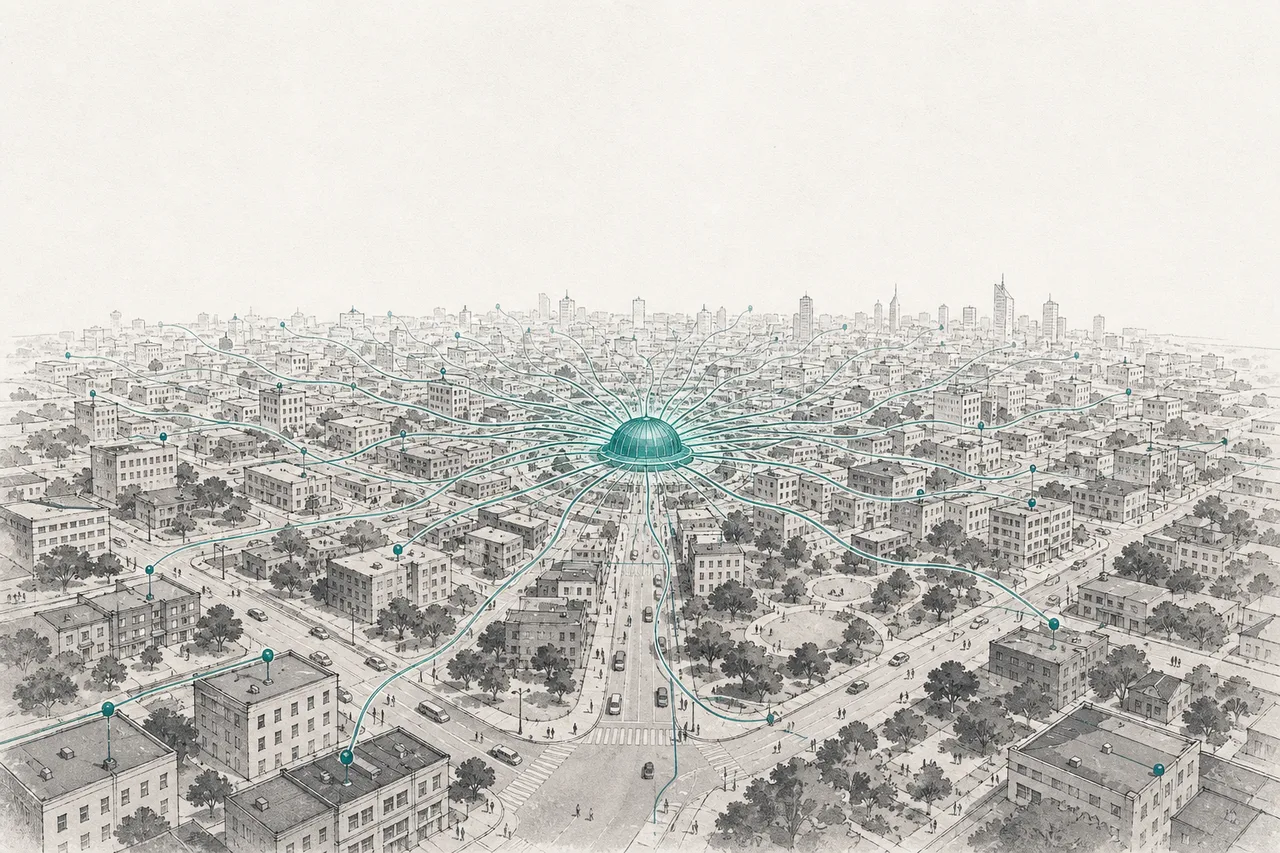
Think of a time you called 191 (or 911 / 112 abroad) and the ambulance arrived unusually fast, or when a highway accident got cleared before traffic backed up. Behind these moments there's usually the same system at work — a network of cameras, sensors, and software that a city uses to "sense" what's happening, then coordinate the response.
This node is a branch of the megatrend Smart City / Autonomous Infrastructure. Its definition is "mission-critical comms, video surveillance and analytics, and license plate reading (ALPR) deployed for cities, government agencies, and critical infrastructure." Put simply, it's the "public safety" layer of the smart city.
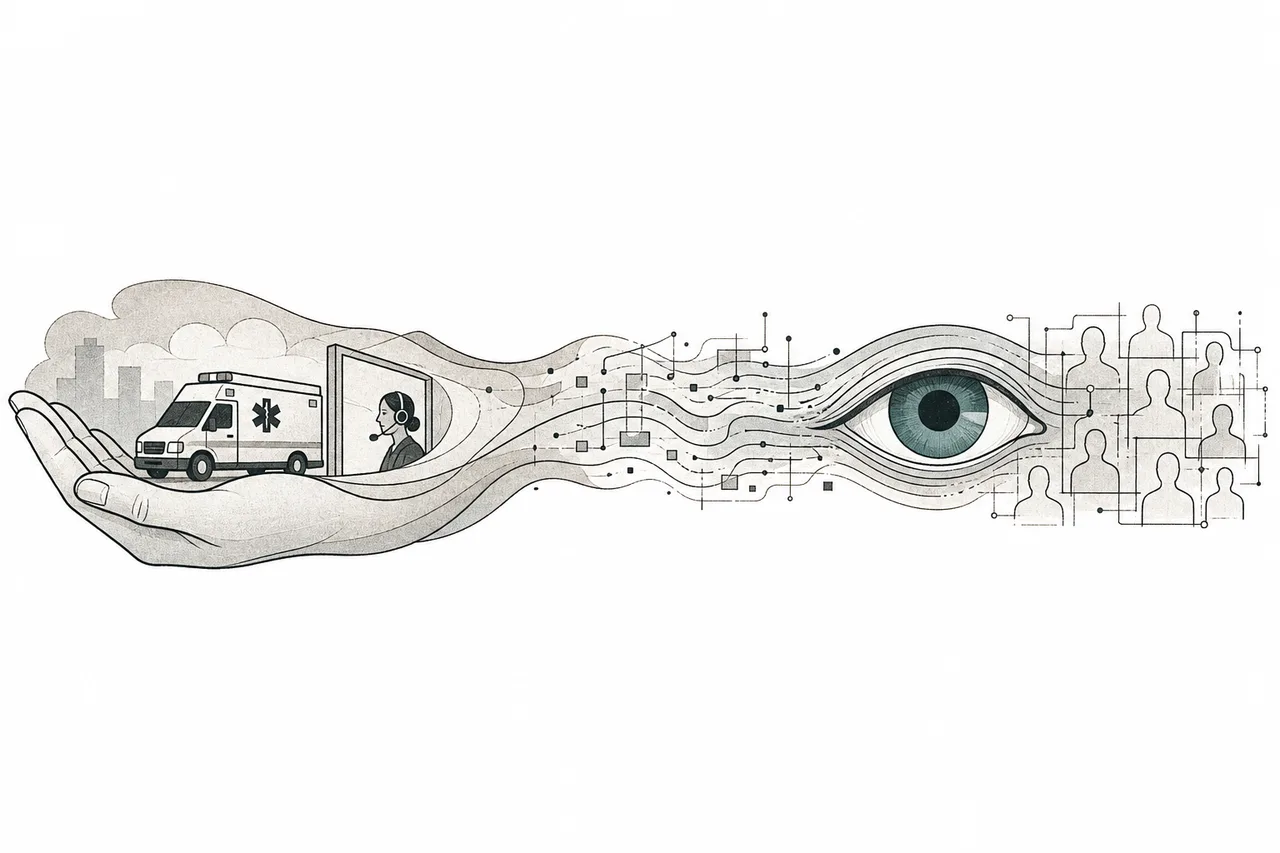
The key thing to grasp from the start: this isn't one block of technology that's good or bad — it's a "spectrum" that runs from one end society broadly accepts to another end that's fiercely debated:
- The broadly accepted end: next-gen emergency dispatch (Next-Gen 911), automatic traffic-accident detection, rescue-team radios, and police body-worn cameras meant to "hold accountable" how officers do their job
- The fiercely debated end: facial recognition, mass surveillance, and predicting crime before it happens (predictive policing)
The same set of tools — the same camera, the same AI — can slide from one end to the other just by changing "how it's used." And this tension is exactly what makes this market both fast-growing and worrying at once.
02Why governments keep paying for this
The economic logic of this node is simple but powerful: public safety is a core duty of the state, and the state pays for it "durably," whether the economy is good or bad. Whenever there's crime, a disaster, or a terror attack, the political pressure to "do something" always pushes this budget up.
Look at the market numbers: the global video surveillance market was worth about $56 billion in 2025 and is expected to reach $88 billion by 2031 (CAGR ~8%). Research houses with a more bullish view put it at $148 billion by 2030 — the numbers differ because the definition of "market" differs, but every house agrees on one thing: it keeps growing.
But growing much faster than the raw cameras is "video analytics" — AI software that watches the footage instead of a person. This market was around $12.7 billion in 2024 and is expected to reach $37.8 billion by 2030, a CAGR of ~19.5% — nearly twice the camera market. Because cameras are already everywhere in the city, the new value has moved to "the intelligence that reads all that footage."
Other sub-segments follow: the gunshot detection market is expected to grow from $1.2 billion (2023) to $3.01 billion (2031), and in the U.S. the Next-Gen 911 market (next-gen dispatch that can take video/text/images) is projected to reach $1.5 billion by 2030. All of it is tax money flowing steadily into the same category.
03How it works — the city's safety stack
This node's mechanism is an easy-to-follow three-stage conveyor belt. But the place where the story hides is the middle stage.
- Sense: CCTV cameras, police body cameras, license plate readers (ALPR), gunshot-detection microphones, and emergency-call lines — all of it the "sensory organs" spread across the city
- Analyse: AI watches this video and audio instead of a person — detecting whether there's an accident, a crowd, a car parked in the wrong place, or (at the debated end) trying to match faces against a database. This is the stage where you can "choose" which end of the spectrum to stand on
- Coordinate: a command center pulls everything onto one screen. Officers see the full picture, then direct rescue/police/fire crews over mission-critical radio
ALPR (Automatic License Plate Recognition) = a camera that automatically reads license plates, used to find stolen cars or cars tied to a case · Video Analytics = AI software that "watches" video instead of a person, because a human can't watch 100 monitors at once — so the AI nudges you that "something's probably happening here." But that very capability extends into facial recognition, depending on what it's configured to do.
04Where it sits in the smart city
This node is a "public safety layer" that sits on top of several other trends — it doesn't work alone:
- Relies on AI as its brain: without AI to analyze the video, a million cameras are just tape no one watches — AI is what turns "footage" into "data you can decide on," and it's also the source of every ethical issue
- Sits on Cloud & Digital Infrastructure: video from across the city has to be stored and processed somewhere — Axon's police body cameras store evidence straight to the cloud
- Needs Cybersecurity & Digital Trust: a system that can see the whole city is a nightmare if it's hacked — so cybersecurity is a hard prerequisite
- Sibling of Intelligent Traffic & Tolling: traffic cameras and safety cameras are often the same infrastructure — accident detection is where the two overlap
- Overlaps with Defense & Geopolitical Fragmentation: urban surveillance tech and national defense share a lot of technology. Companies like Leidos and Parsons play in both markets
The point to stress is that this node is "where AI leaves the screen and meets real people in public" — and that makes it the segment of the smart city most closely watched by law and society.
05Where it stands now
The technology is ready now, but society hasn't finished arguing over how much to use it — and this is where we have to speak plainly and neutrally, because both supporters and opponents are holding heavy facts.
The practical side, broadly accepted by people, is growing very strongly. The clearest example is Axon, the king of police body cameras — full-year 2025 revenue grew about 39% to ~$2.74 billion, and it holds roughly 85% of the body-camera market in major U.S. cities. What's interesting is that police body cameras were originally pushed by the "civil rights" side to hold accountable how police work — an example of surveillance technology used to "watch those in power" rather than to watch citizens.
But the other end of the spectrum has real wounds — and this is the part to tell in full, not brush aside:
1) Facial-recognition bias is measurable. In a landmark 2019 test by NIST (the U.S. standards agency) of nearly 200 algorithms, many were found to have a "false match" (false positive) rate 10–100 times higher for Asian and Black faces than for white faces in some cases — meaning the chance the system "points at the wrong person" isn't equal across groups. (An important point to be fair about: the best algorithms have very little of this gap, and algorithms trained on diverse data give fairer results — so the problem is "which system, used how," not that this technology is all bad.)
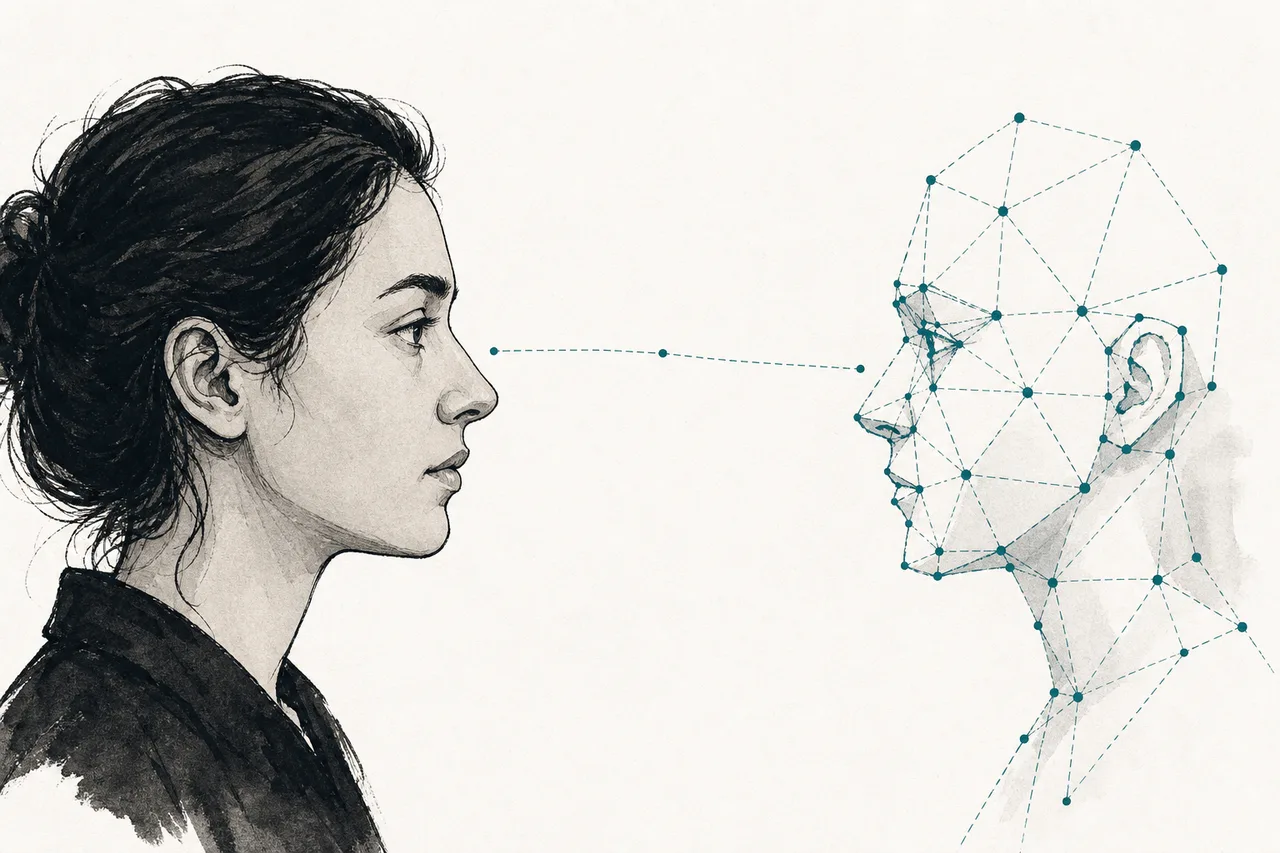
2) This error has already happened to real people. The most-cited case is Robert Williams, a Black man in Detroit arrested by police in 2020 because a facial-recognition system matched his face (from blurry CCTV footage) to the wrong suspect in a theft case. He's the "first publicly known case" of a wrongful arrest from facial recognition. The case ended in 2024 when Detroit police agreed to bar arrests based on facial-recognition results alone.
3) Predicting crime in advance has a structural problem. "Predictive policing" systems like PredPol were dropped by the LAPD in 2020 after a review found a "feedback loop": crime data isn't a record of "crime that happened" but a record of "where police went to patrol" — once the AI sends officers to the same neighborhood again and again, more arrests are made there, and the data points back to that neighborhood even harder. It becomes a snake eating its own tail, reinforcing bias instead of cutting crime.
4) China's scale is an unavoidable market fact. China has already installed over 700 million surveillance cameras (roughly one per a handful of people), and Chinese makers like Hikvision and Dahua hold much of the global market — but both were placed on the U.S. "Entity List" in 2019 on human-rights grounds (tied to surveillance of Uyghurs) and barred from importing new equipment into the U.S. This is why we list these companies as a "market fact", not an endorsement.
06The future — law will decide the market
For most nodes, the future is set by technology or demand. But for this node, the most powerful variable is "law" — because it decides which end of the spectrum can be sold and which is illegal.
The clearest example is Europe's EU AI Act, which began enforcing its bans in February 2025 — it prohibits real-time facial recognition in public spaces for law enforcement (except for a few grave cases, like terrorism or finding trafficking victims, and only with a court's approval), and bans scraping images from the net/CCTV to build facial databases. Fines run as high as €35 million or 7% of global revenue.
In the U.S., the direction is "fragmented city by city" — starting with San Francisco, the first city to ban police use of facial recognition (2019), followed by Boston and many others, with roughly 20+ cities/counties and some states already imposing limits. The result: the same market has different rules in each district — companies selling on this side have to design products that can switch features "on/off" to match local law.
The second direction is AI getting smarter and running on the device. New-generation cameras are starting to carry AI models built in (on-device), letting them analyze on the spot without sending footage to the cloud — good for speed and for cutting accidents faster, but it also makes surveillance cheaper and more widespread. A double-edged sword, as always.
The third direction is the growth of the "drama-free" side — Next-Gen 911, accident detection, body cameras for transparency, and command centers will keep growing with almost no one objecting, because they solve real problems without touching the privacy line much. This is why players like Axon and Motorola choose to weight themselves toward this side.
07Challenges & risks
This node carries deeper, more complex risks than other parts of the smart city, because it's not just about money but about rights and freedom too — and you have to look at both sides fairly.
1) Civil liberties. A city that "sees everything" is a city where privacy in public fades away. Even used in good faith for safety, a system that can track everyone's movement creates a "chilling effect" on assembly and expression. The challenge is striking a balance between "being safer" and "being watched all the time."
2) Bias and error. As the NIST data and the Robert Williams case show — when a system's errors aren't equal across population groups, that error falls harder on some groups. And in the law-enforcement context, an error means an innocent person gets arrested. So having a human double-check (human-in-the-loop) isn't optional, it's a necessity.
3) Authoritarian misuse. This is the biggest risk of this node — the same technology that sends an ambulance can be used to track political dissidents. China's scale of 700 million cameras is a reminder that the "tool" and the "intent of whoever uses it" are two different things. And once the infrastructure is built, "changing how it's used" is far easier than tearing it down.
4) Investor risk (regulatory + reputational). On the business side, the risk is that fast-changing law (the EU AI Act, city-by-city bans in the U.S.) could make "facial recognition" products unsellable overnight — plus reputational risk and the risk of being sanctioned (like Hikvision/Dahua) — which is why the smart players choose to weight themselves toward the "drama-free" side.