Megatrend · Robotics & Physical AI
The eye that shoots lasers — the device that lets cars and robots "see" distance directly, no guessing
A camera sees a 2D image and has to "guess" how far away things are. LiDAR fires millions of laser points a second, times how long the light takes to bounce back, measures the distance of every point, and draws the world around it straight into a 3D map. This is the story of the real "eyes" of self-driving cars and robots — a technology that once cost $75,000 a unit and today sells for under $500, after a price war, a string of bankruptcies, and an ending where China controls nearly 90% of the market.
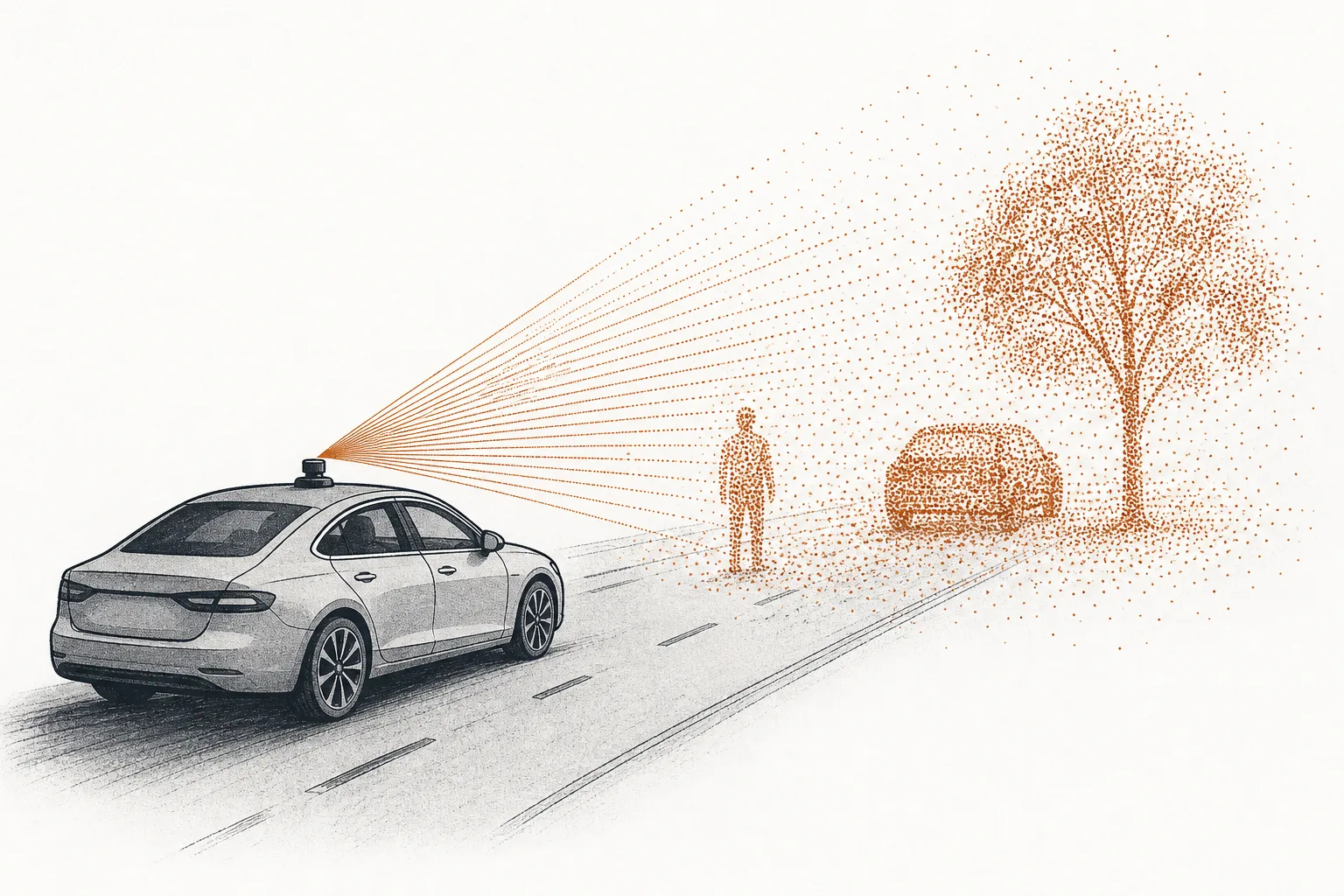
01What it is (a 3D laser eye that measures distance)
Close one eye and reach for a glass of water — you can still do it, but you'll clearly miss the distance more often, because your brain uses images from both eyes to "guess" depth. A car's camera has the same problem: it sees only a flat 2D image, and has to rely on AI software to guess how many meters away each object is. Most of the time it guesses right. But "most of the time" isn't enough when you're talking about a car doing 100 km/h.
LiDAR (Light Detection and Ranging) is a sensor that measures distance directly, without guessing. It fires millions of laser pulses a second, times how long each pulse takes to hit an object and bounce back, and from that time calculates distance to centimeter precision. Repeat it in every direction and you get a "point cloud" of hundreds of thousands of points that forms a 3D model of the scene — you know the pedestrian is 18 meters away and the lamppost is 30 meters away, without guessing from an image.
On the megatrend map, this node is the deepest branch under Robotics Components & Actuation, inside the big trend Robotics & Physical AI. It sits in the "supply chain layer" — making the perception components that robots and self-driving cars install. If motors and reducers are a robot's "muscles," LiDAR is the "eye" that tells depth. Its sibling sitting right next to it, Machine Vision & Force/Tactile Sensing, is the camera and the sense of touch — different roles, but they work as a pair.
Point cloud = the output of LiDAR — a set of hundreds of thousands to millions of points in 3D space, each with x, y, z coordinates marking where the light hit "something" at that spot (you don't yet know if it's a person or a post — the perception software has to classify it). · Time-of-Flight (ToF) = measuring distance from the "round-trip flight time" of light. Because light travels at a constant speed (~3×10⁸ m/s), knowing the time lets you calculate the distance instantly.
02Why it matters — the LiDAR vs camera-only battle
At the heart of this is the biggest bet in the car industry: what should a car "see" the world with? Two camps have been arguing about it for a decade. One is led by Tesla, which believes "camera-only" (vision-only) is enough — Elon Musk's reasoning is blunt: humans drive with two eyes and no lasers, so if the AI is smart enough, cameras should do the same. Tesla even pulled radar out of its cars back in 2021 and bet everything on cameras alone.
The other camp — which is nearly everyone else in the world, including all the Chinese carmakers, Waymo, and the European luxury brands — believes cameras alone are too risky, because a camera can go blind in backlight, fog, or pitch dark (there have been real cases of a Tesla on FSD where the camera was blinded by sunlight). This camp adds LiDAR as an "eye that measures distance directly," so the car has depth data that doesn't depend on the AI's guesswork at all.
This bet has sent the automotive LiDAR market rocketing. In 2025 it was worth about $1.25 billion, and it's expected to hit ~$5.3 billion in 2030 — growing around 34% a year, driven by Chinese passenger cars that now come with LiDAR as standard.
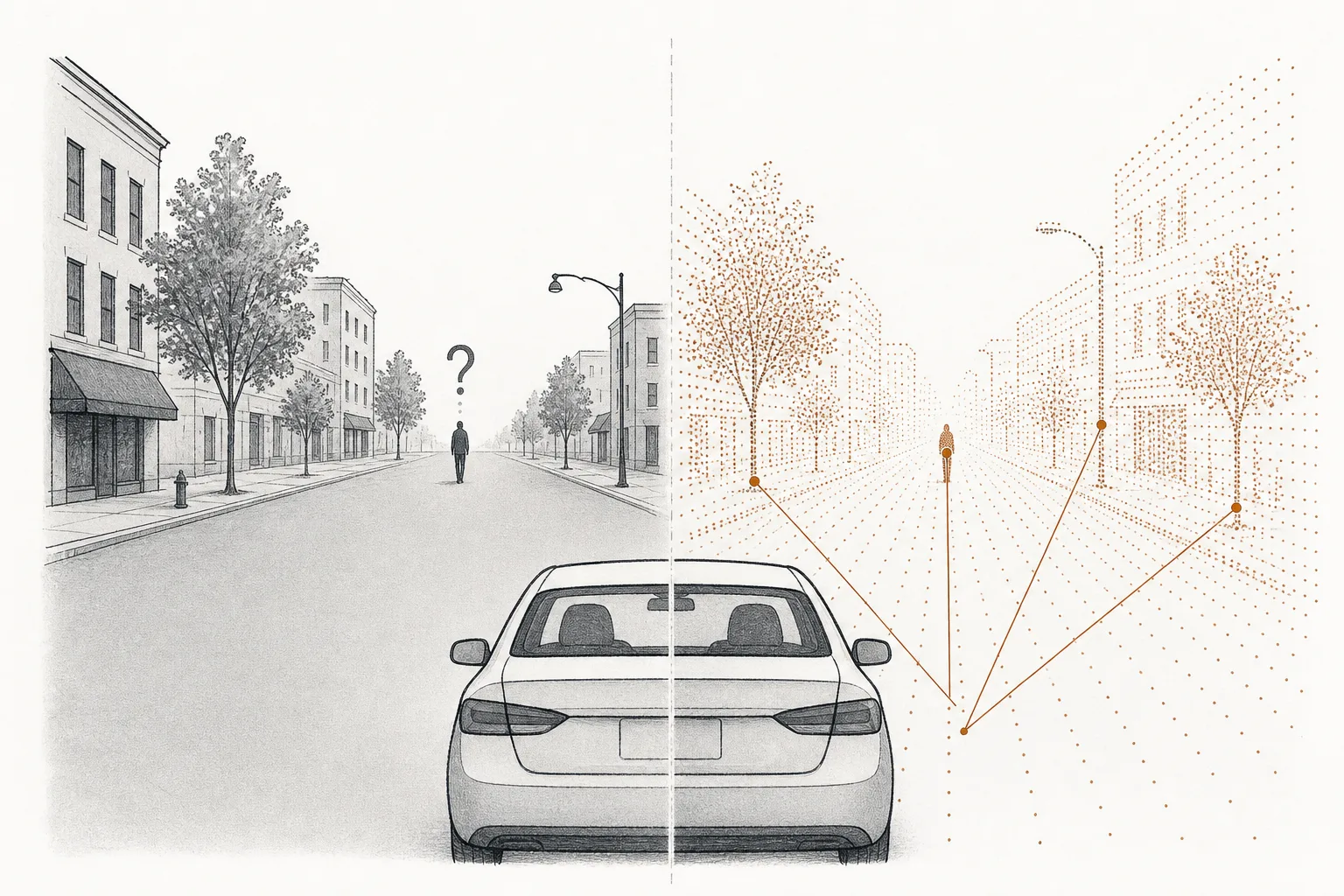
This price plunge is exactly why the battle flipped so fast. The "camera-only" camp used to win on one thing: it was far cheaper. But once a single LiDAR fell to a few hundred dollars, the camera's cost advantage kept shrinking — and that opened the door for LiDAR to flow into affordable cars, not just luxury ones.
03How it works (fire the laser → time it → point cloud)
The principle behind LiDAR is shockingly simple — it's a light version of "knock and listen for the echo." Let's walk through, step by step, how one laser pulse becomes a 3D map.
What separates the different kinds of LiDAR is "how they sweep the beam across the scene." The earliest kind was mechanical-spinning — a head that rotates 360° and swings the laser all around (the spinning dome on the roof of the early Waymo cars was this kind). It works well but is big, expensive, and has spinning parts that wear out. So the newer generation turned to solid-state / MEMS, which uses chip-scale tiny mirrors to flick the beam instead of rotating the whole thing — smaller, cheaper, more durable, and embeddable in a car's bumper.
Most LiDAR today is ToF (measuring a pulse's flight time — the one explained above). But there's a newer technology called FMCW (Frequency-Modulated Continuous Wave) that fires a continuous wave and measures the frequency shift of the reflected light. The advantage is that it can tell an object's "speed" instantly from a single hit (via the Doppler effect), with no need to compare multiple frames, and it's more resistant to light interference — a trump card that companies like Aeva use to stand out.
04Where it sits in the ecosystem
LiDAR isn't something you sell as one piece and be done with. It's part of a "perception stack" that feeds data into the brain of a car or robot. Let's look at what it connects to.
- Gives eyes directly to Robotaxis & self-driving cars: this is the biggest customer. Robotaxis like Waymo and Chinese passenger cars with advanced driver assistance use LiDAR as the main pair of eyes that measure distance more accurately than cameras
- Are the eyes of autonomous trucking: high-speed long-haul trucks need long-range LiDAR to "see" far enough to brake in time — a market where sensor prices have fallen fast enough to start paying off
- Work hand in hand with Machine Vision (cameras) to complement each other: cameras are good at "what is this" (reading signs, telling traffic-light colors apart), while LiDAR is good at "how far away." Fusing the two (sensor fusion) lets a car see both meaning and depth
- Rely on the brain from AI and the chips from Semiconductors: a raw point cloud is meaningless until AI software sorts out which points are people, and the sensor itself needs a processing chip — so modern LiDAR is a "sensor + chip + software" combination
05Where it stands now
If you had to tell this industry's state in one sentence: it crawled out of the graveyard, and then China walked in and took the field. Back in 2020–2021, LiDAR companies rushed onto the stock market via SPACs (shell companies that take you public fast) at valuations based on future revenue that hadn't happened yet. When reality caught up, the bubble burst — Quanergy went bankrupt in late 2022 (it once had an implied valuation of ~$1.4 billion), Ouster and Velodyne were forced to merge to survive in early 2023, and most recently Luminar — once the American star — sold its assets to MicroVision for just $33 million.
While the West stumbled, China cut prices and took share. In 2024, four Chinese companies — Hesai, Huawei, RoboSense, and Seyond — together controlled about 88% of the global automotive LiDAR market, and China is expected to supply about 83% of the world's high-resolution sensors in 2025. The production numbers tell it plainly: Hesai made over 1 million units in Jan–Sep 2025, and RoboSense sold 544,200 units in 2024 (up 109.6% year over year).
China's weapon is a price war. Hesai launched its ATX in 2025 at under $200 a unit — half the price of the previous model — by making its own chips and scaling up its factories fast. That puts LiDAR within reach of affordable EVs. The remaining American players (Ouster, Aeva, Innoviz) chose to flee the cheap-car battlefield for the robotics and industrial (Physical AI) market, where you compete on technology more than price — Aeva's 2025 revenue jumped 99% to $18.1 million, and it landed deals with Daimler Truck and Nikon.
06The road ahead
The first direction is everything getting smaller, cheaper, and disappearing from view. LiDAR is walking the same road digital cameras once did — from a spinning dome on the roof to a tiny solid-state chip hidden in the bumper or windshield until you can barely see it. Once the per-unit price gets close to a few hundred dollars, it becomes standard equipment like a backup camera, not a luxury-car option.
The second direction is breaking out of cars and into robots. As China's car market gets squeezed on price until margins thin out, Western players turn to the world of Physical AI — warehouse robots, automated forklifts, delivery robots, construction machinery — which need the same "distance-measuring eye" but will pay more for accuracy. Ouster and Aeva have even rebranded themselves as "Physical AI sensing" platforms to ride this wave.
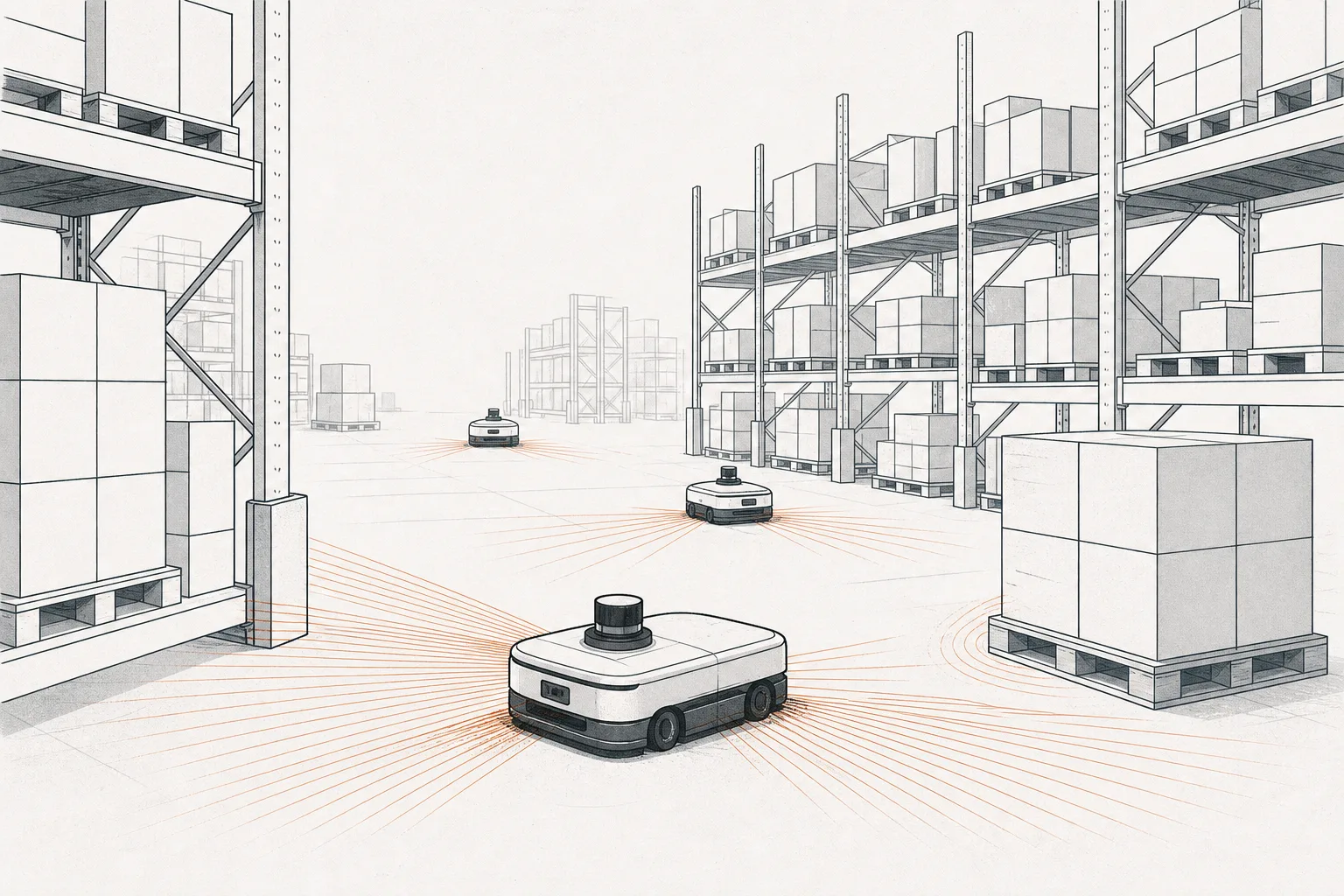
The third direction is a new round of consolidation. This industry has far more LiDAR companies than the number of carmakers that actually pick one. So the consolidation isn't over — small players who run out of cash before turning a profit will be bought or shut down, leaving just a few survivors per region. Next-generation technology like FMCW (which can measure an object's speed on its own) may be the deciding factor in who stays and who goes.
07Challenges & risks
The first and biggest risk is the shadow of Tesla and the camera-only camp. If one day a camera's AI gets good enough to "guess" depth as accurately as real LiDAR, the question "why pay extra to add lasers?" comes back to haunt the whole industry. This is a structural risk: the entire industry stands on the assumption that cameras alone aren't enough — and if that assumption is wrong, the whole market can shrink.
The second risk is commoditization. As the price plunges from $75,000 to a few hundred dollars, the profit per unit thins out too. The price war China lit risks turning LiDAR into something "anyone can make," competing on price alone — good for car buyers, but brutal for makers burning cash on cost-cutting while still not turning a profit. Many in the West are still carrying heavy accumulated losses.
The third risk is concentration in China. With four Chinese companies controlling nearly 90% of the market and supplying over 80% of the world's high-resolution sensors, players outside China risk being squeezed on both price and share. At the same time, geopolitical tension is a double-edged sword — measures to shut out Chinese LiDAR might help Western players in their home markets, but would also cut them off from the world's largest car market.
In short: LiDAR is the sensor that lets cars and robots "see the depth of the world directly," without guessing like a camera. It survived a SPAC bubble that shattered to pieces, came through a 99% price collapse, and is now a battlefield China controls on volume and price — and the big question still unanswered is which the world will ultimately pick as the standard: the "eye that shoots lasers" or the "camera-only eye."