Megatrend · Robotics & Physical AI
While everyone watches the robotaxi in the city, the trucks have quietly crossed the finish line first on the highway
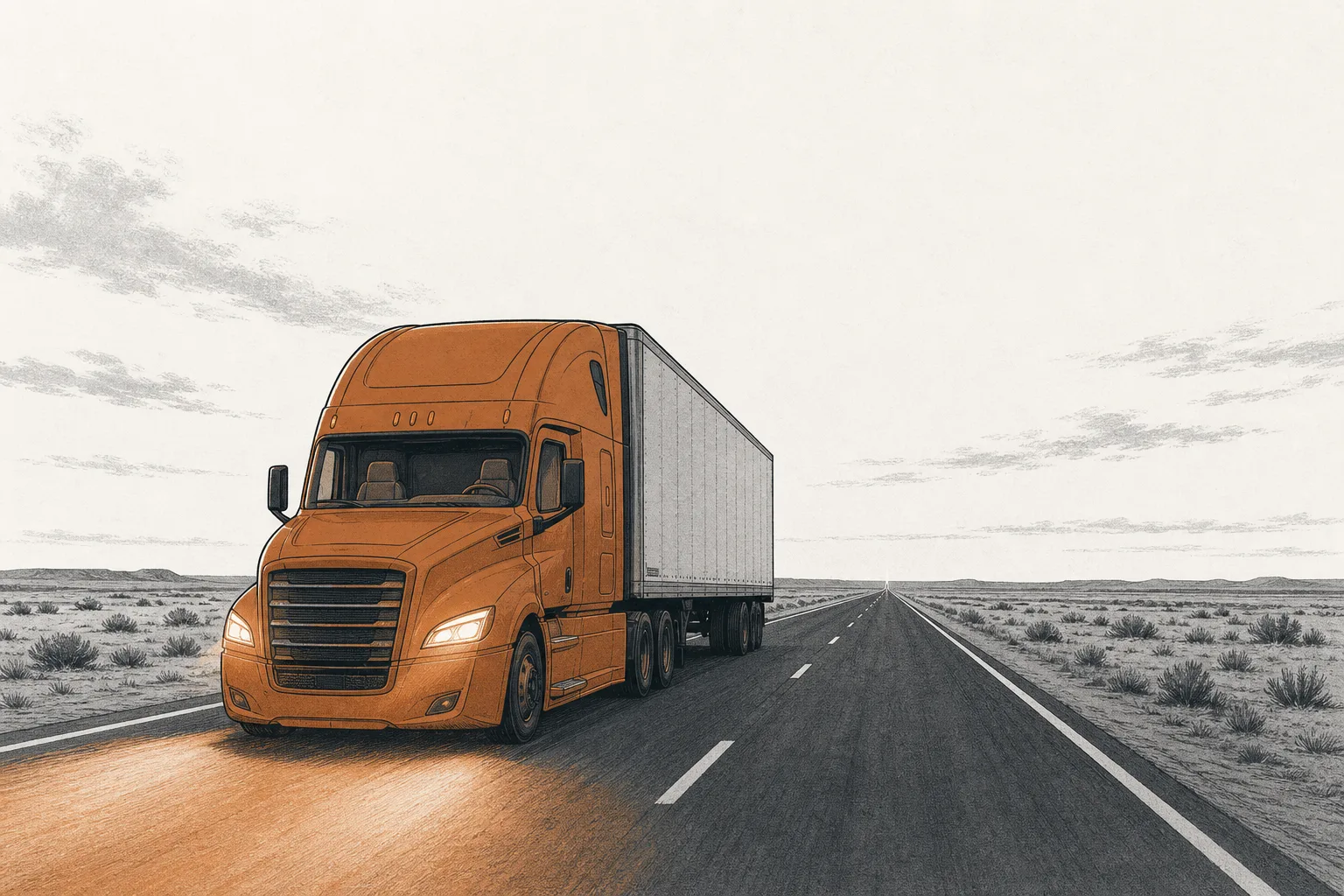
In May 2025, an 18-wheeler drove from Dallas to Houston with the driver's seat empty — the world's first commercial driverless heavy-truck freight service. This is no accident: America is short tens of thousands of truck drivers, and a highway that's straight, repetitive, and free of pedestrians is the "easiest autonomy there is." This lesson is about the two arenas of driverless hauling — long-haul trucks on the highway and last-mile delivery robots on the sidewalk — why they arrived before the city taxi, who's leading, and what the wreckage of the companies that fell first can teach us.
01What it is — two worlds of driverless hauling
When people say "self-driving cars," most picture a robotaxi carrying passengers around the city. But this node is the flip side of the same coin — it doesn't move people, it moves things. And it splits into two worlds that look alike but sit at opposite ends.
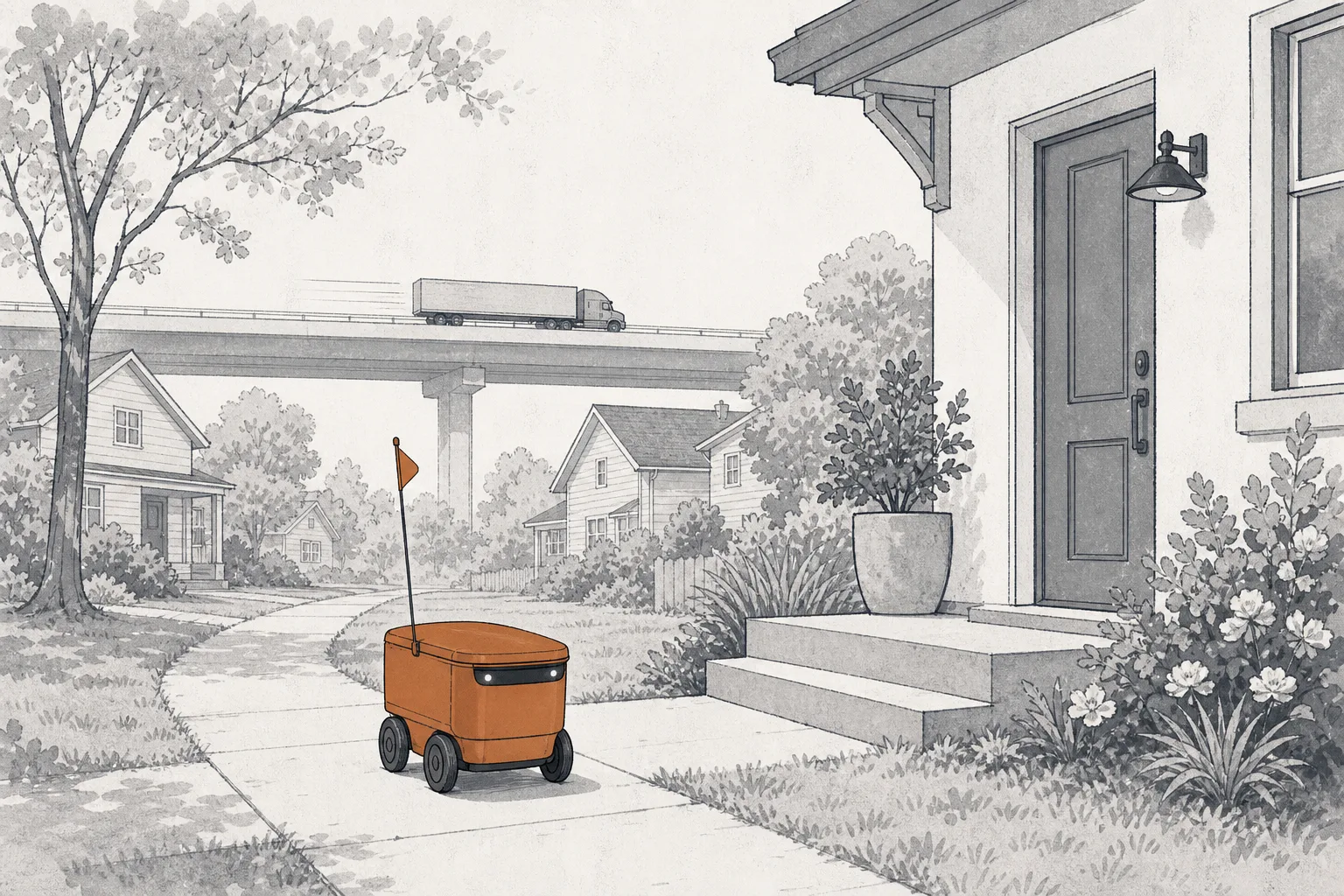
The first world is autonomous trucking — 18-wheelers weighing dozens of tons that haul freight between cities on the highway. This is the "middle of the journey" (long-haul), on roads that are straight, fast, and the same route every day. The second world is last-mile delivery robots — little boxes on wheels crawling along the sidewalk to bring pizza or groceries to your front door. This is the "last leg," the shortest but fussiest part of the supply chain.
On the megatrend map, this node is a leaf under Autonomous Vehicles & Robotaxi, inside the big trend Robotics & Physical AI. It has a sibling right beside it: Robotaxi — the driverless taxi in the city. Both use the same "driving brain," but their use cases are completely different — and that difference is exactly what gives trucks the chance to make money first, as we'll see in the next chapter.
The supply chain breaks into segments · Long-haul = hauling long distances between cities/states, hundreds to thousands of miles (the main problem for driverless trucks) · Middle-mile = hauling medium distances from one warehouse to another or to a branch store, the same route every day · Last-mile = the final leg from a distribution center to the customer's door — the shortest but most expensive and fussiest, because it makes many stops. This is the arena of sidewalk delivery robots.
02Why it matters — driver shortage + the highway is the easiest gate
This trend is pushed by two forces that happen to converge at just the right moment. The first is a structural problem on the demand side, and the second is technical ease on the technology side.
The first force is a chronic shortage of truck drivers. The American Trucking Associations (ATA) estimates the U.S. was short about 60,000 drivers in 2024, and that number is set to climb toward 175,000 by 2028. The reason is that the job is brutal — weeks on the road, away from home, with a rising average driver age and a younger generation that doesn't want the work. The result: the "driver" has become both the most expensive cost and the scarcest resource in the freight business. Having a truck that can run itself 24 hours a day without rest isn't just a cost cut — it directly solves the "no one to hire" problem.
The second force is a deeper reason: the highway is the easiest autonomy. Picture the difference between driving on a freeway and driving through downtown alleyways — on the highway, the truck just has to stay in its lane, keep its distance, and change lanes occasionally. No pedestrians, no chaotic intersections, no cyclists cutting in, no traffic lights. And the route is the same every day, so you can map it in detail ahead of time. A city taxi, meanwhile, has to guess whether someone on the curb will step into the street, read a cop waving them on, and handle countless freak events — and that's exactly why the trucking arena reached "actually running, actually getting paid" first.
And the prize is huge. The U.S. trucking market is worth over $530 billion a year. Analysts estimate autonomy can cut long-haul shipping costs by about 30%, worth up to $168 billion a year in savings — which is why billions in investment pour into this arena even knowing the road is long.
03How it works (the hub-to-hub model)
The key that makes driverless trucks "actually usable" even while full autonomy is still hard is a clever idea called the hub-to-hub model — instead of letting the truck drive itself all the way from the warehouse at origin to the door at destination (which means going through hard city streets), you split the work so people and machines each do what they're good at.
Here's the mechanism: a human driver does the first leg from the city warehouse to a "transfer hub" by the highway. There the truck switches into driverless mode and runs the long-haul highway itself to another transfer hub near the destination city. Then a second driver takes over to go into town. The result: the AI only ever meets easy scenes — pure highway — while the hard city work stays with people. That's why this model can "run for real" before autonomy is perfect.
Last-mile delivery robots use the same logic in reverse — they take only the short legs, a few kilometers around a distribution center, crawling along the sidewalk at walking speed. If they hit a confusing situation, they just stop and wait, or let a remote human step in to help. The risk is low because they're small and slow — a slip-up just means cold pizza, not a person hit.
04How it connects in the ecosystem
Driverless hauling uses the same "brain" as the driverless taxi, but applies it to a different problem. That's why it weaves deeply into other trends:
- Shares technology with Robotaxi, but a different use case: both need perception (sensing what's around) and planning (mapping a route), with similar sensors and algorithms. But trucks are tuned to be good at "seeing far on the highway + braking a heavy vehicle over a long distance," while taxis focus on "handling the chaos of the city" — the same base technology, but their strengths are designed in different directions
- Leans on AI as the brain: the ability to "predict the future" — whether the truck ahead will brake — comes from an AI model trained on millions of miles of driving. No AI, no driver
- Eats LiDAR and semiconductors: driverless trucks need LiDAR that "sees farther" than taxis (they run fast and a heavy truck brakes slowly, so it has to see hundreds of meters ahead), plus high-power chips that think in real time — every truck is a rolling computer
- Solves the Aging Population problem: as the workforce ages and younger people don't want to be truck drivers, autonomy is a direct answer to "the job no one wants to do" — a demographic force backing this trend
05Where it stands now
The state of things in 2025–2026 sums up in one sentence: "It's truly begun — and the ones who survive are the ones who chose the easy problem and have enough money to make it to the finish line."
The biggest milestone belongs to Aurora Innovation. In May 2025, it launched the world's first commercial driverless heavy-truck freight service on the Dallas–Houston route — the driver's seat genuinely empty. From there it scaled fast: adding nighttime runs (using the truck a full 24 hours), opening routes to Phoenix and El Paso–Fort Worth to reach 10 routes, racking up over 250,000 accident-free driverless miles, and targeting 200+ driverless trucks by the end of 2026 before entering "industrial-scale" deployment in 2027.
The major rival is Kodiak AI, which went public via a SPAC merger (Ares Acquisition Corp II) in September 2025 at a valuation of about $2.5 billion. Kodiak chose a different strategy — instead of running public highways, it started from routes in closed industrial areas, like hauling sand in the Permian Basin oil fields for Atlas Energy (which ordered 100 driverless trucks running day and night). It has racked up over 3 million self-driven miles and delivers for big customers like Maersk, IKEA, and J.B. Hunt.
The other side of the node is last-mile delivery robots, growing quietly but fast. Serve Robotics (backed by Nvidia and Uber) expanded its fleet of sidewalk robots past 2,000 units across 20 cities by the end of 2025, completing over 100,000 deliveries at a 99.8% success rate on platforms like Uber Eats and DoorDash. The big players still private — Waabi (trucking, focused on simulation training), Gatik (the middle-mile leader, delivering for Walmart/Tyson), and Nuro (driverless delivery vehicles) — are also mainstays of this arena.
06The road ahead — cost per mile
The first direction is expanding route by route, because a driverless truck doesn't flip a switch and drive the whole country — it has to "validate" each route one at a time: map it, test it, tune it to each state's road conditions and laws. So over the next 3–5 years, we'll see autonomy spread out one route at a time from the Sun Belt (Texas–Arizona, with good weather, little rain, and friendly rules) — not blanketing everything at once. And "the number of routes actually opened per year" is the best measure of progress.
The second direction is the war over cost per mile. The real goal isn't just "can drive itself" but "can drive itself cheaper than hiring a person." A driverless truck can run day and night without the rest breaks driver hours-of-service rules require, doubling how hard the truck works, while LiDAR and chip prices fall every year. Whoever can push "cost per mile" genuinely below a driver's wage and broadly enough — wins. That's why Aurora is rushing a second-generation truck designed specifically for "mass production."
The third direction is that middle-mile and last-mile will come before "hauling people". Repetitive hauling between warehouses (like what Gatik does for Walmart) and sidewalk delivery robots are "narrow and controllable" problems — and the last-mile delivery robot market itself is expected to grow several-fold by 2030. So driverless hauling has a chance to become the first killer app of autonomy, before city taxis turn a broad profit.
07Challenges & risks
This trend has "truly begun," but the road ahead is full of pitfalls — and history just taught an expensive lesson very recently.
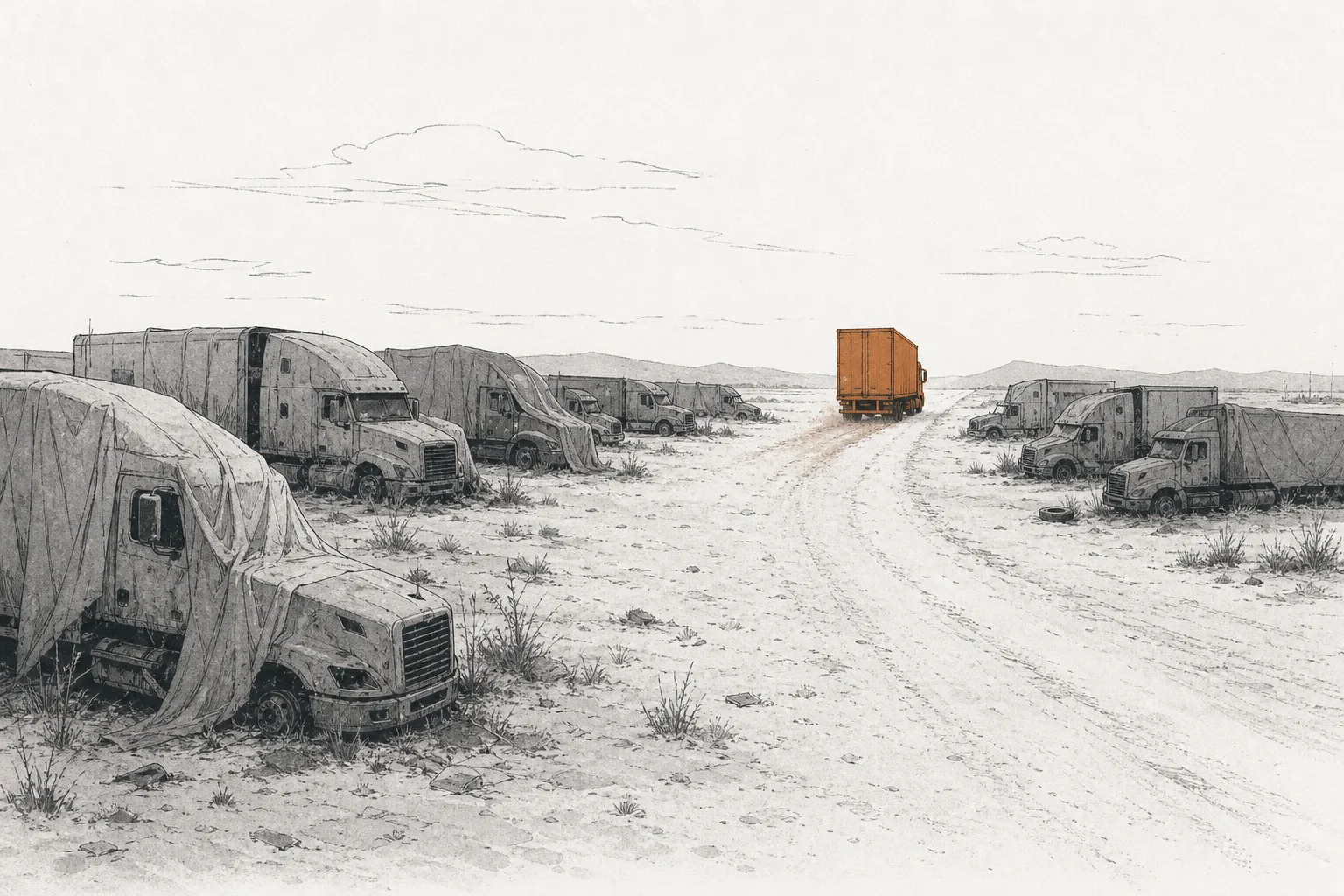
The first risk is the "SPAC wreckage" — running out of money before the finish line. This arena is a brutal "cash-burning pit." TuSimple was once a star but ended by withdrawing from America amid a dispute over transferring assets to China, laying off about 75% of its U.S. staff. Embark went public via SPAC at a target valuation of about $5 billion, then collapsed within 16 months, finally sold off for just $71 million. The lesson — most of these companies didn't die because the technology didn't work, but because the money ran out first. Autonomy takes enormous capital and longer than the capital markets can stomach.
The second risk is law, safety, and liability. An 18-wheeler weighing dozens of tons running fast on the highway does far more damage than an ordinary car if it slips up. And if a driverless truck hits someone — whose fault is it? The software company, the truck owner, or the manufacturer? The legal framework isn't settled, and driverless-vehicle rules still differ from state to state, making it messy to expand across state lines. One prominent accident could prompt regulators to halt the whole field.
The third risk is proving the economics at scale. Right now only dozens to hundreds of trucks run for real, on routes hand-picked as easy. The unanswered question is whether it can scale from hundreds to tens of thousands with cost per truck falling and safety holding up — climbing from "can run on chosen routes" to "can run anywhere profitably" is the hardest and most cash-hungry stretch, just as the robotaxi neighbor is finding.
In short: this node is about taking the "driving brain" and placing it on the field's easiest problem — the long-haul highway and the short-haul sidewalk — then using the hub-to-hub model to split the work between people and machines by what each does best. 2025–2026 proved it runs for real and gets paid for real (Aurora, Kodiak, Serve), but it also still burns real money and can really fail (TuSimple, Embark). Understanding this node is understanding why the first "driverless car" to change the economy may not be the taxi you ride in, but the truck you never see.