Megatrend · Semiconductors
The chips that 'think': GPUs, CPUs, and the brains driving the AI era
In the chip world, one branch does the actual 'computing' — from the NVIDIA GPUs that trained ChatGPT, to the CPUs in servers and phones, to the chips Google and Amazon design themselves. This is where a $5 trillion company was born, where NVIDIA holds an almost total grip on the market — and where its biggest customers are trying to 'escape' by building their own chips.
01What it is (the chips that compute)
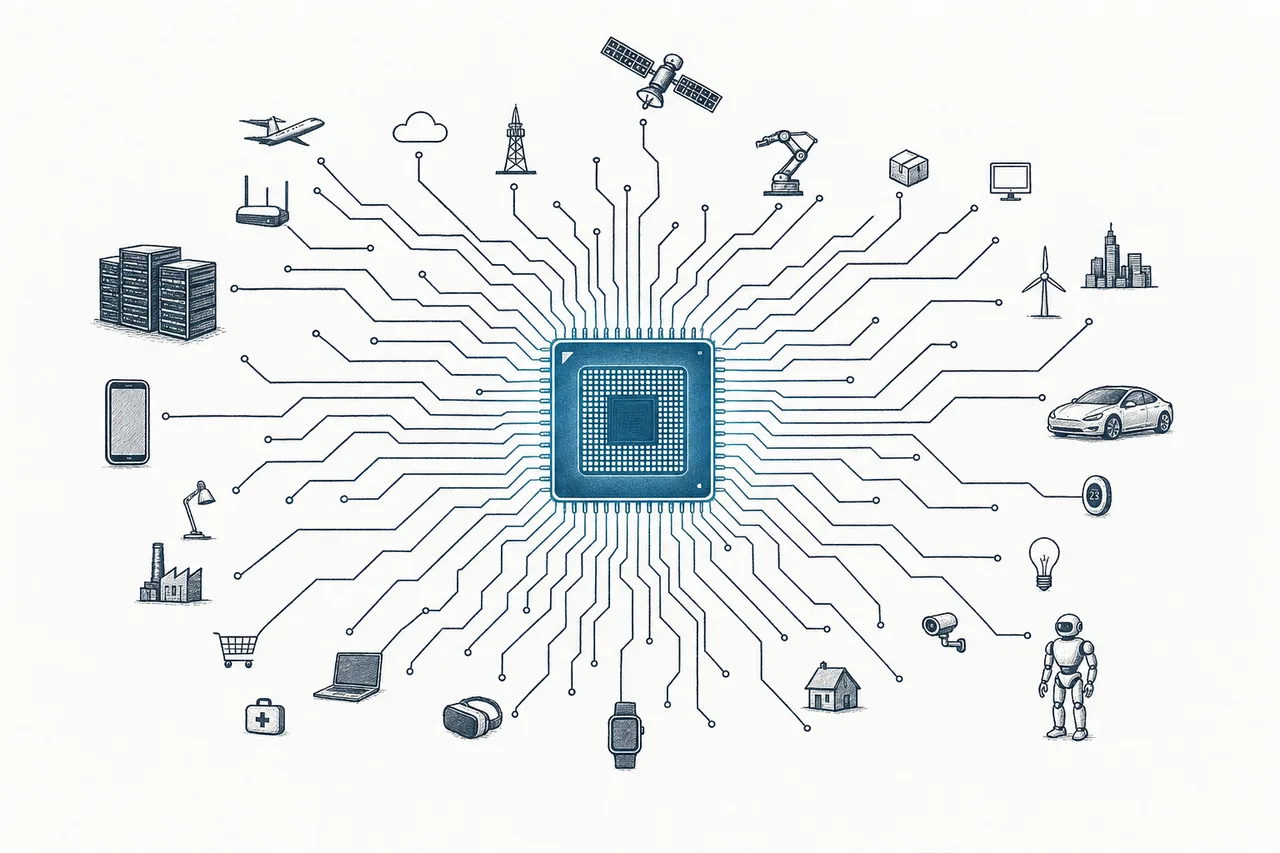
Inside every computer's body are many kinds of chips. Some 'remember' (memory), some 'store,' some deliver power — but one group does the actual 'thinking,' the real computing. That's this branch. If you had to put it simply, this group of chips is the 'brain,' and the rest is the body that supports it.
It spans GPUs (the graphics chips that became the engine of AI), CPUs (the central brain of computers and servers), mobile SoCs (chips that pack everything into one for a smartphone), custom ASICs (chips designed to do one specific job, like Google's TPU), all the way to connectivity chips that let thousands of chips in a data center talk to each other.
A 'Logic chip' is a chip that computes by following instructions (unlike memory, which just holds data) — think of it as the 'cook' who actually makes the dish, while memory is the 'pantry' that stores the ingredients. The logic we focus on here isn't pure AI accelerators only (GPUs/AI chips count as the main driver, but the node's definition covers general logic in full: CPUs, MCUs, SoCs, networking).
On our megatrend map, this node is a sub-branch under Semiconductors, and it's the industry's 'highest value-add layer' — because these are the chips that command the highest prices, carry the fattest margins, and where the names you know (NVIDIA, AMD, Intel, Qualcomm) cluster. If Foundry is the 'contractor that builds the chips,' this branch is the 'architect that designs the brain.'
02Why it sits at the center of all the money
The reason boils down to one name: NVIDIA. Selling AI processing chips pushed its market cap past ~$5 trillion — making it the most valuable company in history. In its latest fiscal year NVIDIA brought in $130B+ in revenue, and in Q3 alone (ended Oct 2025) it set a record at $57B, with data center revenue of $51B in that single quarter. All of it from one group of chips: GPUs for AI.
But the story doesn't end with NVIDIA. This branch is the biggest and fastest-growing market in chips. The 'data center accelerator' market (combining GPUs + AI ASICs) sits at about $171B in 2025 and is expected to grow to ~$373B by 2030 (about 17% a year). And that figure doesn't even include server CPUs, mobile chips, and connectivity chips — each a market worth tens of billions on its own.
And here's what sets it apart from other branches: in chips, this is the layer with the fattest margins. NVIDIA's gross margin runs as high as 73% — higher even than chipmaker TSMC. Because the real value isn't in 'manufacturing,' it's in 'designing the brain,' and even more in the software that locks customers in (we'll get to that in the final chapter).
03GPU vs CPU vs ASIC — how they differ
The heart of this branch is the difference between three kinds of chip, each designed to 'think' a different way — and get this, and you'll understand the whole AI industry.
A CPU is the 'all-purpose thinker.' It has a few dozen processing cores, but each one is very smart and can run complex work, one task at a time, very fast. Think of a few 'professors' solving hard problems one by one. It's built for general work — running an operating system, managing a database.
A GPU is an 'army of calculators.' It has thousands to tens of thousands of small cores, none of them very smart on its own, but doing a massive amount in parallel at once. Think of 'ten thousand students' all adding simple sums at the same time — and it happens that training AI is doing an enormous number of multiplications at once. So the GPU became the engine of AI almost by accident (it was originally built to render game graphics).
So what about the ASIC? It's a chip designed to 'do one specific job' — if the CPU/GPU is a Swiss-army knife, the ASIC is 'a knife forged to peel one kind of fruit.' It does that job much faster and uses far less power, but trades away all flexibility. That's why Google built the TPU, Amazon built Trainium, Microsoft built Maia — to run their own AI more cheaply. For workloads you know in advance, these custom chips are estimated to give 40–65% better value (TCO) than a GPU.
ASIC (Application-Specific Integrated Circuit) = a chip designed for a specific job, not a general-purpose chip · when a big tech company (a hyperscaler) commissions its own ASIC for AI, we call it custom silicon — but they don't do it all themselves; they hire a 'design partner' like Broadcom or Marvell to turn the spec into a real chip.
04How it connects in the ecosystem
This branch sits at the very 'downstream' end of the chip world — it designs the brain, then hands it off to every technology trend on the planet. At the same time, it leans heavily on its siblings in the chip industry:
- It's the engine of AI directly: this is the relationship that defines the whole branch. Without this group of chips, there's no modern AI — the entire AI boom is the boom of this group of chips
- Feeds Cloud, cars, robots, and Quantum: every trend that needs to 'compute' runs back to this group of chips. The CPUs/GPUs in data centers, the chips driving electric cars, the chips controlling robots
- Relies on Foundry to manufacture: NVIDIA, AMD, Qualcomm are all 'fabless' — they design but own no factory. Every chip goes to TSMC to be made, so TSMC's leading-edge node capacity is the ceiling on this branch
- Can't do without Memory (HBM): every GPU needs HBM as its partner — without fast memory feeding it data, even the strongest GPU 'starves.' So the HBM bottleneck is this group's bottleneck too
- Depends on EDA & IP to design: chips this complex can't be designed by hand; they need EDA software and ready-made design blocks, especially the Arm architecture that underpins nearly every mobile chip and is now pushing into the data center
05Where it stands now
Right now there are three big things happening at once: NVIDIA dominates in a way that's hard to challenge, its biggest customers are trying to escape with their own chips, and the CPU is back in play.
First — NVIDIA's dominance. In the pure AI accelerator market, NVIDIA holds about 85–90%. That's not just because the chips are strong, but because of CUDA, the software AI developers worldwide have used for over 15 years. Switching to another brand's chips means rewriting all your code — that's the real 'moat.' AMD is the most serious No. 2 challenger, with its MI-series chips matching on specs, but it's still held back by the software ecosystem.
Second — the 'custom silicon war.' NVIDIA's biggest customers (Google, Amazon, Microsoft, Meta) don't want to pay it a 73% margin forever, so they've turned to designing their own chips. This is becoming the hottest front: in 2026, custom ASIC growth is expected to outpace GPU growth for the first time (ASICs ~44.6% vs GPUs ~16.1%).
The winners from this trend are Broadcom and Marvell — the two 'design partners' for hyperscalers, together holding about 95% of the custom ASIC design market. Broadcom's AI revenue hit $8.4B in Q1 FY2026 (up 106% year over year), and its CEO says he can 'see' AI revenue topping $100B in 2027 — a way to play AI without going head-to-head with NVIDIA.

Third — the CPU is back. On the server CPU side, Intel once owned the market outright but now holds about 67–71% of x86, while AMD has surged to an all-time high of ~29% (and by server revenue AMD reaches ~41%). Meanwhile Arm is breaking into the data center through chips hyperscalers design themselves (AWS's Graviton), reaching about 15% share and growing fast.
And don't forget the mobile side, a huge market in its own right — here MediaTek leads Qualcomm with about 34–36% SoC share versus ~28% (MediaTek is strong in the mid-to-low range, Qualcomm in flagships). China has its own rising star, Cambricon, whose revenue is surging on the domestic AI boom; it turned its first profit in 2025 (revenue ~6.5 billion yuan), though it's still far smaller than Huawei Ascend.
06The road ahead
The first direction is the tug-of-war between 'standard chips' and 'custom chips.' NVIDIA will keep dominating AI-training work that needs high flexibility (with its new Rubin chip following Blackwell). But for repetitive work you know in advance — especially running AI (inference) at huge scale — custom ASICs will keep taking more share. The big question is how long NVIDIA can hold its ~85% share.
The second direction is the CPU's new role in the AI era. For years the CPU was seen as 'boring,' but at the end of 2025 demand came back strong, because inference and prepping data for AI also lean harder on the CPU — so the CPU front is lively again, between Intel, AMD, and Arm pushing into the data center.
The third direction is China's 'decoupling.' With the US banning high-end AI chip sales to China and Beijing ordering domestic firms to cut their reliance on NVIDIA, China's market is becoming a 'separate arena' where Huawei Ascend and Cambricon can grow even with lagging specs — creating a parallel chip ecosystem that may split from the West for good.
07Challenges & risks
The most profitable branch in the industry comes with its own specific risks.
The first risk is concentration and over-reliance on AI. This branch's enormous value rests on a single assumption: that AI demand keeps growing. Big tech's AI capex ($380B+ in 2025) is the engine driving all of it. If one day AI's ROI falls short of expectations and the giants slow their spending, the whole branch's revenue shakes instantly — this is the 'AI bubble' risk investors debate most.

The second risk is your biggest customers becoming competitors. For NVIDIA, the deepest risk is that the customers who pay it the most (Google, Amazon, Microsoft) are all building their own chips. The faster custom ASICs grow, the more they erode NVIDIA's market long term — the CUDA moat is still strong, but that wall is tested harder every year.
The third risk is geopolitics. This branch sits at the center of the US-China tech war. Export bans cut off the China market (once a big revenue source for NVIDIA) and push China to build its own competitors. At the same time, because every chip has to be made at TSMC in Taiwan, this branch carries the full geopolitical risk of Foundry along with it.
In short: this branch is where 'thinking' turns into money. It's the story of the chips that do the computing for the whole world — and of the one company that dominates it almost completely, with software, not just hardware. Get GPU vs CPU vs ASIC clearly, and you understand why 'AI chips' became the most valuable asset in today's economy — and why whoever controls them has to watch their own customers most closely of all.