Megatrend · Critical Materials
Turning “ore powder” into the heart that drives EVs, robots, and missiles
What comes out of the mine is a whitish “oxide” that can't actually drive anything yet. The real game starts at the next step — you “reduce” the oxide into metal, blend it into an alloy, and run it through more than a dozen steps of craft until you get a tiny block of NdFeB permanent magnet, the strongest in the world. This is the “downstream” of the rare-earth chain — a step that looks more like a workshop than a mine, yet it's where China holds the tightest grip, about 90% of the world, and the gate the West is now spending billions of dollars to build for itself.
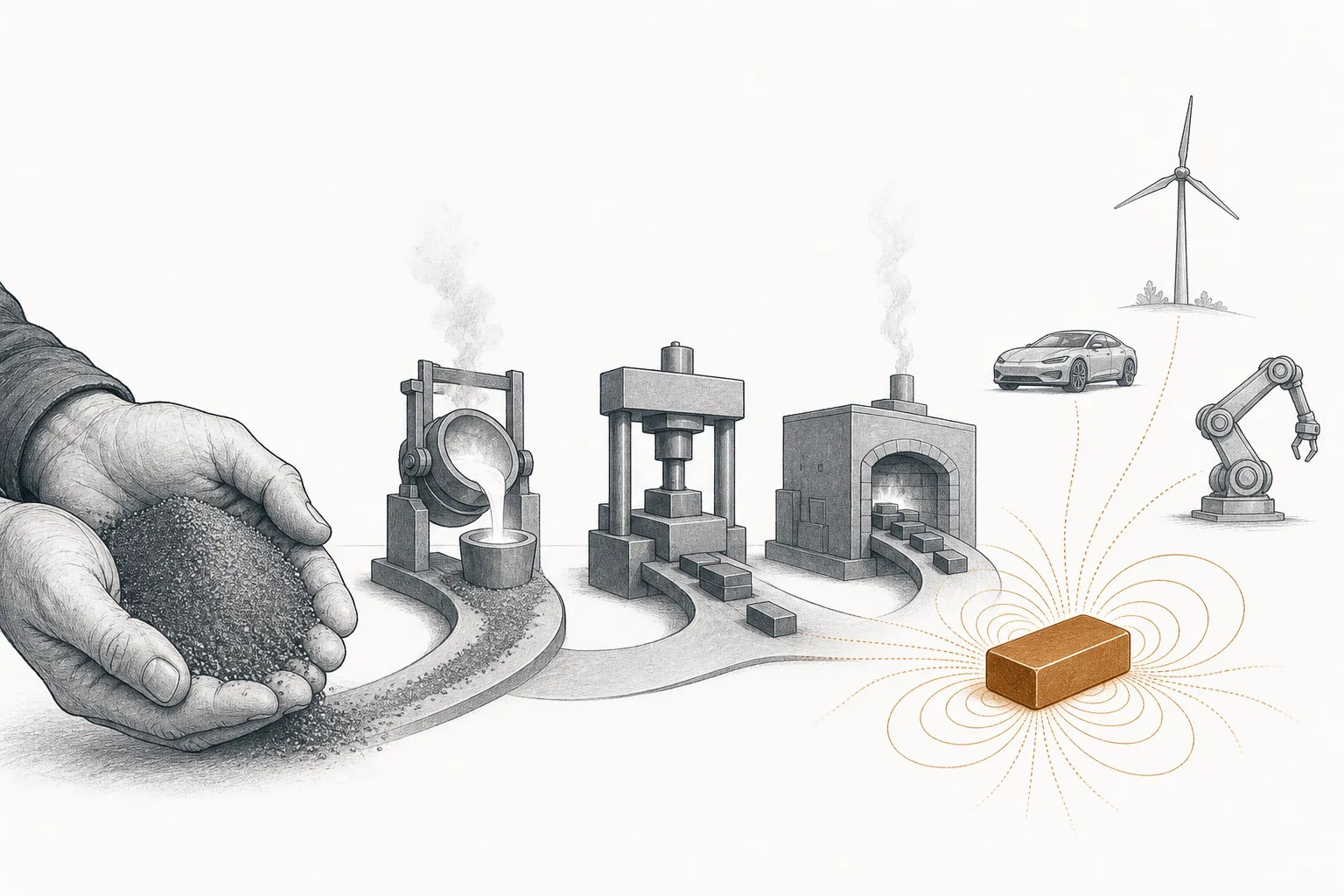
01What it is (metal · alloy · magnet)
If mining the ore and separating the oxide is “finding the right clay,” this node is forging that lump of clay into a sword — every step after you've got the “rare-earth oxide” (a white powder like Nd₂O₃) in hand, all the way to a finished permanent magnet ready to drop into a motor.
There are three gates here, linked into a single line:
- Metal: the oxide is still a “compound” that can't drive anything. First you have to reduce it into pure rare-earth metal — mostly the NdPr (neodymium-praseodymium) alloy that's the starting material for the magnet
- Alloy: you melt that rare-earth metal together with iron (Fe) and boron (B) in a vacuum furnace, getting a “magnet alloy” with the formula Nd₂Fe₁₄B — this is the core, because it's this crystal structure that holds a magnetic field tighter than any other material
- Magnet: you take that alloy and crush, press, sinter, and “align” it until it becomes a real, usable NdFeB permanent magnet. This step is where the craft really piles up
On the megatrend map, this node is the very last leaf under Rare Earths & Permanent Magnets within the big trend Critical Materials & Supply Chain. It's the “downstream”, paired with its sibling leaf Rare-Earth Mining & Oxide, which is the “upstream” — that leaf tells the story of mining and separating the ore, this leaf tells the story of what comes after: turning the powder into parts that actually spin.
Sintered = a magnet where the powder is pressed and then fired so the grains fuse into a dense body — the strongest, used in EV motors, wind turbines, and weapons, and the star of this lesson · Bonded = magnet powder mixed with plastic and molded; weaker, but can be formed into complex shapes, used in sensors and small motors · almost all of the high-value market is in sintered.
02Why this little block matters
The NdFeB magnet is the “muscle” of the electric age. Anywhere you need to turn electricity into strong, precise motion in a tight space, it all comes back to this — the drive motor in an EV, the generator in an offshore wind turbine, the joints of a robot, the targeting systems of missiles and fighter jets. The reason is that it delivers the highest force per size — the motor gets smaller and lighter, but just as strong.
The world NdFeB magnet market is around $16–28 billion in 2025 (the figure varies by source), and is expected to grow about 7–8% a year for years to come, driven by the EV, clean-energy, and robotics waves — but more important than market size is who can actually make it.
Here's the biggest misconception: many people think the power lies in the “mine,” but in reality the power lies downstream — in the metal, alloy, and magnet steps. Even if you can mine the ore yourself in America or Australia, if you can't do this step yourself you still have to ship it to China for processing. Because it's not about “having the ore,” it's about decades of accumulated knowledge and skill that the West once threw away.
03How it works — from powder to magnet
The charm of this step is that it's a very fine craft — not just “melt it and pour it into a mold,” but a sequence of more than a dozen steps where missing a single one weakens the magnet instantly. Let's follow the main path.
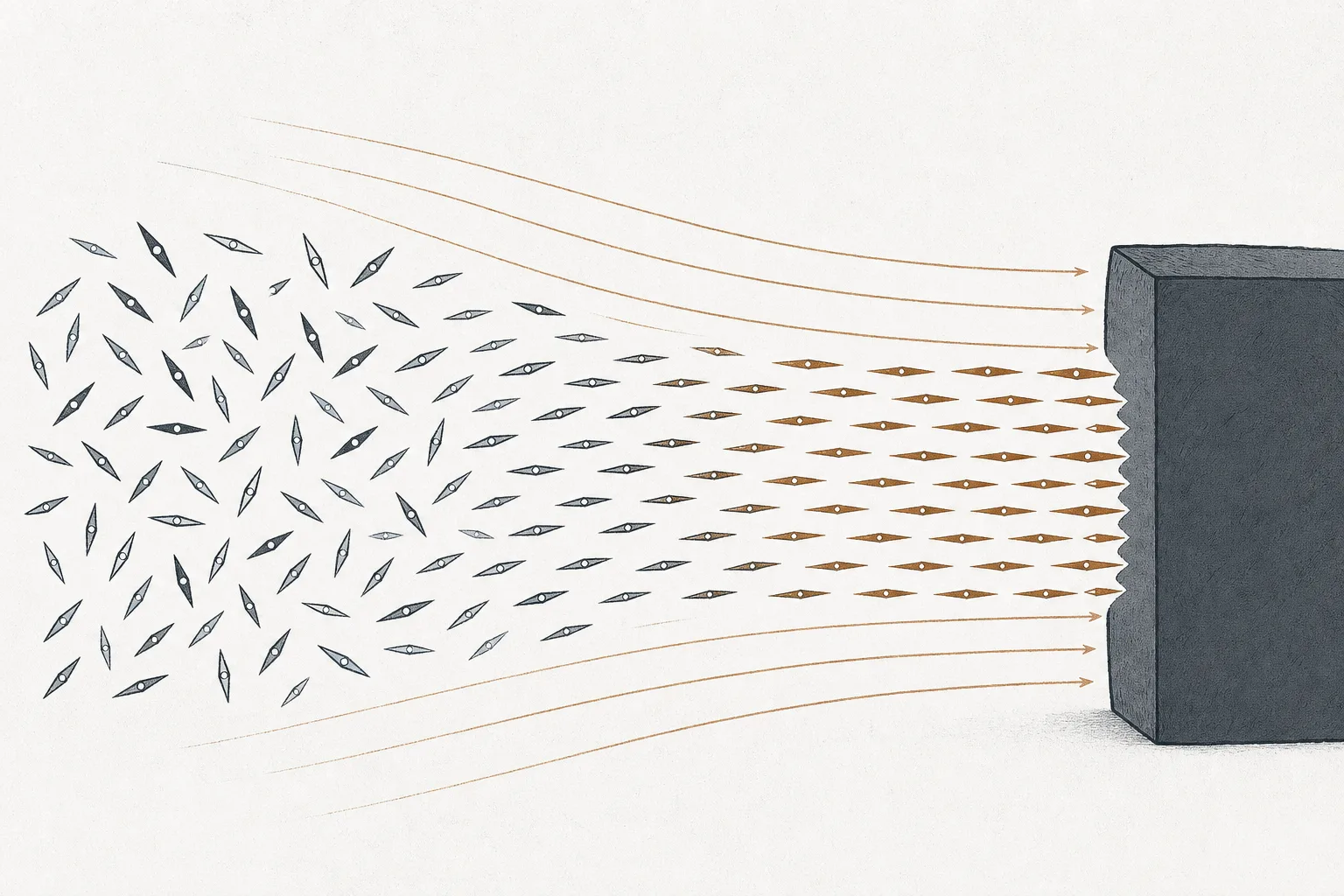
The step people overlook but matters most is “alignment” — each grain of NdFeB powder has its own “direction it wants to be magnetic in.” When you press it into shape, you have to apply a strong magnetic field to force every grain to face the same way before firing. The straighter the alignment, the stronger the magnet — this is why a “high-grade” magnet and an “ordinary” one can be made from the same raw material yet differ wildly in quality. It's in the skill, not just the recipe.
Then dysprosium (Dy) and terbium (Tb) — heavy rare earths that China controls almost entirely — come in at the end to fix the one weakness of NdFeB: it loses its strength when it gets very hot. An EV motor can easily exceed 150–200°C under hard acceleration. A modern technique like grain-boundary diffusion (GBD) coats a thin layer of Dy/Tb on the surface and lets it diffuse along the grain boundaries, giving heat resistance while using far less heavy rare earth — both an engineering feat and a strategy to cut reliance on the most fragile material.
Strip casting = casting the alloy into very thin sheets (just ~0.2–0.4 mm thick) and cooling it fast, so the grain structure comes out fine and uniform — the starting point of a good magnet · Hydrogen decrepitation = using hydrogen gas to seep along the grain boundaries so the alloy sheet “crumbles apart” into fine grains on its own, before being jet-milled into powder; it's cheaper and gives better grain control than crushing it mechanically.
04Who it takes from, who it feeds
This node sits right in the middle of the conveyor belt of the electric economy — it takes raw material from upstream, then feeds the “muscle” to nearly every megatrend that runs on motors.
- Takes from mining the ore and separating the oxide (upstream): mines and separation plants send rare-earth oxides (Nd, Pr, Dy, Tb) — if upstream stumbles (say, hit by export controls), this downstream step runs dry of material instantly. The two gates can't be pulled apart
- Feeds EV drive motors (E-motors / Drivetrain) directly: nearly every EV maker's motor relies on NdFeB magnets, using about 1–2 kg per car — this is our biggest and fastest-growing chunk of demand
- Feeds robot servo motors and magnets (Servo Motors & Magnets): every joint of a robot needs a motor that's small, light, strong, and precise in position control — exactly NdFeB's specialty, and a new wave of demand riding the humanoid-robot trend
- Feeds wind power, defense, and more: direct-drive offshore wind turbines eat several tons of magnets per unit, while weapons systems, fighter jets, and drones rely on heat-resistant high-grade magnets — making this step a “strategic point” for security as well
05Where it stands now
The current picture is clear: China is the world's magnet factory. Chinese makers supply about 90% of high-performance NdFeB magnets, with total capacity on the order of over 130,000 tons a year. The real market leader is JL MAG — the world's largest high-performance permanent-magnet maker, with capacity around 40,000 tons/year and plans to expand to 60,000 tons/year by 2027, followed by several other Chinese giants like Zhongke Sanhuan and Ningbo Yunsheng.
On the other side, Japan still holds the “high-end craft” — Shin-Etsu Chemical, Proterial (formerly Hitachi Metals), TDK have long owned the patents and techniques for premium-grade magnets, especially heat-resistant magnets for high-end EV motors. They can't match China on volume, but their quality and know-how are still in demand.
And the thing shaking up the industry most is that the West has started building its own magnet plants for real. In the U.S., MP Materials opened a magnet production line at its “Independence” plant in Fort Worth, Texas — starting to make NdPr metal and automotive-grade NdFeB magnets, targeting about 1,000 tons/year capacity in the first phase, supplying GM and signing a $500 million deal with Apple for magnets made from recycled material. Meanwhile e-VAC (part of Germany's Vacuumschmelze) is putting in $506 million to build the first magnet plant in the U.S., in South Carolina, also supplying GM — all of it a signal that “making magnets outside China” is genuinely starting, not just on paper.
06The road ahead
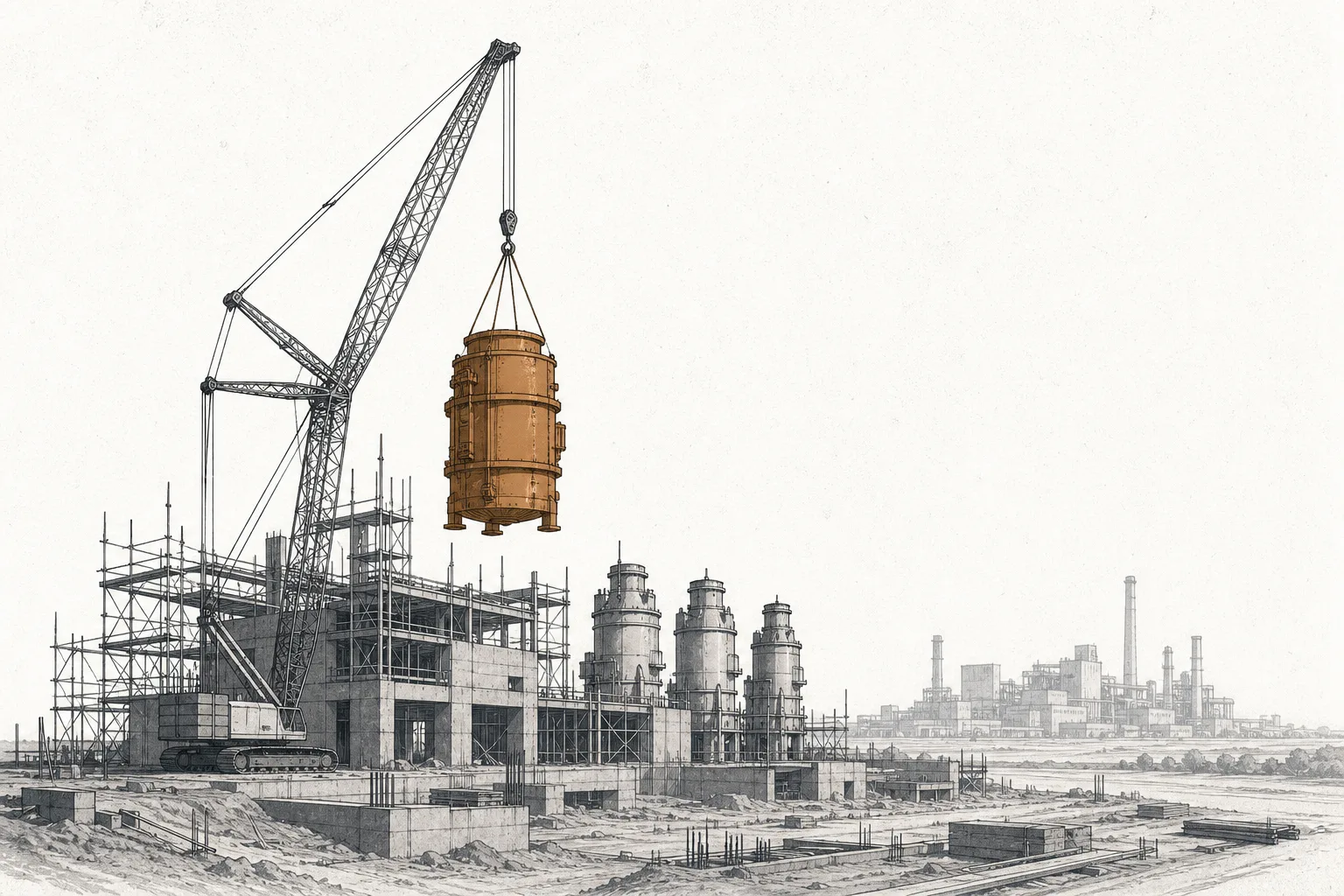
The first direction is building “magnet plants outside China” with state backing. The MP Materials model (the state takes a stake + props up the price + customers like GM/Apple commit to long-term offtake) is likely to be copied across Europe, Japan, and India, because everyone has learned that a pure free market can't beat a Chinese state that has subsidized for decades. Over the next 5–10 years we'll probably see many metal plants and magnet plants spring up outside China — but you have to understand it's slow and expensive. Catching up the “align–sinter” craft to China's yield and quality takes years.
The second direction is cutting reliance on heavy rare earths (Dy/Tb). A technique like grain-boundary diffusion lets you use far less Dy/Tb while keeping heat resistance. Some makers have even gone as far as developing EV motors that use no rare-earth magnets at all (such as induction or wound-rotor) — but they usually pay for it with a larger size or lower efficiency. Cutting reliance on the most fragile point is possible in some applications, but it's not a blanket answer yet.
The third direction is recycling becoming the “urban mine.” The magnets inside EVs, hard drives, and old motors are a source of rare earths that's still barely been mined. The Apple–MP Materials deal using entirely recycled material is a signal that recycling is starting to pay off commercially — and if it can scale, it'll become an important downstream material source outside China in the coming decade.
07Challenges & risks
The first and biggest risk is concentration in China. When almost all of downstream is in one hand, China's export controls on magnets and heavy rare earths (as happened in 2025) can hit production lines worldwide instantly — this risk doesn't show up on any company's books; it sits on the negotiating table between great powers, and can open or close with the rhythm of politics.
The second risk is the skill wall that's hard to catch. For players outside China, announcing you'll build a plant is easy. But getting the “align–sinter–coat” step to run at high yield and consistent quality really requires the decades of accumulation China has and the West already let go. This gap can be closed, but it takes enormous time and money — and in the meantime, the world keeps depending on China.
The third risk is wild swings in price and cost. The rare-earth market is small and thin, so when China opens and closes the tap, raw-material prices can swing several times over within a few months. Producers outside China, already higher-cost, are even more exposed if China slams prices back down (as it has done in the past to kill rivals) — which is why almost every plant outside China needs a state or a major customer to prop up the price just to survive.
In short: this node is the “swordsmith” of the electric age — turning powerless ore powder into the magnets that spin the world's motors. It's a downstream step that looks like quiet craft work, yet it's one of the most powerful bottlenecks in the modern economy — and a battlefield where great powers are pouring money to build it for themselves.