Megatrend · Critical Materials
Easy to mine, but so hard to "separate" that nearly the whole world leans on China
Before it becomes the magnet in an EV motor or a part in a fighter jet, a rare earth has to clear an upstream gate first — you dig the ore out, then "separate" the 17 elements jumbled together into pure, single-element oxides. It sounds like ordinary mining, but here's the truth: anyone can do the "digging" — it's the "separating" that's enormously hard, dirty, and that the whole world relies on China for, to the tune of ~90%. For the indispensable heavy rare earths, China controls nearly 99%. This is the story of the very first gate in the chain — and of the bottleneck hidden in hundreds of chemical tanks, not in a mine pit.
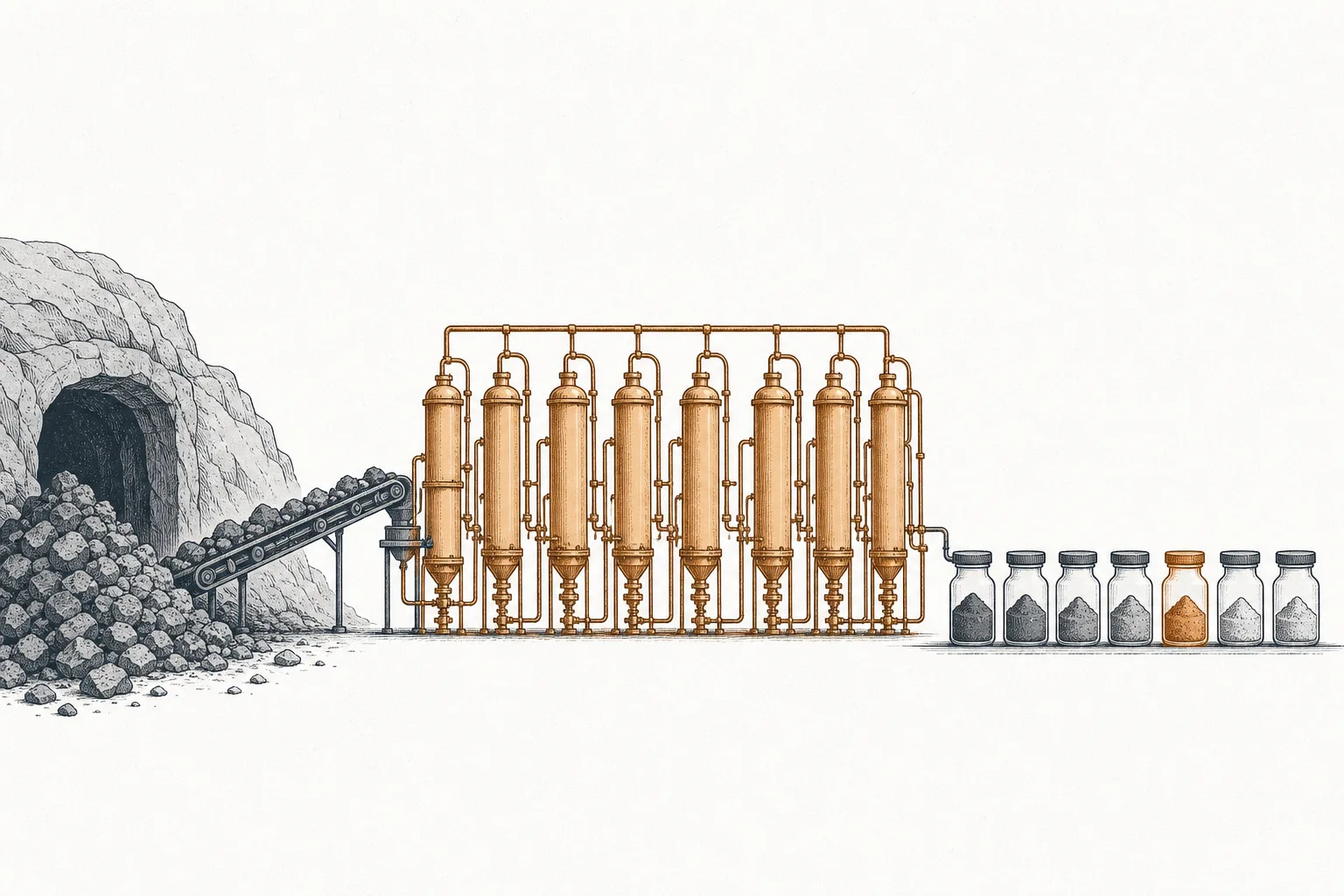
01What it is (mining + making oxides)
Picture a rare earth not as something you dig up and use right away, but like a "bag of 17 kinds of candy melted together" — a single chunk of ore holds all 17 rare-earth elements mixed in. The ones you want (neodymium, dysprosium) and the ones almost no one uses, all jumbled together. And worst of all, their chemical properties are so similar they're the hardest in the periodic table to pull apart. This node is the gate that does two jobs: (1) mine the ore out of the ground, then (2) separate it into pure single-element oxide powders, ready to pass on.
This is the upstream of the whole rare-earth chain — the very first gate, before the material flows to the next gate, making metals, alloys, and magnets (midstream), where these oxides get smelted into metal and formed into NdFeB magnets. On the megatrend map, this node is a sub-branch under Rare Earths & Permanent Magnets within the big category Critical Materials & Supply Chain. If the magnet gate is "forging the sword," this node is the one who finds the right earth and sifts out only the pure ore for the swordsmith.
And that ore comes in several types, each one setting both how easy it is to separate and which elements you get:
These three sources together make up about 95% of the world's rare earths · Bastnäsite = a hard-rock ore with a high oxide content of 65–75%, strong in the light elements (Nd/Pr) — the main ore of Bayan Obo in China and Mountain Pass in the U.S. · Monazite = a sand ore often picked up as a byproduct of mining something else, but it comes laced with radioactive thorium, so it's hard to handle · Ion-adsorption clay = a special source in southern China that yields the heavy rare earths (Dy/Tb) that are almost impossible to find elsewhere — about 80% of the world's heavy rare earths come from this kind of clay.
The heart of it to remember is — the value and the power aren't in "mining" but in "separating." Mining rare earths isn't all that different from ordinary mining, and many countries can do it. But turning raw ore into pure single-element oxides at 99.9% purity is chemistry that's hard, expensive, and that very few can actually do at industrial scale — and that's the whole story of this lesson.
02Why "upstream" matters more than you'd think
Everything that has to "turn electricity into motion" with strength and precision — EV car motors, wind turbines, robot joints, drone propellers, missile guidance systems — all trace back to NdFeB magnets. And every one of those magnets begins with the oxide powder that comes out of this gate. No oxide, no metal; no alloy, no magnet. A tower of value worth trillions of dollars sits on the white powder in the bottles that leave this gate.
But what makes upstream "dangerously important" is the misconception about mining. People think China controls rare earths because it "has lots of mines" — that's only half true. China mines about 60–69% of the world's ore, which is a lot, but it's not the point that locks everyone else out. The real lock is the separation / oxide-making (separation) stage, where China controls about 90% — and for heavy rare earths (Dy/Tb), nearly 99%. Put simply: even if America or Australia can mine the ore themselves, in the end they still have to ship it to China to be "separated."
On the market side, oxides aren't cheap. The global rare-earth oxide market was worth about $6 billion in 2024, and is expected to grow several times over the next decade on the wave of EVs, clean energy, robots, and defense. Neodymium oxide alone (the main one for magnets) is projected to reach about $5 billion by 2030 — and all of this demand always has to run through the separation gate first.
03How it works — from ore to oxide
To understand why the "separation" stage is the bottleneck, let's follow the ore's journey step by step, from the mine pit to oxide powder in a bottle.
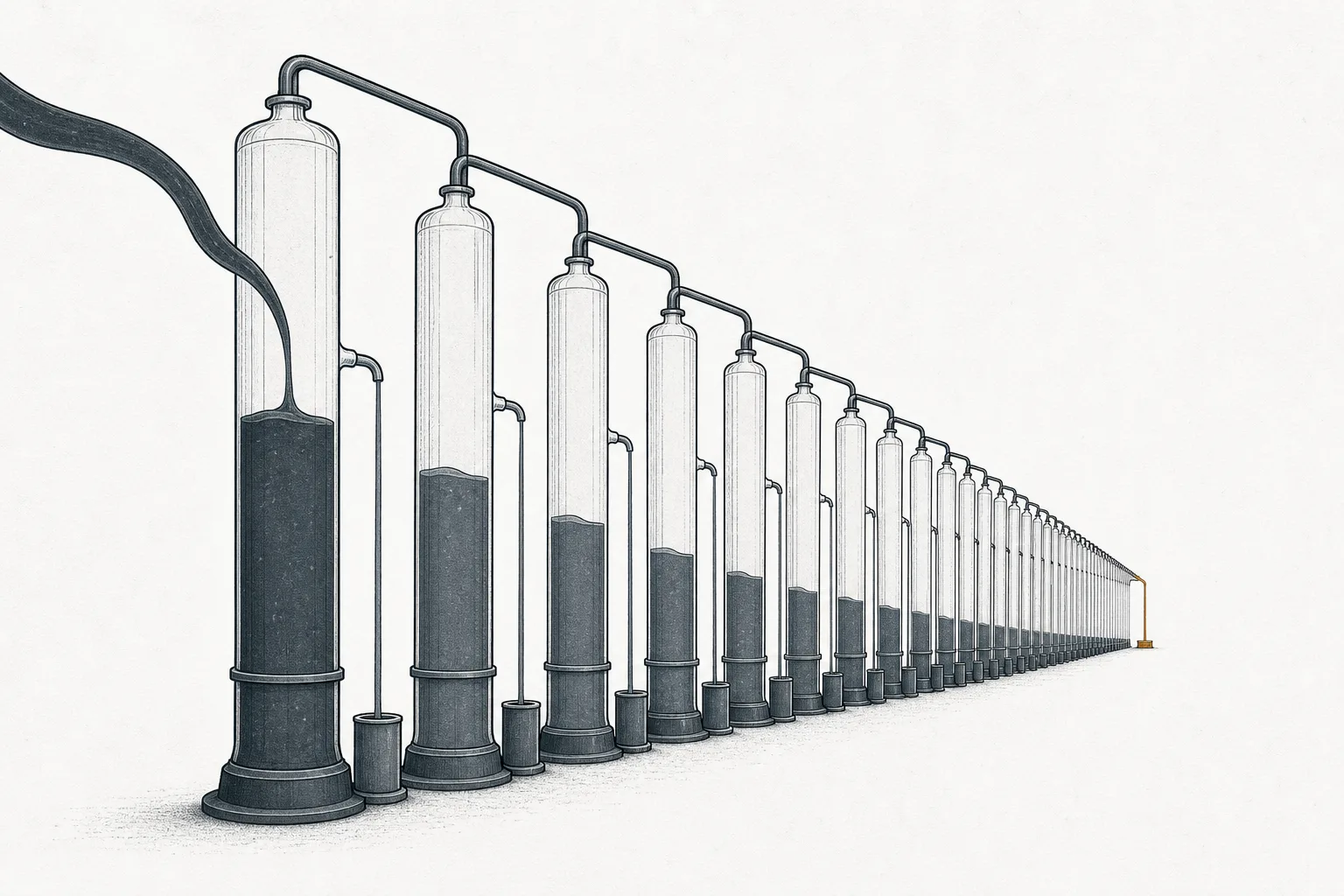
The heart of the difficulty is step 4 — solvent extraction. The problem is that all 17 rare-earth elements have chemical properties that are very similar (their ion sizes differ by just a hair). To pull each one out pure, you have to run the liquid through a long row of 200–400 connected mixer-extraction tanks, each stage drawing off a little of the target element, slowly working it up to purity. And the precision required is brutal — a swing of 0.1 in pH throws the whole line off, so it has to be monitored and tuned around the clock. This is the "knowledge that's hard to copy" that makes this gate a high wall.
Crack & leach = the step of "opening the ore" with strong acid or alkali and heat to dissolve the rare-earth elements into solution (for monazite, you also have to remove the radioactive thorium here) · Solvent extraction = separating the elements one by one with organic solvents through hundreds of connected tanks — this step is the "heart" and the "bottleneck" of the whole chain. Whoever controls this technique controls rare earths.
The reason the West fell behind isn't that it lacks ore — it's that separation is dirty and expensive. It generates large amounts of chemical and radioactive waste. The West once had its own separation plants but shut them down one by one 20–30 years ago, unable to compete on price with China and hitting environmental pushback. China shouldered this cost for decades, and today it has accumulated the knowledge, the skills, and the plants to become "almost the only expert left" — and building a new separation plant isn't cheap either: the separation system alone runs about $200–500 million, and a full chain can reach $1,500–2,000 million.
04How it connects in the ecosystem
This node is the "upstream tap" of rare earths — it feeds the people ahead, and if it stalls, the tremor flows all the way down the line.
- Feeds making metals, alloys, and magnets directly (the sibling gate just downstream): this is the main customer of this gate. The separated oxides are smelted into metal, blended into alloys, and formed into NdFeB magnets — upstream and midstream are joined inseparably. Different gates, but one chain
- A "fragile point" of the Sovereign Critical Minerals chain: the security angle lives at that node — fighter jets, missiles, radar all depend on the oxide that leaves this gate. The U.S. Defense Department's order to purge Chinese rare earths from weapons systems by early 2027 is an effort to stand up its own upstream in time
- Specialty chemistry, shared with Materials & Specialty Chemicals: separating ore is pure chemistry — it takes organic solvents, high-purity acids/alkalis, and large amounts of specialized extractants. So this gate is both a customer of and a sibling to the specialty-chemicals industry
- The upstream raw material of new demand waves: the oxide leaving this gate flows on to become the magnets in EV motors, clean-energy turbine blades, robot joints, and the servers/fans of AI data centers — the more these trends grow, the more oxide demand grows with them
05Where it stands now
2025 was the year upstream became a battlefield. On April 4, 2025, China announced export controls on 7 heavy rare earths and on products containing them. The result was an instant squeeze on upstream outside China — the clearest number being U.S. imports of yttrium, which plunged from over 333 tons in the 8 months before the measure to just 17 tons in the 8 months after — a drop of over 95%.
On the Chinese side, the real upstream champion is China Northern Rare Earth, the world's largest rare-earth producer by volume. Its base is the Bayan Obo mine in Inner Mongolia, with oxide reserves of over 35 million tons, and it controls most of China's light rare-earth mining. Combined with the separation plants China has built up over decades, the country's total output reaches about 270,000 tons a year.
Outside China, the most important move is building your own "separation" capability, not just mining:
- MP Materials (Mountain Pass mine, U.S.) mines bastnäsite, producing over 45,000 tons of oxide in concentrate in 2024, and is racing to make single-element oxides itself — producing 718 tons of NdPr oxide in Q4 2025 (up ~74% year over year) and planning to open a heavy rare-earth (Dy/Tb) separation line in mid-2026. Crucially, MP stopped selling to China in July 2025 to build a full Western chain
- Lynas (Australia, separation plant in Malaysia) is the largest separator outside China, and in 2025 became the first heavy rare-earth producer outside China — starting with Dy, then Tb oxide. Its new separation line has capacity of about 1,500 tons/year, which, focused on Dy/Tb, could amount to roughly a third of the world
- Energy Fuels (U.S.) feeds monazite sand into its White Mesa plant in Utah, and in 2025 successfully made its first batch of 99.9%-pure Dy oxide; by year's end its heavy rare-earth oxide was certified for use in magnets
At the same time, governments are stepping in to plug the upstream gap the free market can't fill in time. In June 2026, the U.S. Defense Department announced a $500 million loan to Phoenix Tailings to build a domestic rare-earth separation/processing plant (part of a roughly $1 billion program) — a sign that the West has finally accepted it needs state backing to stand up its own upstream in time.
06The road ahead
The first and clearest direction is building "separation lines" outside China with state backing. The world has learned that mining alone helps nothing if you still have to ship the material to China to separate it — the real thing is having your own separation/oxide-making plant. Over the next 5–10 years we should see several separation plants spring up outside China: Lynas expanding its heavy rare-earth line in Malaysia, MP opening a heavy rare-earth line at Mountain Pass, Energy Fuels running White Mesa at full tilt, and full-chain "mine-to-oxide" projects like Arafura (the Nolans mine in Australia) and Iluka's Eneabba refinery (expected to open in 2027) that aim to mine and separate in one place.
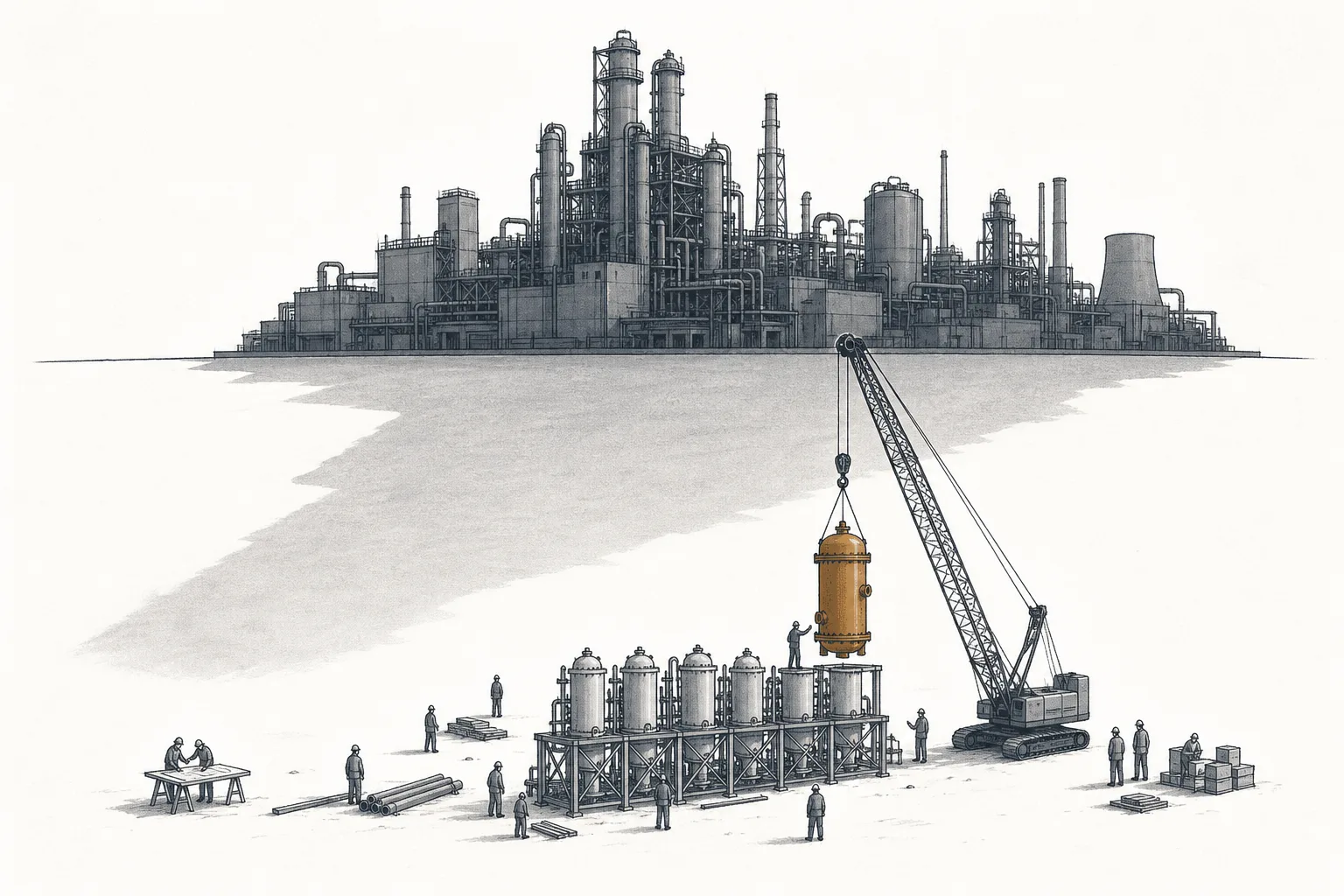
The second direction is going after the heavy rare earths (Dy/Tb) specifically, because this is where China controls nearly 99% and the West is most fragile. Whoever opens a heavy rare-earth separation line outside China first (Lynas leads, followed by MP and Energy Fuels) holds the rarest card in the chain — so ion-adsorption clay sources outside China (in Brazil or Africa, for instance) have become a hot new exploration battleground.
The third direction is new separation technology that tries to break out of the old solvent-extraction siege — for example, using proteins/bacteria to capture elements, or new separation methods that are cleaner and use fewer steps. If they succeed commercially, they'd lower cost, pollution, and the "knowledge wall" China holds. But most are still at the research or pilot stage, not yet at industrial scale.
07Challenges & risks
Upstream rare earths is a business where "end demand grows for sure, but the supply side is full of traps."
The first risk is China's price dumping. This is a classic weapon China has used before — when rivals outside China start building separation plants, China can open the production tap until oxide prices crash, leaving new, higher-cost projects "in the red before they can even grow." This market is small and thin, so prices can swing several times over in just a few months — which is exactly why states have to step in to prop up prices to keep producers outside China alive.
The second risk is the environment and radioactivity. Leaching and separating ore generates large amounts of chemical waste, and ores like monazite also carry radioactive thorium/uranium, so the residue has to be handled safely. Environmental permits in the West take a long time and face community opposition — one of the reasons the West shut its separation plants in the past, and a gate new projects have to clear.
The third risk is time and capital. Announcing a separation plant is easy, but actually getting it running with good yield and producing genuinely 99.9%-pure oxide takes the decades of accumulated knowledge that China has and the West threw away — many experts estimate the West needs about a decade to close this gap, and billions of dollars of capital per project. In the meantime, the world still has to keep relying on China.
In short: this node is the first gate of rare earths — you mine the ore and separate it into single-element oxides. And the counterintuitive truth is that the hard, powerful work isn't in the mine pit but in the hundreds of chemical tanks that pull very similar elements apart one by one. That's the bottleneck China spent decades building, and the gate the whole world is now racing to rebuild for itself.