Megatrend · Critical Materials
A few grams of material China turned into a weapon that shook the world
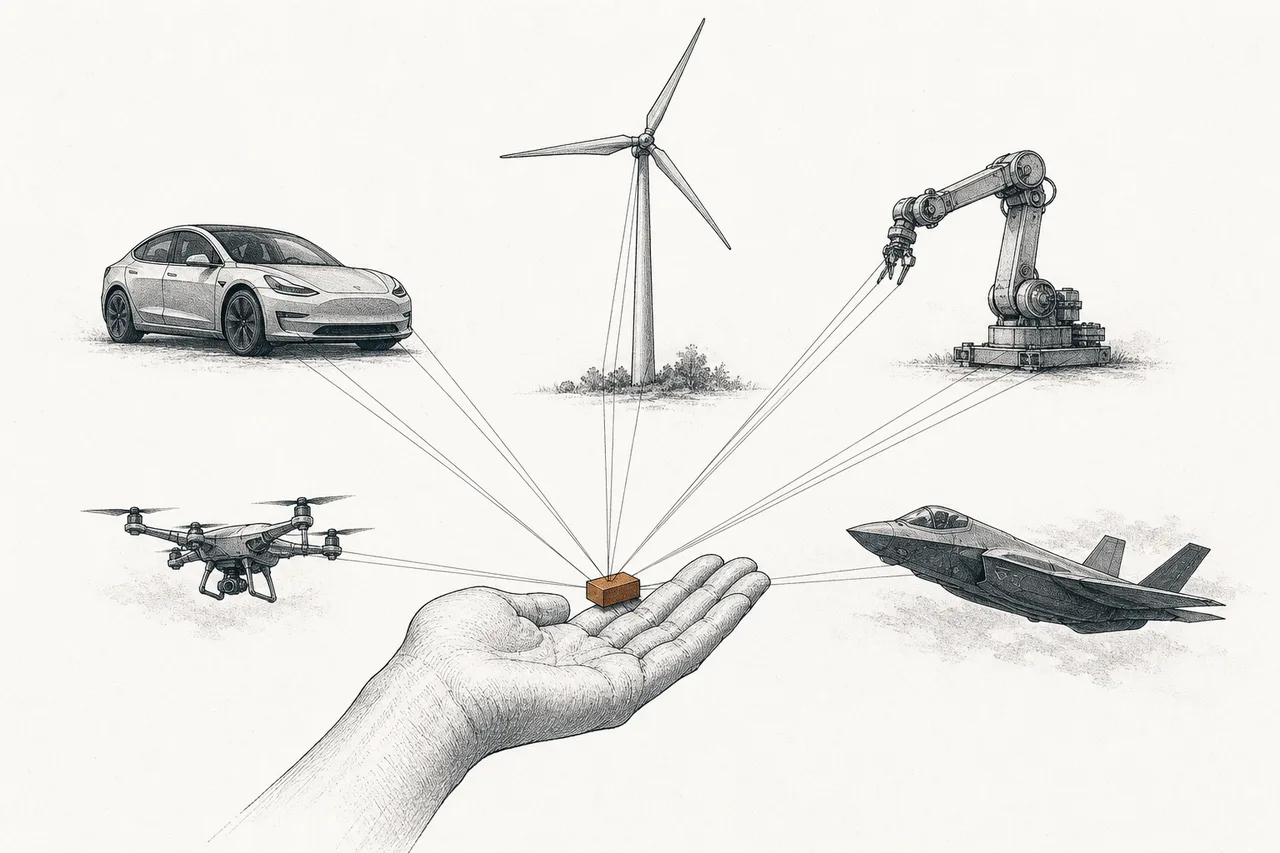
Inside the motor of every EV, every wind turbine, every robot, every drone, and every missile hides a tiny magnet — the strongest in the world. It's made from just a handful of rare earth elements, uses only a few grams per part, and is almost impossible to replace. And China controls more than 90% of the "refining" and "magnet-making" behind it. In 2025, China actually played that card as a weapon, and factories around the world stalled. This is the story of the quietest — and most dangerous — bottleneck in the modern economy.
01What is it? (rare earths + the strongest magnet)
This story has two layers of characters linked into one chain. Think of "clay" and "sword" — you need the right clay first before you can forge a sharp blade.
- Rare Earths: 17 oddly-named elements on the periodic table. Our heroes are just four of them — neodymium (Nd), praseodymium (Pr), dysprosium (Dy), terbium (Tb). These four are what make the magnet strong. Of them, Dy/Tb are the "heavy" rare earths — far scarcer and much harder to source
- NdFeB permanent magnets: mix these elements with iron and boron and you get a neodymium-iron-boron (NdFeB) permanent magnet — the strongest magnet humans can make commercially. It's the real hero of this lesson
The name "rare earth" is misleading — they aren't actually that rare by sheer amount in the Earth's crust. They're scattered all over the world. What's "rare" is that they usually sit mixed in at very low concentrations, and separating them out to high purity is a chemical process that's hard, dirty, and done at industrial scale in only a few places — and that is the heart of the whole story.
Light rare earths like Nd and Pr are more abundant, cheaper, and the main feedstock for magnets · Heavy rare earths like Dy and Tb are far scarcer and many times more expensive — used in tiny amounts but indispensable, and China controls nearly 100% of their production. So when people talk about the world's "weakest point," they usually mean these heavy rare earths.
On the megatrend map, this node is a sub-theme under Critical Materials & Supply Chain, and it splits into two connected gates: the first is mining and oxide separation (upstream), the second is making metal, alloy, and magnets (midstream). We'll walk through both together in this lesson — because the real power isn't where most people think it is.
02Why a few grams carry so much power
The trick of this story is one phrase: "used in tiny amounts, but impossible to do without." One EV motor uses only about 1–2 kg of NdFeB magnets — almost nothing next to the weight of the whole car. But without it, the motor won't turn. And nearly every carmaker picks the motor type that depends on this magnet, because it's the smallest, lightest, and most efficient.
Wind turbines eat far more — the big offshore ones use around 2–3 tonnes of magnets each (roughly 400–600 kg per megawatt). Then there are robots, drones, hard drives, speakers, all the way to weapons-targeting systems and fighter jets — a single F-35 uses hundreds of kilos of rare earths. Anything that turns electricity into strong, precise motion comes back to this same magnet.
The global NdFeB magnet market is about $30 billion in 2025, and growing steadily on the EV and clean-energy wave. That sounds small next to the chip or car markets — but here's the most interesting part: its own value is small, yet it props up enormous value sitting above it. A whole EV worth tens of thousands of dollars is locked to a magnet worth a few dollars. That's the real definition of a "bottleneck."
03How it works — from a lump of ore to torque
To see why this magnet is "irreplaceable," follow its journey — from a lump of ore in a mine to the torque that turns a car's wheels.
A question many people ask: why is NdFeB so strong? The short answer is its crystal structure (Nd₂Fe₁₄B), which stores a "magnetic field" more densely than other materials. It can put out over 1.6 tesla — many times stronger than a cheap ferrite magnet. That means a smaller motor with the same force. This is why the whole world chooses it, even knowing the raw material is risky.
But it has a weakness: when it heats up, it starts losing power. An EV motor under hard acceleration easily tops 150–200°C. With bare NdFeB, the magnet "lets go" of its strength. This is where dysprosium (Dy) and terbium (Tb) come in — adding just about 2–8% lets the magnet take the heat without degrading. And that's exactly why these two heavy rare earths are the "most fragile point" of the whole chain: scarcer, pricier, and almost entirely controlled by China.
It's the magnet's ability to "not give up its strength" even when hit by heat or an opposing magnetic field · pure NdFeB sees this value drop fast when hot. Adding a little Dy/Tb raises it a lot — like adding a "heat-resistance agent" to the magnet, which is what makes it usable in EV motors and hard-working weapons.
04The bottleneck is "refining," not "mining"
This is the most important misconception in the whole story. Most people think China controls rare earths because it "has lots of mines" — that's only half true. China mines about 60–69% of the world's rare earths, which is a lot, but it's not the dangerous point.
The dangerous point is the next two gates, the ones making metal and magnets takes over: China controls about 90% of refining/purification and about 90% of permanent-magnet production. And for the indispensable heavy rare earths (Dy/Tb), China controls nearly 98–100% of the separation. Put simply: even if you mine the ore yourself in America or Australia, you still end up having to ship it to China to be refined.
Why is refining so hard to take over? Because it's a chemical process that's complex, dirty, and laced with radioactive waste (rare earths often come paired with thorium/uranium). The difficulty of "separation" comes from the 17 rare earths being so chemically alike that you have to pull them out one at a time through hundreds of linked extraction tanks (we go deep on the upstream gate → 30010100). The West once had its own rare-earth separation plants, but they shut down one by one 20–30 years ago — they couldn't compete with China on price and ran into environmental pushback. China carried that cost for decades, and has now accumulated the know-how, the skills, and the factories to become "almost the only remaining expert."
This is why the lesson doesn't separate "mining" from "magnets." Economic power isn't at either end — it's in the middle, where everyone has to pass through.
05How it connects in the ecosystem
Rare earths are an "upstream raw material" feeding several megatrends at once — so when they stumble, they don't stumble in one place, they ripple through a chain:
- Feeds EV motors (EV Powertrain) directly: this is the fastest-growing demand. Nearly every EV motor relies on NdFeB magnets — the more EVs boom, the more magnet demand grows
- Feeds wind power (Wind): new wind turbines (especially offshore) use direct-drive generators that eat 2–3 tonnes of magnets each
- Feeds robotics components (Robotics Components): every robot and drone joint needs a motor that's small, light, and strong — exactly NdFeB's specialty, and this is the new wave of demand that's coming
- Is the "fragile point" of sovereign defense supply (Sovereign Supply): weapons systems, fighter jets, and radar rely on rare earths — the security angle and the "build your own supply" story live in that node; this lesson focuses on the raw-material/magnet chain itself
It also connects to its siblings in Critical Materials — a cousin of lithium and nickel/cobalt (battery materials). But it differs in one way: rare earths aren't scarce by volume — they're scarce in terms of "who controls the processing," which is more a geopolitical problem than a geological one.
06Where it stands now
2025 was the year the "silent weapon" was actually used. On April 4, 2025, China announced export controls on 7 heavy rare earths (including Dy and Tb) and the magnets containing them. Every export now needs a case-by-case license — and the effect came fast and hard.
In the two months after the announcement, China's magnet exports plunged about 75%. Carmakers in the US, Europe, and Japan couldn't get magnets, and some plants had to cut output or temporarily halt production. Even as trade gradually recovered, magnet prices outside China stayed high — at one point Europe's price was 6 times China's.
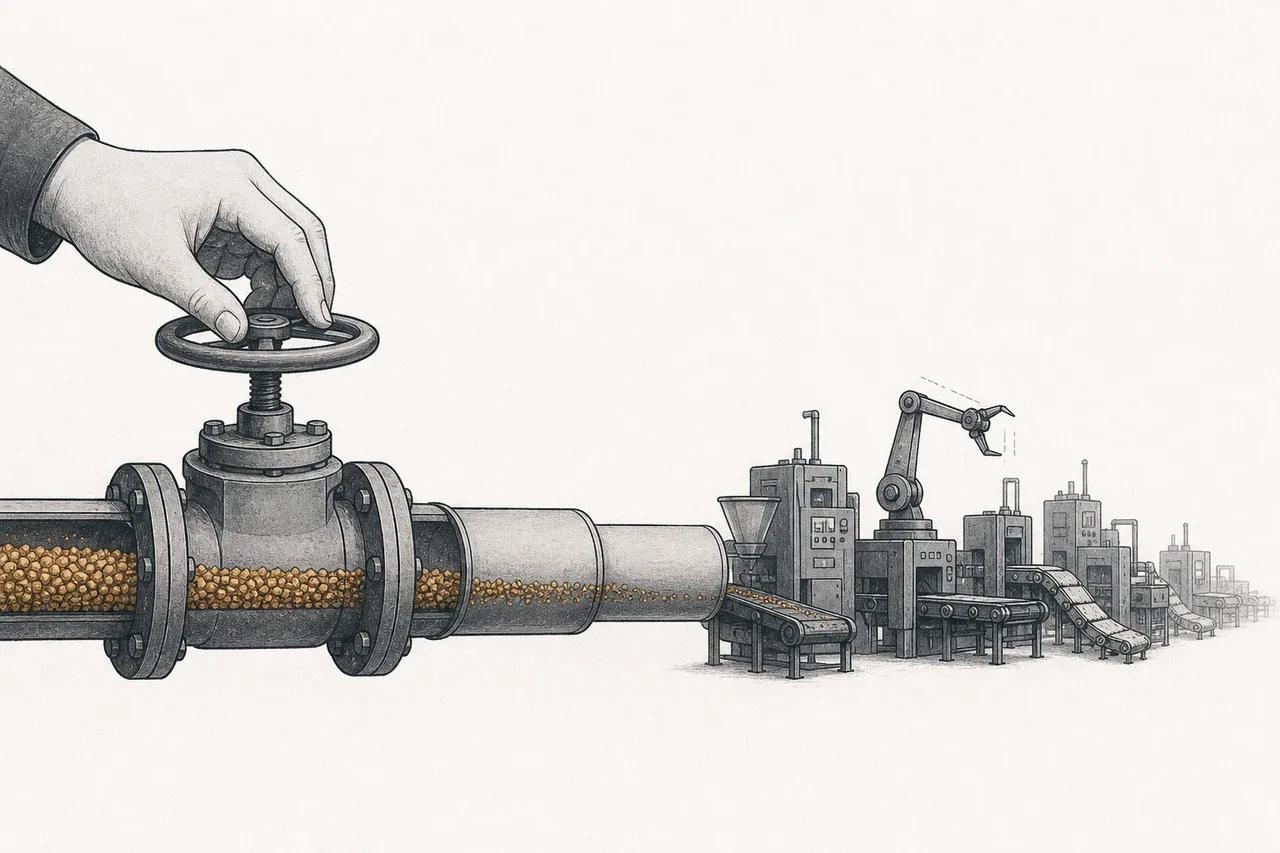
By late 2025, China raised it another notch — expanding the list of controlled elements, and crucially using "extraterritorial" power for the first time: any product made anywhere in the world, if it contains more than a set share of Chinese rare earths, needs China's permission. It mirrors how the US once controlled chips against China — a retaliation of "hitting back with the card you hold." That said, after the China–US leaders' meeting in late 2025, China suspended the October package for one year (until November 2026) — but the "button" is still in China's hand, and the whole world has now seen it really can be pressed.
The West hit back by "building its own supply" in a way it never had before. The deal that shook the industry most was the Pentagon taking a stake in MP Materials in July 2025 — a $400 million preferred-stock investment (about a 15% stake, making it the largest shareholder), plus a 10-year floor price on NdPr at $110/kg and an offtake of 7,000 tonnes of magnets a year. For the US government to "backstop the price" like this is an admission that a pure free market can't beat a Chinese state that's been subsidizing for decades — you have to play the same game.
These are the key players shaping the field:
07The road ahead
The first direction is "building supply outside China, with state backing." The MP–Pentagon model (price floor + long-term offtake) is likely to be copied in Europe, Japan, and India, because everyone has learned that leaving it to a pure free market always loses to a China that's willing to subsidize. Over the next 5–10 years we should see separation and magnet plants spring up outside China — but understand that it's slow and expensive. Getting a refinery actually running takes years and enormous money.
The second direction is reducing reliance on heavy rare earths. Engineers worldwide are designing magnets that use less Dy/Tb (with techniques like grain-boundary diffusion). Some makers are even developing EV motors that use no rare-earth magnets at all (like induction or wound-rotor motors) — but it usually comes at the cost of larger size or lower efficiency. So "breaking the dependence" is possible for some uses, but not a blanket fix yet.
The third direction is recycling. The magnets in old EVs and hard drives are an "urban mine" that's barely been dug. Today only a tiny share of rare earths is recycled (low single-digit percent). If it can be made to pay, it becomes an important supply source outside China in the next decade.
08Challenges & risks
The appeal of this trend comes bundled with risk that's tightly tied to world politics.
The first and biggest risk is the "trade weapon." 2025 proved China is willing to use rare earths as a bargaining tool. Even with some measures suspended for now, the "button" is still in Beijing's hand. This risk isn't on any company's balance sheet — it's on the negotiating table between great powers, switched on and off to the rhythm of politics.
The second risk is violent price swings. This market is small and thin. When China opens or closes the tap, prices can swing several-fold in just months (like when Europe's price jumped to 6 times China's). It's a double-edged sword for producers outside China — a price spike makes new projects viable, but if China "crushes the price" back down (as it has before, to kill rivals), projects outside China can collapse easily — which is exactly why the state has to backstop the price.
The third risk is that building supply outside China is slower than hoped. Announcing a plant is easy. But getting a refinery running at good yield and actually making high-quality magnets takes decades of accumulated know-how that China has and the West threw away. That gap can be closed, but it takes years — and in the meantime the world still has to lean on China.
In short: rare earths & magnets are the story of a few grams of material that hold up the entire electric economy — and of a bottleneck hidden in the middle of the chain, which one country spent decades building into a global bargaining power. To understand why "one small magnet" can stop a whole continent's car factories is to understand why great powers are willing to pour in vast sums to build their own supply — this isn't just a story about minerals, it's a story about power.