Megatrend · Spatial Computing / AR/VR
A screen smaller than your fingernail decides how bright, sharp, and long-lasting your AR glasses are
Inside every pair of AR glasses and every VR headset, there's a screen hidden away that's smaller than your fingernail — it's the "master copy" of every image you see, and it's the part that decides whether the picture is sharp, whether it's bright enough in daylight, and how long the glasses' battery lasts. This lesson digs into that tiny screen, and the three-way fight to become the standard of the spatial-computing era — micro-OLED, with beautiful color but not enough brightness; LCoS, cheap and ready to sell; and MicroLED, the rising star that's a million nits bright but still the hardest of all to make.
01What it is — the tiny screen in the glasses
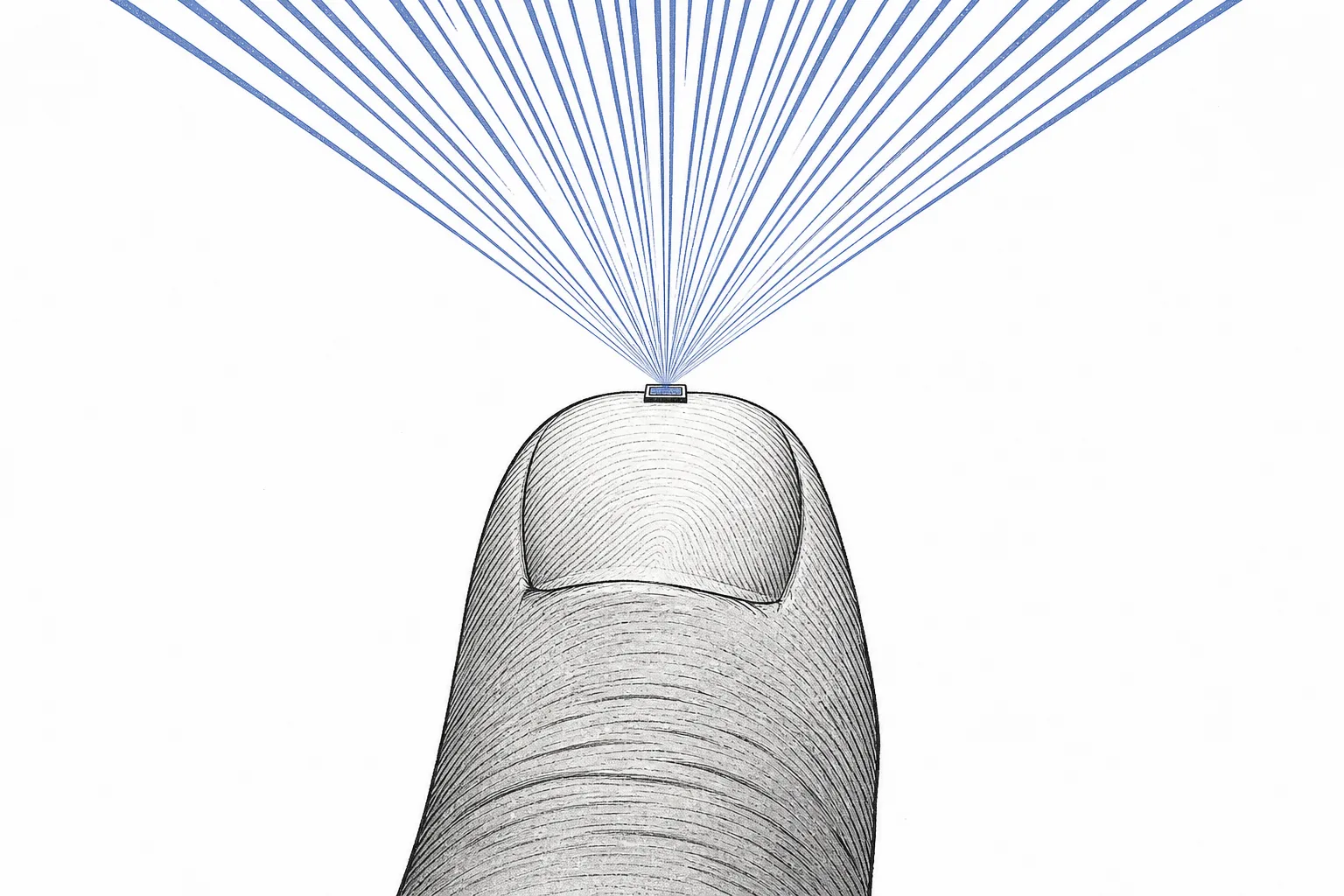
Pick up your phone and look at the screen — about 6 inches wide, around 1,000–2,000 nits bright. Now shrink that whole image down into a screen that's smaller than your fingernail, roughly 0.5–1.4 inches, and put it just a few centimeters from your eyeball. That's a micro-display (microdisplay) — the heart that creates the "master image" in every AR glasses and VR headset.
Because the screen is tiny and so close to the eye, each pixel has to shrink to the micrometer scale (Apple Vision Pro's pixels are just 7.5 microns wide — ten times finer than a human hair). The result: a stamp-sized screen packs in 3,386 PPI, while a flagship phone sits at only about 460 PPI. So a microdisplay isn't a "shrunken screen" — it's a different species of device that has to be built on silicon, like a chip.
Microdisplay = a screen smaller than ~1.5 inches, meant to be viewed through a magnifying lens (near-to-eye), not looked at directly · nit (cd/m²) = a unit of brightness; the higher the number, the brighter — a good phone is ~1,000–2,000 nits · PPI (pixels per inch) = pixel density; the higher, the sharper. A microdisplay needs very high PPI because it's so close to the eye that you'd see every dot.
On the megatrend map, this node is a leaf under Optical & Display Components in the big trend Spatial Computing / AR/VR, with one sibling right next to it: Waveguides & AR Optics. The easy way to tell them apart: this node is "the screen that makes the image," while the node next door is "the glass that carries that image into your eye." This lesson focuses purely on the screen itself; getting the light into the eye (the waveguide) belongs to the sibling node.
02Why it matters — the screen sets everything
People tend to think the heart of AR glasses is the chip or the AI. But the part that actually decides whether the experience is great or broken is this tiny screen — because it's the "ceiling." The image your eye sees can't be any sharper or more beautiful than the quality of the master screen. No matter how good the software is, if the screen isn't sharp enough or bright enough, that's where the picture ends.
And the toughest problem of all is brightness. In see-through AR glasses, the light from the screen has to travel through the light-guiding glass (the waveguide), which lets only a few percent of the light reach the eye. That means if you want the image in your eye to be bright enough to fight daylight, the master screen has to be enormously bright — tens of thousands to hundreds of thousands of nits. This is why "microdisplay brightness" has become the industry's main battlefield, and the deciding factor for whether glasses can really be used outdoors.
Its importance shows in a market that's surging. The whole microdisplay market in 2025 sat at about $1.65 billion and is expected to grow to $5.33 billion by 2030 — about 26% a year on average, with the micro-OLED segment in particular seen by many houses as the fastest-growing. Because it's the part that every pair of glasses, every headset must have, no matter which brand wins.
Another way the microdisplay sets the terms is battery. In thin, light glasses with almost no room for a battery, a screen that has to be tens of thousands of nits bright can become one of the biggest power drains. So a screen technology that's better at "brightness per watt" isn't just about the picture — it's about whether the glasses can be worn all day or have to be charged every hour. And that's why every camp is chasing screens that are bright and power-efficient at the same time.
03How it works — the three-way tech fight
There are three competing ways to create the image in a microdisplay, and what sets them apart is "where the light comes from." Walk through them one by one and you'll understand why none of them wins outright.
The first, micro-OLED — a "self-emissive" screen. Each pixel is a tiny OLED dot that lights up on its own, built on silicon (OLED-on-silicon). The upside: beautiful color, deep blacks, very sharp. But the weakness is limited brightness (just a few thousand nits) and degradation when you push the brightness for long stretches — great for opaque VR, but often not bright enough for see-through AR in daylight.
The second, LCoS (Liquid Crystal on Silicon) — a "reflective" screen. The screen itself doesn't emit light; an external LED shines in, and a liquid-crystal layer on silicon acts as a "switch," turning the reflected light on and off to form the image. The upside: cheap, mature technology, ready for mass production, and you can push the brightness by adding more light — a practical, available-today option for smart glasses.
The third, MicroLED (sometimes called LEDoS) — a "self-emissive" screen like micro-OLED, but using tiny micron-scale inorganic LEDs instead of OLED. The upside: enormous brightness (a million nits), more power-efficient, long-lived, no burn-in — this is the industry's "holy grail," the only answer bright enough for real daylight AR. But it's also the hardest to make (more in the risks chapter).
The heart of this fight is brightness, because it decides whether the screen can be used for see-through AR in daylight. The real numbers make the picture clear: Sony's best micro-OLED screen (the ECX350F) does about 10,000 nits, Himax's front-lit LCoS has shown up to 350,000 nits, while JBD's MicroLED breaks 2 million nits — a hundredfold gap. And that's why MicroLED is called the hope of daytime AR.

04Where it sits in Spatial Computing
The microdisplay doesn't work alone. It's the first part in the glasses' optical chain, and it's inseparably connected to its neighbors, both inside and outside the trend.
- Always paired with Waveguides & AR Optics: the microdisplay makes the master image, then hands it off to the waveguide to carry the light into the eye — these two are one team. And because the waveguide eats over 97% of the light, that's exactly what forces the screen to be enormously bright. The screen and the light-guiding glass have to be designed together
- Built directly on semiconductors: micro-OLED and MicroLED are built on a "silicon backplane" like a chip (the Vision Pro's screen uses a backplane from TSMC) — so the microdisplay is where the display world and the chip world meet, relying on semiconductor fabs to manufacture
- Works with Edge AI silicon: thin, light glasses have to process imagery/AI on-device for speed and privacy. The small AI chip inside the glasses has to feed the microdisplay in real time, so the screen and the AI chip work in tight coordination
- Feeds the whole Spatial Computing trend: every VR/MR headset and every AR smart glasses needs a microdisplay — it's the shared part that no product in this trend can do without
05Where things stand now + the real players (2025–2026)
2025–2026 is when microdisplays began to "split the market clearly" along each technology's strength — and each camp has a real player that owns its lane.
On the opaque VR/MR side, micro-OLED dominates. The clearest example is Apple Vision Pro, which uses a 1.42-inch micro-OLED screen from Sony at about 3,386 PPI (3660×3200 per eye, 23 million pixels across both). Sony is the sole supplier of this screen and dominates the high-quality micro-OLED market with microdisplay revenue of about $0.97 billion, while Korean display giant Samsung Display jumped into the arena by buying eMagin, the U.S. OLED-on-silicon pioneer, for about $218M.
On the AR smart glasses side that needs see-through, the story is different — here LCoS is the one that's "ready to sell today." In September 2025, Meta Ray-Ban Display (priced at $799) launched with a 5,000-nit LCoS screen from OmniVision and a waveguide from Lumus, proving that consumer AR glasses can really be made with LCoS. And Himax is the leader on the AR LCoS screen side; at CES 2026 it showed front-lit LCoS bright to 350,000 nits drawing just 200mW. TrendForce expects LCoS's share to climb to ~13% in 2026.
But the star everyone's watching is MicroLED, led by China's Jade Bird Display (JBD), which showed a full-color screen breaking 2 million nits, began volume production in Q3 2025, and set up a ~$92M production line in Hefei (full capacity 120 million panels a year). JBD is still a private company, like many of the real players in this field. On the stock market, there's both Kopin (the industry's No. 2 in defense/AR microdisplays, ~$180M) and the Taiwanese group Ennostar/PlayNitride, which sit upstream in the MicroLED chain.
06The road ahead
The first direction is MicroLED gradually winning the brightness fight. If makers can solve the manufacturing problem, it'll become the standard for see-through AR glasses, because it's the only technology bright enough for real. The signs are already here: JBD started volume production in 2025 and cut defective pixels from ~100 to ~3 per panel. Even Meta is aiming to ship AR glasses using MicroLED by 2027 — this line is coming, even if slowly.
The second direction is the three technologies coexisting. It's not that one takes it all — each will find its own lane: micro-OLED owns the VR/MR that needs color and sharpness, LCoS owns affordable smart glasses in the near term, and MicroLED gradually takes premium and outdoor AR. The question is when MicroLED will cut costs fast enough to eat into the other two's markets.
The third direction is the smart-glasses wave really arriving — Meta Ray-Ban Display, RayNeo X3 Pro, and several other models make 2025–2026 the turning point when AR glasses leave the lab and land on real people's faces. Every new pair of glasses is a fresh chunk of microdisplay demand, and the thinner and lighter the glasses get, the more the "bright + power-efficient + small" problem pushes screen technology to run faster.
07Challenges & risks
Let's be honest: the microdisplay is a deep-tech that looks great on paper, but still has walls it can't get past.
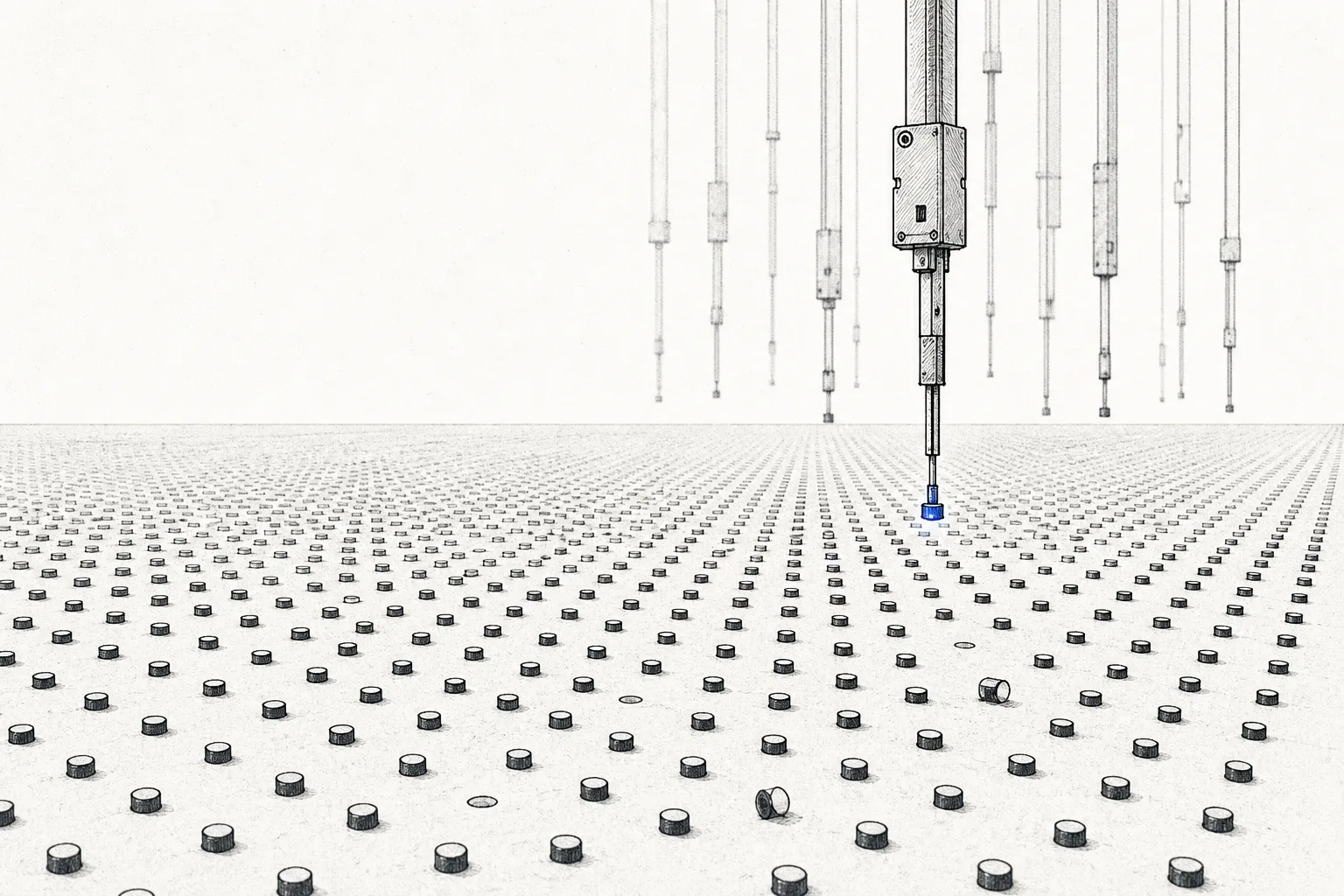
The first risk is MicroLED being enormously hard to make. The big problem isn't brightness, it's "mass transfer" — picking up millions of tiny micron-scale LEDs and placing them on the panel perfectly, every single one. Consumer-grade economics demand a 99.99%-plus yield (good-output rate), which is brutally hard, and making MicroLED red bright and stable is still an unsolved problem. This isn't a "done in six months" issue — it may take several more years.
The second risk is the market still being small and tied to AR that's coming slowly. The whole microdisplay market today is still only around $1.65 billion in size, and every growth projection rests on the assumption that AR/VR glasses will catch on — which has been pushed back several times. If consumers still don't bite, microdisplay demand grows slower than the dream.
The third risk is fierce competition with the real players off the stock market. This field has three technologies competing at once, so betting on the wrong one is a risk in itself. On top of that, several holders of key technology (like JBD, the MicroLED leader) are still private companies, making it hard for retail investors to reach the real players — and the accessible public names are often display giants for whom microdisplays are just one part of the business.
In short: the smallest thing in the glasses — a screen smaller than your fingernail — turns out to be the part that decides everything: the sharpness, the brightness, and the battery life. Whoever can make a screen that's bright, sharp, and power-efficient all at once in that tiny thing is the one who holds the quality ceiling of the whole spatial-computing trend.