Megatrend · Spatial Computing / AR/VR
The thin glass that "floats" an image in front of your face — the hardest, priciest part of AR glasses
The dream AR glasses need a crisp digital image floating right in front of your face while you still see through to the real world — and the thing that does this is a sheet of clear glass about 1 millimeter thick called a waveguide. It takes the image from a tiny display hidden in the temple, then bends the light around and releases it exactly at your eye. Sounds simple, but this is the part with the lowest yield, highest cost, and hardest manufacturing in the whole pair of AR glasses — the waveguide lens alone once made Meta Orion cost about ~$10,000 per unit to build. This lesson drills into the "light-guiding optics" specifically; the "display that makes the image" is the story of its sibling next door, Micro-Displays.
01What it is
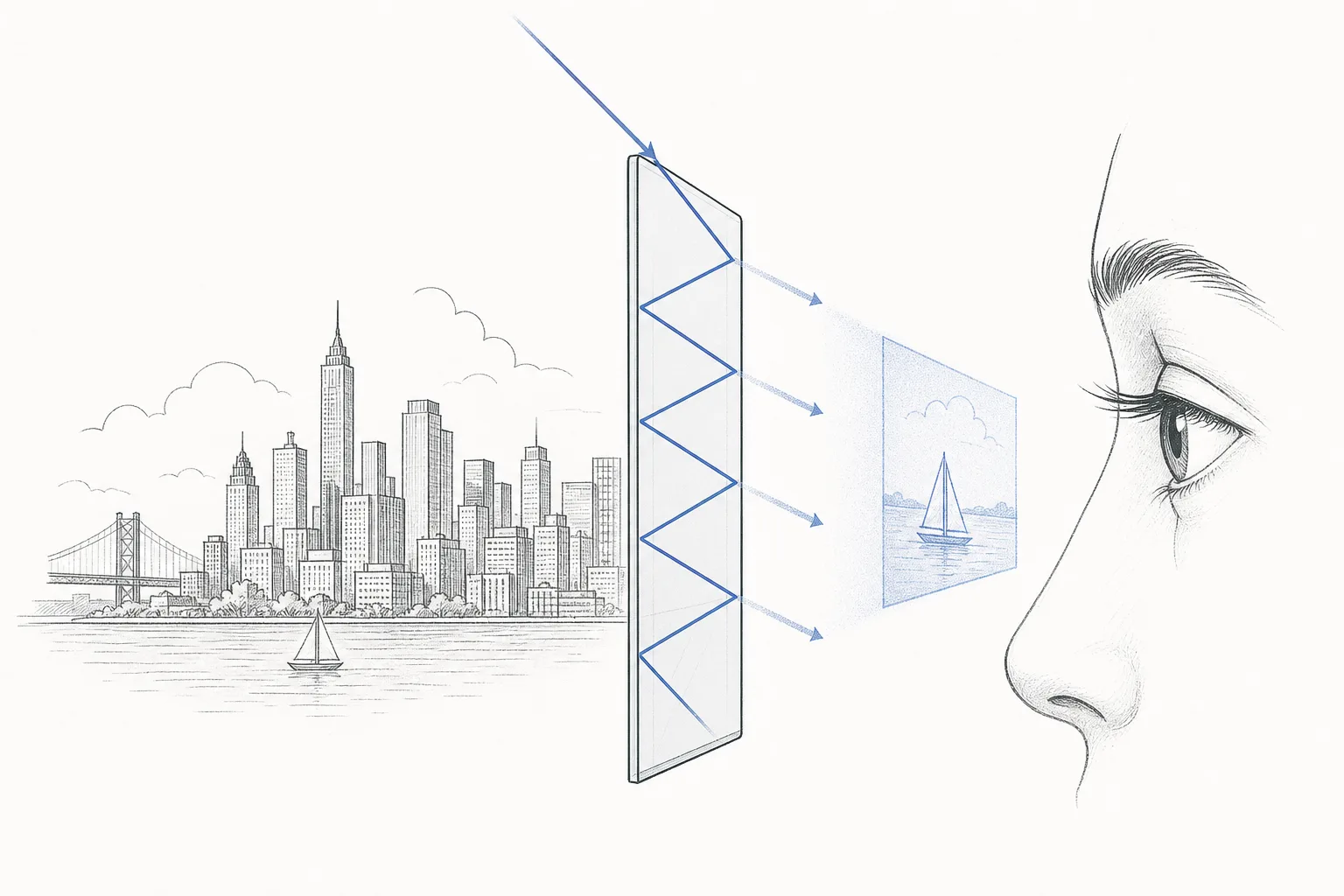
Picture AR glasses as thin as sunglasses, but with a digital image — a map, text, a cartoon character — floating over the real world in front of you. The hardest question isn't "how do you make the image," it's "how do you get that image right in front of your eye, inside something thin and clear that you can still see through". The answer is a part called the waveguide — a sheet of clear glass about 0.7–1 millimeter thick that acts as a "light pipe," carrying the image from a tiny display hidden in the temple and bending it around to come out exactly in front of your face.
The heart of this idea is separating where the "display" lives from your "eye". Instead of putting the display in front of your eye (which would block the real world and make the glasses bulky), engineers tuck a tiny display at the edge of the temple, then "shoot light into the glass" so it bounces back and forth inside the sheet until it reaches the eye, where it finally leaks out — the result is glasses that look like ordinary clear lenses but have an image floating in the middle.
On the megatrend map, this node is one of the deepest branches — a leaf — sitting in the supply-chain layer of Optical & Display Components, under the bigger trend Spatial Computing / AR/VR. It has a paired sibling with a different job: Micro-Displays is the "tiny display that makes the original image," while this node is the "optics that carry that image to your eye" — the two always have to work together. This lesson focuses only on the latter.
Waveguide = a thin clear sheet that "guides" light internally by reflection — in AR glasses it's the part that carries the image from the edge to your eye. · Combiner = a name for its job: to "combine" the digital image with the real world so they overlap in a single eye. · See-through = the property of still being able to see through to the real world, unlike VR glasses whose opaque screen blocks everything — see-through is exactly what makes a waveguide far harder than VR optics.
02Why it matters — the priciest bottleneck
If you had to point one finger at the single part keeping dream AR glasses from finally shipping at a consumer price — that finger lands on the waveguide almost every time. It's the hardest to make, the most expensive, and the lowest-yield part of the whole pair. The clearest evidence is Meta Orion, the prototype AR glasses Meta showed off in late 2024 — Meta itself admitted the waveguide lens was the "most expensive part" and the main reason Orion cost about ~$10,000 per unit to build, so Meta made only around 1,000 of them for internal use and demos, never selling a single one.
Why so expensive? Because a waveguide has to etch nanometer-scale grooves into a sheet of glass accurately and uniformly across the whole sheet, and still make the image bright enough, sharp enough, and free of rainbow-color artifacts — all in something razor-thin that can be mass-produced. One small slip and the whole sheet is scrapped. For silicon-carbide waveguides (the kind Orion uses), yield is still below 20% right now — meaning fewer than 2 out of every 10 you make are usable, and the rest become wasted cost.
This market is genuinely "important," but let's be straight: today it's still small — the AR waveguide market is only at the low single-digit billions and growing fast (mid-range estimates around 22–23% a year), but everything is tied to how quickly consumers accept AR glasses. The diffractive waveguide segment alone (the type with the best shot at reaching consumer prices) was worth about $300M in 2023 and is expected to hit ~$1B by 2030.
This makes the waveguide a deep "pick-and-shovel" investment — not a bet on which brand of glasses wins, but a bet on the "seller of picks and shovels" that every brand has to buy from. Anyone making AR glasses has to lean on the handful of specialists who hold the patents and the manufacturing know-how that's extremely hard to copy.
03How it works — light traveling to your eye
Let's trace, step by step, how the image travels from the tiny display in the temple to your eye. The path has four key points, and every one of them is where light "leaks away" until the image fades.
Step one: the tiny display in the temple shoots the image as a beam into the edge of the glass, where it hits an etched in-coupling grating. This groove bends the light to travel inside the glass at just the right angle. The mechanism that keeps the light from escaping out the sides along the way is a phenomenon called total internal reflection — TIR: light traveling at the right angle reflects back into the glass every time it hits a surface, like a ball bouncing through a pipe without slipping out the side, until it reaches the out-coupling grating at the eye position, which pulls the light out toward your eye — perfectly overlaid with the real-world image coming through the glass.
It sounds elegant, but the devil is in the details. Every time light bends through a grating it loses a huge amount of energy — this is why a waveguide's light efficiency ends up at just a few percent (over 95% of the display's light is lost along the way), and exactly why the Micro-Display has to be enormously bright to compensate. Worse, because the grating bends each color (red/green/blue) at a different angle, you get a "rainbow artifact" disturbing the image and "eye-glow" — some light leaks outward so the person in front of you sees a glow at your eyes. These three (light loss, rainbows, eye-glow), plus making the nano-grooves uniform, are the wall the whole industry is hitting.
There are two camps of waveguide built on opposite philosophies. · Diffractive uses nano-grooves etched on glass to pull the light — made with a process similar to semiconductors, so it's very thin (each color layer under 2 mm) and has a hope of getting cheap at volume, but its efficiency is low and it has rainbow artifacts. · Reflective / geometric (like Lumus's) embeds tilted mirrors in layers inside the glass — brighter, more color-accurate, no rainbows, but thicker (around 6–12 mm) and needing high-precision assembly, so it's expensive. This is the central trade-off of the industry: cheap-and-easy-to-make vs bright-and-good-color.
04Where it sits in the value chain
The waveguide doesn't stand alone — it's a convergence point that has to take things from the layer above, hand the image to the layer below, and depend on special materials from another trend. Let's see who it's tied to:
- Always receives the image from Micro-Displays: the waveguide doesn't "make" the image — it just "carries" it. The tiny display (micro-OLED / LCoS / microLED) creates the original image, and the waveguide takes it and delivers it to the eye. These two are always designed together, and because the waveguide throws away over 95% of the light, the display has to be enormously bright — the challenges of both sides are tightly linked
- Depends on materials from Semiconductor Materials: the waveguide itself is a special material — high-index glass (from Corning, SCHOTT) or optical-grade silicon carbide (SiC). The higher the refractive index, the wider the field of view you can get in a single sheet, so this node's competition is tied directly to materials progress
- An optical component alongside Interconnect & Passives: the glasses contain several other optical and passive components (projection lenses, color combiners, anti-reflective coatings) that have to be assembled with the waveguide so the light travels precisely — this is the science of high-precision optical assembly
- Feeds the entire see-through AR glasses industry: the end customers are glasses makers like Meta, Snap, RayNeo, XREAL — anyone making thin, light AR glasses has to buy waveguides from the specialists. And it runs further into AI, which makes these glasses "smart" enough to be worth wearing
05Where it stands now
2025–2026 is when the waveguide started leaving the lab and landing on real glasses. The clearest signal is Meta Ray-Ban Display, the 2025 glasses using Lumus's reflective waveguide — the first time a geometric waveguide proved it could be mass-produced in a consumer product. And at CES 2026, Lumus became the first to unveil a waveguide pushing the field of view past 70°. On the China side, glasses like RayNeo and XREAL use diffractive waveguides, steadily pushing brightness up and suppressing rainbow artifacts.
The competitive map splits clearly into two camps. The reflective side is led by Lumus (the brightest and most color-accurate, claiming several times the efficiency of diffractive), while the diffractive side has DigiLens, Dispelix, and WaveOptics (bought by Snap for its Spectacles), competing on light efficiency per lumen and on suppressing eye-glow — with Corning and SCHOTT supplying the high-index glass and EVG making the nanoimprint machines that etch the grooves.
But here's the honest part: the players holding the most important IP in this layer are mostly still private companies that aren't on the stock market — Lumus, DigiLens, and Dispelix are all still private. The ones that are public are usually optics giants where AR is just one part of the business (lenses/glass/modules), or glasses makers who buy waveguides to assemble. So we arrange the players by their role in the value chain rather than by raw market cap.
06The future — the silicon-carbide era
The biggest change to the waveguide industry in years came when Meta showed Orion: switching the material from glass to silicon carbide (SiC). The reason comes down to a single number — the refractive index. SiC is around 2.7, versus about 1.8–2.0 for glass. The higher the value, the more it "traps" light to reflect inside the material at a wider angle. The result: Orion achieved a 70° field of view with a single waveguide, where normally you'd have to stack several. And because it's a single sheet, it eliminates almost all the rainbow artifacts and eye-glow that plague glass waveguides — a 2025 study reported a full-color, single-layer SiC waveguide weighing just ~3.8 grams and only 0.75 mm thick.
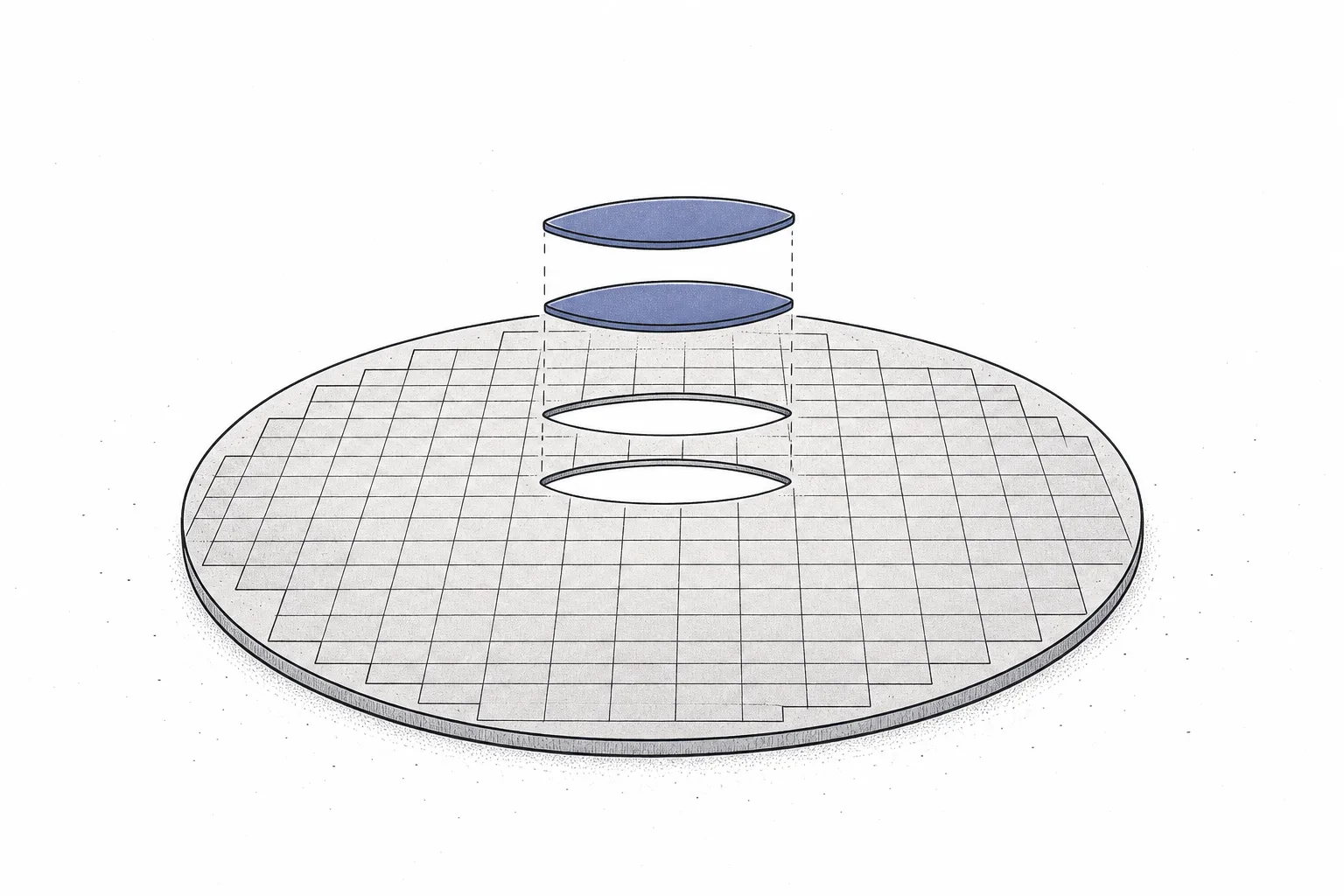
The second direction is relentlessly driving SiC cost down. Today a SiC waveguide is still expensive — about ~$1,000 per unit, with high-purity SiC material accounting for ~40%, and a sub-20% yield wasting another ~$500 per unit. The way out is scaling up the wafer — in 2025, 6-inch SiC wafer capacity reached half a million wafers a year and pilot 8-inch lines started running. A 6-inch wafer makes about 2 pairs of glasses, an 8-inch one makes 3–4. Moving to 8-inch after 2026 is expected to cut material cost by about 30%, and wafer-scale production could cut per-unit cost by over 50% by 2030.
The third direction is China accelerating its investment in optical SiC materials. In late 2025 came an announcement to build a 12-inch-grade optical SiC production base in Guangdong (Kuotan Semiconductor's project, worth about 1.15 billion yuan, targeting 200,000 wafers a year). Meanwhile Chinese SiC makers like SICC have shown 300mm optical wafers, and suppliers like Tianyue and Coherent are reported to have won waveguide orders for the 2026 production version of Orion — making SiC materials another battlefield where China is accelerating fast.
The fourth direction is the two camps coexisting: reflective (bright/color-accurate/expensive) for premium and military uses, and diffractive — especially on SiC (thin/wide-angle/made like semiconductors) — for consumers. No one "solves it all" across every dimension, but every year it gets good enough to make the glasses more genuinely usable.
07Challenges & risks
Let's be straight: the waveguide is deep-tech that's "beautiful on paper" but still has walls that haven't been knocked down.
The first risk is low yield and high cost — etching nano-grooves uniformly across the whole sheet is enormously hard, especially on SiC where yield is still below 20%. This isn't a "done in another six months" problem; it's a physics and manufacturing-engineering challenge that could take several more years. As long as waveguide cost stays at hundreds to thousands of dollars per unit, AR glasses will remain too expensive to be a mass consumer product.
The second risk is image quality that's still imperfect — low light efficiency (only a few percent reaches the eye) makes the image fade in bright conditions and forces the display to be so bright it drains power. Rainbow artifacts and eye-glow, though reduced, aren't gone, especially in traditional glass diffractive waveguides. Getting "wide field of view + bright + no rainbows + thin and light + cheap" all at once is still a problem no one has fully cracked.
The third risk is a small market with IP concentrated in private hands. Today's waveguide market is still small, and every growth projection rests on the assumption that consumer AR glasses will arrive — something that's been pushed back several times already. On top of that, many of the real technology holders (Lumus, DigiLens, Dispelix) are still private, making it hard for retail investors to reach the real winners. And the risk of a portfolio invested in public names (which are usually side businesses) may not reflect the true winners of this layer.
In short: the problem that sounds the most basic — getting a sharp, bright-enough image to float right in front of your face, inside thin clear glass you can still see through — turns out to be the wall that's blocked dream AR glasses for years. Whoever knocks down this waveguide wall holds the key to the entire Spatial Computing trend.