Megatrend · Brain-Computer Interface
The brain murmurs across millions of channels — who translates it into meaning?
When we talk about the "brain chips" from Neuralink or Synchron, we usually picture the hardware that gets implanted. But the hardest part — and the real wall that keeps rivals out — is the software that translates the messy electrical waves from thousands of neurons into intent: speech, moving a cursor, controlling a robotic arm. This node is the "brain of BCI" layer — the AI-powered decoder, plus the brain-mapping tools building the map of which circuit does what. This is where AI meets neuroscience.
01What it is
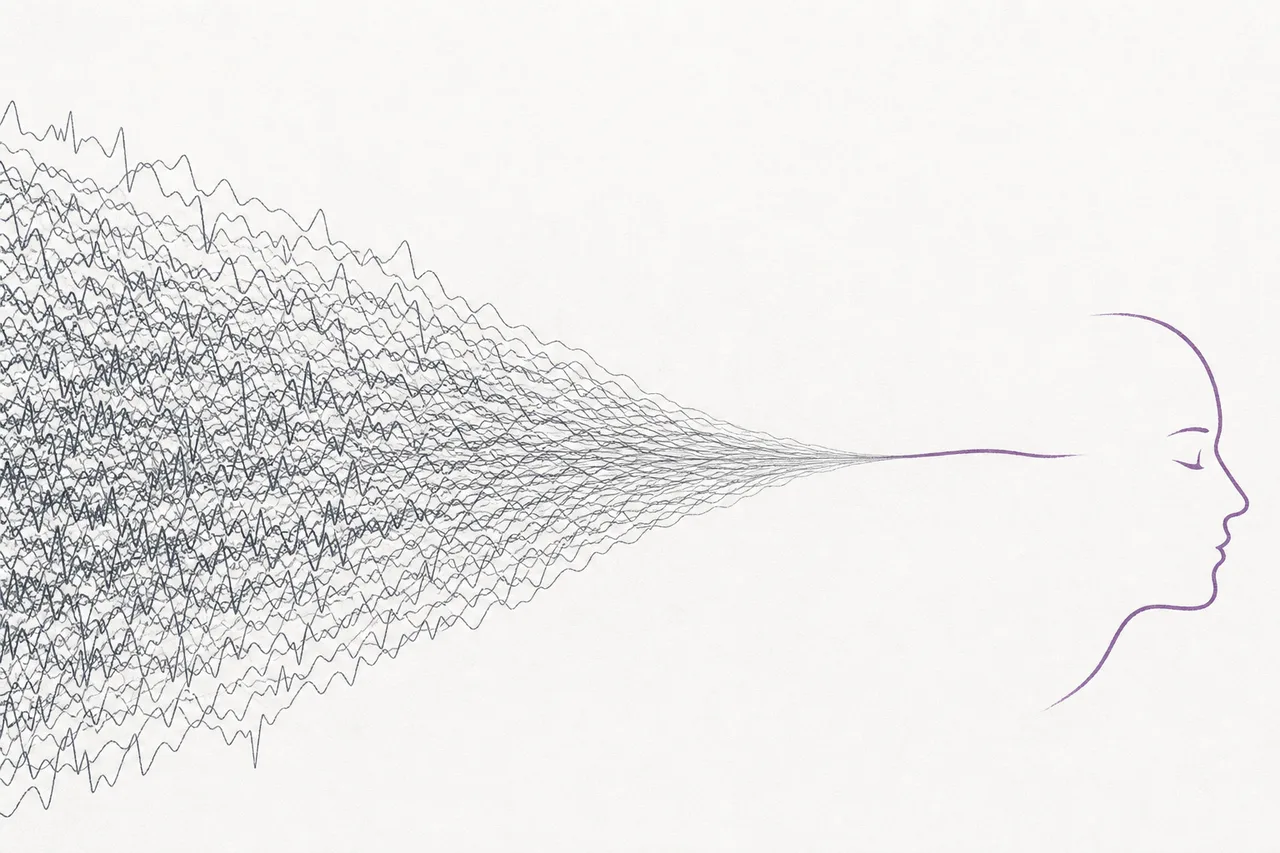
Picture yourself standing in the middle of a stadium with thirty thousand people shouting at once, and someone tells you to "listen to what the lady in row 12, seat 7 is saying." That's the problem a BCI system has to solve every millisecond. Your brain has about 86 billion neurons firing electrical signals all the time. When you implant an electrode, it doesn't receive a "command" as text — it receives electrical waves all jumbled together from thousands of channels.
This node — Neural Signal Processing & Brain-Mapping Tools — is the layer of software and tools that turns that raw signal into meaning. It's a sub-field under the megatrend Brain-Computer Interface, sitting in the "infrastructure" layer — the foundation every BCI system has to lean on, whether implanted in the brain (invasive) or stuck on the outside of the skull (non-invasive). It splits into two big, intertwined parts:
- Signal processing + the decoder: software that cleans up the signal, sorts out which cell fired when (spike-sorting), then uses Machine Learning to learn which wave pattern = which intent. This is the "translator"
- Brain-mapping tools: high-density probes (like Neuropixels), two-photon microscopes, and MRI/connectomics that build the "map" of which circuit does what — surveying the territory before anyone can lay roads on it
A math/AI model that learns to match "the firing pattern of neurons" to "what the user intends to do" — like wanting to move the cursor right, or to say the word "water." It's the heart of every BCI — and the hardest part to copy, because it has to be trained on a massive amount of real brain data.
An important point people often get wrong: this node's definition makes it clear that BCI is just a small slice of this market. Most of the market is neuroscience research instruments sold to universities and pharma companies — that market already makes money today, while the BCI side is just getting started.
02Why it matters — this is the "brain" of BCI
There's one line that explains it best: the hardware is what you see, but the algorithm is what you're buying.
When Neuralink unveils a chip with thousands of electrodes, people get excited about the chip. But the reality is, even if the implanted electrodes pull in plenty of data — decoding it raw gives you an error rate as high as ~40% on communication tasks, which simply isn't usable. What makes it work is a "translator" that's smart enough. In May 2025, Neuralink even brought in a large language model (xAI's Grok) to help guess words, dropping the error rate on a limited vocabulary to under 10% — in short, generative AI is now doing real work in the brain-decoding pipeline.
On market size, you have to draw the line clearly. The whole neuroscience research instruments market (including instruments, brain imaging, and chemicals) is worth about $41 billion in 2026 and is expected to grow to ~$55 billion by 2031 (CAGR ~6%). The hottest-growing part is brain-mapping tools and specialized microscopes, growing 10–13% a year — this is the part that "collects money today," while the BCI decoder side is still an investment for the future.
03How it works — from noise to intent
Let's follow the path a signal takes, from when it's just a jumble of electrical waves to the word "hello" on a screen. There are 4 main checkpoints:
The first checkpoint is the raw signal — like a blurry photo full of noise. The second is spike-sorting: the computer looks at the waves and decides "did this spike come from cell A or B?" Today, standard software like Kilosort4 (the default since late 2024) does this automatically. The third checkpoint is the decoder — an ML model that learns which firing pattern means what. And the fourth is the output: speech, a cursor, or commands to a robotic arm.
Neurons communicate with "spikes" — short electrical pulses. When one electrode picks up several nearby cells at once, the signals mix together. Spike-sorting is the work of separating which cell each pulse came from. Think of transcribing a meeting recording where people talk over each other, then identifying who said which sentence.
A number that makes it vivid: a 2025 study decoded "attempted speech" at 62 words per minute — 3.4× faster than the previous record, and getting close to natural conversation speed of about 160 words per minute, with a 9.1% error rate on a 50-word vocabulary. But it jumped to 23.8% once the full 125,000-word dictionary was opened up — this pair of numbers tells an important truth: on a narrow task it's already good, but on an open-ended one there's still a lot of work to do.
04The other half: brain-mapping tools
A decoder can only get good once we know "which circuit does what" first — and that's the job of brain-mapping tools. Think of it simply as Google Maps for the brain: before you can navigate, someone has to go out and survey and draw the map.
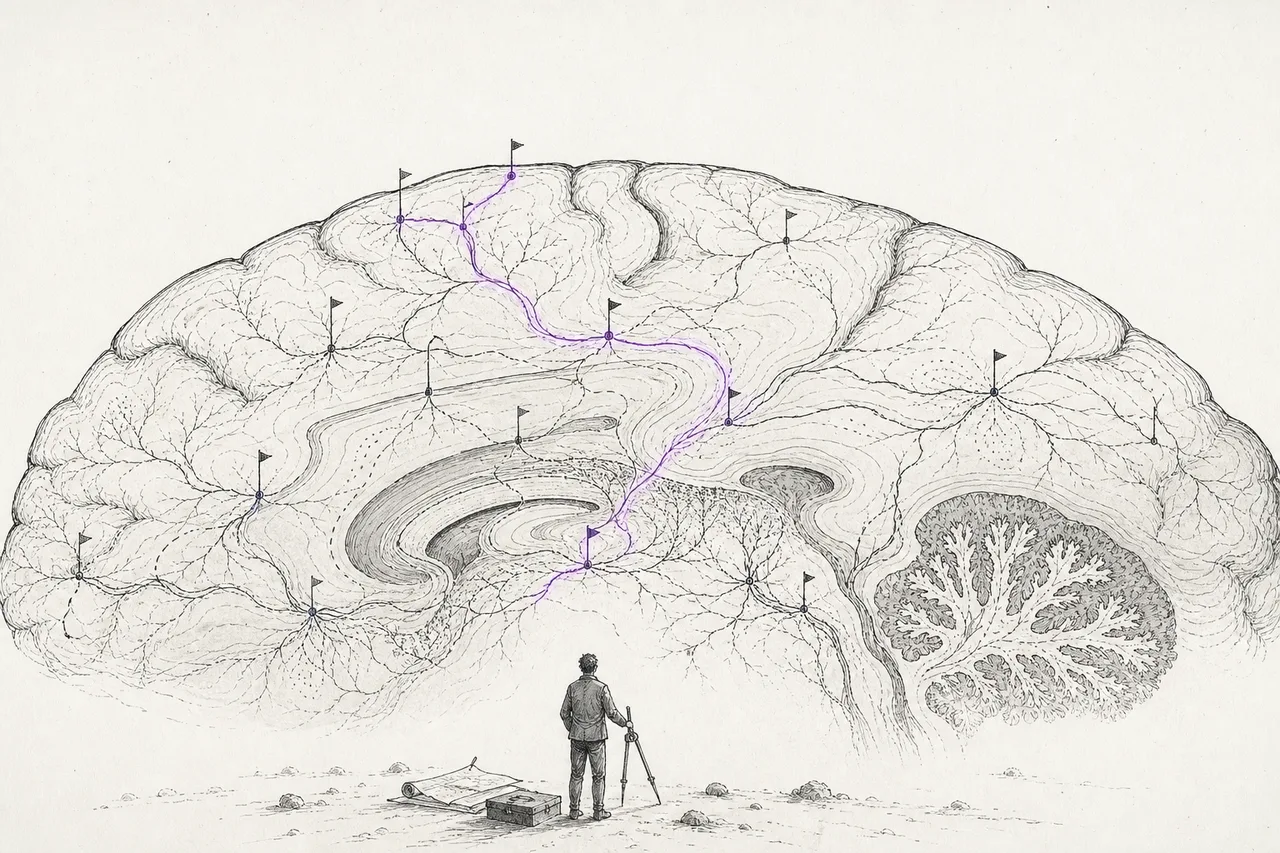
There are three main families of tools:
- High-density probes: the standout is Neuropixels, developed by the IMEC research center. The 2.0 version has 5,120 recording sites per probe (4 shanks), reads 384 channels at once, and can record hundreds of neurons simultaneously and stably over long periods — a tool that changed how brain research is done
- Two-photon microscopy: peers at neurons actually working while alive. In April 2025, Bruker just launched the miniature nVista 2P in its Inscopix line
- MRI and connectomics: build a wiring map of the whole brain. The U.S. BRAIN Initiative just released the highest-resolution map of brain tissue ever, recording cell-level connections at about 150 million junctions
Mapping which other cell each neuron connects to — like diagramming a whole city's wiring down to each individual wire. The ultimate goal is the "connectome," the connection map of the entire brain — which, for a human brain of about 200 billion cells, is still a very distant goal.
Here's a point to watch: the public funding that feeds this basic research is being cut — the BRAIN Initiative came to $321 million in FY2025, down from $402 million the year before, or about 20%. It's a reminder that the research-instruments side leans heavily on government budgets, and doesn't always grow in a straight line.
05Where it sits in the BCI ecosystem
This node is the "middle layer" everything has to run through. Let's see how it connects to its neighbors:
- Receives signals from Invasive BCI Systems: the implanted chip collects raw electrical signals and passes them to this layer to translate — hardware and software are partners that can't do without each other
- And from Non-invasive BCI: the stuck-on-the-outside type (EEG) gets a blurrier, noisier signal, so it leans even harder on strong signal processing
- Leans deeply on Artificial Intelligence: modern decoders are ML models, and lately they've started borrowing Foundation Models to help guess intent — both Synchron and Neuralink are walking this path
- Complements Biotech & Genomic Medicine: understanding brain circuits helps both treat neurological disease and develop drugs
The most interesting part is the relationship with AI — it's a two-way street. On one side, AI makes the decoder better; on the other, brain data is becoming the fuel to train new AI. In 2025, research even proposed training a foundation model directly from human brain data. This is where neuroscience and AI truly fuse.
06Where it stands now
The 2026 picture has two very different worlds. The first is research instruments that make real money today — giant scientific-instrument companies selling microscopes and recording systems to labs worldwide. The second is the BCI decoder, advancing fast but mostly still private companies or inside university labs.
The most important milestone of the year is Synchron unveiling Chiral, billed as the first "brain foundation model" — trained directly from brain data, running on NVIDIA's technology (Holoscan) to decode in real time. It drives home the point that "the decoder is the product."
07The road ahead
The first direction is brain foundation models — instead of training a new decoder every time for each patient, the goal is to build a large model that "understands the brain in general" first, then fine-tune it for an individual quickly — like the way ChatGPT is trained once and works for everyone. Synchron's Chiral is the first step of this idea. If it works, it sharply cuts setup time and boosts stability.
The second direction is more stable decoding. One of the advances seen as most important to the field in 2026 is a technique to quickly recalibrate the decoder with just a little calibration data each day, instead of retraining the whole thing — solving a problem that has held this field back for a long time.
The third direction is research tools getting finer and cheaper. Probes like Neuropixels and miniature two-photon microscopes put high-end technology within reach of small labs. The more good-quality brain data there is, the better the decoder gets — a reinforcing loop between the mapping tools and the decoder.
08Challenges & risks
Let's be honest: this node is full of challenges that haven't been solved.
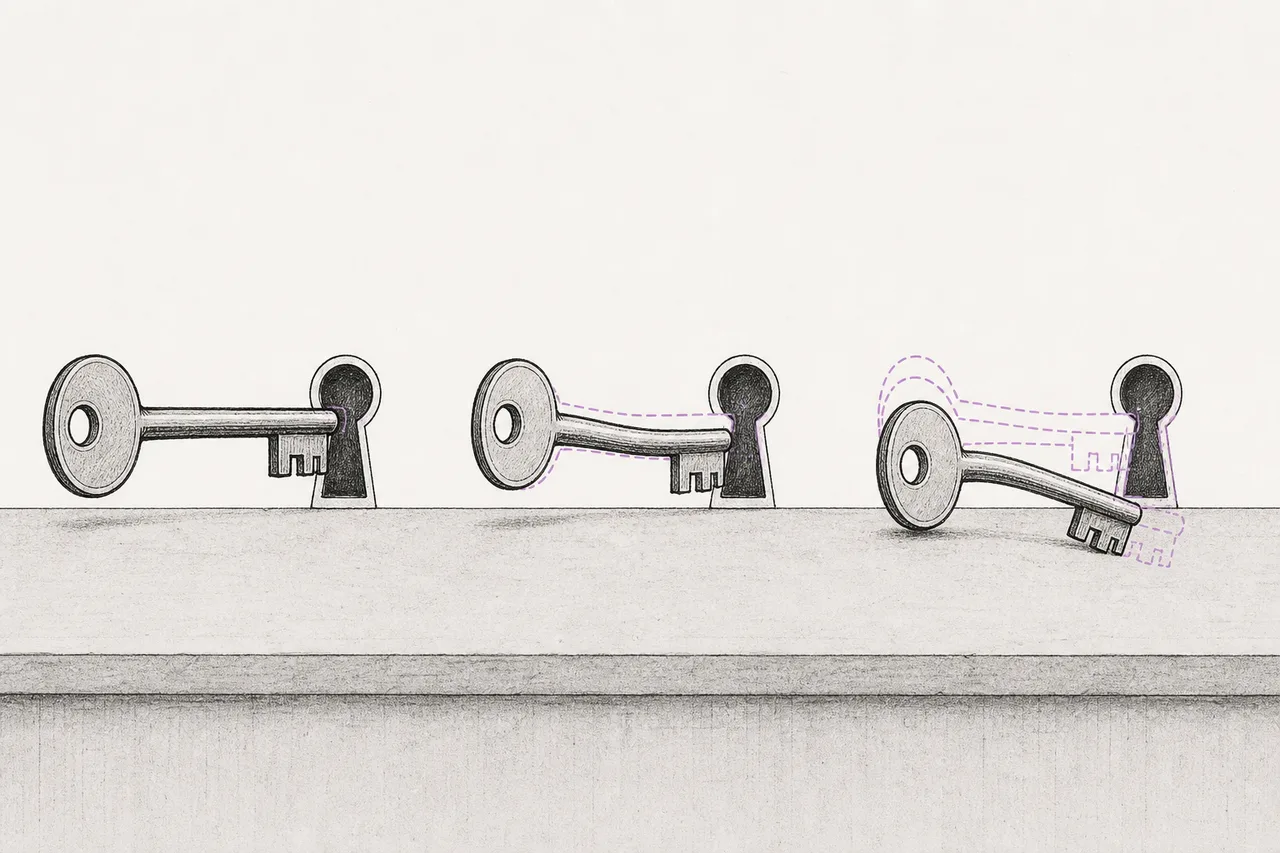
The first and biggest risk is "decoder drift" (neural drift). The brain isn't a static machine. The signal changes every day — from electrodes shifting, cells changing behavior, or recording conditions changing. The result: a decoder that was accurate yesterday may drift today. Research calls the need to retrain the decoder every day the "main factor limiting real clinical use" — it sounds like a small technical detail, but it's really the biggest wall.
The second risk is generalization. As the numbers show, the decoder is very good on a narrow task (50-word vocabulary, 9.1% error) but the error rate jumps to 23.8% once you open the full vocabulary. Making it work in genuinely open-ended situations is still a hard problem.
The third risk is that it's still mostly academic and private. The best decoders are inside university labs or private companies that haven't gone public. Most of the players on the stock market are on the instruments side, which grows slower and leans on government research budgets — which were just cut about 20% in 2025.
In short: when you see the news that "a disabled person moved a cursor with their thoughts," the unseen hero is this software layer — the one that translates thousands of channels of electrical chaos into intent, and the one building the map of how the brain works. It's where AI meets neuroscience, and where BCI's real contest will be decided — not at the chip, but at the translator.