Megatrend · Brain-Computer Interface
Reading the brain without surgery — the side ordinary people can actually touch
If implanted BCI is "opening the skull to hear brain cells clearly," this side is the opposite: you wear a headset or earbuds, stick sensors on the outside of your scalp, and quietly listen to the brain's faint electrical waves through the "wall" of the skull. Safe, cheap, sellable by the millions — but the signal is blurry, so all it can do is read "rough states" like focus or stress, not read thoughts word by word. This is the story of the mass-market side of neurotech, and the thin line between the real thing and selling a dream.
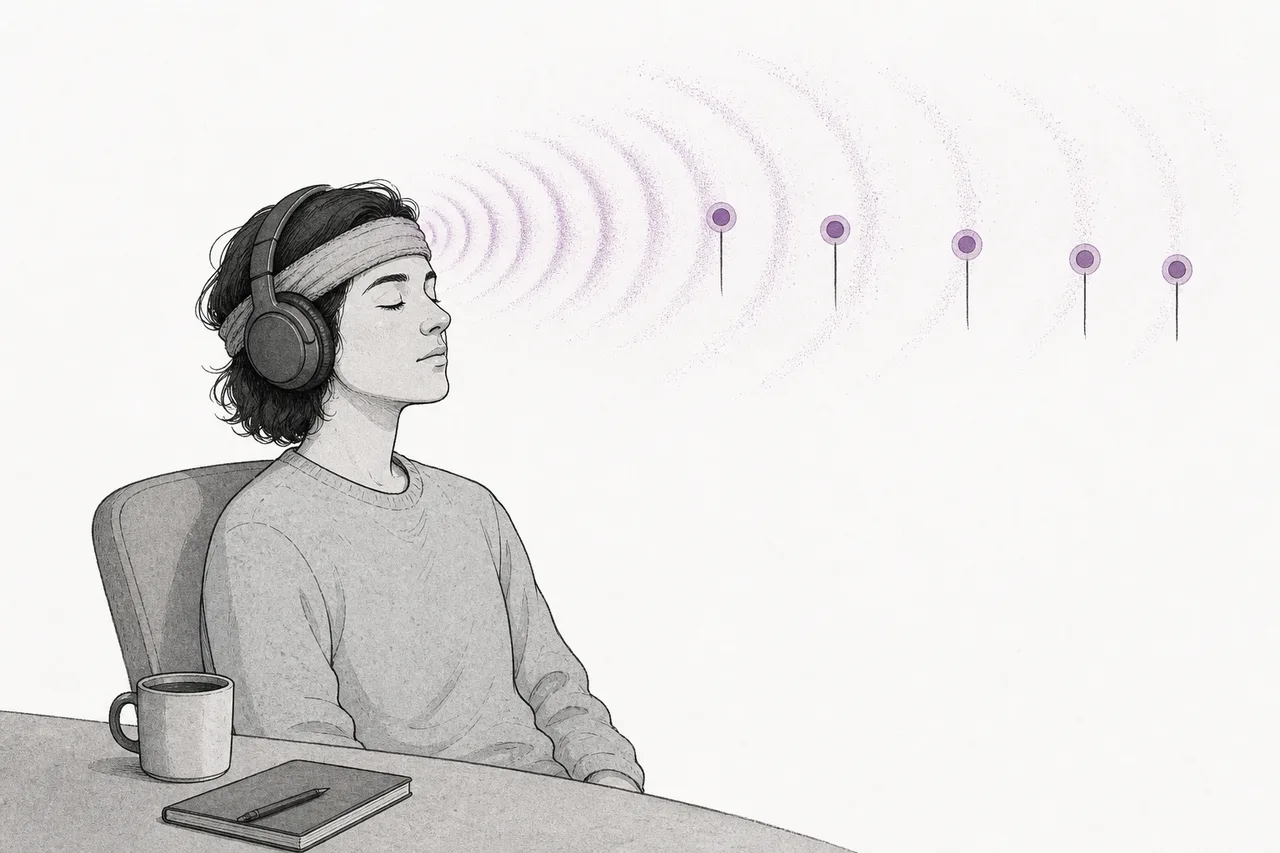
01What it is
Our brains run on electricity. Billions of neurons are constantly "firing" at each other, and their combined electrical waves leak out to the scalp just a little. The question is: can we read them without surgically implanting electrodes into the brain like Invasive BCI?
Non-invasive BCI & Neurotech is the answer: "yes, but you have to accept it's rough." It's the group of devices that read brain signals from outside the skull — sensors stuck on the scalp, built into headbands, caps, or even earbuds. There are two lead technologies: EEG (reading electrical waves) and fNIRS (reading the flow of oxygen in the brain's blood using infrared light), plus a new breed that uses sound waves (ultrasound). This is the side of neurotech that's "safe, cheap, and sellable to ordinary people" — unlike the implant side that needs brain surgery.
EEG (electroencephalography) reads the brain's electricity directly — very fast (responds in milliseconds) but locates things only roughly. fNIRS (functional near-infrared spectroscopy) shines infrared light through the thin skull and measures the oxygen in the blood the brain uses — locating things a bit better, but slow (blood flow trails thought by seconds). Both read from outside the skull, so they hit the same problem: the skull blocks the signal.
On the megatrend map, this node is a branch of Brain-Computer Interface and the "opposite side" of Invasive BCI on the same line — a line where one end is "safe but blurry" and the other is "sharp but needs surgery." This node stands on the safe side, and because of that it's also the side with the largest market by volume in the entire BCI field.
02Why it matters
The first reason is straightforward: no one will get brain surgery to play a focus app. Implanting electrodes into the brain is worth it only when you're paralyzed and want your life back. But for the billions of "normal" people, the only way neurotech reaches them is the painless way. That makes the non-surgical side the one and only door to this field's "mass market."
The numbers make this clear: non-surgical BCI holds about a 62% share of the entire BCI market in 2026 — the largest of any type, because it's the side that can actually sell today, not the one waiting years for the FDA to approve brain implants.
But you have to separate the "two markets" stacked under the word neurotech. One is the consumer market (meditation headbands, focus-measuring earbuds) — flashy but small and hard to prove revenue. The other is the medical EEG device market (hospital brain-wave machines, epilepsy diagnosis, ICU monitoring) — far larger. It uses the same outside-the-skull brain-reading technology, but actually makes money and has public companies. The medical EEG device market sits at about $4.9 billion in 2025 — several times bigger than the consumer side.
03How it works
The mechanism has three beats: (1) catch the signal from outside the skull — scalp sensors pick up electrical waves (EEG) or measure oxygen in the blood (fNIRS) · (2) decode it with ML — AI models learn which wave patterns correspond to which "state" · (3) output the result — as rough values like focus level, stress, sleep quality, or a few simple commands.
The heart of this whole lesson is in that first beat, and in one single barrier: the skull. The electrical signal from brain cells that reaches the scalp is very faint — just 10–100 microvolts (millionths of a volt) — and by the time it passes through brain tissue, cerebrospinal fluid, skull, and 2–3 cm of scalp, it's been "smeared" into a blur. So one sensor isn't listening to a single cell, it's listening to the average of brain tissue across a 1–3 cm area. This is the fixed ceiling of the non-surgical side.
The "decode" beat is where this trend is inseparably tied to artificial intelligence and neural signal processing — because the raw signal is so blurry, all the heavy lifting falls on the AI that has to distill "signal" out of "noise." The smarter ML gets, the more the non-surgical side can wring out of a lousy signal. That's why many of these companies call themselves AI companies rather than hardware companies.
04Where it sits in BCI — the safe/mass side
The easiest way to understand this node is to set it beside its siblings in the Brain-Computer Interface megatrend, all of which pick different positions on the same single "risk vs sharpness" line:
- The polar opposite of Invasive BCI: the implant side accepts surgery for a signal sharp enough to "type thoughts" (BrainGate hit ~60 words/min) but has been tested in only a few dozen people and is almost entirely private. Our side (non-surgical) accepts a blurry signal in exchange for selling millions of units today. These two don't compete head-on — they solve different problems
- It leans heavily on AI and signal decoding: because the raw signal is blurry, almost all of a product's quality is decided by how good the ML is, not the sensor
- It builds on Spatial Computing / AR-VR: this is the brightest real arena in the near term — AR/VR glasses need a "way to control them without holding a controller," and reading muscle/nerve signals from outside fits perfectly (see the Meta case in the next chapter)
- It supports an aging society: brain monitoring and early screening for cognitive decline are clinical uses with real demand that grows with the aging population
A key difference from the implant side for investors: in this node, "the real public players aren't in the flashy consumer side but in the medical EEG device side" — companies that have sold brain-wave machines to hospitals worldwide for decades. These are the ones that actually make money and have stock you can buy. The consumer brands in the news are usually still private and can't prove a profit.
05Where it stands now
Telling it straight, because this side has a long history of "overselling the dream": the technology has proven itself on two fronts — medicine (EEG has been the standard for diagnosing epilepsy and monitoring the brain for decades) and light wellness (measuring focus/sleep). The dream of "controlling a computer with your mind" still only goes as far as a few rough commands. This is the picture for 2025–2026:
- The wellness side that survived: Muse (by Interaxon), a meditation headband, has sold over 500,000 units and claims to have sold more portable EEG devices than any system in history — a rare example of a consumer product that "actually sells," even if the market is small
- The research/dev side: Emotiv and NeuroSky pioneered cheap EEG headsets for researchers and developers, with modest revenue (NeuroSky ~$14M/year) — reflecting that the real consumer market is smaller than the news buzz makes it feel
- The side that's getting hot again — neurotech in everyday objects: in late 2025, Neurable launched the MW75 Neuro, premium noise-canceling headphones with 12-channel EEG built into the earcups that measure focus in real time, for $499 — the "sneak EEG into things people already use" model is replacing "dedicated EEG devices"
- The pivot side: Kernel once made fNIRS helmets costing tens of thousands of dollars; now it focuses on the Flow2 model shipped to researchers and on building "brain biomarkers" to screen for depression / cognitive decline — a clear example that even a deeply funded company has to turn from the consumer dream toward tangible medicine
- The tech-giant side stepping in: Meta unveiled the Neural Band, a wristband that reads muscle signals (EMG) to control Ray-Ban Display glasses, built on CTRL-labs (acquired for ~$0.5–1B in 2019). A Nature paper (July 2025) showed handwriting through the band at ~20.9 words/min — likely the first non-surgical neurotech to actually land on millions of people's wrists
- The big-bet new round: in January 2026, Sam Altman's Merge Labs (with OpenAI co-investing) raised a $252 million seed to build non-surgical BCI using sound waves (ultrasound), hoping to read/stimulate the brain without implants — a new approach trying to break EEG's "blurry signal" ceiling (still pure research)
06The future
The first and most tangible direction is neurotech in everyday objects — instead of selling "EEG devices" one at a time, players are quietly embedding sensors into the earbuds, glasses, and wristbands people already wear. The Meta Neural Band and Neurable MW75 are two clear signals that this path is coming. The point where it could explode is when AR/VR glasses need a "way to control them without holding a controller" — reading signals from outside fits that need exactly.
The second direction is preventive medicine — using cheap EEG/fNIRS to screen for depression, cognitive decline, or sleep quality from home before symptoms get bad — which fits the aging society perfectly. This is the side even Kernel turned to bet on, because it has clearer demand and a clearer payment channel (the health system) than the wellness market.
The third direction is the attempt to break the "blurry signal" ceiling. Big bets like Merge Labs (ultrasound) and Openwater (light + sound) wager that there's a new kind of physics that can read the brain from outside the skull far sharper than EEG. If anyone truly pulls it off, it would change the whole equation — but it bears repeating that this is still a long-term bet with no product, and the skull's physics ceiling is brutal.
07Challenges & risks
The first risk is a physics ceiling that doesn't move easily. As long as you read from outside the skull, the "wall" will always smear the signal into a blur. EEG's 6–8 cm resolution versus the implant side's millimeter scale is a difference of worlds. This isn't a problem that disappears once you "wait for technology to improve" — it's a law of physics. So this side suits reading rough states — not "typing thoughts." Hoping for more than that is misunderstanding the ceiling.
The second risk is a history of selling dreams and disappointing real revenue. This side has long been full of overblown claims ("control things with your mind!"), but when you look at the real numbers, most consumer brands are small and can't prove a profit — Emotiv/NeuroSky have modest revenue, Kernel had to pivot, and NextMind was bought by Snap and went silent. Consumers don't yet feel they "must have" a brain-reading device in daily life. Investors have to watch out for stories prettier than the financials.
The third risk hits investors most directly: the flashy ones are private, the buyable ones are boring. The names in the news (Muse, Neurable, Merge Labs) are all private. What the stock market can actually touch is the makers of medical EEG devices (Natus, Compumedics) or neurotech that's just a tiny piece of a tech giant (Meta) — and the public pure-play, Wearable Devices, is a small company that isn't profitable yet. So "playing" this trend head-on is limited.
And the last one, which is becoming a bigger gate all the time: the privacy of "brain data" (neural data). When earbuds or a headband read brain signals and send them up to an app, the question is who owns that data. In 2024–2025, Colorado, California, and Montana passed laws classifying "neural data" as sensitive data that needs special protection — a new regulatory gate every player on the consumer side will face.
In short: if Invasive BCI is "an amazing future you can't reach yet," the non-surgical side is "a present you can actually reach, but that does less than advertised." It's the one and only door for neurotech to reach ordinary people without surgery — and that's both its strength and its ceiling. Understanding this trend means understanding that in the world of reading the brain, "safe and cheap" and "sharp" are still something you can only pick one of.