Megatrend · Brain-Computer Interface
Reading "thoughts" to give paralyzed people movement back
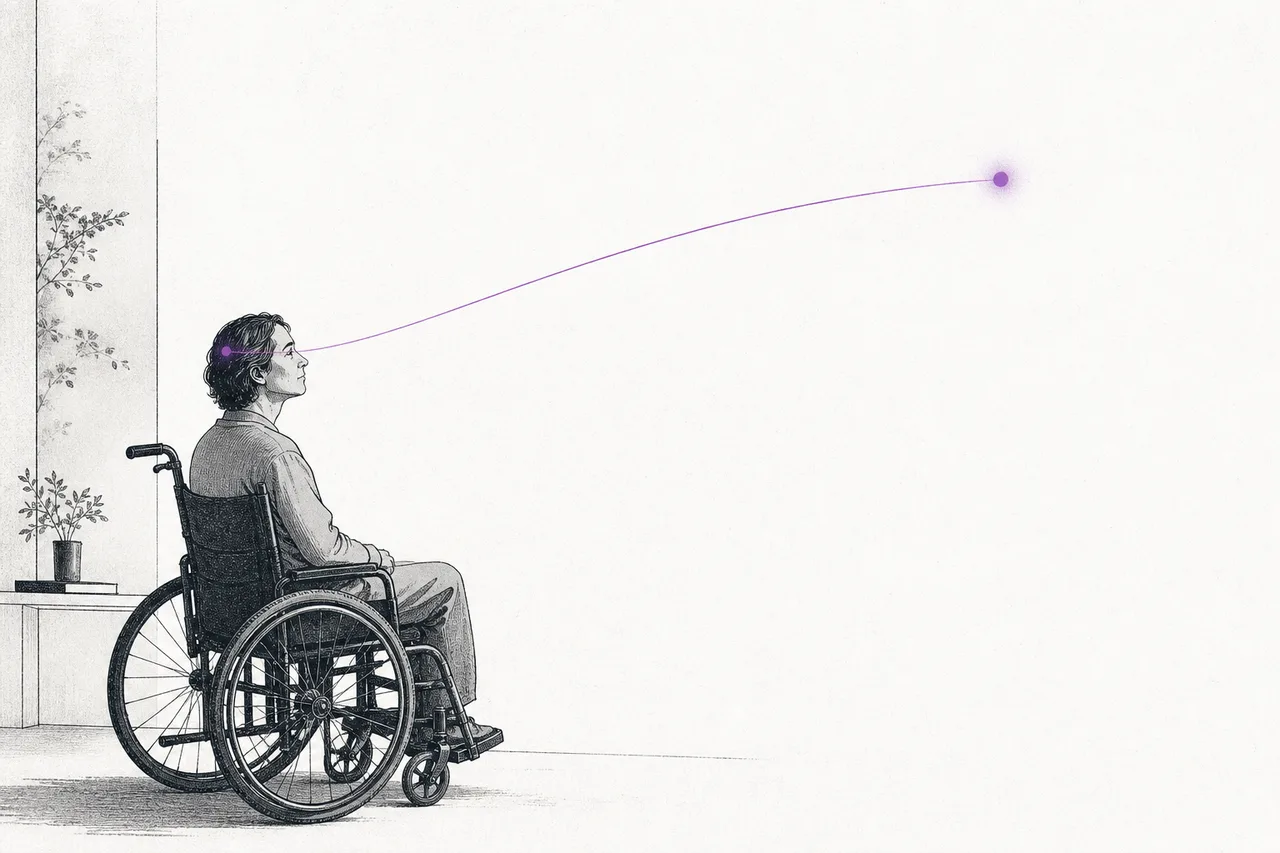
Picture someone who can't move their body at all, yet moves a cursor, types a message, or controls a robotic arm purely by "thinking." This is something Invasive BCI can already do for real in the lab — by implanting electrodes to "listen" to brain cells directly. But it's still a very early-stage technology: only tens of people have been tested, and almost all the real leaders are still "private companies" whose stock you can't buy.
01What it is
When you want to move your hand, the part of the brain that commands movement (the motor cortex) "fires off" electrical signals from thousands of neurons at once. That signal runs down the spinal cord to the muscles. But if the spinal cord is severed (paralysis from an accident, say) or the command neurons die off (as in ALS), the "command" inside the brain is still fully intact — it just can't reach the muscles. It's like someone talking in a room where the phone line has been cut.
Invasive BCI (an implanted brain-computer interface) is about "rewiring" it directly — placing tiny electrodes on or inside the brain to eavesdrop on that command signal right at the source, then letting a computer translate it into a moving cursor, typed letters, or a robotic arm instead. The word "invasive" means you have to operate to put the device inside the skull — unlike the head-worn approach (EEG) that reads from outside the skull.
The skull and scalp act like a "thick blanket" over the signal. Reading from outside the skull (an EEG cap, say) gets you a blurry picture, like hearing people talk through a wall. Implanting electrodes right up against the neurons gives a signal sharp enough to tell "which finger you intend to move" or "which word you intend to say." This is the only thing that makes it worth letting someone operate on your brain.
On the megatrend map, this node is a sub-branch of Brain-Computer Interface — and its "most cutting-edge tip," because it's the side that goes deepest into the actual brain tissue.
02Why it matters
First, to be straight with you: this is still a very small technology in market terms — the entire BCI market (including the non-surgical kind) was worth about $2.4 billion in 2025, tiny next to the drug or chip industries. What draws people in isn't today's size, but what it can solve and the long-term ceiling of ambition.
Take the medical side first. People with severe paralysis, ALS, or "locked-in" syndrome (fully conscious but completely unable to move or speak) number in the millions worldwide. For them, being able to "type a message to their kids" or "drive their own power wheelchair" isn't a toy — it's getting their life back. That's why the FDA has given several of these devices "Breakthrough Device" status.
But what makes investors and billionaires like Jeff Bezos and Bill Gates put money in is the long-term ceiling — if one day you can "read and write" the brain accurately enough, it could extend to treating depression and Parkinson's, restoring sight to the blind, or (in the far-off dream) enhancing memory. It's precisely this huge end-state possibility that pulls money in even when today's revenue is near zero.
03How it works
The heart of Invasive BCI is three steps: (1) capture the signal electrodes placed on or implanted in the cortex catch the "firing" of thousands of neurons · (2) decode it a machine-learning model (the decoder) learns which signal pattern = which intended movement · (3) act on it the result comes out as a cursor that moves, letters that get typed, or a robotic arm that lifts.
The key is "how deep you implant." The closer the electrode gets to the neurons, the sharper the signal (higher resolution) — but the surgical risk climbs right along with it. This is the single biggest trade-off in the whole field.
The "decode" step ties straight into AI — the decoder is really just a good ML model. The smarter the AI, the more accurate the signal translation. A concrete example: BrainGate research decoded a paralyzed patient's effort to speak into text at speeds approaching ~60 words per minute — about the same as an average person typing on a phone.
04Two philosophies: drill deep vs. thread the blood vessels
This field splits into two big schools of thought that answer the "deep vs. risky" trade-off in different ways.
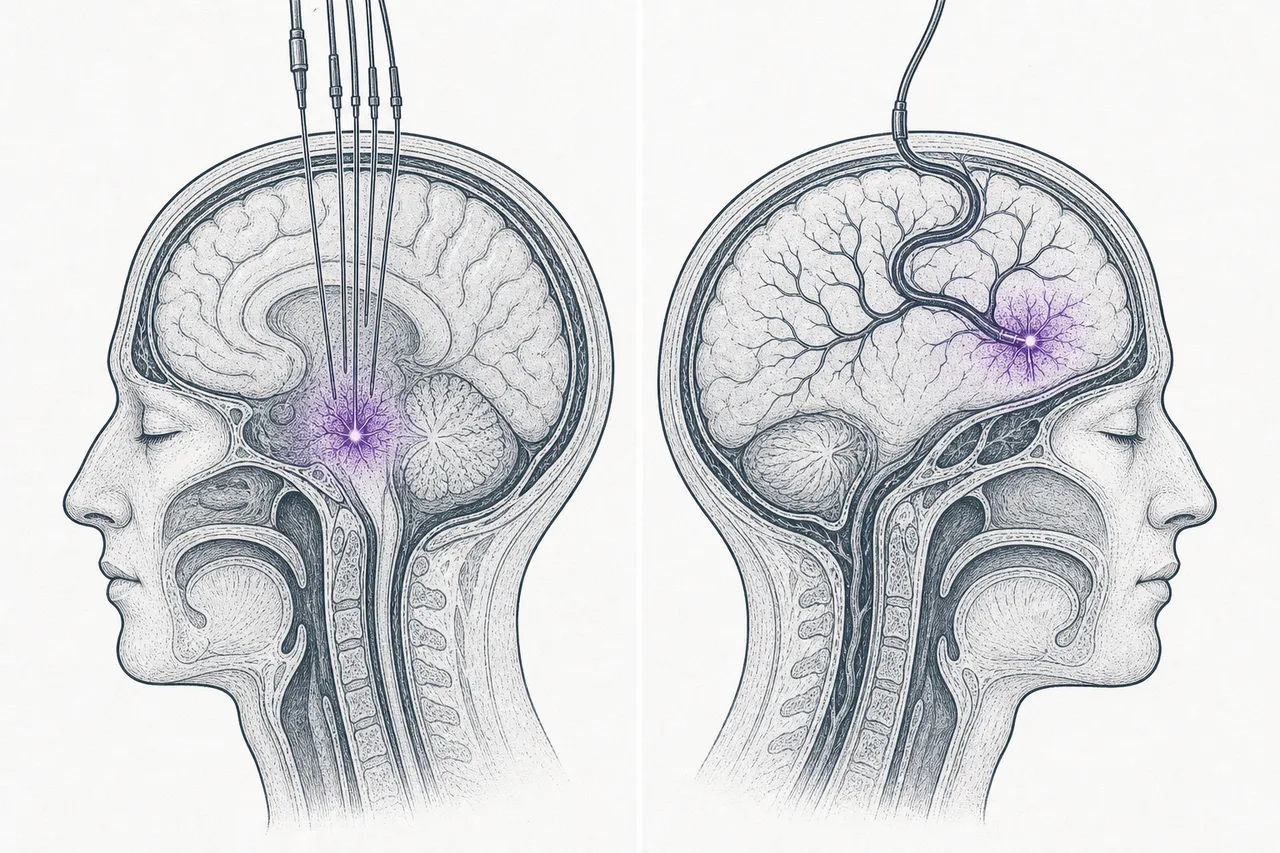
School 1 — drill deep, high bandwidth (penetrating array). Implant electrodes as "needles" or "threads" stuck shallowly into brain tissue to sit as close to the neurons as possible, getting many sharp signal channels. The classic example is the Utah array — a 10×10 silicon-needle plate that's been the research standard for over 20 years. A newcomer like Neuralink uses "threads" thinner than a hair, implanted by robot, reaching up to 1,024 electrodes / 64 threads — at the cost of open-skull surgery and long-term risks (scar tissue around the electrodes, durability).
School 2 — thread the blood vessels (endovascular). The clever idea from Synchron: instead of opening the skull, take an electrode shaped like a "coiled mesh" (called the Stentrode), feed it through a catheter into the vein in the neck, and push it up to park in a blood vessel sitting right next to the motor cortex — with no open-brain surgery at all. Far safer (it's a procedure a vascular doctor can do). But because it reads from "inside the vessel" and doesn't touch the cells directly, the signal is coarser and there are fewer channels.
A portmanteau of "stent" (the coil that props open a blood vessel, which heart doctors use all the time) + "electrode." It takes the coil-placement technique the cardiac field already does by the million each year and adapts it into a brain-reading device — the selling point being "no need to open the skull."
There's a third school in the middle: lay a "thin film" on the surface of the brain without piercing into it (called surface/ECoG), like Precision Neuroscience's film that's 5× thinner than a hair — less invasive than needles, but finer than the vessel approach.
05Where it sits in the BCI ecosystem
Invasive BCI doesn't stand alone. It's one of the five pieces of the megatrend Brain-Computer Interface, linked together in a chain:
- It's built from electrodes and neural sensors: the "thin-film electrodes" and signal-reading chips are the "bricks" that get assembled into a BCI system — and crucially for investors, this is the layer with more public companies you can touch (selling devices/components instead of carrying the whole system's risk)
- It feeds work to neural signal processing and decoding: the raw signal you capture has to be handed off to software/computers to decode — without this part, the signal is just noise
- It's the opposite pole from non-surgical BCI: the head-worn side (EEG) is safe and a bigger market by volume, but the signal is coarse and can't match the implanted kind on fine work — the two pick different positions on the same "risk vs. sharpness" line
- It relies on AI as the decoder and ties into Biotech on biocompatibility (materials implanted in the brain for long periods must not trigger the body to reject them)
The angle investors should remember: because the "full system" (Invasive BCI) is almost entirely private, playing this trend through the stock market is usually indirect — through the components layer, or the Neuromodulation layer (FDA-approved brain-stimulation devices with big public companies), which is more the field's "bridge."
06Where it stands now
Let me put it clearly and plainly: this is a field that's still "very early." Across the whole industry combined, only tens of people have had this kind of BCI implanted. But 2024–2026 is the first big leap in years.
- Neuralink did its first human implant in January 2024, and by early 2026 had done more than 20 people across 4 countries (U.S., U.K., Canada, UAE), with a target of moving into the "hundreds" in 2026 — and in mid-2026 it announced its surgical robot can now reach nearly any region of the brain
- Synchron has implanted the Stentrode in 10 paralysis patients (U.S. + Australia) and raised a $200M Series D in November 2025 (cumulative $345M), preparing to enter a "pivotal trial" in 2026 — which, if passed, could make it the first permanently implanted BCI to file for commercial FDA approval
- Precision Neuroscience got FDA clearance (510k) for its Layer 7 film electrode in March 2025 — the first wireless BCI cleared by the FDA for "measuring signals," already tested in 37 patients
- Paradromics did its first human implant in May 2025 (at U. Michigan, taking ~20 minutes), touting its Connexus claiming a data rate of 200+ bits/second, and got an FDA green light to start a speech-restoration trial in November 2025
And here's the most important point for investors: every real leader — Neuralink, Synchron, Precision Neuroscience, Paradromics — is a private company with no stock traded on the market yet. That means there's essentially no "pure-play" stock of Invasive BCI to buy directly. Participating through the stock market is only indirect — through medical-device giants, or sellers of the components/services around them.

07The future
The first direction is big clinical proof. The most important near-term milestone is Synchron's pivotal trial (2026) — if it passes, it could be the first permanently implanted Invasive BCI to win commercial FDA approval, turning the field from "research" into "product" for the first time.
The second direction is expanding from movement to other diseases. The original challenge was restoring movement/speech, but as surgical robots can reach deeper and wider into the brain (as Neuralink announced in mid-2026), the goal is shifting toward stimulating the brain to treat Parkinson's, drug-resistant epilepsy, and depression, all the way to sight-restoration projects — and here Invasive BCI starts to overlap with the Neuromodulation side.
The third direction is the farthest ceiling — to "enhance," not just "repair." End-state dreams like enhancing memory or linking the brain directly to a computer are still far off and full of ethical questions — they should be seen as a "long-term research direction," not something about to happen soon. The field's real path is "medicine first," then expanding one careful step at a time.
08Challenges & risks
This may be the trend where "the highest hope" sits closest to "the highest risk" of any megatrend. It has to be said plainly.
The first risk is safety and durability inside the body. Implanting a foreign object in the brain for years has unsolved problems: the body may form scar tissue around the electrodes so the signal slowly fades, there's a risk of infection/bleeding, and the question of how long the device lasts before it has to be surgically replaced. This is why Synchron bet on "no opening the skull" — because safety is the real gate.
The second risk is it's still very early. Only tens of people have been tested, long-term data is thin, and the distance from "works in a few patients" to "approved for broad use" means passing bigger trials, taking years, with a chance of stumbling at the FDA gate at every step — the expectations in the news usually run far ahead of clinical reality.
The third risk is the one that hits investors most directly: almost everything is a private company. The real leaders have no stock to buy, and the "peripheral players" you can buy on the market are often small companies that aren't yet profitable, or just a tiny part of a big company's business. Trying to play this trend directly risks buying something whose story looks good but whose real connection to Invasive BCI is still thin.
And the last is ethics and the privacy of "brain data." Once a device can read signals inside the brain, questions of who owns that data, consent, and cybersecurity will become an ever-heavier regulatory gate as the technology's capability grows.
In short: Invasive BCI is one of the most astonishing stories of the era — reading thoughts to give movement back to people who've lost it is already real in the lab. But its greatness is still more in the form of a "promise" than a "product," and it's still driven by private companies that ordinary investors can only watch from outside the door. Understanding this trend is understanding that sometimes "the most important thing technologically" and "what you can invest in today" are still two different things.