Megatrend · Critical Materials
The metals that were once the heart of the battery — and that people suddenly don't want to use
Nickel and cobalt are the duo that lets an EV go far — packing more energy into a single battery. But right now both are being squeezed from two sides at once: a new, cheaper battery that uses neither metal, and a global supply concentrated in the hands of just a few countries — Indonesia (nickel) and Congo (cobalt). This is the story of metals sitting at the center of both the car revolution and a geopolitical game.
01What is it? (the battery's duo of metals)
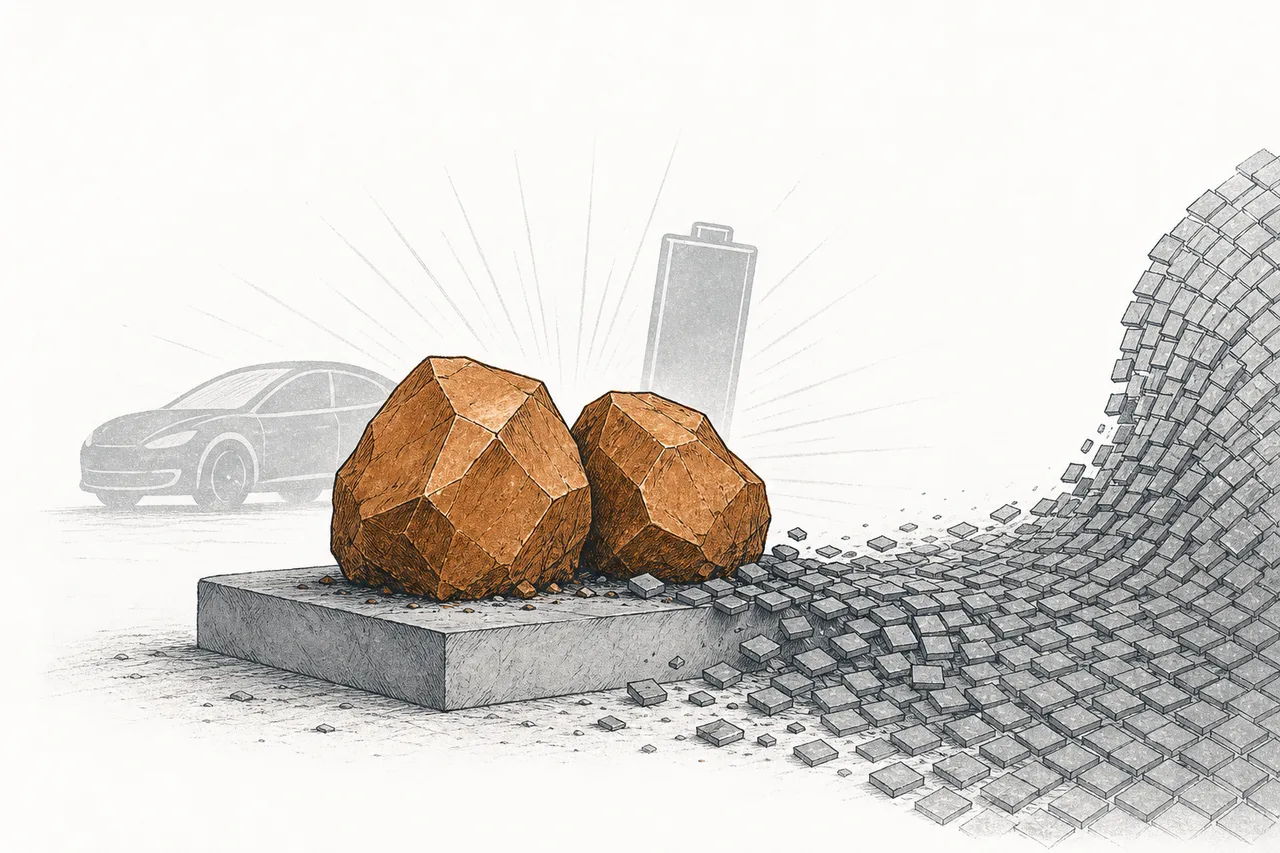
When we talk about EVs that "go far," behind the scenes are two metals working as a pair: nickel and cobalt. Both go into the "cathode" of one type of lithium-ion battery called NMC — and they're the reason the same-sized battery stores more energy, so the car goes farther.
Each plays a different role. Nickel is what packs in "energy density" — the more nickel, the more electricity the battery holds, and the farther the car goes (a premium cell like NMC 811 uses a cathode that's 80% nickel). Cobalt is more like a "stabilizer" — it keeps the cathode structure from breaking down, making the battery safer and more durable even though it's used in a smaller share.
Cathode, the "positive electrode," is the core that decides how much energy a battery can store · NMC = Nickel-Manganese-Cobalt, the most popular cathode recipe in Western and Korean EVs · NCA = Nickel-Cobalt-Aluminium, a close cousin Tesla used heavily — both recipes "lean on nickel and cobalt," unlike LFP, which uses neither.
Beyond batteries, nickel is also a key raw material for stainless steel — and in fact, as of today, stainless steel is nickel's single biggest user, about 68% of total demand. Batteries are just the part growing "fastest," not yet the biggest part. Cobalt, on the other hand, depends on batteries as its main source of demand.
On the megatrend map, this node sits under Critical Materials & Supply Chain — the group of "key raw materials" that, if missing, make an entire era of technology stall. Nickel and cobalt are a prime example of why "who controls the minerals" matters just as much as "who makes the technology."
02Why it matters — and why it's being challenged
For decades, nickel and cobalt were seen as the "gold of the EV era" — the more the world switched to electric cars, the more demand for this metal pair would surge. Battery nickel demand was expected to triple by 2030, topping 1.5 million tons, with total global nickel possibly reaching ~5.5 million tons a year. The story back then was simple: scarce thing, rising demand, higher prices.
But then two "game-changers" hit at the same time.
On the demand side: a new type of battery called LFP (lithium-iron-phosphate), which uses no nickel and no cobalt at all, started taking market share fast — it's about 30–40% cheaper and more durable. In 2025, LFP overtook nickel-based batteries for the first time in history, holding more than 55% of EV batteries installed worldwide (up from under 10% in 2020). In China it's even more extreme: over 80% of EVs sold in 2025 used LFP.
On the supply side: both nickel and cobalt are alarmingly concentrated in production — nickel from Indonesia and cobalt from the Democratic Republic of Congo (DRC). That concentration means prices swing hard on the decisions of just a few governments — and those are the two stories that dominated the market in 2024–2026, which we'll tell next.
03How it works: NMC vs LFP
To understand why this metal pair is both important and challenged at the same time, you first have to grasp the "battle" between two battery recipes. This is the arena that decides nickel and cobalt's fate.
On one side is NMC (and NCA) — the recipe that uses nickel and cobalt. Its strength is storing energy more densely, so the same battery takes the car farther — ideal for premium cars and cold-climate markets (LFP loses performance in the cold). On the other side is LFP — the recipe that uses iron and phosphate instead. Its strength is being cheaper, more durable, safer, but it stores less energy, so the car's range is shorter for the same weight.
So the market's logic shifted. As EVs went "mass market" (low price is the hero) instead of premium, many makers chose LFP to cut costs — every time a car switches from NMC to LFP, a chunk of nickel and cobalt demand disappears. This is what investors call "demand destruction" — demand shrinking not because of the economy, but because it's been replaced by a competing technology.
04How it connects in the ecosystem
Nickel and cobalt are the "upstream" of the battery supply chain. So they connect directly to their siblings in the same megatrend and to the trends downstream:
- Feed Battery Cells and Battery Components & Materials: both metals get processed into "precursor" and cathode materials before becoming battery cells — the real customers that decide demand's fate.
- Compete with / complement Lithium: lithium is in every recipe (both NMC and LFP), but NMC needs "lithium + nickel + cobalt," while LFP only uses "lithium + iron." So LFP's rise is good for lithium but bad for nickel/cobalt.
- Squeezed by Battery Recycling: when old NMC batteries get recycled, nickel and cobalt are recovered and reused. Long term this is the "urban mine" that will cut demand for fresh mining — especially for cobalt, which is expensive and worth recycling.
- Driven by Electrification & Mobility: EV sales are the single biggest variable for demand — but "more EVs" no longer means "more nickel/cobalt," because it depends on whether those new cars use NMC or LFP.
05Where it stands now + who the players are
2024–2026 was the most dramatic stretch for this metal pair, and nickel and cobalt's stories ran in strikingly opposite directions.
Nickel: Indonesia crashed the price
Nickel's story is the story of Indonesia. Within just a few years, Indonesia built a huge number of nickel smelters (mostly backed by Chinese capital), becoming the producer of over 56% of the world's mined nickel in 2024. The result: supply flooded the market, and nickel prices plunged to about $15,000 per ton — the lowest in over four years.
That price crash made Western nickel mines unviable. The most famous example is mining giant BHP, which decided to "pause" its Nickel West mine in Australia (putting it into care & maintenance), pulling about 90,000 tons a year of capacity out of the market — a clear picture of how, when supply concentrates in the hands of a few low-cost producers, high-cost players get squeezed out of the game.
Cobalt: Congo opens and shuts the tap
Cobalt's story is the opposite — instead of flooded supply, it's about controlling supply. About 70–75% of the world's cobalt comes from the DRC alone. And in February 2025, the DRC government banned cobalt exports to revive a slumping price. The result: cobalt prices jumped from about $21,500 to over $56,000 per ton (+67% over the year) before the DRC switched to a "quota" system in October 2025 (an export ceiling of about 96,000 tons for 2026).
Cobalt has a knot that nickel doesn't: an ethical problem. Some of the DRC's cobalt comes from "artisanal mining" — informal hand-digging — with reports of dangerous working conditions and child labor. That pushes Western car/battery makers to "cut cobalt" from the recipe and tighten checks on where it's sourced.
What's interesting is that cobalt's market leader changed hands — the Chinese company CMOC (China Molybdenum) produced 114,000 tons in 2024, overtaking the West's Glencore to become the world's number one (its share jumped from 24% to ~41% in a single year), via the Tenke Fungurume and Kisanfu mines in the DRC. Glencore (~36,000 tons) remains the largest non-Chinese producer.
So the big picture is clear: the nickel/cobalt market isn't driven by a single company on the stock exchange, but is set by the policies of Indonesia and the DRC, plus a group of Chinese-backed producers and multinational mines — this geographic concentration is the market's central fact, not a footnote.
06The road ahead
The first direction is the "battery-chemistry war" that isn't over. LFP will keep ruling the mass market and China, but high-nickel NMC will stay in long-range cars, premium cars, and cold-climate markets. Overall nickel demand is still expected to grow (just slower than once dreamed), because stainless steel is still a big base and batteries keep adding. Cobalt is more fragile, because it keeps getting "thinned out" in recipes and replaced outright by LFP.
The second direction is the fight to pull supply out of concentration. The West is trying to build nickel/cobalt chains that don't depend on China and the DRC, through laws (like the sourcing conditions in US EV tax credits) and investment in new mines — but as long as Indonesia's costs stay the lowest, competing is very hard.
The third direction is recycling that will gradually become new supply. When the first batches of NMC batteries start retiring late this decade, recycled nickel and cobalt will become an "urban mine" that's cleaner and closer to the factory — good for the planet, but another pressure on the price of freshly mined ore.
07Challenges & risks
This metal pair's appeal comes with risks baked deep into the market's structure.
The first risk is "demand destruction" from LFP. This isn't a theoretical risk — it's already happening, and still going. Every time LFP gains share, demand for nickel (and especially cobalt) gets eroded. The question isn't "will EVs grow," but "how much will those growing EVs still need this metal pair."
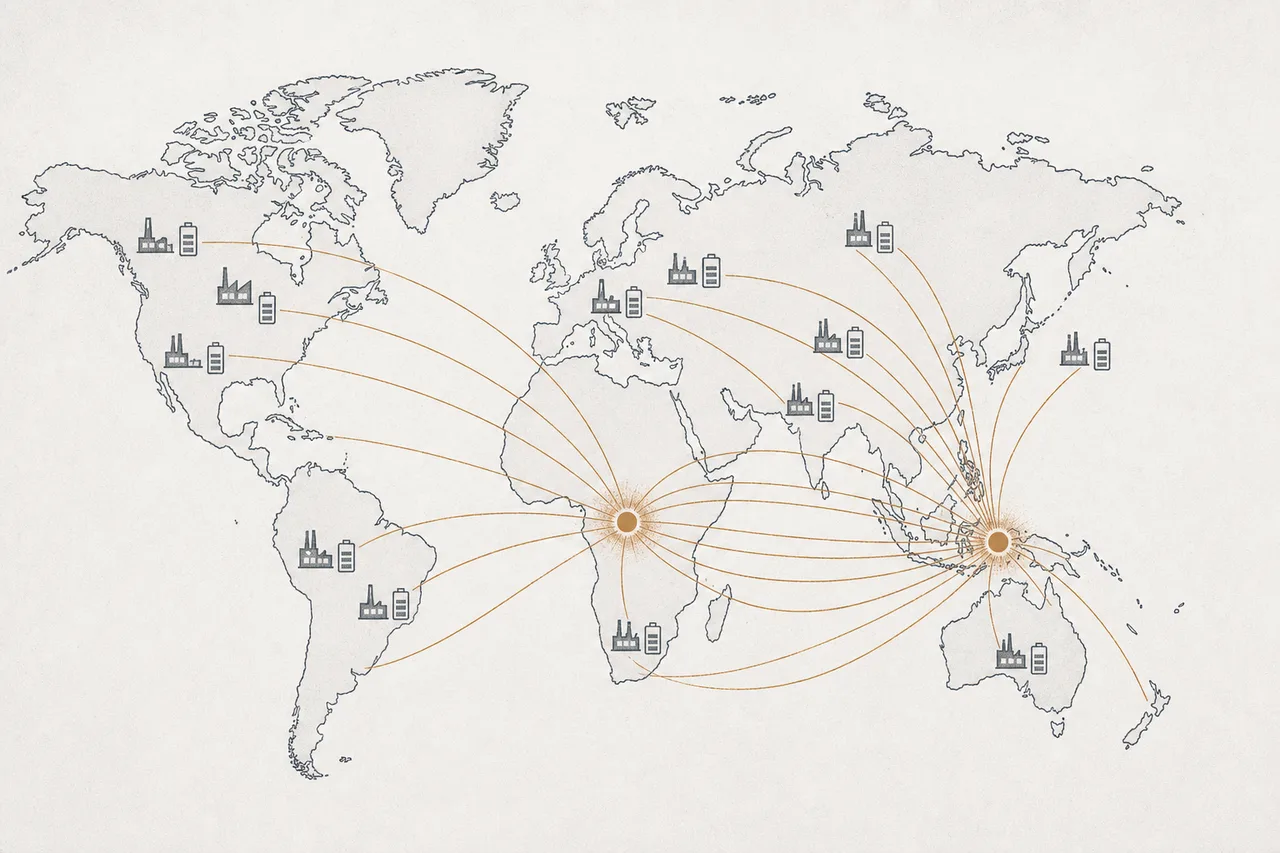
The second risk is geopolitical concentration. When over half of nickel comes from Indonesia and ~70% of cobalt from the DRC (with Chinese capital controlling much of the processing), the decisions of just a few governments — banning exports, setting quotas, raising taxes — can swing world prices overnight. This is a commodity where "the risk isn't on the balance sheet — it's on the world map."
The third risk is a brutal price cycle. This is a full-on commodity business — prices can swing from peak to trough in just a few years (nickel crashed on oversupply, cobalt bounced on the export ban). High-cost producers vanish at low prices, then there's a shortage when demand returns. So investing in this group means watching "who's the lowest-cost producer" and "where we are in the cycle" more than just the EV trend.
In short: nickel and cobalt are the story of metals once seen as the "sure future" of the EV era, that suddenly ran into both a competing technology (LFP) and supply concentration at once. Understanding this metal pair fully means understanding why "raw materials" aren't a straightforward bet — because their value depends on the technology that uses them, and on the world map, as much as on how badly the world wants EVs.