Megatrend · Critical Materials
The "white gold" that just crashed 80%
Lithium is the metal every battery on Earth depends on — an EV uses tens of kilos of it, and nothing else can replace it at scale, which is why people call it "white gold." But its real story is a brutally violent price cycle: it spiked nearly 10x in 2022, then crashed more than 80%, sending giants into multi-billion-dollar losses, mine shutdowns, and layoffs — before bouncing back again in 2026. And behind all of it, one country controls the single most important step.
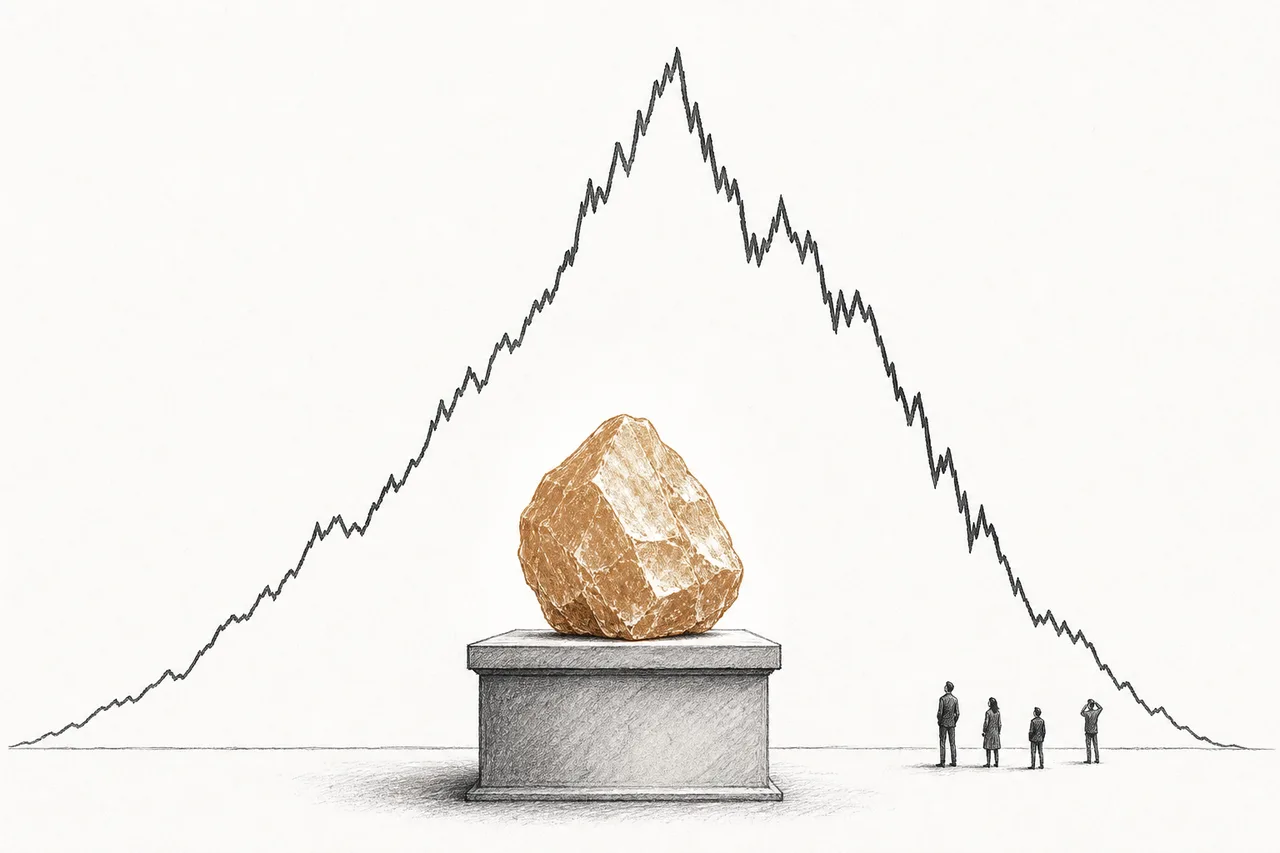
01What is lithium?
Take the phone out of your pocket. Inside is a battery, and at the heart of that battery is the third-lightest element in the universe — lithium. It's extremely light, stores a lot of energy per unit of weight, and "wants" to give up its electrons easily. Those three traits together make it the raw material for almost every rechargeable battery in the world — from phones and laptops to electric cars and whole-factory backup power.
This node sits under the megatrend Critical Materials & Supply Chain — the category of "upstream raw materials" that future technology can't live without. Lithium is the most famous member of the group, because it's tied directly to the biggest story of the era: the shift to clean energy and electric vehicles.
But "lithium" in the investing world doesn't mean the shiny metal you see in a lab. What actually trades is battery-grade lithium compounds — mostly lithium carbonate and lithium hydroxide, white powders refined pure enough to make battery electrodes. And here's the key point we'll come back to all lesson: "digging the ore out" and "refining it pure enough to use" are two different things — and the real power lives in the second step.
Because lithium sells in several forms (carbonate, hydroxide, raw ore), the industry converts everything into one common unit called LCE — "lithium carbonate equivalent." When you see a figure like "3.7 million tonnes of LCE demand," read it as the total amount of lithium converted into a single unit so it can be compared apples-to-apples.
02Why it matters to the world
The short version: if the world is going to quit oil, it needs a vast amount of lithium. One electric car uses roughly 8–10 kg of lithium (as LCE), and no other element does the job as well at mass-production scale. Put simply, lithium is the physical bottleneck of the entire energy transition.
The demand numbers tell the story well: global lithium demand sits at around 1.8 million tonnes of LCE in 2025 and is expected to grow to roughly 3.7 million tonnes by 2030 — about a 2x jump in five years, or roughly 15% growth a year. The main driver is EV batteries (battery demand grows from ~840 GWh in 2024 to about 2,600 GWh in 2030), plus a fast-rising newcomer: grid energy storage, which is growing even faster than EVs.
This is why many countries call lithium a "strategic mineral," and why its price once got pushed to such extremes — because everyone feared there wouldn't be enough. But as we'll see in the next few chapters, that fear led to a shockingly opposite outcome.
03Where it comes from — two extreme ways to mine it
The world gets its lithium two main ways that are almost complete opposites — one fast and crude, the other slow and cheap. Understanding the difference is the key to grasping why the price swings so hard, and why some countries hold the advantage.
Method 1 — hard-rock mining (hard-rock / spodumene). This means digging up rock that contains a lithium mineral called spodumene, crushing it fine, then using high heat and chemicals to extract the lithium. The strength is that it's fast to build and quick to ramp up. Australia is the king of this method and the world's #1 lithium miner (about 88,000 tonnes in 2024). The downside: it uses a lot of energy and tends to cost more per unit.
Method 2 — salt-lake brine (brine). Beneath the dry highlands of South America sits "brine" with lithium dissolved in it. The traditional method is to pump the brine into wide ponds and let the sun evaporate the water over 12–24 months until the lithium is concentrated enough to collect. The strength is the lowest cost per unit, because the sunlight is free. The downside: it's very slow, hard to ramp, and needs huge amounts of land and water. This whole region is called the "Lithium Triangle" of Chile, Argentina, and Bolivia.
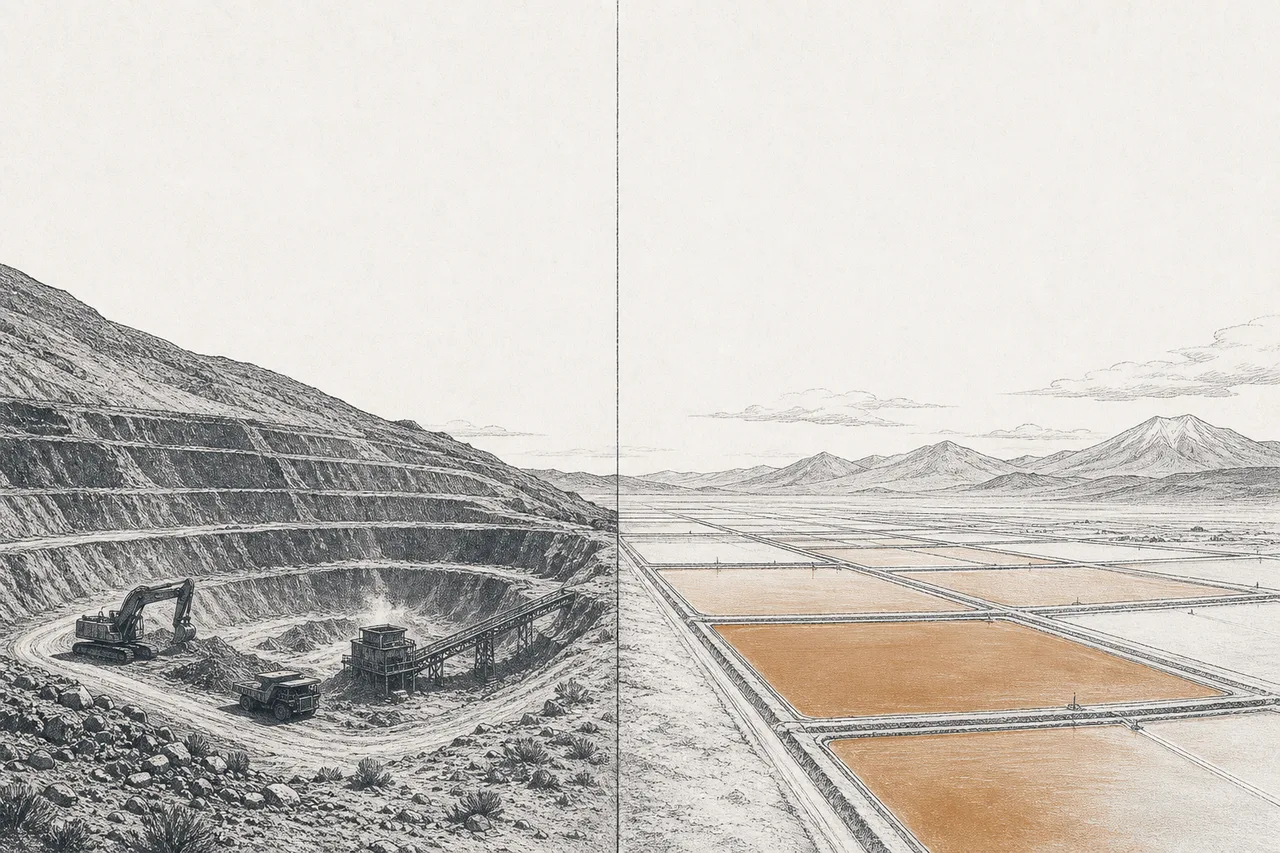
A "Method 3" that many hope will change the game is now emerging — DLE (Direct Lithium Extraction) pulls lithium straight from brine directly using a special filter, instead of waiting years for the sun to evaporate it. It takes hours to days, recovers more lithium, and uses less water. But for now DLE makes up only about 10% of global supply, and it hasn't been fully proven at industrial scale to be cost-effective in every deposit.
04A brutally violent price cycle
This is the heart of the lithium story, and one of the rawest investing lessons of the clean-energy era. In 2021–2022, everyone panicked that lithium would run short for the coming wave of EVs. The result: the price got pushed up insanely — lithium carbonate in China spiked to ~567,500 yuan per tonne (about $80,000) in late 2022, nearly 10x the normal level.
A sky-high price did what high prices always do — it pulled everyone in to produce. New mining projects sprang up worldwide, and global production capacity grew 192% between 2020 and 2024. But when all that supply flooded out at once, while EV demand grew slower than hoped, the result was a glut of more than 150,000 tonnes in both 2023 and 2024 — and the price collapsed.
The severity of the swing is striking: from the ~567,500-yuan peak, the price plunged to just 72,250 yuan by September 2024 — down 87%. And in February 2025, the North Asia delivered price broke below $10,000 per tonne (dropping to $9,550), the lowest since early 2021. Then in Q1 2026 the price bounced almost back to double, to around $26,000 per tonne, as producers began cutting output and speculation moved in.
The wreckage from this bottom was severe: many projects were halted or delayed, high-cost mines were paused, and the giants bled — which we'll see in the players chapter. But first, there's one more truth even more powerful than price.
05The most important secret: China controls "refining"
When people talk about lithium, they usually focus on "who has the most mines" — Australia, Chile, China. But that's a mental trap, because the raw ore you dig up can't make a battery yet. It has to be "refined" to battery grade first — and this is exactly where one country holds almost total power.
Australia does mine the most lithium in the world, but most of it is shipped as raw ore to be refined in China, because China controls roughly 65–70% of the world's refining and processing of lithium into battery-grade chemicals (in 2022, of 700,000 tonnes LCE refined globally, 458,000 tonnes were refined in China). This is the real power — not who owns the rock, but who turns the rock into something usable.
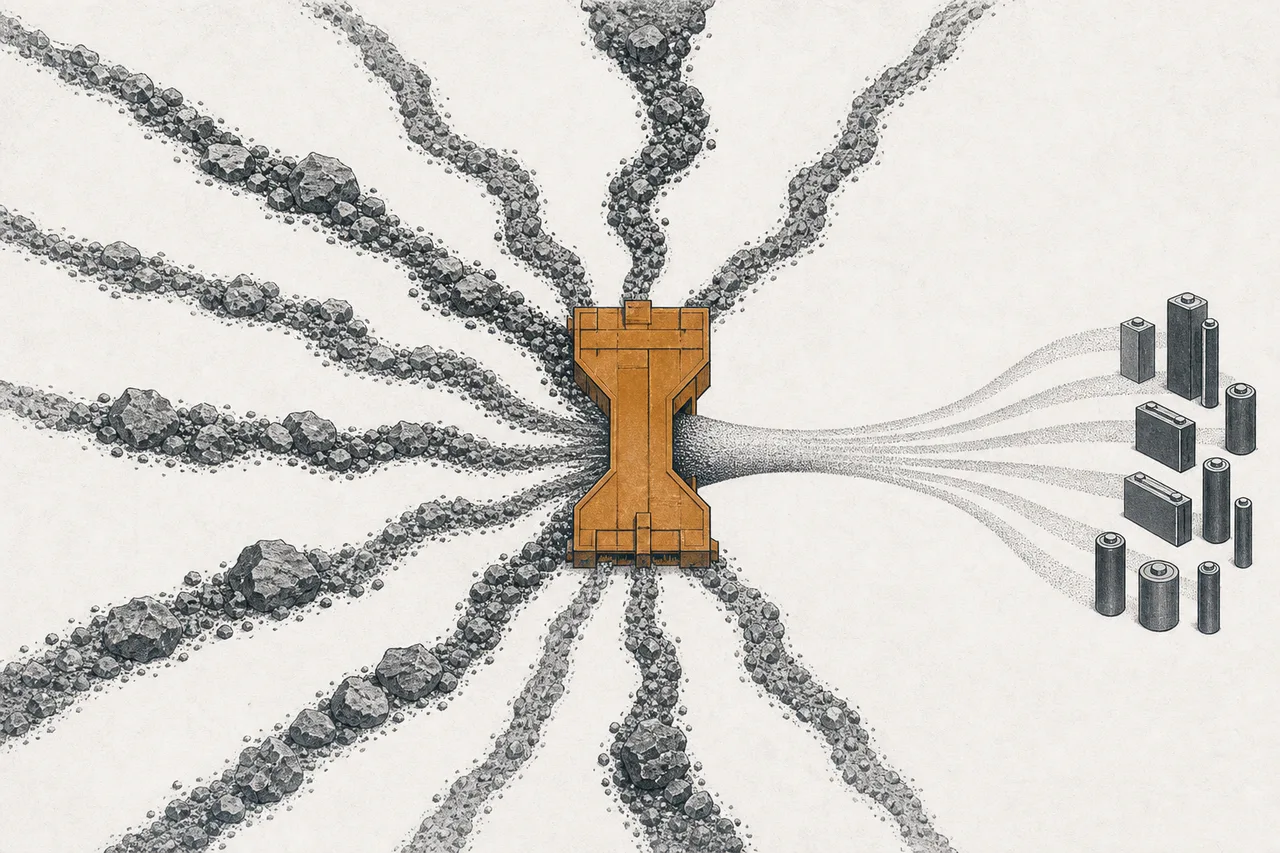
This power matters more than you'd think. In 2025, some Chinese refining-equipment makers began restricting machinery exports abroad, making it harder for rivals in the US and Europe to build their own refineries. And because China controls the processing step, it can influence prices, create volatility, and make Western projects hard to greenlight. That's why lithium isn't just an economic story — it's a national supply-chain security story.
06How it connects across the megatrend
Lithium is the "upstream" that feeds raw material into several big trends. Let's trace the chain from ore to car:
- Feeds Battery Cells directly: battery-grade lithium is the main raw material for battery electrodes. No lithium, no lithium-ion cell — this is the real end customer
- Connects to Battery Components & Materials: lithium is processed into cathodes (like NMC, LFP) alongside other metals — this node is the "middle step" between ore and cell
- Sibling to other battery metals in Critical Materials: especially copper, which wires up the whole EV and runs across the power grid — both are "metals of the energy transition"
- One day challenged by Battery Recycling: as the first EVs reach end of life, the lithium in old batteries gets pulled back out and reused — an "urban mine" that could cut the need for new mining over the long run
Zoom out and lithium's demand doesn't come from itself — it comes from bigger trends. Energy Transition and Electrification & Mobility "pull" demand, and lithium is the "supply" side that feeds them. That's why when EV sales slow just a little, the lithium price shakes hard — because it sits at the far end of a chain where the ripple gets amplified (a phenomenon called the bullwhip effect).
When end demand (EV sales) changes just a little, that swing gets "amplified" larger and larger as you move upstream. By the time it reaches a raw-material layer like lithium, a small stumble in EVs has become a huge price swing — this is the structural reason upstream mineral prices are always more volatile than the finished product.
07Where it stands now + who the players are
Right now (mid-2026), the lithium industry is in a "licking its wounds" phase after the bottom. The price rebound has given it some breathing room, but the scars from the last cycle are still clear. Many producers cut investment, closed high-cost mines, and delayed expansion projects — and that simultaneous "belt-tightening" is exactly what's setting the stage for tighter prices in the next round.
What's striking is that lithium mining is still extremely concentrated — in 2024, Australia, Chile, and China together made up over 85% of global mining, with Australia leading at 88,000 tonnes, followed by Chile at 56,900 and China at 41,000.
On the company side, the bust revealed who's truly strong. Albemarle (ALB) — the world's largest lithium producer, from the US — posted a $1.2 billion net loss in 2024 (a loss of $11.20 a share), had to cut capex by more than 50%, halted construction of the Kemerton Train 4 plant, and laid off staff to keep its cash flow alive.
The deal that most defines the era is Rio Tinto buying Arcadium Lithium for $6.7 billion (closed March 2025) — a diversified mining giant seizing the price drop to scoop up cheap lithium assets, instantly making Rio a major world lithium producer with both hard-rock mines and brine ponds in hand.
08The future & the risks
Looking ahead, lithium's story will be decided by two forces colliding — demand that's certain to grow over the long run, against a price cycle that swings violently in the short run.
On the upside: long-term demand is still very strong, with EVs and especially energy storage as the new wave. With producers cutting capacity all at once during the bust, there's a chance supply tightens again once demand catches up — and the 2026 price rebound may be the first sign of exactly that.
But the risks run just as deep. These are the three variables to watch:
1. The price cycle (the eternal risk). Lithium is a commodity where supply can ramp faster than demand can absorb it. Every time the price rises, people pile in to produce, and the market floods again — the cycle we just lived through won't be the last. Investing in this group means understanding where you are in the cycle, not chasing it when the news is at its brightest.
2. Dependence on China for refining. As long as China controls ~65–70% of the world's processing, the West is exposed to China using that power to suppress prices or restrict technology. Building refineries outside China is a strategic goal, but it takes enormous time and money — and is squeezed further by China's machinery-export restrictions.
3. Technological uncertainty. Two sides — on one, DLE: if it becomes genuinely cost-effective at scale, it would unlock a vast new supply and push prices down (a risk to incumbent producers). On the other, battery chemistry that could change — sodium-ion batteries that use no lithium at all are being developed for certain uses, and if they take share, lithium demand in some segments shrinks.
In short: lithium really is the "white gold" the clean-energy future can't do without. But it teaches the rawest lesson in commodity investing — that "important to the world" and "a good investment all the time" are two different things. The price can rise 10x and fall 80% in just a few years, and the real value isn't in who owns the most rock — it's in who has the lowest cost, and who controls the bottleneck that turns that rock into energy in your hands.