Megatrend · Critical Materials
Two precious metals living in different universes: one is an engine part, the other is fear itself
We tend to lump "precious metals" together — gold, silver, platinum, palladium. But they're really two almost-unrelated stories. The first is the PGM group (platinum, palladium, rhodium): an "industrial" metal buried inside car exhaust pipes — and EVs are threatening to kill it, though a new lifeline called "hydrogen" exists. The second is gold, which is barely industrial at all but a financial safe haven that central banks worldwide bought so hard it set 53 record highs in a single year.
01What is it? (Two worlds in one name)
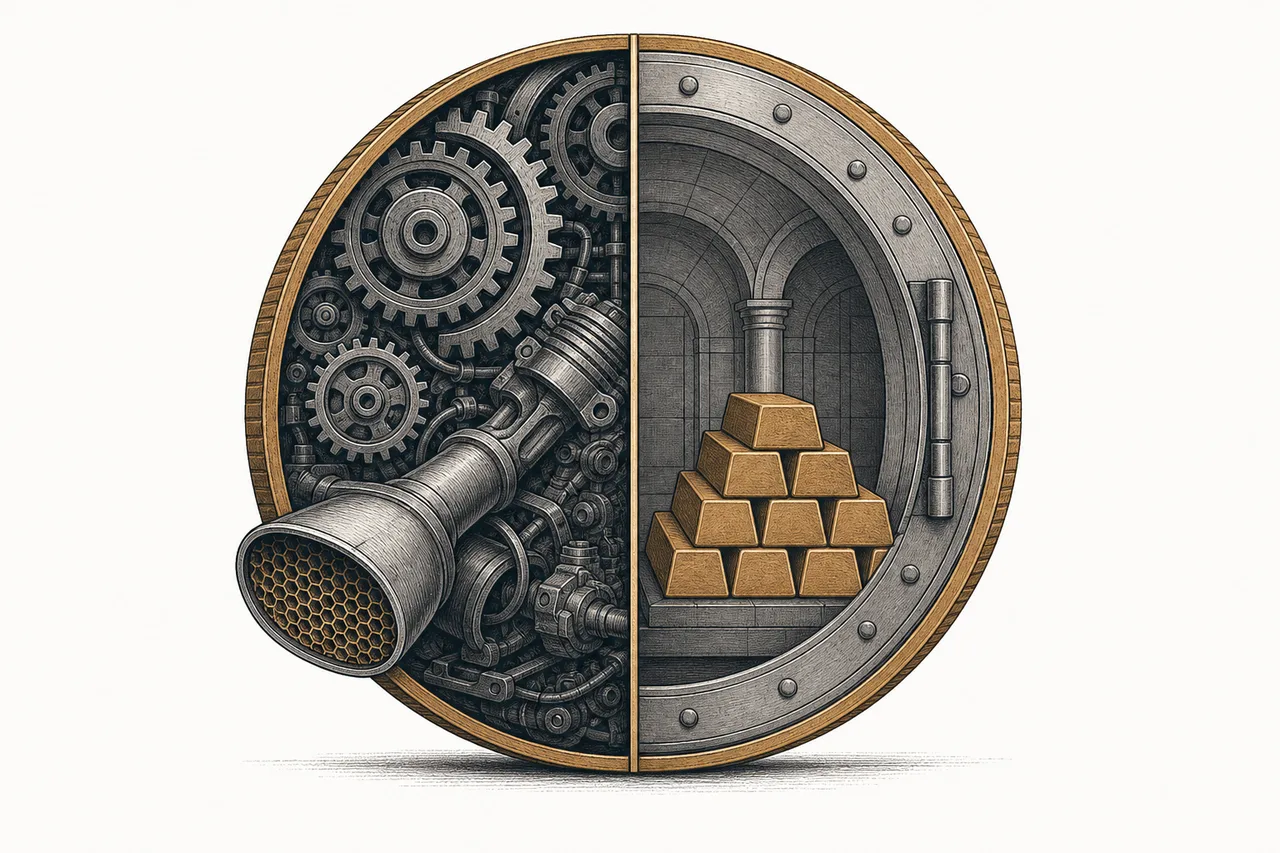
When we hear "precious metals," we usually picture luxury that stores value — gold, silver, jewelry. But look at it through a real investing lens and this node hides two stories that live in different universes, each driven by a completely different set of forces.
The first is the PGM group (Platinum-Group Metals) — platinum, palladium, and rhodium. These are "industrial" metals most people never touch, because most of them sit inside car exhaust pipes. Their price depends on how many gasoline cars the world builds — not on fear.
The second is gold (and its sibling, silver). Gold is barely industrial — it's a "financial asset" people hold when they don't trust paper money. Its price hangs on interest rates, the dollar, and fear in global markets — not on car production, not even slightly.
A group of six metals with similar chemistry; the commercially important ones are platinum (Pt), palladium (Pd), rhodium (Rh). Their standout trait: they're extremely powerful "catalysts" — they speed up chemical reactions without wearing down themselves. That's why they're the heart of the catalytic converter in cars, and of the hydrogen fuel cell.
This node sits under the Critical Materials & Supply Chain megatrend — the "raw inputs" the modern world can't do without. But here's the odd part: most of its siblings (copper, lithium, rare earths) get scarcer as the energy transition advances, while precious metals tell the opposite story: the energy transition (EVs) is a threat to PGMs, not a tailwind. That's exactly why the node's definition says plainly that it's driven by "interest rates and industry," not by "electrification-driven scarcity."
02PGM: the heart is in the exhaust pipe
Let's start with the first story, because it's the literal "child" of this node — Platinum Group Metals (PGM). To understand PGMs, grasp just one thing: this is the gasoline-car business.
Almost every car with an internal-combustion engine (gasoline/diesel) has a "catalytic converter" on the exhaust side. Inside is a ceramic mesh coated with a thin layer of PGM that turns toxic gases (CO, nitrogen oxides, hydrocarbons) into harmless ones. The reaction works because PGMs are excellent catalysts that barely wear out — so the world has to keep mining them to put into new cars.
How deep does that bond run? Over 80% of palladium demand comes from the auto industry alone. This isn't "one use case" — it's nearly the whole market. So palladium is the metal whose fate is tied most tightly to the gasoline engine, while platinum is more spread out (autos + jewelry + chemical industry), and rhodium is the tiny one with the wildest price swings of the three.
The problem: a bond this deep becomes a "fatal weakness" the moment the world starts ditching gasoline cars. That's the heart of the next chapter.
03The EV threat vs the hydrogen lifeline
PGMs are interesting as a megatrend not because they grow, but because they stand at a "three-way crossroads" that decides the whole group's value.
The first road is the EV threat. A pure battery electric vehicle (BEV) has no exhaust pipe, so it needs no catalytic converter at all. That means every EV sold is one gasoline car gone — and PGMs gone from the market. Analysts estimate the shift to EVs has been eating 1.5–2.25 million ounces of palladium demand per year, or roughly 15–22% of a market that's only about 10 million ounces.
But the second road is the hydrogen lifeline. As the world turns to hydrogen and fuel cells, platinum becomes the heart of the matter again — both in "fuel cells" that turn hydrogen into electricity (used in trucks and buses) and in "electrolyzers" that split water to make green hydrogen. WPIC (World Platinum Investment Council) estimates hydrogen demand could absorb about 11% of total platinum demand by 2030, or roughly 875,000–900,000 ounces — offsetting part of what EVs take away.
Fuel cell = a device that combines hydrogen + oxygen to make electricity (the only exhaust is water); it uses platinum as a catalyst · Electrolyzer = the reverse: it uses electricity (from solar/wind) to split water into "green" hydrogen. These two are the entry and exit of the hydrogen economy — and both depend on platinum.
The third road is the current supply deficit that's propping up the price. Whichever way long-term demand goes, platinum is "not being made fast enough" today — WPIC expects 2025 to end with a deficit of about 1.08 million ounces (the largest since 2014), with deficits running through 2029. The result: in 2025 platinum jumped more than 130% to about $2,400/oz, while palladium (tied purely to gasoline cars) bounced back about 70% after several years of heavy declines.
04Gold: the asset of fear
Now the second story, a completely different world from PGMs. Gold is barely industrial — most demand comes from jewelry, investment, and most important in this era, central banks. So gold doesn't depend on car production or anything in a factory. It depends on "fear" and on distrust of paper money.
2025 was a historic year for gold. The price set new all-time highs 53 times in a single year. The full-year average jumped to $3,431/oz (+44% from the prior year), and the Q4 average reached about $4,135/oz. Total gold demand topped 5,000 tonnes for the first time.
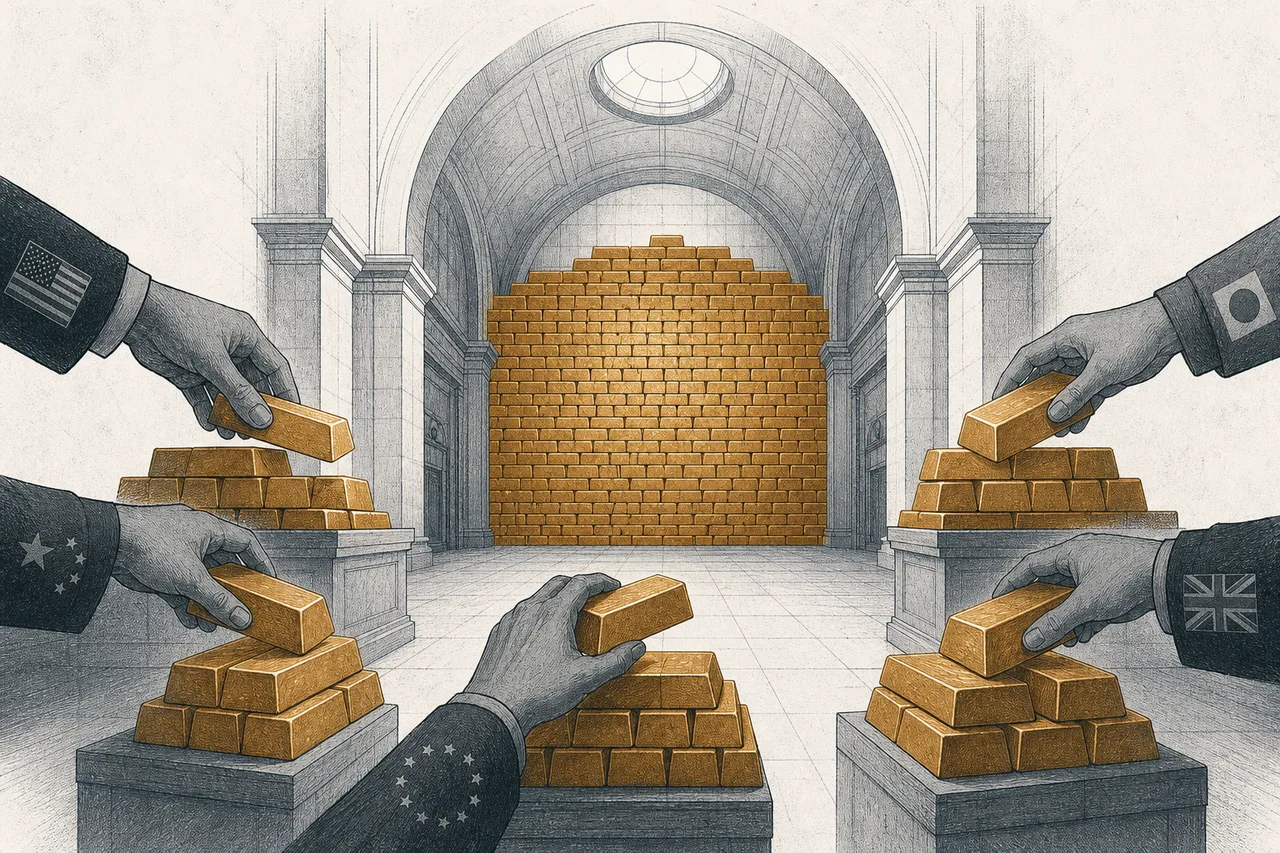
So who's buying? The real star is the world's central banks, scooping up gold into their reserves to "diversify" away from the dollar. In 2025 central banks bought a combined 863 tonnes — looking slower than the 2022–2024 stretch above 1,000 tonnes/year, but still nearly double the pre-2022 average of just 400–500 tonnes/year. Poland's central bank was the biggest buyer for a second year, adding 102 tonnes.
And what about silver? Silver is the "half-and-half" — half safe haven like gold, half genuinely industrial, especially in solar panels that use silver as a conductor. Solar grew until it made up 29% of industrial silver demand in 2024 (from just 11% in 2014). In 2025 the silver market ran a deficit for the fifth straight year (~95–117 million ounces), pushing the silver price past $60/oz in December 2025 for the first time in history — so silver gets a tailwind from both gold-style "fear" and the energy transition at once.
05Where it sits in Critical Materials
This node sits under Critical Materials & Supply Chain, alongside siblings like copper, lithium, nickel-cobalt, and rare earths. But as said up top — it's the family's "black sheep."
Most of the siblings are raw inputs that the energy transition makes scarcer (the more batteries/motors/wiring you build, the more copper-lithium-nickel you need). But precious metals split into two poles:
- PGMs run against the family: EVs (part of Electrification & Mobility) are a threat, not a tailwind, because EVs kill catalytic-converter demand — this is where one megatrend eats another
- PGMs connect to hydrogen: but they also feed Hydrogen & Fuel Cells directly — platinum is a key material for fuel cells and electrolyzers. If the hydrogen economy arrives for real, PGMs benefit fully
- Gold connects to finance: gold is a "rival/alternative" to the financial system. When people don't trust paper money or the dollar, they flee into gold — and this is where it relates to Digital Finance & Tokenization, which the node's definition calls a "substitute": both gold and Bitcoin are sold as "safe havens outside the system" that compete for the same money
Bottom line: this single node touches the world of "engines" (the auto industry), the world of "clean energy" (hydrogen), and the world of "money" (central banks) — few nodes straddle three unrelated worlds this widely.
06Where it stands now + the players
The 2025–2026 picture is "two speeds." Gold is as hot as it gets, driven by central-bank buying and geopolitical fear. PGMs, meanwhile, are recovering off the bottom after palladium's price collapse — it once spiked to $3,420/oz in March 2022 (when the market feared Russia's supply being cut off), then fell 76% to about $813 by August 2024 as the fear eased and the EV wave pressured demand.
Another axis to understand is "who owns the ore". The PGM side is frighteningly concentrated — South Africa produces about 70% of mined platinum supply (and about 91% of reserves) and is the source of roughly 35–40% of palladium. Russia (via the Norilsk mine) controls another ~26% of palladium. So just these two countries can set the price for the whole market — and both have problems: South Africa faces chronic blackouts and surging costs that have pushed many mines into the red, while Russia carries sanctions risk.
Players in this group split clearly into three kinds: (1) gold miners that benefit from record gold prices · (2) PGM miners concentrated in South Africa and standing at the three-way crossroads · and (3) royalty/streaming companies — the smartest model in the business. They don't mine; they pay cash up front for a "share of gold rights" from other companies' mines, so they profit when gold rises without carrying the mining costs or the mine risk.
A business model where companies like Franco-Nevada and Wheaton pay a mine a lump sum today in exchange for the right to buy its gold/silver very cheaply for the life of the mine. So they get "leverage to the gold price" at a fixed cost, avoiding the risk of labor, blackouts, or runaway mining costs — which is why this group tends to have the highest margins in the mining industry.
07The road ahead
This node's future, as always, has to be read as two separate stories.
On the PGM side, the big question is "will hydrogen arrive in time to offset EVs?" If the hydrogen economy really moves forward (fuel-cell trucks + electrolyzers making green hydrogen), a fresh slug of platinum demand comes in — about 11% by 2030, per WPIC — and combined with a deficit expected to drag through 2029, that's enough to support the platinum price. But if hydrogen arrives slower than hoped (very easy to happen), palladium, tied purely to gasoline cars, hurts the most.
On the gold side, the direction hangs on three forces: interest rates (lower rates = gold more worth holding), central-bank buying (still nearly double the prior era), and geopolitical fear. As long as the world distrusts the dollar and stays full of uncertainty, gold has a floor — but watch out, because a price that's set record after record is more exposed to a sharp correction once the fear eases.
And silver is interesting because it gets both forces at once — safe-haven demand like gold, plus industrial demand from solar/EV/data centers that's expected to keep growing through 2030. That makes silver a rare "meeting point" of this lesson's two worlds.
08Challenges & risks
This node's risks also split into two worlds.
PGM's first risk is EVs killing gasoline-car demand. This is a structural threat, not a cyclical one. Every EV sold is PGM gone for good. Palladium, ~85% dependent on gasoline cars, is the most fragile. If EVs grow faster than hydrogen can offset, demand keeps shrinking — and rhodium, with its wild price swings, is even more dangerous.
The second risk is supply concentration. When South Africa controls ~70% of platinum and Russia ~26% of palladium, a problem in either one (blackouts, strikes, sanctions) can swing the whole market's price instantly. It's a double-edged sword: scarcity does push prices up, but the chain is fragile — and many South African mines ran losses deep enough to shut shafts during the last price downturn.
The third risk is gold's sensitivity to interest rates and market mood. Gold pays no interest and no dividend; its value is pure "belief." When real rates rise, or fear eases, gold tends to get sold hard for profit. A price that set record after record through 2025 makes the correction risk higher still — and if central banks ever stop buying or start selling, the biggest support disappears.
In short: this is the node that teaches us category names can deceive. "Precious metals" sounds like one family, but inside there's a metal in your car's exhaust pipe and a metal in the central bank's vault — two things that almost never travel the same road. And that's exactly what makes it worth studying.