Megatrend · Climate Adaptation & Water
The tractor that drives itself — and spots weeds one plant at a time
The people who farm are disappearing — US family farm labor fell from 7.6 million in 1950 to about 2 million, while labor costs spiked and the weather gets less predictable every year. The industry's answer is smart farm machinery that's starting to drive itself — tractors steered by centimeter-grade GPS, sprayers that spot weeds one plant at a time and hit only that spot, and a software layer that records every square inch of the field. This lesson digs into the "second lever" of climate-adaptive agriculture: getting more done with fewer people, fewer inputs, and higher precision.
01What it is
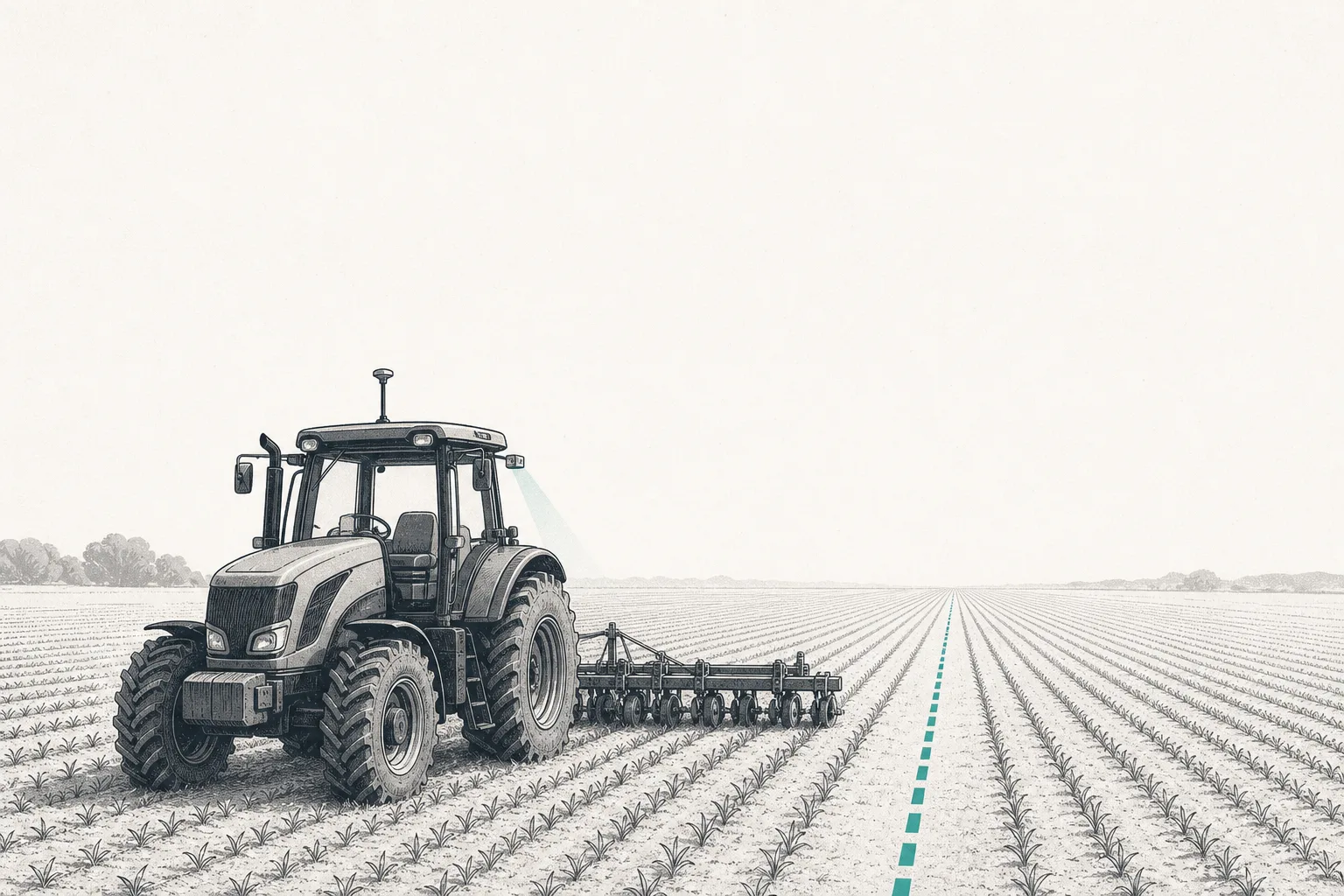
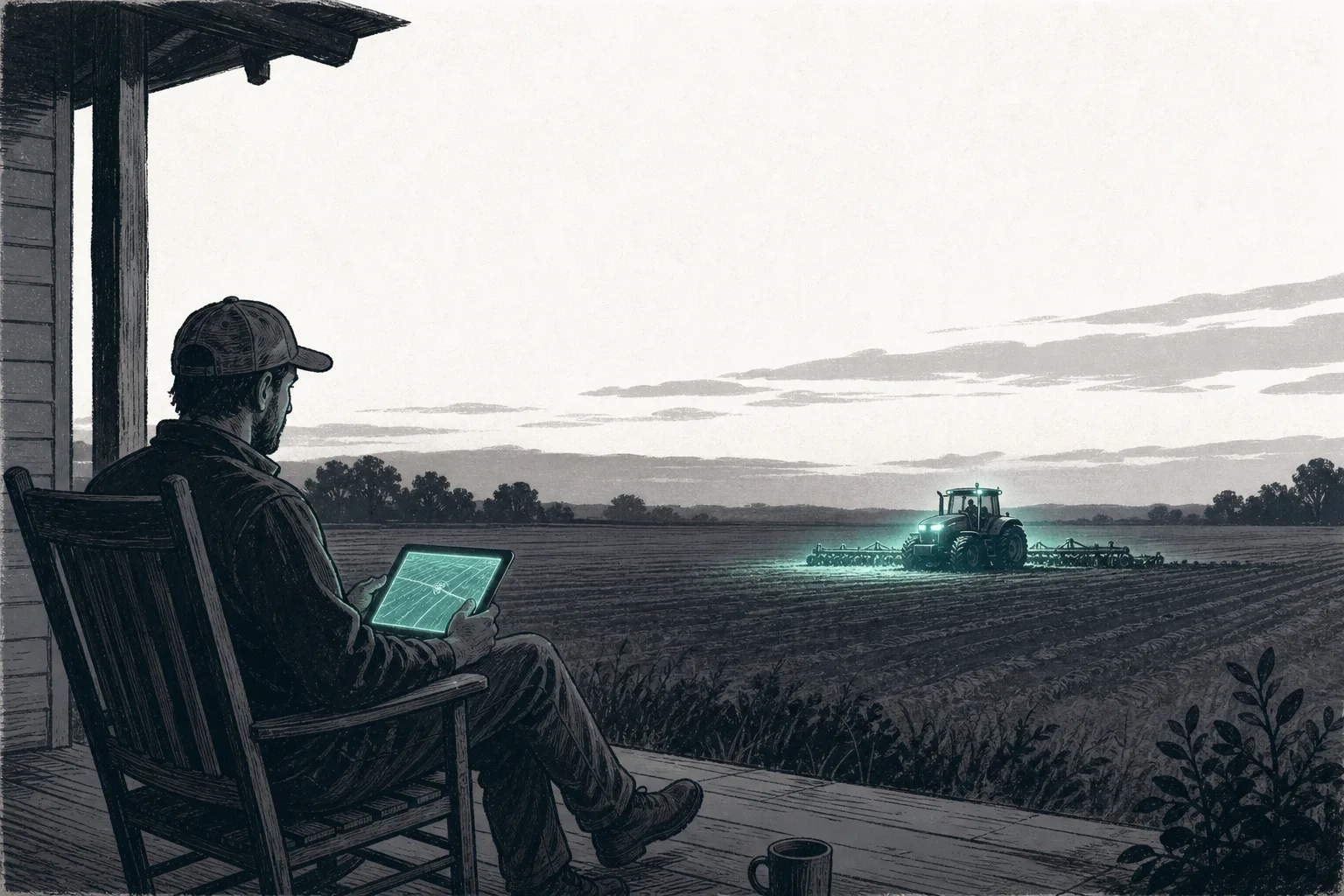
Picture a corn farm spanning thousands of rai in the US Midwest. It used to take several people driving tractors all day, spreading fertilizer and spraying chemicals evenly across the whole field, because they couldn't see where it was actually needed. Today the picture has changed — a single tractor runs dead-straight on GPS, the sprayer spots weeds one plant at a time and hits only that spot, and that night the farm's owner opens an app to see how many rai got worked today, which soil is dry, and how big the harvest is likely to be. This is the node we'll talk about: smart farm machinery that's starting to run itself, plus the data layer behind it.
On the megatrend map, this node is a sub-branch under Climate-Resilient Agriculture & Food, inside the big trend Climate Adaptation & Water. In the parent lesson we call it the "three levers" working on the same field — this node is the second lever, and its two siblings are precision irrigation (water) and resilient seeds and inputs. If seeds are about "making the plant strong" and water is about "delivering to the roots," this node is the "brain and hands" — it decides which input goes where and how much, then executes it precisely down to the plant-by-plant level.
Concretely, this node bundles three connected layers: (1) the machine hardware — tractors, sprayers, harvesters · (2) the navigation and perception systems — high-precision GPS receivers, cameras, and sensors that let the machine "see" the field · (3) the software/data layer — the platform that records everything the machine does, then turns it into instructions to make the next pass more precise. And the layer gaining momentum is the one on top: autonomy, taking the person out of the driver's seat entirely.
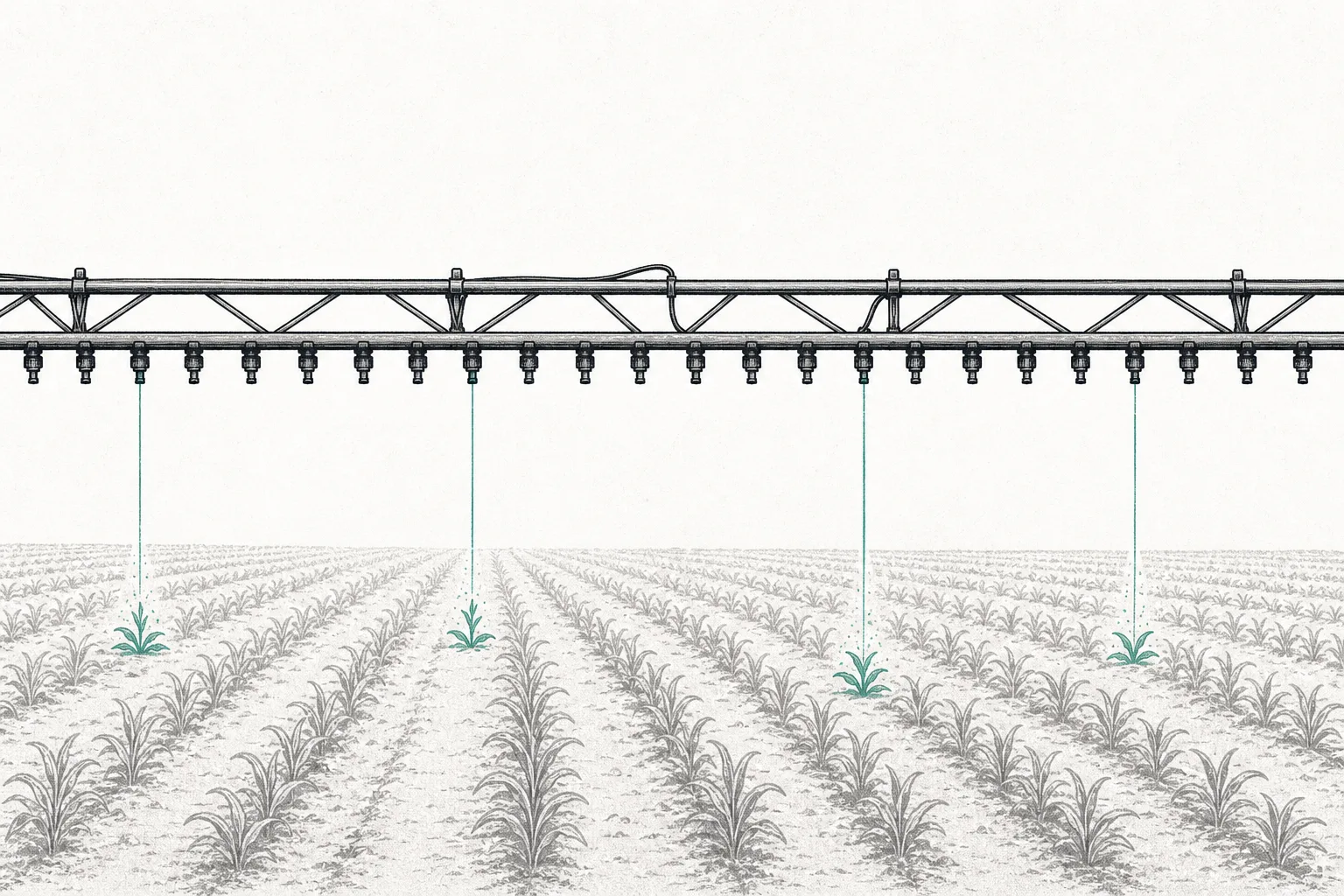
RTK (Real-Time Kinematic) = an extra-precise GPS that uses a reference station to correct readings, pinning your position to within 2–3 centimeters instead of several meters — accurate enough that a tractor can retrace the same track every season · Variable-rate (VRT) = adjusting the amount of fertilizer/seed/chemical differently at each spot in the field, to match what that patch of soil actually needs · See & Spray = a sprayer that uses cameras + AI to look for weeds, then opens only the nozzle that lines up with that weed.
02Why it matters — people vanishing, costs spiking, weather turning harsh
The most powerful reason is that the people who farm are disappearing. In the US, family farm labor (owners and household members who work the land themselves) fell from about 7.6 million in 1950 to around 2 million in 2000 — nearly three-quarters gone, and still dropping. Hired labor shrank by roughly half over the same period. A recent survey found about 56% of farmers report a labor shortage, while farm labor costs have risen double digits in some years. When people get harder and more expensive to find, machines that can do the work instead aren't a toy — they're a way to survive.
The long view makes it even clearer: between 1948 and 2017, labor hours in US agriculture fell more than 80%, yet total output nearly tripled — this is the story of machinery and precision replacing labor, and this node is the latest chapter of that same story. Only this time, the "machine" is smart enough to decide for itself.
The second reason is input costs. Fertilizer, chemicals, and fuel have all gotten more expensive, so spraying the whole field evenly becomes burning money. Precision farming flips that logic — put in only what's needed, only where it's needed. A tangible example is Deere's See & Spray, which in 2025 helped farmers cut their use of (non-residual) herbicide by an average of nearly 50%, covering more than 5 million acres and saving over 31 million gallons of spray mix in a single year.
The third reason is harsher weather, which is the heart of the whole parent trend. As the planting window gets narrower and harder to predict (rain arrives late, comes down too hard, or a heat wave cuts in), farmers have to finish the work in the exact moment the soil is ready, before the window closes. Machines that work faster, more accurately, and can run at night or non-stop without resting people are what make "on time" possible in a world where time is running short.
03How it works (from GPS to nozzle)
Behind a "smart machine" is a sense–decide–act loop that spins many times per second. Let's trace it step by step, from the satellite in the sky to the nozzle in the field.
Its speed is striking — Deere's See & Spray scans more than 2,500 square feet per second while the machine runs at up to 15 miles per hour, then opens and closes nozzles one at a time to match the weeds it sees. All of this is computed on the machine in real time, with no need to send data to the cloud — because internet signal in the field is often unstable, and the decision has to happen in a split second.
What many people overlook is step 5 — the data loop that circles back. Every time the machine works, it records where it met weeds, how moist the soil was, how much harvest came out. This data makes the AI smarter and the next round's plan more precise — the more the machine works, the more data it has, the better the system gets. This is the "data flywheel," and it has become the industry's real battleground — not who makes harder steel.
04What it connects to
This node doesn't work alone. It's the "brain" that commands the other levers on the same field, and it borrows technology from neighboring trends.
- Pairs with precision irrigation (the water-lever sibling): the soil-moisture sensors in this node say which spots are dry and which are fine — that data feeds the drip system to open and close valves only in the zones that need it. The machine's precision makes water go further
- Pairs with seeds and inputs (the seed-lever sibling): a precision planter places each seed at the optimal spacing and depth, while variable-rate systems put in fertilizer and chemicals according to what each patch of soil needs — good seeds only deliver fully when they're planted and tended precisely
- Uses technology straight from Robotics & Physical AI: a driverless tractor is a robot moving through the real world — it uses computer vision, obstacle-detection sensors, and the same path planning as self-driving cars. The further the robotics trend advances, the more autonomous farming follows
- Depends on Critical Materials & Supply Chain: these machines consume chips, sensors, and electronic parts by the load — so this node is just as exposed to chip and raw-material supply-chain tension as any other high-tech industry
05Where it stands now
The big picture is a market that's growing fast and shifting from hardware to platform. The overall precision-agriculture market is estimated at about $14.8 billion in 2025 and expected to reach ~$27 billion by 2030 (CAGR roughly 12–13%). The hottest sub-market is driverless tractors, still small (~$1.6 billion in 2025) but growing at over 12% CAGR toward ~$2.8 billion by 2030 — small because it's just beginning, not because it doesn't matter.
The runaway leader is Deere (John Deere), which holds about 40–50% of the US tractor market with company-wide revenue around $45.7 billion in 2025. But what makes Deere formidable isn't the amount of steel — it's the "data flywheel". Its Operations Center platform already manages more than 485 million acres of cropland worldwide (targeting 500 million actively-used acres by 2026), with about 650,000 connected machines — the more machines and farms in the system, the harder it is for rivals to catch up.
But Deere isn't alone. AGCO stepped on the gas by setting up the joint venture PTx Trimble (April 2024 — AGCO owns 85%, Trimble owns 15%), combining Trimble's GPS/navigation technology with Fendt/Massey Ferguson/Valtra machines and targeting precision-agriculture revenue of over $2 billion by 2028. PTx's edge is its focus on the "mixed-fleet" market — you can add its technology onto a tractor of any brand. Meanwhile CNH Industrial plays a similar hand through its Raven acquisition to bolster autonomy, while Kubota dominates Asia's small-tractor market and is catching up on automation.
06The road ahead — driverless tractors, and data as revenue
The first direction is full autonomy. Deere has launched a tractor that works on its own with no one aboard, and is moving toward a fully autonomous planting season by the middle of this decade, targeting 1.5 million connected machines by 2026. The economic logic is clear — when you can't find a driver, a machine that drives itself is the only way to get the work done in a shrinking time window, and it can run day and night without a break.
The second direction is data becoming recurring revenue. The market leaders are turning themselves from "someone who sells a tractor once" into "a platform that charges a service fee every year" — subscriptions for farm-management software, annual fees for the See & Spray feature, charges for data and navigation services. This kind of revenue is steady and higher-margin than selling steel, and it also "locks in" customers, because years of a farm's data are tied to a single platform. That's why Deere introduced an annual-license option for See & Spray in the 2026 season.
The third direction is retrofit, and making it fit any brand. Farm machinery lasts a long time; farmers don't replace tractors every year. So the fast-growing market is retrofit kits (cameras, GPS receivers, AI boxes) that bolt onto older machines — this is the battleground where PTx Trimble and independent players compete head-on with the brand owners, because it unlocks precision farming for the fleet already out there worldwide, with no need to wait and buy new.
07Challenges & risks
The first risk is farm-income cyclicality. Machine-makers' revenue is tied to farmers' "mood," which depends directly on crop prices. When corn or soybean prices fall, farm income shrinks and farmers immediately hold off on buying new tractors — this is why Deere's and AGCO's revenue swings in cycles, and why machinery sales softened in some markets in 2025. This business has good margins but has to ride out agriculture's seasonal volatility.
The second risk is the "right-to-repair" fight. The more machinery leans on software, the less farmers can fix it themselves, and the more they have to depend on the brand's dealers. This has become a political and legal issue — in 2025, Deere agreed to pay about $99 million in a class-action lawsuit over restricting customers' repair rights, and regulators are starting to push. If laws force tools and software to be opened up, it could hit the "service revenue" that's at the heart of the platform model.
The third risk is adoption and intensifying competition. Precision farming is often expensive up front and takes years to pay back. Small farms in developing countries (where climate stress is heaviest) have the hardest time accessing capital. At the same time the field is getting crowded — autonomy startups (like Monarch Tractor and Bear Flag Robotics, which Deere acquired), plus chip/AI players who want in, force the market leaders to run faster to protect their own data flywheels.
In short: this node is the answer to a problem that gets heavier every year — doing more farm work with fewer people, lower costs, and higher precision, in a world where the weather can't be counted on. From centimeter-grade GPS to a nozzle that spots weeds one plant at a time, it's turning farming from muscle and guesswork into data-driven decisions — and whoever controls that data controls the future of the world's food.