Megatrend · Climate Adaptation & Water
Growing more "per drop of water" on a planet running short of it
Agriculture sucks up about 70% of the freshwater humans withdraw — and the old way of watering is to flood the whole field, losing nearly half of it to evaporation and runoff. This lesson is about the technology that flips that equation: deliver water precisely to the plant's roots instead of spraying the whole plot, through three pieces that work together — drip irrigation that drips water one drop at a time to the roots · the center pivot that adjusts the amount of water point by point · and moisture sensors that tell you "when, where, and how much to water." In an era of more frequent droughts and shrinking groundwater, this is the business of "squeezing more yield out of less water."
01What it is
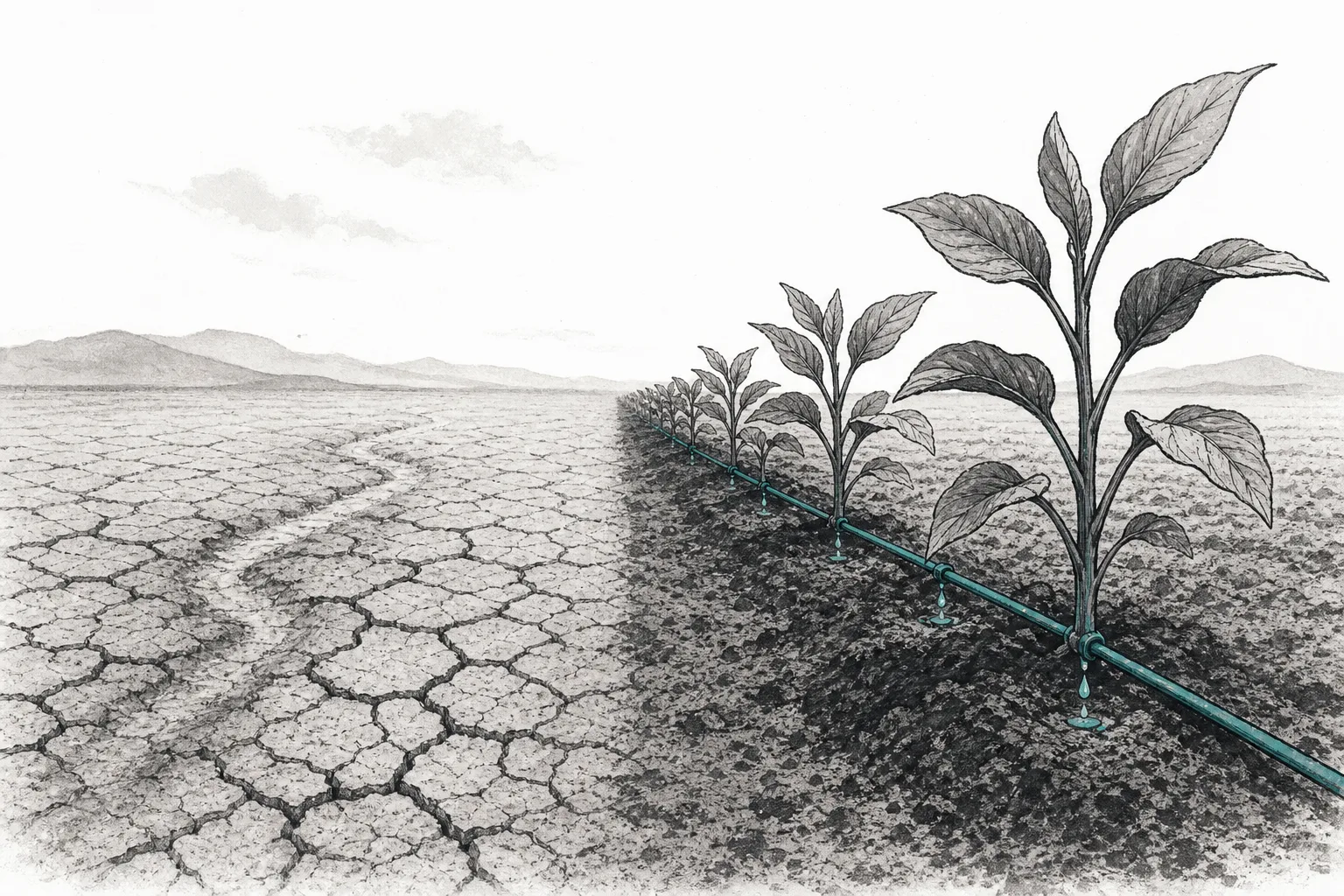
Picture two ways of watering a tree. The first is dumping a whole tub of water onto the plot — most of it pools in the furrows, evaporates into the sky, or seeps down too deep for the roots to reach. The second is putting a small tube at the base of the trunk and dripping water slowly, one drop at a time, straight into the roots — the amount of water used differs by several times, yet the tree gets the same or more. This node is about taking that second way and doing it at the scale of an entire field.
"Precision irrigation" is the group of technologies that get water only where the plant needs it, when it needs it, in just the right amount — instead of watering the whole plot in one blanket pass. It's made of three main pieces that work in sequence:
- Drip & micro-irrigation: tubes and emitters that release water one drop at a time at the base of the roots — best for orchard crops, vegetables, fruit, and grapes
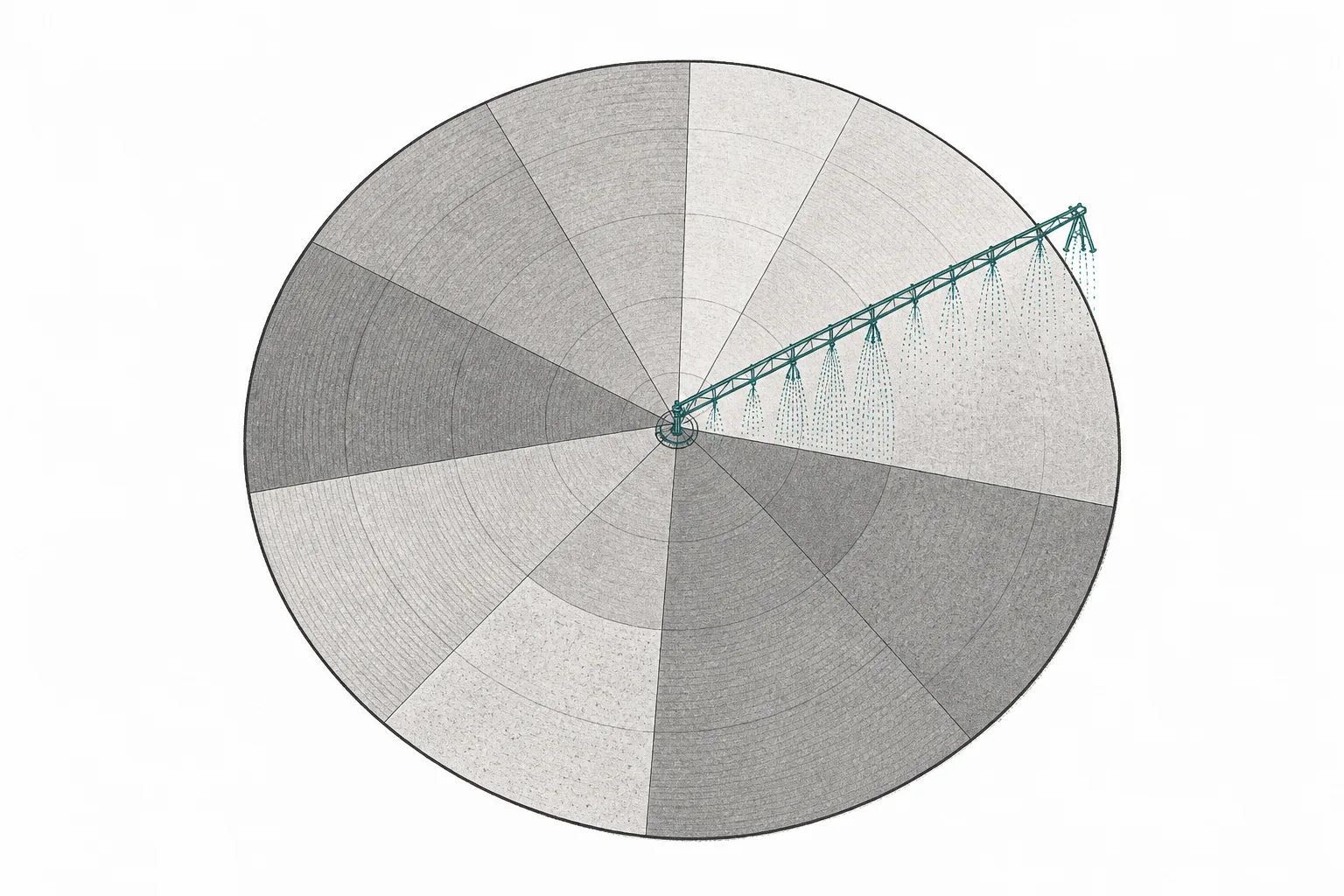
- Center pivot & VRI: a long sprinkler arm that rotates around a center point, watering the whole circle; newer models can vary the amount of water "by zone" (variable-rate irrigation) depending on which soil is drier — suited to big fields like corn and soybeans
- Soil-moisture sensing & controllers: the "brain" that measures whether the soil is moist enough and whether it's going to get hot, then orders water only when it's truly needed
On the megatrend map, this node is the most specific sub-branch (leaf) under Climate-Resilient Agriculture & Food, within the big trend Climate Adaptation & Water. It's the "water lever" — its neighboring siblings are resilient seeds and inputs (making the plant itself stronger) and precision farm machinery and automation (the brain and robotic arm that manage the whole field). These three levers work on the same field, but this lesson focuses specifically on "water."
Drip / micro-irrigation = a drip system that delivers water slowly to the base of the roots through an emitter — the most water-saving, but high investment per area · Center pivot = a long sprinkler arm rotating around a center point, watering in a circle (satellite photos show it as "green circles" in the middle of the desert) · VRI (variable-rate irrigation) = adjusting the pivot's water amount by zone, according to the real soil condition, instead of watering the whole circle equally
02Why it matters — agriculture drinks 70% of the world's freshwater
Start with the number that sets up the whole problem: agriculture sucks up about 70% of the freshwater humans withdraw — several times more than industry and households combined. That means if you want to solve the world's "not enough water" problem, the highest-impact place to move isn't shutting off the tap at home, it's making the fields use water more efficiently.
The problem is that most of the world's watering is still flood irrigation, which wastes enormous amounts. Of the water poured in, only about 40–50% actually reaches the roots; the rest evaporates into the sky or runs off. Meanwhile drip delivers water to the roots so precisely that efficiency hits 90% and above — in practice using about 30–60% less water for the same yield or more. Many studies also find that at the same amount of water, drip can produce up to ~29% more yield than flooding, because the roots don't drown and nutrients don't get washed away.
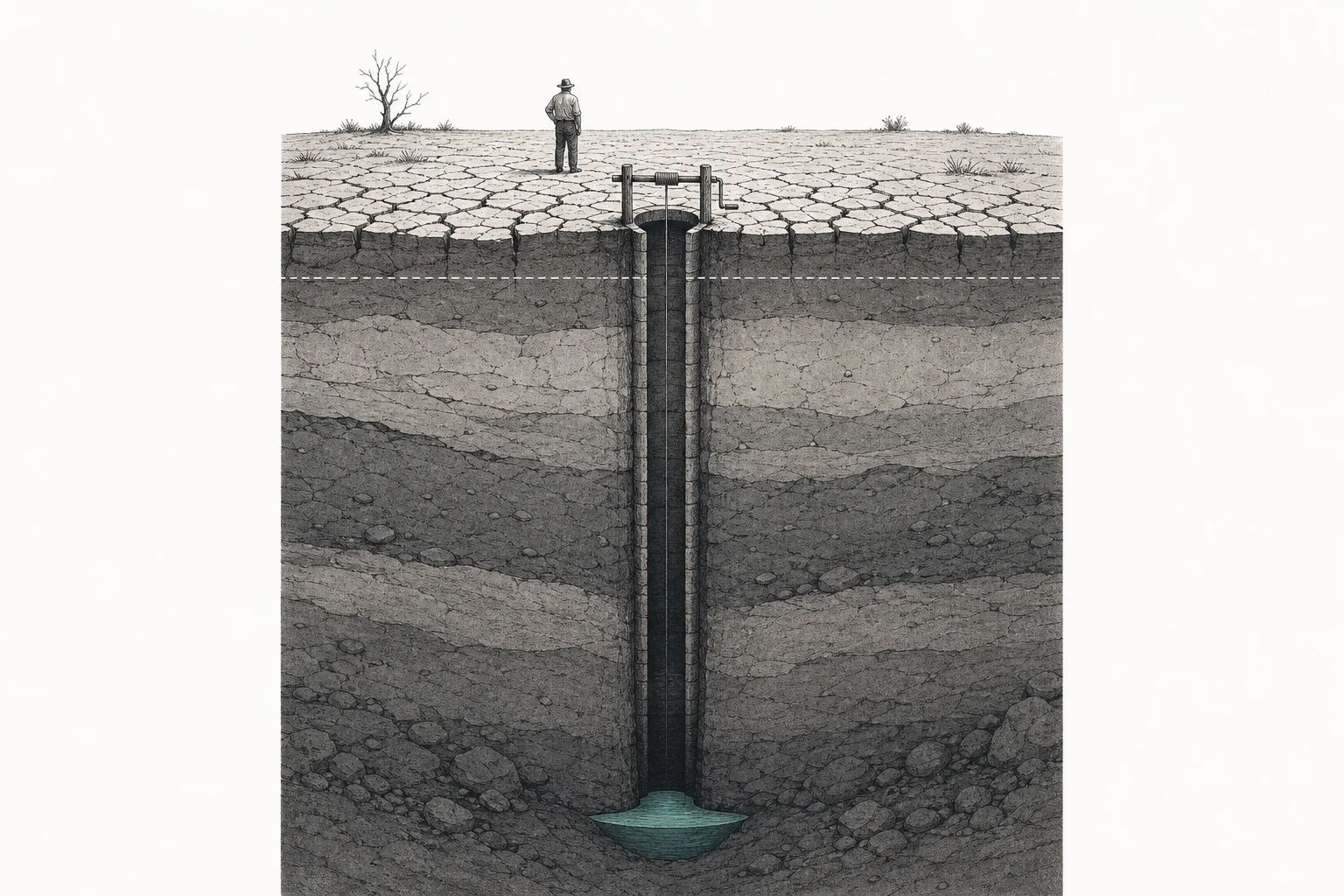
The pressure making this urgent is that water is running short in many regions: droughts are more frequent and longer, many rivers are drying up, and worst of all groundwater is shrinking — farmers in dry areas pump groundwater up faster than nature refills it, and water levels in major aquifers worldwide keep falling. As water gets scarce and expensive, the equation changes: drip irrigation, once seen as "too costly an investment," becomes "a must-have to keep the field alive." This is why demand for this node is structural, not a fad — as long as water is short, the need to "use water efficiently" won't go away.
03How it works (flood vs drip)
The easiest way to grasp the heart of this node is to set two fields side by side. The top field uses the old flood method; the bottom field uses a drip system with sensors for a brain. Then watch where one bucket of water "ends up."
What makes the new system smart is a closed loop — sensors in the soil measure the real moisture and send the value to a controller; the controller compares it against the weather and the plant's needs, then orders water only when needed, not on a fixed schedule. Instead of watering every morning whether it's raining or the soil is still moist, the system "knows" which soil has had enough and which is still short. This is the point where hardware (tubes, emitters, pivots) meets software (data + AI), and the reason companies in this field try to sell not just "tubes" but a "water-management platform" they can charge an annual fee for.
04Where it sits in the ecosystem
Precision irrigation doesn't work alone. It's a meeting point of several trends, and it connects directly with its siblings in the same family:
- Paired with Water Treatment & Flow Technology: drip needs "clean water at steady pressure." If the water carries sediment or salt, the tiny emitters clog instantly — pumps, valves, filtration, and pressure management are the indispensable partner of an irrigation system
- Complements resilient seeds: seeds bred to tolerate drought still need water at critical moments — the drip system delivers just enough at that moment. A good seed plus wasted water still loses efficiency; the two have to go together
- Shares a brain with precision farm machinery and automation: the sensors, field data, and AI that command the machinery are the same dataset that commands the water — a farm-management platform that reads the soil and orders both fertilizer and water at once is where these two nodes are merging
- Eats power — depends on Energy Transition & Power: water pumps and pivots use energy; in remote areas, solar pumping is taking off because it cuts the fuel/electricity that is a big cost for farmers
05Where it stands now
The overall market picture right now is "growing steadily, with an enormous amount of room still to grow." The micro/drip irrigation market was around $8.6–10.9 billion in 2024, and is expected to climb to roughly $18–27 billion by 2034 (CAGR around 8–10%, depending on the source). More interesting than the market-size number is the usage gap — worldwide, less than 4% of irrigated land has micro systems installed. That means this market has barely begun to penetrate. So the growth opportunity isn't "fighting for share," it's "converting the 96% still flooding to precision systems."
The player structure splits clearly into two camps by technology. The center pivot side, for big fields, is dominated by two American giants in a "duopoly": Valmont (the Valley brand), which holds about 40–45% of the global pivot market, and Lindsay (the Zimmatic brand), following at 20%+. Neither just sells steel — Lindsay carries the FieldNET platform, which now manages over 65,000 irrigation systems worldwide, turning itself from a "machine seller" into a "water-management platform." Lindsay's fiscal 2025 total revenue was about $725 million (around 82% from irrigation), and it was the first year in company history that irrigation revenue outside the U.S. overtook domestic — reflecting that the real growth is in water-short emerging markets.
The drip side, for orchard/fruit crops, is led by Netafim, the Israeli pioneer of drip (over 60 years old, now part of the Orbia group), the largest irrigation company in the world, with about $560 million in first-half 2025 revenue. The key rival is Jain Irrigation of India, which merged its international business with Rivulis to become a ~$750 million drip giant, and Toro, strong in both ag irrigation and turf. The fastest-growing market is India, where the government subsidizes drip installation through programs like PMKSY to cope with shrinking groundwater and recurring drought.
06The future — irrigation that thinks for itself
The first direction is irrigation going fully "smart" — combining sensors, satellite imagery, weather forecasts, and AI into one system that decides on the watering itself. The goal is a pivot that varies water by zone (VRI) according to a real-time moisture map, instead of watering the whole circle equally. The way Lindsay and Valmont race to accumulate field data and build software platforms shows the battlefield shifting from "who makes better steel" to "who has better data and algorithms for managing water."
The second direction is expansion into dry areas and emerging markets, where the water pain is heaviest. India, Central Asia, Africa, the Middle East — all places where flooding still rules and groundwater is shrinking fastest. Lindsay's irrigation revenue outside the U.S. overtaking domestic for the first time is a signal that the wave of change from flood to drip/pivot is really happening in these markets, often with government subsidies as the accelerant.
The third direction is solar + drip. In remote areas without power, solar pumping plus drip is becoming a new standard kit, because it cuts the energy cost (diesel for pumping) that is a big burden on small farmers — making this technology more accessible to people who once couldn't afford the investment.
07Challenges & risks
The first risk is commodity cyclicality. The revenue of irrigation-system sellers is tied to "the farmer's wallet," which depends on crop prices and farm income. When corn/soybean prices fall, farm income shrinks and farmers immediately delay investing in new systems — this is why pivot sales swing in cycles rather than growing in a straight line. The soft U.S. farm market in 2025 pressured the domestic sales of every maker.
The second risk is high upfront cost and slow payback. A good drip system has high investment per area, and small farmers in developing countries (where water stress is heaviest) tend to have the hardest access to capital. The gap between "the technology truly exists and truly pays off" and "the farmer actually has the money to install it" may be wide and slow to close — which is why global usage stays below 4% despite the clear benefit. Growth thus depends heavily on government subsidies, and if subsidy policy changes, demand wobbles.
The third risk is maintenance and clogging. Drip is not a technology you can "install and forget." The tiny emitters clog easily if the water has sediment or salt; a poorly maintained system degrades fast, and farmers may revert to flooding. This is why water quality (linked to water treatment technology) and after-sales service are the deciding factors in whether the investment truly pays off.
The fourth risk is the paradoxical-sounding "rebound effect" — when drip lowers water use per area, some farmers respond by expanding their planted area or planting more water-hungry crops. In the end, the region's total water use may not fall — or even rise. Field-level water savings thus don't guarantee that the whole region's groundwater will recover — a policy problem that technology alone can't solve.
In short: this node is the technology that lets us "grow more per drop of water" on a planet where agriculture drinks 70% of the freshwater and water is running short. It's the most measurable lever among adaptive-agriculture technologies — but how far it grows depends on how fast we can close the gap between "what pays off" and "what the farmer can reach."