Megatrend · Quantum Computing
The quantum you get "for free" in stocks you already own
While tiny quantum companies bet their entire business on a machine that isn't finished, giants like Google, IBM, Microsoft, Amazon, Nvidia, and Intel are building quantum computers too — but for them it's just a "small R&D line item" inside a business that earns hundreds of billions a year. So they can wait a decade without rushing to make money. This is the opposite bet from a pure-play: you get the quantum upside thrown in "for free" in a stock you'd probably hold anyway, with almost no bubble risk.
01What it is — a bet with a safety net
This lesson has a sibling node called Quantum Hardware — Pure-plays, about the tiny quantum companies whose "entire business" is building a quantum computer. If quantum works, their value goes through the roof; if it fails, almost nothing is left — a pure bet.
This node is the opposite bet. It's quantum embedded inside tech giants that already earn enormous profits from other businesses — Google (Alphabet), IBM, Microsoft, Amazon, Nvidia, Intel. For them, quantum isn't the whole company, it's just a "small research department" funded by a sliver of revenue, while the heart of the company is still advertising (Google), cloud (Microsoft/Amazon), or AI chips (Nvidia).
This difference sounds technical, but it's actually the heart of the investment. A genuinely usable quantum computer is still years away — maybe after 2030. In the meantime, someone has to keep "paying for the experiment" with no revenue coming back. Whoever has pockets deep enough to wait is more likely to reach the finish line — and that's what makes this node interesting in a quieter, but possibly sturdier, way.
Hyperscaler = a company that runs massive cloud data centers rented out to the whole world (Google Cloud, Microsoft Azure, AWS) — they already have the money, the engineers, and the cloud customers · Strategic optionality = investing a little today to "buy the right" to be in the game if that technology gets big in the future, without betting the whole company — quantum inside these giants is exactly that kind of option.
On the megatrend map, this node sits under Quantum Computing in the "hardware" layer, alongside the pure-plays — the only difference is who owns the machine. Many of the most advanced machines in the world today aren't in the hands of pure quantum companies, but in the labs of these giants.
02Why "deep pockets" change the game
Picture a marathon where the finish line is farther off than anyone expected — maybe 10 years, maybe 15. Two groups start together. The first (pure-play) has to find money to buy drinking water every kilometer; on any day they can't raise it, they're out of the race. The second (the giants) has a support car following with unlimited supplies — they just have to get there, without worrying whether there's water to drink.
This isn't an exaggeration. Look at the 2025 profits of these giants and compare them to the revenue of the smallest quantum company on the stock market — the gap is so vast they hardly look like the same kind of business.
This number says one thing clearly: Google's profit in a single year (~$132B) is about 1,000 times IonQ's entire company revenue. Alphabet's one-year research and development (R&D) budget is around $61B — that one chunk alone is bigger than the market cap of every pure-play quantum company combined. Quantum is just a tiny scrap of that budget.
The consequence is huge: the giants don't have to rush and don't have to worry their stock will drop because quantum has no revenue yet — because investors buy Google stock for advertising and cloud, not quantum. So quantum is a "bonus thrown in": if it works, it's upside; if it doesn't work yet, it won't sink the company — the opposite of a pure-play, whose share price swings on every milestone headline.
03Two ways to hold a machine that isn't finished
The heart of this lesson is the structural difference between two ways investors can "own" quantum — and why the second one is far more durable over this long road.
This difference translates into three things for investors:
- Endurance: a pure-play has to keep raising money (issuing new shares dilutes existing holders) or rely on government subsidies, while the giants feed quantum from their own core profit
- Bubble risk: pure-play stocks swing on a single quantum headline, while giant stocks are driven by the core business — quantum is barely priced in, so if it works it's bonus upside
- Many bets at once: the giants have enough money to try several modalities — for example, Microsoft bets on topological but also opens its cloud to rent out other companies' machines — they don't have to "back a single horse" like a pure-play
04Where it sits in the quantum universe
Quantum inside the giants doesn't stand alone. It sits at the very center of the whole quantum ecosystem, and connects deeply with other big trends:
- Rivals (and sometimes allies) — Quantum Hardware — Pure-plays: pure quantum companies like IonQ, Rigetti, D-Wave — the giants both compete with them on technology and sometimes rent out their machines over the cloud (like AWS Braket, Azure Quantum)
- The real way to make money today — Quantum Software, Algorithms & Cloud Access: this is where the giants have a massive edge — Amazon and Microsoft don't have to wait for a finished machine. They can sell access to quantum over the cloud starting today, using cloud infrastructure they already have
- Computing partner — AI and Foundation Models: Nvidia positions itself as the "bridge" linking quantum machines to GPU supercomputers — because quantum error correction needs an ordinary computer to help with real-time calculations, and AI also helps design and control quantum machines
- Why governments pour in money — Cybersecurity and Biotech: the day the machines grow big enough, they'll be able to crack the encryption that protects the whole internet (which is why we have to rush post-quantum cryptography) and simulate molecules to design drugs — these two arenas are the security reasons governments worldwide are pumping in huge sums
An important point many people get wrong: quantum is not competing with Nvidia's AI chips — they solve different kinds of problems. In the near term, the two will work together (hybrid) more than replace each other. The reason Nvidia jumped into this game is that it wants to be the "middleman" every quantum machine has to connect through, no matter which modality wins.
05Where things stand now + who the players are
The good news is that 2024–2026 is when the giants hit the most real and most important technical milestones in quantum history — and interestingly, many of the most advanced items are in the giants' labs, not the pure-plays'.
The most talked-about milestone is Google's Willow (105 qubits, late 2024), which pulled off something scientists had waited 30 years for: when you grow the size of the qubit cluster (from a 3×3 grid to 5×5 to 7×7), the error rate halved each time instead of rising. It's the first time anyone went "below threshold." This is some of the first evidence that scalable error correction is genuinely possible — and it came out of Alphabet's research department.
Normally, the more qubits you add, the more error you get. The point where "adding qubits makes the error drop instead" is called crossing the threshold — a crucial dividing line that says if you keep scaling the machine up, it will get more stable, not break down. Willow is one of the first machines to prove it's really achievable — but the distance from here to a "machine you can sell" is still very long.
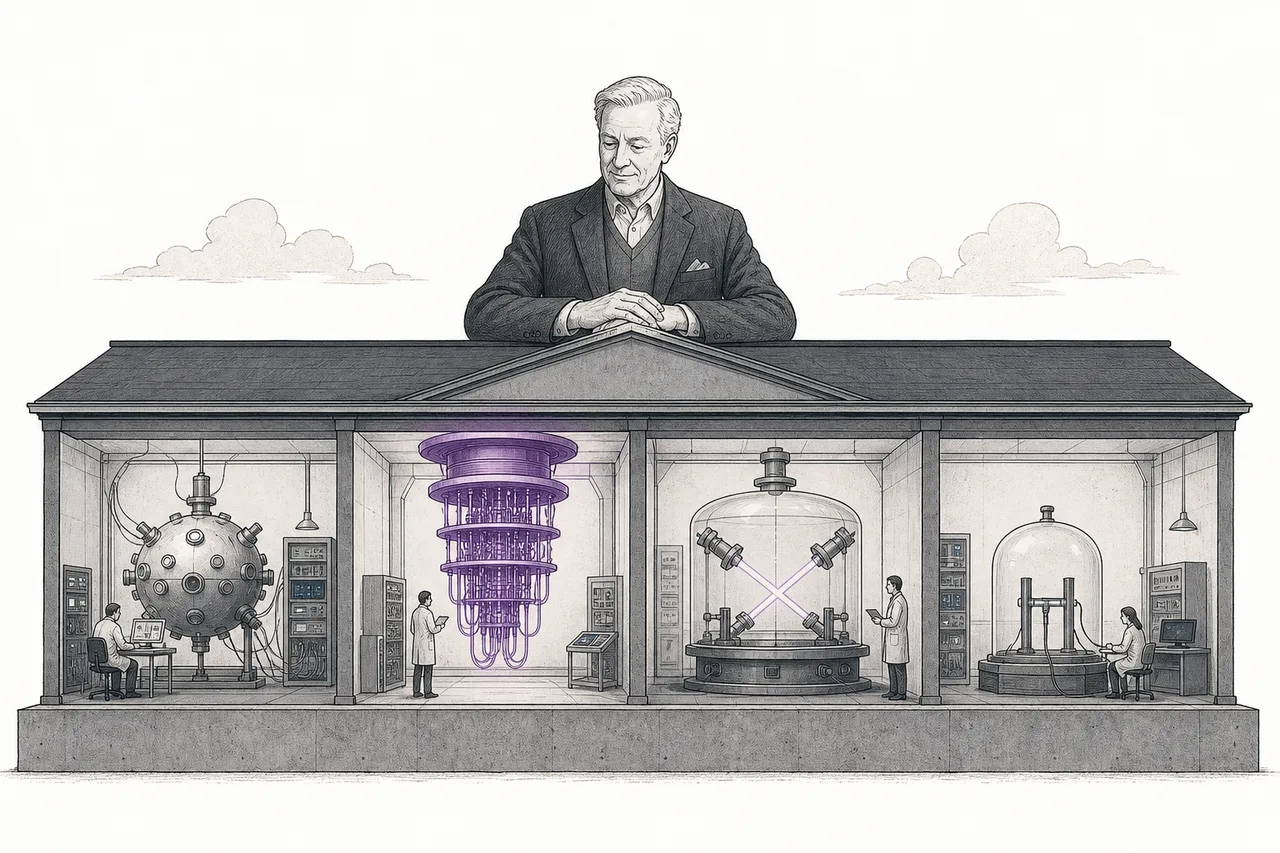
The other camps aren't far behind: IBM has the clearest "roadmap," aiming to ship its first fault-tolerant machine, Starling in 2029, capable of running 200 logical qubits · Microsoft bets on the strangest and riskiest path, Majorana 1 (Feb 2025) — the world's first topological qubit chip, which if it works will be far more stable than rivals (though many scientists remain skeptical) · Amazon unveiled the Ocelot (Feb 2025) chip, which uses "cat qubits" to cut error-correction cost by 90% · and Nvidia doesn't build qubits itself but launched NVQLink as a bridge connecting every kind of quantum machine to the GPU.
But to be clear — just like every pure-play: quantum inside these giants also still has "no meaningful revenue". The difference is that it doesn't have to, because the core business feeds it. What does bring in some money today is the cloud side — Amazon Braket and Azure Quantum can already charge for time on the machines (their own and partners'), but it's still a tiny scrap compared to the core cloud revenue.
Another force to watch is governments. Worldwide they've already invested over $40B in quantum, from more than 30 countries (China leading, then the EU and the U.S.). For the giants, government money is just an extra "handicap" boost — unlike some pure-plays for which subsidies are the lifeline keeping them breathing. It drives home, once again, whose pockets are deeper.
06The road ahead
The first direction is the race to fault-tolerance. Several camps have planted their flags alarmingly close together — IBM is aiming for 2029, and Microsoft says it'll have a scalable topological machine by 2029 too. If anyone succeeds on schedule, that's the point where quantum starts to "actually work" on commercial tasks — but this industry's history teaches that timelines always slip.
The second direction is Quantum-as-a-Service. This is where the giants are likely to "collect money first" — no need to wait for a perfect machine, just open it up for companies and researchers to rent experiment time through AWS Braket, Azure Quantum, Google Cloud, and revenue starts to flow. And crucially, it "locks" customers into their own cloud ecosystem early on.
The third direction is "teaming up with pure-plays" rather than competing head-on. Many giants open their cloud to rent out IonQ, Rigetti, and others' machines while developing their own, because their real goal isn't to "own the best qubit" but to "be the platform everyone has to use quantum through" — the same game they won in the cloud and AI eras.
07Challenges & risks
This node is safer than a pure-play on many fronts, but it's not without things to watch — and the things to watch are a completely different kind from a pure-play's.
The first and most important risk is "it isn't a concentrated bet on quantum." If you buy Google stock because you want quantum upside, you have to understand that quantum is a tiny sliver of the company — even if Willow succeeds spectacularly, Google's share price might barely move, because almost all of its value comes from advertising and cloud. Put simply: the quantum upside you get is very "diluted." Anyone who wants full quantum exposure has to look at the pure-plays (which come with bubble risk).
The second risk is "it's still far off and scientifically uncertain." Milestones like Willow or Majorana 1 are real and important, but still years away from a usable machine — they're a "proof it can be done in principle," not a "product ready to sell." In Microsoft's Majorana case, a number of scientists even question the results. The quantum road is still full of physical uncertainty that even deep pockets can't buy their way past.
The third risk is "bet on the wrong path and you can still lose." Like a pure-play, though lighter — Microsoft pours into topological that isn't fully proven, and Intel into silicon spin that lags on qubit count. If the chosen path doesn't work, the money and time put in are lost. It's just that, because it's only a tiny scrap of the company, it won't sink the whole company.
In short: if a pure-play is a high-risk lottery ticket, quantum inside the giants is a "scratch-off thrown in with something you were buying anyway." It won't make you rich overnight off a single quantum bet, but it keeps you in the long game with almost nothing to lose — and in a technology with a road this long and uncertain, the "endurance to wait for the finish line" may matter even more than getting off the line fastest.