Megatrend · Quantum Computing
You don't buy a quantum computer — you just "rent time" on it through the cloud
A real quantum machine has to be chilled near absolute zero, costs hundreds of millions of dollars, and only a handful exist in the world. So how does anyone else actually use one? The answer is the layer this lesson is about — software, algorithms, and the "cloud doorway" that lets you send a problem to run on a real machine for a few seconds, without owning anything. It's the layer that turns quantum "from a lab toy into a service." But here's the million-dollar question: right now it's still hard to find "a job quantum actually does better."
01What it is
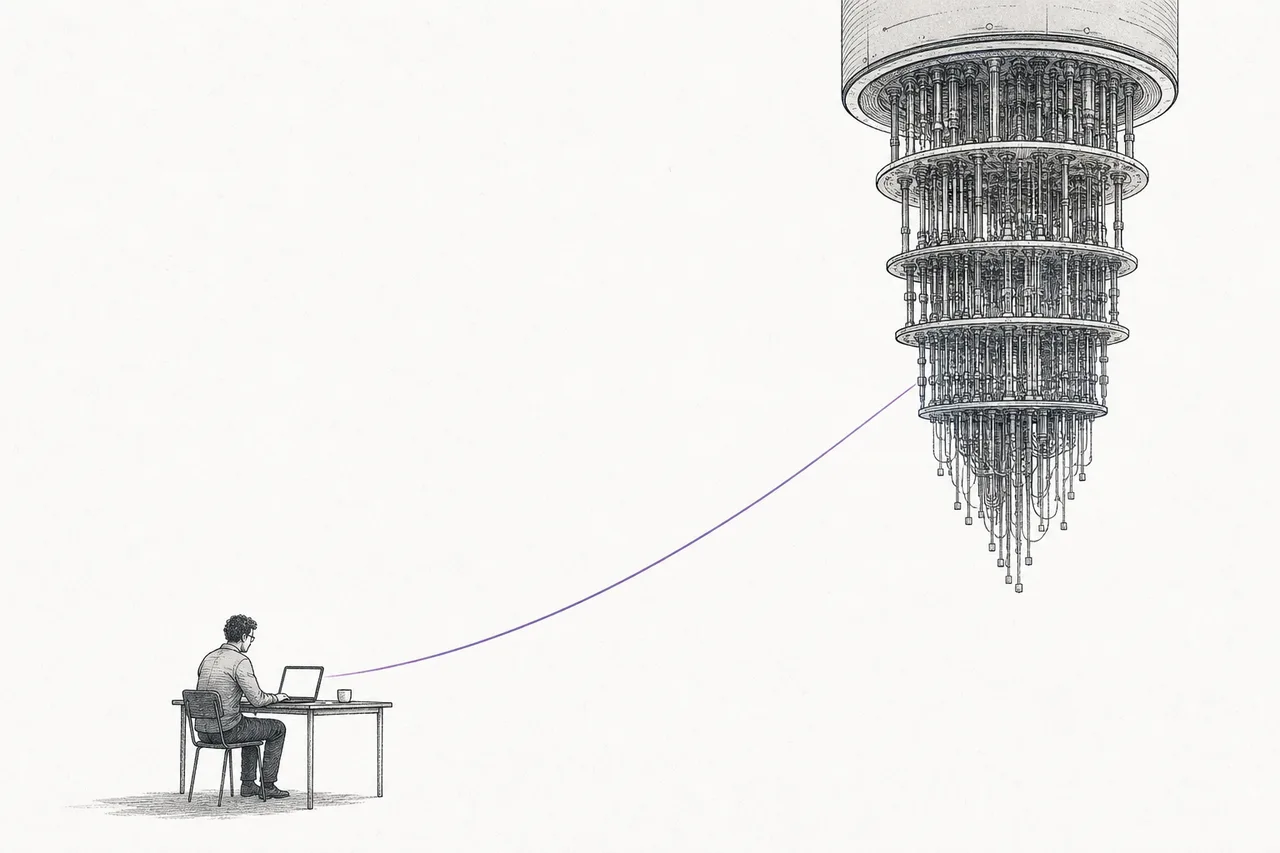
When we say "quantum computer," most people picture the gold chandelier-shaped machine hanging in a lab — that's the hardware. But bare hardware does nothing on its own. It's like an F1 engine sitting in the middle of a garage: without a steering wheel, a throttle, and a driver, it's just a block of metal. This node is everything that sits "above the hardware" — the layer that turns a quantum machine into something you can actually use, without owning a single machine.
Its definition is the software + algorithms + cloud doorway layer of the quantum world, split into three connected parts:
- Cloud access (QCaaS): a service that lets you send a problem over the internet to run on a real quantum machine sitting on the other side of the world, and get an answer back — paying per use, like renting the machine instead of buying it
- Software stack: the tools to write programs — the SDK/compiler that translates your problem into something the machine understands, plus "noise-reduction" techniques (error mitigation), because today's quantum machines still have very "shaky hands"
- Algorithms: the calculation recipes designed specifically to use quantum power — and the hunt for which problems quantum actually does better than an ordinary computer
A business model where a cloud provider "rents out time" on a quantum machine over the internet — you don't build the machine or maintain the cooling system, you just write a program, send it to run, and pay for what you use (per "run" or per "reserved hour"). It's the "AWS of quantum" — the same concept the hyperscalers apply to ordinary servers.
On the megatrend map, this node is a sub-branch under Quantum Computing — while sibling branches like quantum hardware (pure-play) and hyperscaler-side hardware build the "machine," this node is the layer that gets that machine used. Think of hardware as the "power plant" and this node as the "transmission line + the outlet in your house" — without this layer, the power inside the machine reaches no one.
02Why "rent," not "buy"
The reason is blunt: a quantum machine is almost impossible to "own." It has to be chilled near −273°C (colder than deep space), shielded from vibration and magnetic fields, and tended by a team of physicists. A real working machine runs tens to hundreds of millions of dollars apiece — almost no company on earth has a reason to buy one and set it up themselves. It's like no one buying a nuclear power plant for their office when all they want is "electricity."
So the cloud is the only sensible path, and it unlocks the market instantly — because it turns "something absurdly expensive that you can't afford" into "a service anyone can try for a few hundred dollars." The numbers show it clearly: the QCaaS market sits at roughly $3,000–4,500 million in 2025, and nearly every research house expects it to grow fast — about 35–49% a year — reaching $20,000–48,000 million in the early 2030s, one of the hottest growth runs anywhere in tech (the ranges are wide because it's an emerging market that's defined differently by different sources).
But "why rent" has a deeper layer still — because quantum machines in 2026 are still changing generations very fast. The best machine today might be obsolete a year from now. If you invest in buying one, you're betting on a technology that hasn't settled. Renting through the cloud lets you switch the machine you use at any time — run on a superconducting chip today, try a trapped-ion chip tomorrow, by changing a single line of code.
03How it works (the quantum cloud stack)
The heart of this layer is the journey of "one problem" from your laptop to a real quantum machine and back as an answer. The key thing is it doesn't run on pure quantum — it's a back-and-forth collaboration between an ordinary (classical) computer and a quantum machine, taking turns. This is the most important pattern of the era, called "hybrid quantum-classical."
Why do you need a hybrid loop? Because today's quantum machines still "shake" — a qubit holds information for a split second before it "slips away" (called noise). So we don't let quantum run the whole thing for long; we let it do "the short stretch it's best at," send the result back to an ordinary computer to adjust, then fire it back into quantum, repeating until we get an answer. This family of algorithms (like VQE for chemistry and QAOA for optimization) is the hero of the era "before quantum is complete."
SDK/compiler (like IBM's Qiskit) = the toolkit that translates a problem from human language into a "quantum circuit" the machine can run · Error mitigation = software techniques that "estimate and subtract" noise out of the results, to make answers from an imperfect machine more trustworthy · Hybrid loop = having the ordinary computer and the quantum machine take turns instead of relying on pure quantum — the way to squeeze the most out of a machine that still has "shaky hands."
04The hunt for an algorithm that's "worth it"
This is the part to say as straight as possible, because it holds all the "hope" and all the "risk" of this layer — the question still without a clear answer is: which problems does quantum actually do "better value" on than an ordinary computer?
People often hear that "quantum will crack everything" — that's Shor's algorithm, mathematically proven to be able to break RSA (the encryption that props up banks and the entire internet). But the truth is that Shor needs a machine thousands of times bigger and more stable than what we have now. Most analysts estimate that actually breaking RSA-2048 is still 10–25 years away (some say ~2035) — it's a future threat, not a today one, and it's why the world is rushing to build post-quantum encryption in advance.
So where is the "today" value? The most tangible hope isn't code-breaking, it's "simulating nature" — because molecules and materials are quantum systems by nature, so simulating them on an ordinary computer is immensely hard. There are only a few fields researchers see as the most promising:
The latest progress is genuinely exciting — in October 2025, IonQ showed it could calculate the "forces between atoms" in complex chemical systems more accurately than classical methods in some cases, and Quantinuum is pushing ahead on automated discovery of chemistry algorithms. But — and this is the most honest warning in this lesson — several 2025 studies suggest that chemical systems "small enough to compute on an ordinary computer" still extend to about 200 logical qubits, meaning "real economic advantage" in chemistry likely arrives around the mid-2030s, not tomorrow.
This is why the "algorithm" layer is still mainly research, not a finished product. So the tangible value today flows to "access" (selling machine time) and "tools" (selling SDKs/platforms) more than to selling "answers only quantum can solve" — anyone claiming quantum is solving real business problems by the bucketload in 2026 is overselling the dream.
05How it connects in the ecosystem
This software-cloud layer sits right in the middle of the quantum world — it connects everything:
- Sits on top of pure-play hardware and hyperscaler-side hardware: this layer can't sell without a "machine" to run on — it's the middleman that takes other people's machines (and its own) and opens them up for rent. The more kinds of machine there are to choose from, the more valuable the cloud doorway becomes
- A direct arm of the hyperscalers: AWS, Microsoft Azure, and Google each have their own quantum service (Braket, Azure Quantum, Google Quantum AI) — for them, quantum is "one more new channel" on the same cloud millions of customers already use
- Supports AI both ways: AI helps design and "reduce noise" for quantum circuits, while quantum may someday help some kinds of machine learning — and both use the same "rent compute power through the cloud" model
- Both threatens and protects cybersecurity: Shor's algorithm (in the future) is a threat to encryption worldwide, which is the force driving the "post-quantum encryption" field to defend in advance
- Feeds hope into biotech and pharma + new materials: the dream endgame everyone imagines is using quantum to simulate drug molecules and materials, cutting discovery time from years to months
06Where it stands now
The big picture in 2026 is "people have flooded in, but it's still an experimental era." IBM's quantum platform has surpassed 400,000 users, with over 2,800 research papers done on its machines, while the IBM Quantum Network — its alliance of large organizations — has over 250 members, including Fortune 500 companies, universities, and national labs. The number says "interest" is enormous, but real revenue is still small compared to the scale of other tech industries.
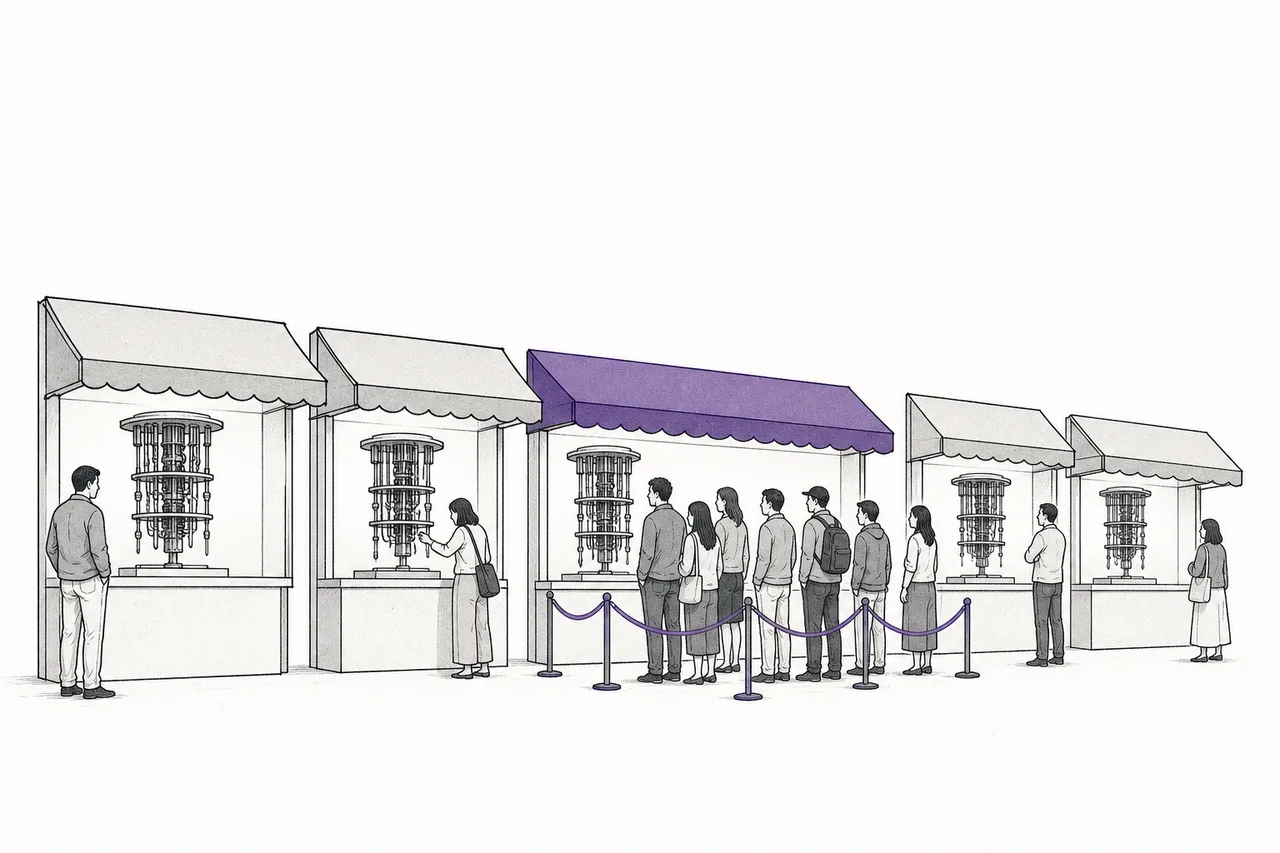
This field splits clearly into three camps: (1) IBM, which controls the industry's "common language" through Qiskit + rents out its own machines · (2) the three hyperscalers (AWS, Azure, Google), the "convenience store" that gathers many companies' machines in one place · and (3) specialized quantum companies that both build machines and sell their own software/algorithms.
The revenue numbers reflect the "early era" clearly: Quantinuum (the leader in algorithms/software, which just went public at a valuation of about $14 billion in mid-2026) made only ~$31M in 2025 revenue but lost ~$193M · IonQ had bookings jump to $95.6M but recognized only $43.1M in actual revenue · D-Wave grew revenue 179% to $24.6M — all small numbers, but growing fast, with everyone betting on massive investment. This is the classic picture of an industry where "the promise runs far ahead of the revenue."
07The road ahead
The first direction is quantum becoming "one more accelerator" in HPC, the way GPUs became standard in AI data centers. The clearest future picture is a QPU (quantum processing unit) working alongside CPUs/GPUs in a supercomputer — with users calling it through the cloud, not even knowing which part of the job ran on quantum. IBM's head of research has gone so far as to say a provable "quantum advantage" might start to show by the end of 2026 if the quantum and HPC communities work together.
The second direction is the fight to be the "common language." Right now IBM's Qiskit is the de facto standard (it runs on both Braket and Azure), but middleware players like Classiq are pushing a "write once, run on any machine" model — whoever wins this war controls the point every developer in the world must pass through, the way the operating system controlled the PC era.
The third direction is private money still pouring in hard. Quantum-software funding rounds set new records in 2025 (Classiq's $110M) and Quantinuum went public at a valuation in the tens of billions — a signal that investors are betting the "layer that collects money first" is software and access, without having to wait for the flagship algorithm to arrive.
08Challenges & risks
The charm of this layer comes with risks you have to look at squarely.
The first and biggest risk is "an advantage that still can't be proven." The whole industry is selling a dream on the assumption that one day quantum will solve problems an ordinary computer can't — but as of 2026 there isn't a single undeniable commercial case. If "that day" comes later than expected, or if ordinary computers (and AI) catch up on the same problems (a phenomenon called dequantization), the value of this entire layer wobbles.
The second risk is "access becoming a commodity (commoditization)." If this layer's core value is "selling machine time," it risks becoming a commodity competing on price, like ordinary cloud — and in that game, hyperscalers like AWS/Azure/Google, with their already-massive customer bases, always have the edge over a small company. So specialized players have to build value that's "hard to copy" (proprietary algorithms/software) before they get squeezed.
The third risk is "a long timeline and money flowing out the whole time." The numbers are clear: even a leader like Quantinuum has ~$31M in revenue but ~$193M in losses in a single year. This is a business that has to burn research money for years before it sees a profit. If capital markets cool, or investors' patience runs out before the "advantage" arrives, some companies may not survive.
In short: this node is the layer that makes quantum "actually usable" without you owning a machine — it turns a building-priced thing into a service anyone can try, and it's the layer that "collects money first" in the whole industry. But the heart you can't forget is that everything still rests on one question — "when will quantum actually do a job worth more than an ordinary computer?" To understand this layer fully is to understand why quantum is both the "most exciting future" and the "most patience-demanding promise" in tech at the same time.