Megatrend · Digital Finance
The "most boring" thing in money markets became the real star on the blockchain
U.S. Treasuries and money-market funds — the dullest, safest assets, the ones nobody gets excited about — turned out to be the first wave of "tokenizing the real thing," and the fastest-growing in the industry's history. And the people doing it aren't new crypto names — they're BlackRock, the world's largest asset manager, and Franklin Templeton, an almost-80-year-old house. This lesson explains why "cash and bonds" were the easiest and most worthwhile things to tokenize before anything else — and how the market grew from $100M to over $15B in just two years.
01What it is
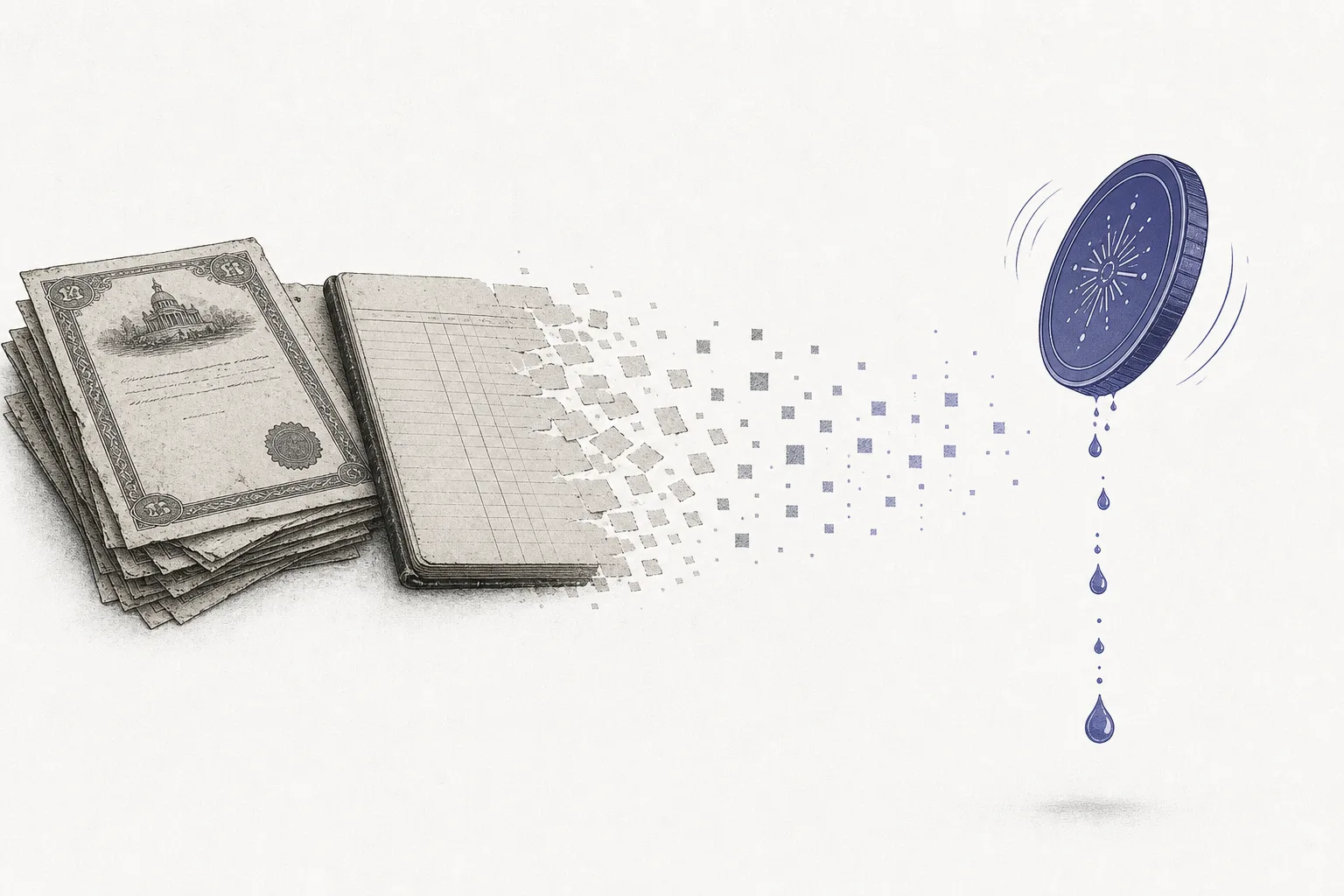
Picture the most ordinary thing in finance: a money-market fund that takes cash, buys short-term U.S. Treasuries (T-bills), and pays the holders interest — a deeply boring "parking spot" for cash that funds and companies have used for decades. This node is about taking a fund like that and "wrapping" it as a token on the blockchain, with one token representing one fund unit, one-for-one.
The heart of this long name is the phrase "Asset Managers" — the people driving this aren't crypto startups, they're real asset managers issuing a token version of funds they already run. The first movers were BlackRock (the BUIDL fund) and Franklin Templeton (the BENJI fund), followed by crypto-born players like Ondo Finance and behind-the-scenes platforms like Securitize.
Money-market fund = a fund that invests in safe short-term assets, especially government bonds, aiming to preserve value and pay steady interest · Tokenized Treasury = taking a bond fund like that and issuing it as a token on the blockchain, so it can be transferred, held, and traded 24 hours a day and pay interest through code — the token still holds real bonds behind it, it's not a simulation.
On the megatrend map, this node is the deepest leaf under Real-World Asset Tokenization (RWA), inside the big trend Digital Finance & Tokenization. If its sibling is the rail for tokenized stocks and securities (putting equities/ETFs on-chain), this node is the "cash and bonds" side — and it's running far ahead, because it's clearly easier and more worthwhile.
02Why it matters — the first wave of RWA
Of all the assets people talk about "tokenizing" — real estate, gold, art, private equity — why were cash and bonds the first to actually work, and the fastest to take off? There are three answers, and all three turn this boring thing into the star.
One — they already have liquidity and a clear price. U.S. Treasuries are the most-traded asset in the world, with a clear market value every second. So tokenizing them doesn't have to "conjure" buyers — it just makes something already smooth even smoother · Two — they pay a yield. In a crypto world that only had "flat" stablecoins paying no interest, tokenized bonds are the "cash that earns" everyone was looking for · Three — they already sit right next to stablecoins. Digital dollars and digital bonds are a natural pair, so they build on each other immediately.
The result was startling growth. The tokenized U.S. Treasury market went from a single fund worth about $100M when BlackRock launched BUIDL in March 2024 to about $15B by mid-2026 — more than a hundredfold in two years — and it makes up over 70% of the total value of all tokenized real-world assets (excluding stablecoins).
More important than the numbers is who is doing it. The fact that asset managers the size of BlackRock and Franklin Templeton are doing it themselves — not just startups — means this has crossed from "a crypto experiment" to "a mainstream financial product." And that's why this small node is the first place TradFi and the blockchain actually meet.
03How it works (real fund → token)
The key question: tokenized bonds aren't fakes — so how do they connect to real bonds? Let's trace the path from a "real fund" to a "token that pays interest by itself on-chain," one step at a time.
What's different from a paper bond in a vault is that it's "programmable". BlackRock's bond token pays interest as new tokens into holders' wallets automatically every day, and it's already starting to be used as collateral in on-chain trading — a paper bond can't do that. Crucially, delivery is instantly settled: the money (stablecoin) and the bond token change hands at the same time in a single transaction, with no waiting for next-day clearing like the old market.
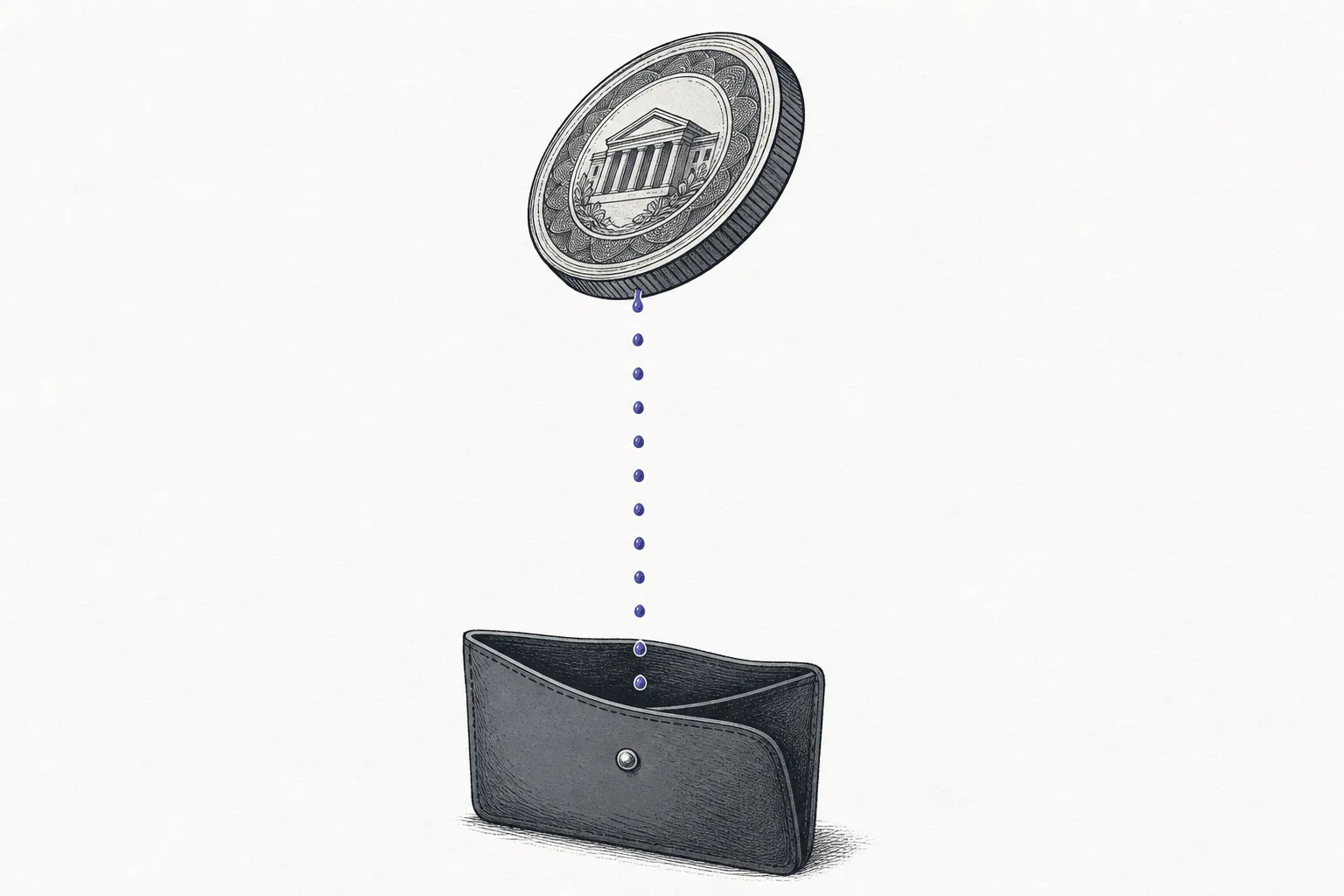
In the traditional bond/stock market, when you trade, the money and the asset actually "settle" one business day later (T+1); while you wait there's risk and you have to post collateral · On the blockchain, the delivery of money and bond token happens at the same time, in a single transaction, finishing in seconds — cutting counterparty risk and money tied up waiting, and it works even outside market hours.
04Where it sits in Digital Finance
A tokenized bond fund doesn't work alone. It only means something when it fits together with its siblings in the Digital Finance & Tokenization family.
- Always paired with Stablecoin — it's the "cash leg": when you buy a bond token, what do you pay with? The answer is a stablecoin (digital dollar), delivered at the same time in a single transaction. The simple way to see it: stablecoin = on-chain cash that earns nothing · bond token = on-chain cash that earns interest. So the two are a tight pair, and many people hold a bond token instead of a bare stablecoin to collect the interest
- Different from the sibling rail for tokenized stocks and securities: that side makes a digital twin of stocks/ETFs, which is much more bound up in securities law and grows more slowly · this node is funds/bonds, which is easier because liquidity and value are already clear — that's why the bond side runs far ahead
- Relies on Cloud & Digital Infrastructure and Cybersecurity & Digital Trust: everything runs on public blockchains and cloud services, so smart-contract security and asset custody are an indispensable foundation — if this layer fails, billions in value shake instantly
05Where it stands now
The state right now is, in a word, "real competition, with several real players" — no longer an experiment. By mid-2026 the tokenized U.S. Treasury market is about $15B, spread across more than 70 products, and the interesting part is that no one dominates — the top three or four are very close in size.
The champion swaps depending on the day you measure: Circle USYC (the Hashnote fund Circle bought) at ~$2.9B · BlackRock BUIDL at ~$2.5–2.6B · Ondo USDY at ~$2.1B · Franklin Templeton BENJI at ~$2.0–2.5B. You could say the top four are at the same level — a far cry from early in the year when BUIDL led alone.
Three things stand out in this period. One — BlackRock spread across many blockchains (Ethereum, Arbitrum, Avalanche, Polygon, Solana, etc.), and BUIDL has already paid out over $100M in cumulative interest since launch · Two — partnerships with big distribution channels, e.g. BUIDL connecting with Binance to expand its use as collateral · Three — the crypto-native challengers, like Ondo, focus on giving retail investors outside the U.S. access (via KYC), while institutional funds like USYC are limited to large investors (minimum $100,000).
Behind almost every fund is the platform Securitize, the "contractor" that issues and manages the tokens (the transfer agent) for BlackRock, Apollo, and many others — quiet, indispensable infrastructure.
06The road ahead
The first direction is bond tokens becoming the "standard collateral" on-chain. Today people hold them to collect interest, but the next step is to post them as collateral in on-chain trading and lending instead of non-yielding stablecoins. If that works, bond tokens become the real "cash that earns" of blockchain finance — a base layer that other products build on top of.
The second direction is banks and big institutions going all in. When JPMorgan, BNY, and other asset managers start issuing their own token products, it will pull in huge institutional money and could turn this market from "billions" into "hundreds of billions" within a few years — because just the cash that funds and companies park in money markets worldwide is already enormous.
The third direction is expanding from bonds to more complex assets. Once the pipes, rails, and trust have been built on the easiest thing (bonds), the same asset managers start moving into private credit and other kinds of funds — so the tokenized bond fund is the "beachhead" that opens the way for all of RWA to follow.
07Challenges & risks
Even as the "safest" side of RWA, there are risks you need to understand clearly.
The first risk is rules and access. Most bond tokens today still aren't open for ordinary retail investors to buy freely — institutional funds like BUIDL and USYC are limited to qualified investors (some have minimums as high as $100,000), because they're securities under strict rules. So how clear each country's law is will decide how widely the market can open.
The second risk is interest rates. The appeal of bond tokens is the roughly 4–5% yield that comes from short-term bond interest, but if central banks cut rates sharply, the yield shrinks too, and the appeal versus holding a bare stablecoin drops — so demand for this asset group is tied directly to the rate cycle.
The third risk is intermediaries and tech. However good the token is, it depends on the "real thing" behind it. If the issuer or custodian has a problem, the token shakes too. Add the risk of a smart contract being hacked, and the fact that a single platform like Securitize sits behind a large share of the market's assets — that concentration is a fragile point to watch.
In short: this node is about taking the "most boring and safest" assets — cash and bonds — and putting them on a digital rail that's faster, always open, and can pay interest by itself. It became the first wave of RWA that actually worked because these things already had liquidity and a clear value. And once BlackRock and Franklin Templeton did it themselves, it stopped being a crypto experiment and became Wall Street moving the real thing on-chain, one step at a time.