Megatrend · Biotech & Genomic Medicine
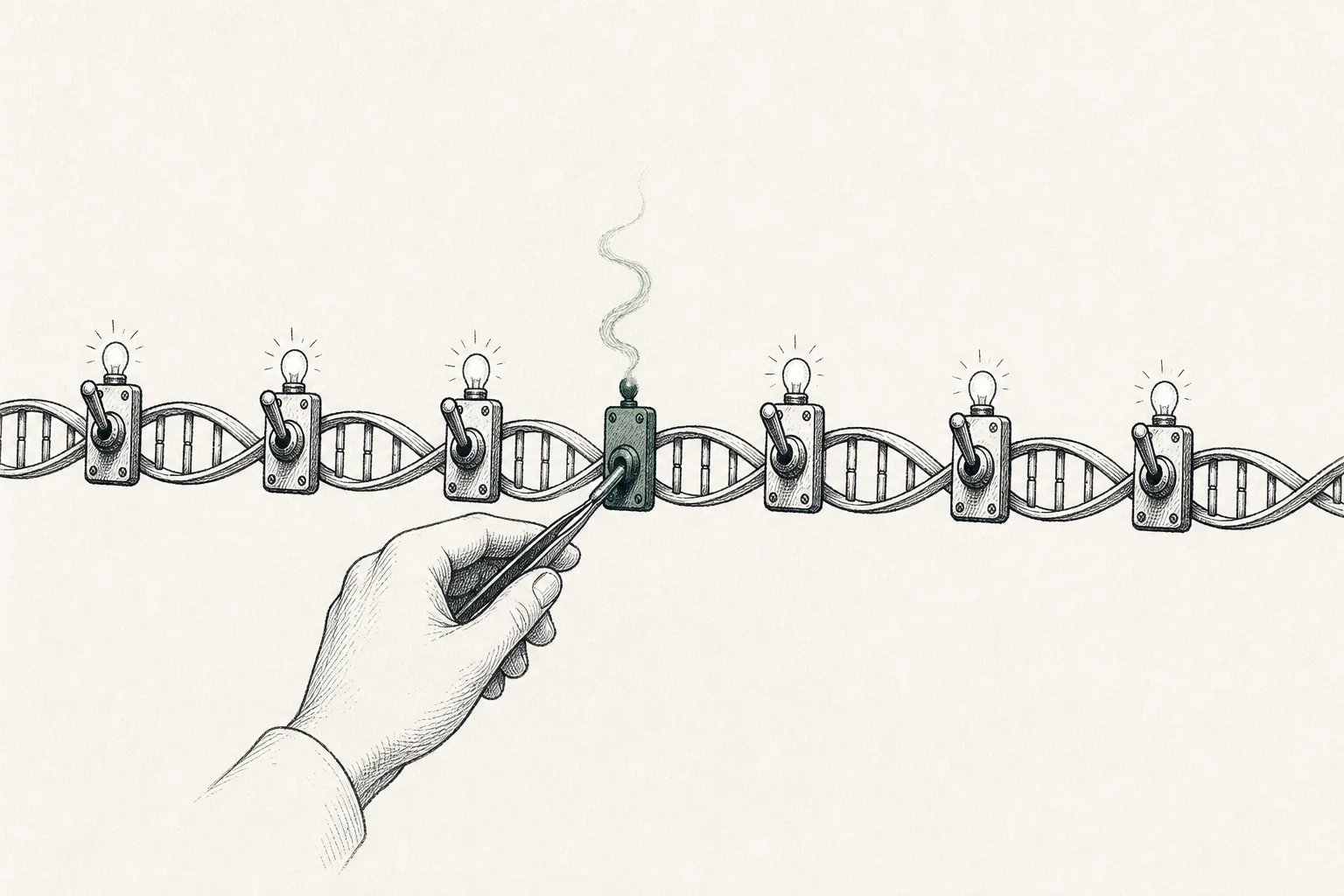
Drugs that don't “build” a protein — they flip the “off switch” on the gene that makes you sick
Almost every drug we know works on a “protein” that's already been built — it binds it, blocks it, plugs it. But this class is smarter than that. It goes one step further upstream, intercepting the “work order” (mRNA) before the bad protein is ever made — silencing the gene at the root of the disease, right at the source. This chapter shows how it works at the molecular level, why a shot given twice a year is changing the game for chronic disease, who the real leaders are, and why “getting the drug somewhere farther than the liver” is the wall the whole field is trying to climb.
01What it is — a drug that “silences” a gene
Picture the body as a giant factory. In the “blueprint vault” (the DNA in the nucleus) sit the blueprints for everything. To build a protein, the cell copies the blueprint into a “work order” called mRNA, then sends that order to the assembly shop (the ribosome) to build the protein accordingly. Almost every drug we know — from painkillers to expensive antibody drugs — acts on the protein after it's already built, intercepting it at the end of the line.
This class does something entirely different: it intercepts the “work order” (mRNA) before the protein is built — tearing up the order, or making it unreadable. The result: the bad protein never appears at all. This is what's called “gene silencing” — it doesn't edit the DNA in the vault (that's the job of gene therapy); it intercepts the “message” on its way out.
There are two main streams here, working by different mechanisms toward the same goal — this field sits under RNA Therapeutics within the big trend Biotech & Genomic Medicine, and has a sibling stream, mRNA Platforms, that does the opposite — instead of silencing a gene, it sends in extra work orders to make the body “build” a protein it needs (like the COVID vaccines). In short: mRNA = sends an order to build · RNAi/ASO = tears up the order to stop building.
mRNA (messenger RNA) = the “work order” the cell copies from DNA to carry off and build a protein · RNAi (RNA interference) uses a short strand called siRNA that borrows the cell's own machine, RISC, to cut the target mRNA apart · ASO (antisense oligonucleotide) = a short, DNA-like strand that binds the mRNA directly to block it or get the cell to chew it up · gene silencing = the combined result, i.e. “that gene goes quiet” — the bad protein drops or disappears.
02Why it matters — a shot given twice a year
The reason the field is excited about this class isn't just that it's new — it's that it opens the door to “targets that were undruggable before”. Roughly 85% of the proteins in the body are the kind ordinary pills or antibodies “can't grab” (undruggable) — because they have no groove for a drug to slot into. But if you go back upstream to act on the mRNA, that problem vanishes instantly, because every mRNA is just a “strand of letters” we can always design a matching complementary strand against — know the gene sequence = you can design the drug.
But the real knockout punch — the one that turned this class from a lab curiosity into a business — is the drug's “durability”. One drug in this class, Leqvio (which lowers cholesterol), is injected just twice a year and keeps LDL controlled all year — versus the older drugs you had to take every single day. Many chronic-disease patients forget their pills or take them inconsistently; a drug a doctor injects twice a year solves the “medication adherence” problem by design. That's why this class is shifting from rare diseases toward chronic diseases that affect millions — like cholesterol and blood pressure.
The numbers bear this out clearly: the antisense and RNAi markets combined sat at around $5.1B in 2024, and many research firms expect them to grow to roughly $14B by 2030 — about 19% a year on average, several times higher than the average for the whole drug industry. And what matters more than the total is the quality of that growth — it's moving from a handful of expensive rare-disease drugs toward drugs that could be used by tens of millions of people.
03How it works (intercepting the message)
The two streams of this class work in different ways but end up at the same place — the target mRNA is destroyed, and the bad protein isn't built. The difference is in “who actually tears up the order.”
The RNAi (siRNA) side is clever in that it borrows the cell's own machinery — siRNA is a short double strand that, once inside the cell, is loaded into a machine called RISC (whose star protein, AGO2, acts like a pair of scissors). One strand is discarded; the other becomes a “wanted poster” that hunts down mRNA with a matching sequence. The moment it finds one, RISC cuts it apart — and the cool part is that the same RISC can keep cutting over and over. A single wanted-poster strand can clear hundreds of mRNAs. That's why siRNA's effect lasts for months.
The antisense (ASO) side is more straightforward — it's a short, single, DNA-like strand that binds the target mRNA directly. Once they pair up, the cell recognizes “something's wrong” and sends an enzyme called RNase H to chew up the mRNA (some ASOs don't degrade it but just “mask” it to fix how the order is read — a mechanism many brain and nervous-system diseases use).
04The ecosystem — GalNAc and the gene-strand factories
However beautiful the gene-silencing mechanism is, it's worthless if you can't get the drug into the right cell — and this is the problem that locked this class in the lab for decades. siRNA and ASO are big molecules, negatively charged; the body sees them as foreign, and injected on their own they degrade or get lost. The fix that changed everything is “GalNAc”.
GalNAc (N-acetylgalactosamine) is a sugar that “liver cells” have a receptor that grabs specifically. So researchers attached GalNAc to the siRNA, like sticking on an “address label” — inject it under the skin and the drug automatically runs straight to liver cells and latches on. The result: it can be injected under the skin (no long IV drips), uses a smaller dose, and lasts for months. Today, about 75% of the RNAi drugs in trials use this GalNAc technique.
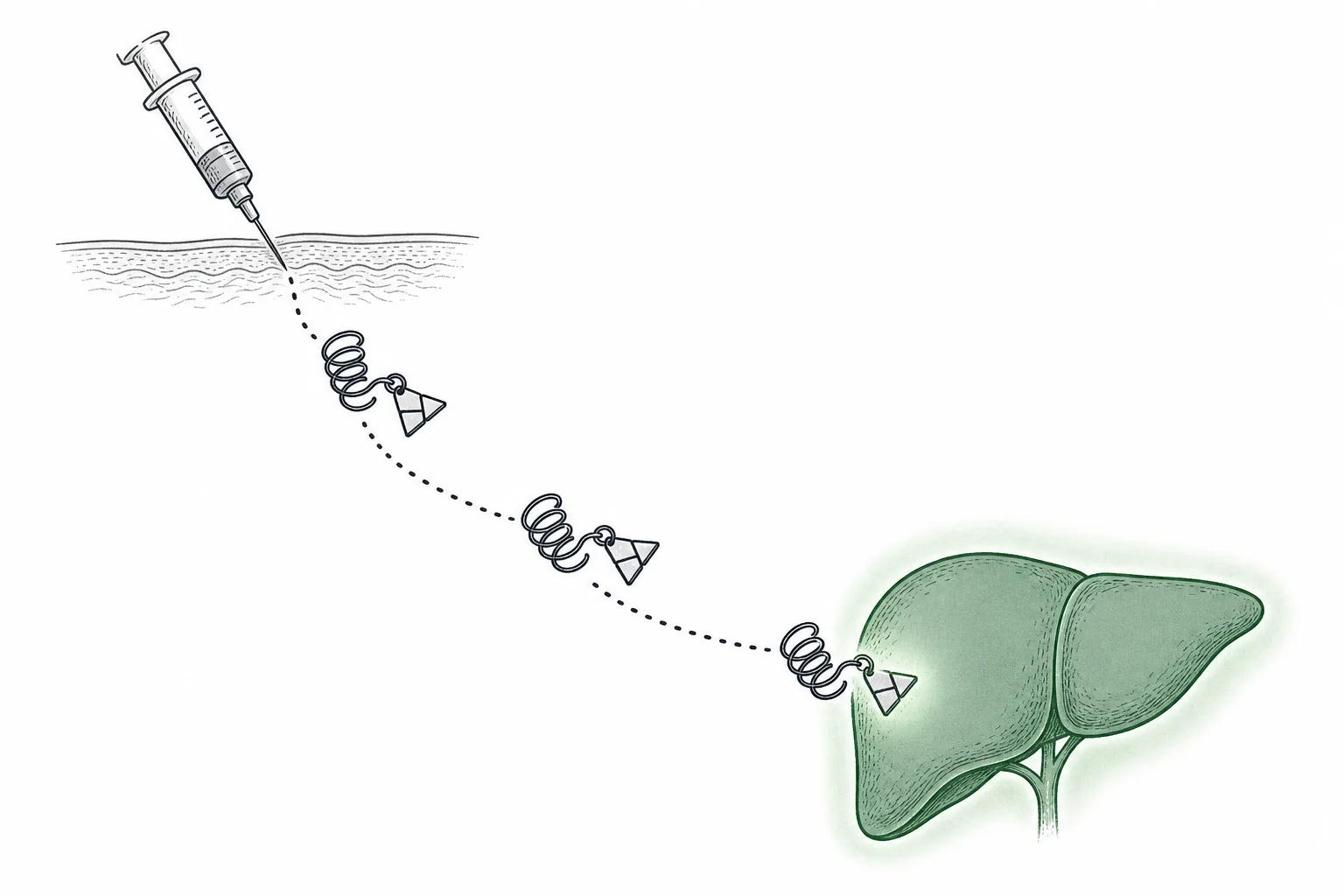
But GalNAc has a “blind spot” built right in: it's too good at carrying drugs to the liver, so nearly the whole field has clustered around “diseases rooted in proteins the liver makes” — which happens to cover big diseases like cholesterol and abnormal-protein buildup (amyloidosis) nicely. To get outside the liver — heart, muscle, brain — you have to rethink the “address label” entirely (we'll come back to this in the future chapter).
The other side of the ecosystem is “who actually makes these genetic strands”. Synthesizing oligonucleotides one letter at a time at industrial scale is hard, expensive chemistry, so most drug companies rely on specialized contract manufacturers — which is why oligo-focused CDMOs get busy in step with drug orders, and connect to mRNA Platforms, which use similar chemical raw materials. On the design side, choosing which gene to silence and which strand will be stable is being accelerated by AI that predicts the structure and stability of strands — cutting the trial-and-error time in the lab dramatically.
05Where it stands now
2025 was the year this class officially “proved itself” financially — there are now around 20 oligonucleotide drugs through the FDA (about 13 antisense and about 7 siRNA). And the big milestone was Alnylam, the RNAi pioneer, pulling off its “first profitable year”, with total product revenue of about $2,987M (up 81%), led by the TTR franchise (Amvuttra + Onpattro), which did about $2,490M (up 103%).
But what most clearly shows the “direction of the future” is this class pushing into the chronic diseases of the masses — Leqvio (inclisiran), Novartis's drug that Alnylam discovered, is injected twice a year to lower cholesterol and did about $298M (up 64%) in the first half of 2025. Novartis places it among the drugs with $3–10B sales potential. Alnylam itself just got Qfitlia (fitusiran) approved in March 2025 — the company's 6th RNAi drug.
The antisense side isn't far behind — Ionis, the original maker of ASO, is shifting from “a company that collects royalties” to selling its own drugs. After putting out Spinraza (treating SMA; global sales once touched ~$1,600M/year via its partner Biogen), Ionis is now launching its own new lineup — Wainua, Tryngolza, and Dawnzera (approved Aug 2025). And worth watching: Asia is entering this field — South Korea has OliX, building its own siRNA platform, while China has several oligo raw-material makers — a sign this technology is no longer concentrated in just a few American companies.
06The future — out of the liver, into the heart and brain
If you had to sum up this class's future in one sentence, it's “the escape from the liver” — because GalNAc carries drugs to the liver so well that nearly the whole field is stuck there. The biggest challenge of the next decade is designing a new “address label” to carry drugs to other organs. And there are three of the hottest fronts.
The first front is heart and blood vessels at mass scale — heart disease is the world's number-one killer, and the liver is already a factory making cholesterol and several risk proteins. Drugs like Leqvio have already proven they work. The next step is high blood pressure, which hundreds of millions of people have worldwide — siRNAs designed to be injected just a few times a year to control blood pressure are in clinical trials. If they succeed, this stops being a rare-disease drug and becomes one that could be used by tens of millions.

The second front is the brain and nervous system — here the antisense (ASO) side has the edge, because it reaches the spinal cord and brain better (Spinraza is injected directly into the spinal fluid). The new hope is getting the drug into the brain without a spinal tap — there's research showing that an injection under the skin lowered tau protein (the culprit behind Alzheimer's) in the brain by about 70–80%, across all 14 regions of the brain in animal studies. If that really translates to humans, it opens the door to a vast set of still-untreatable brain and nervous-system diseases.
The third front is not just “silencing” but “fixing” a gene — new-generation technologies like RNA editing are trying to use the same principle to rewrite the letters on RNA instead of just tearing it up, and exon-skipping (the kind Sarepta uses for the muscle disease Duchenne) uses a short strand to “jump over” the defective part so the cell can still make a usable-enough protein — proving that oligonucleotides aren't just an off button, but a tool that can edit the “genetic message” in many ways.
07Challenges & risks
The first risk is the “outside-the-liver” wall that still hasn't been climbed — nearly all of this class's success right now is tied to GalNAc and the liver. Delivering the drug safely and effectively to the heart, muscle, or brain in humans is still a problem many companies are pouring money into without anyone solving it decisively. Whoever solves it first opens a vast market — but if it can't be solved, this class stays limited to “diseases of the liver,” far smaller than the dream.
The second risk is idiosyncratic side effects and safety — because the drug is a foreign genetic strand, some trigger the immune system, and some accumulate in the kidney or liver and cause toxicity. And because it acts for months, if a side effect occurs you can't “recall the drug” — you have to wait for the effect to wear off on its own, unlike a pill you can just stop taking. This is the double-edged sword of the “durability” that's its selling point.
The third risk is competition and economics — once Alnylam proved this class can really make money, hundreds of companies jumped in. Many are aiming at the same targets (cholesterol, triglycerides), risking drugs that are “too similar” competing on price. And because many of the drugs are still expensive rare-disease drugs costing millions per year, the big question is can the healthcare system afford it — as it moves to millions of patients, prices have to come down a lot, or even an effective drug won't reach most people.
In short: this class is proof that we don't have to wait for the bad protein to appear and then go fight it — we can go back upstream and flip the switch on the gene's “work order.” The challenge that remains isn't “does it work” (it's been proven) but “can we get it to every organ, and make it reachable for people the world over” — and that's the game of the next decade.