Megatrend · Biotech & Genomic Medicine
Inject the "code" and let the body print its own drug — the software of biology
Almost every drug in history has been a "finished product" — we synthesize the drug molecule in a factory and put it into the body. mRNA flips that logic on its head: instead of delivering the drug itself, we deliver the "instructions" (a set of code) and let the patient's own cells make the therapeutic protein — the same technology as the COVID vaccine the whole world got. This chapter walks through how it works at the cellular level, why it's called the "software of biology," why these companies' revenue crashed from tens of billions to a few billion after COVID, and why the next big bet is on individualized cancer vaccines.
01What it is — the software of biology
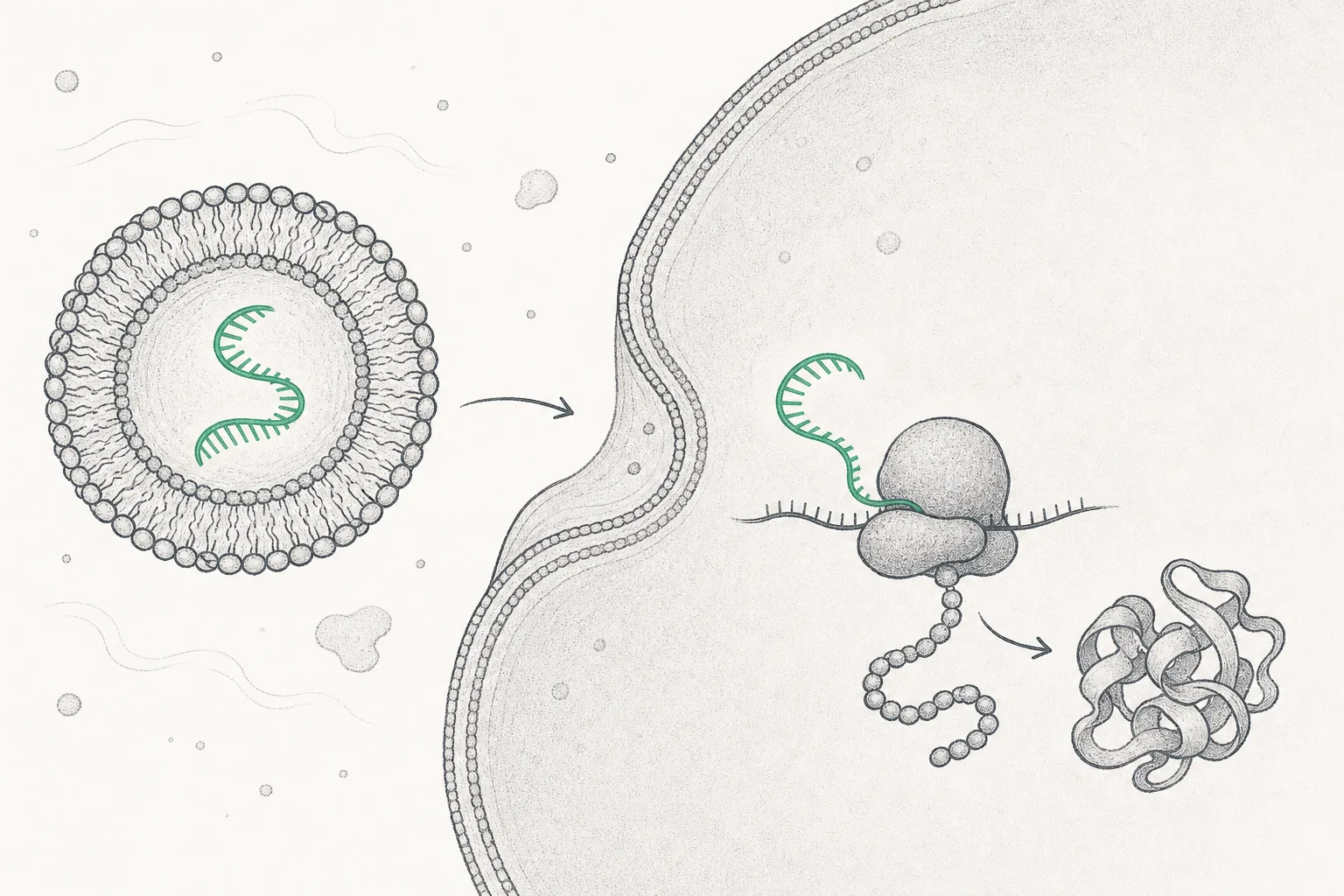
Picture your body as a giant printing plant running nonstop. Every cell holds a "permanent master copy" — your DNA — stored in the nucleus. But the DNA itself doesn't do the work. It sends out a "temporary working copy" of the instructions as a molecule called mRNA (messenger RNA) — this copy drifts out of the nucleus and tells the factory in the cell, "assemble this protein." Once it's done, the copy breaks down and disappears. This is a natural mechanism happening inside us millions of times a second.
The question behind the whole mRNA field is dead simple: "What if we wrote this working copy ourselves in a lab and injected it, to make cells produce the protein we want?" If you can do that, you no longer have to synthesize hard-to-make drugs in a factory — you just send in the "code" and let the patient's own body be the drug factory. That's why people call it the "software of biology": the hardware (human cells) is the same every time, and the only thing that changes is the code you write into it.
The Pfizer–BioNTech and Moderna COVID vaccines the whole world got were the first large-scale proof of this idea — the injected code told our cells to make the virus's "spike protein" temporarily, the immune system saw it and memorized its face, and when the real virus showed up it could fight back in time. This node is a sub-branch under RNA Therapeutics within the giant trend Biotech & Genomic Medicine, and today it's moving from "vaccines that prevent pandemics" to a far bigger arena — treating cancer and rare diseases.
mRNA (messenger RNA) = a temporary working copy of the instructions that tells a cell to make one specific protein · LNP (lipid nanoparticle) = a tiny lipid capsule that wraps the mRNA so it doesn't break down and carries it into the cell — no LNP, no mRNA vaccine · Antigen = the target protein you want the cell to make so the immune system can recognize it (like a virus's spike protein, or a marker specific to a cancer cell) · Platform = the idea that the manufacturing process is the same for every drug, and you only change the "sequence of code" to get a new one
02Why it matters — swapping the recipe as fast as updating an app
The real charm of mRNA isn't just that "it works" — it's that it's "fast" in a way old-style drugs can't be. In early 2020, when China published the coronavirus's genetic code, Moderna took just 2 days to design the vaccine sequence, produced the first batch in 25 days, and began human trials within 63 days — versus the years, even many years, a traditional vaccine takes. The reason: the manufacturing process is the same every time, and the only thing that changes is the sequence of mRNA letters. It's more like "updating an app" than "building a new factory."
That speed turned into enormous money during COVID — and this is where the story gets interesting. In 2021, BioNTech booked roughly €18.8 billion in revenue (nearly all from the Comirnaty vaccine sold with Pfizer), and in 2022 global Comirnaty sales topped $40 billion — breaking the record for the best-selling drug in history. A company that had never put a single product on the market became a money-printing machine overnight. That's what made the whole industry believe mRNA was the "platform of the future," not just a one-time tool in a crisis.
The deeper structural reason is that mRNA opens the door to a drug that can be "truly made for one person". If you read the genetics of one patient's tumor and write mRNA code matched to that tumor's specific markers, you can make an "individualized cancer vaccine" — something a traditional finished-product drug simply can't do, because it has to be made as one batch for everyone. That's why, after COVID, the field's entire research budget flowed in one direction: cancer.
03How it works (from needle to protein)
The big problem with "injecting code" is that bare mRNA is extremely fragile — it breaks down within minutes in the bloodstream, and it carries a negative charge like the cell surface, so the two repel and it can't get in. The field's answer is a hero people rarely talk about: LNP (lipid nanoparticle) — a tiny lipid capsule that wraps the mRNA inside, protects it on the journey, and smuggles it into the cell. The journey of one dose of mRNA drug always follows four steps.
The detail that makes this hard is the "step where it escapes the bag" (endosomal escape) — when the cell swallows the capsule, it gets stored in a tiny acidic bag (the endosome). The problem is that most of the mRNA gets stuck in that bag and is digested away, and only a fraction "escapes" to actually reach the ribosome. So the engineering secret of the LNP lies in the "ionizable lipid" — a special lipid that turns positively charged when it meets the acid in the bag, then helps pierce the bag's wall so the mRNA escapes. Whoever designs this lipid better gets a stronger drug at a lower dose — which is exactly the patent battlefield where companies sue each other fiercely.
04Where it sits in the ecosystem
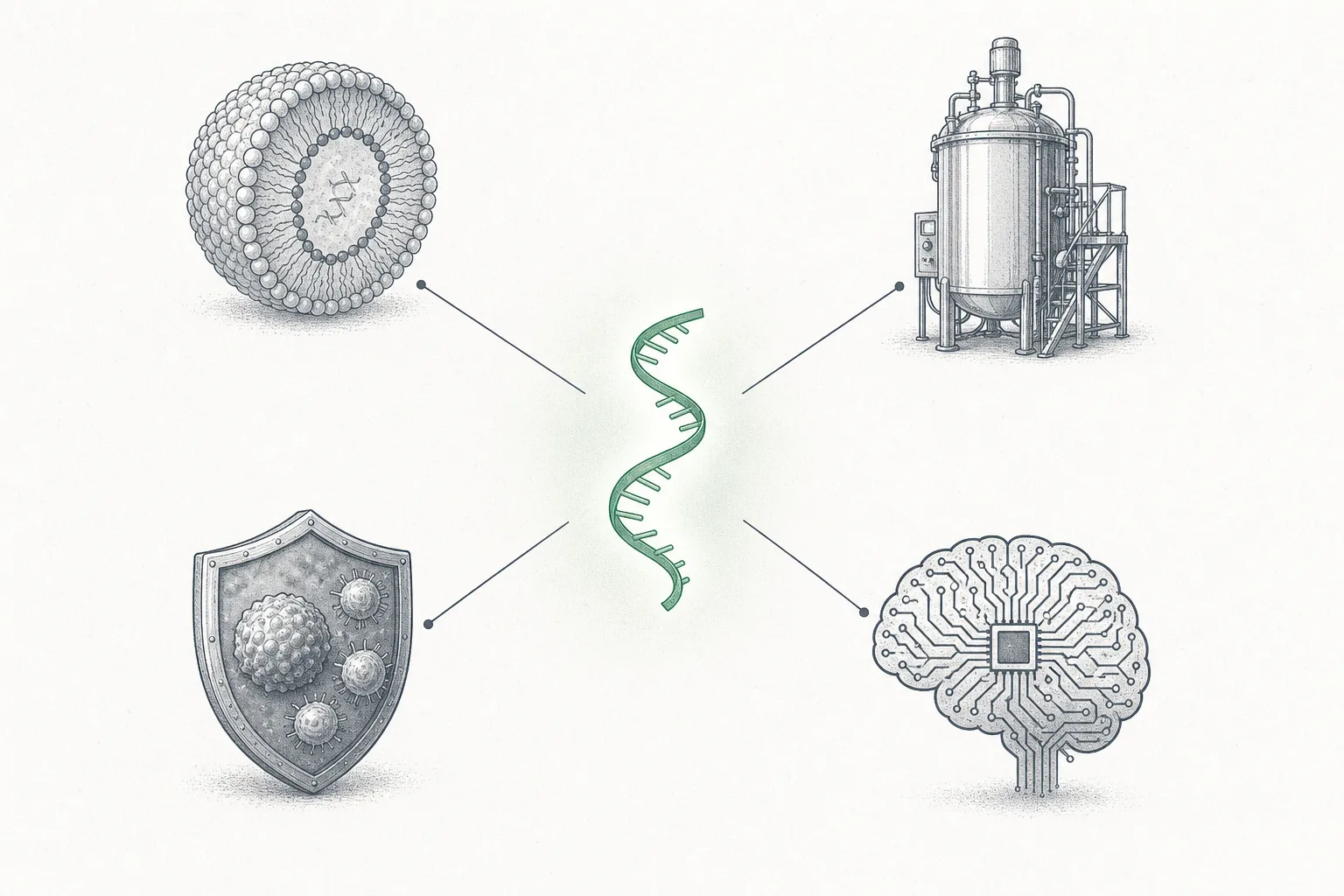
mRNA doesn't stand alone. It's one member of the RNA Therapeutics family, all of which use "RNA" as a drug, but in different ways. The sibling right next door is RNAi / Antisense, which does the opposite of mRNA — instead of telling the cell to make a protein, it "silences" the gene that makes a disease-causing protein (like the one that raises cholesterol). So the two complement each other: one flips the switch on, the other flips it off.
But the more important point is that mRNA can't work alone — it always depends on the ecosystem around it:
- Can't do without the lipid capsule (LNP): without a special lipid to wrap it, mRNA is just a fragile molecule that breaks down instantly. So the LNP world is a real bottleneck — and the reason a company like Maravai (which makes mRNA raw materials) has strong bargaining power
- You need someone to make it — connects to CDMO: producing mRNA at a scale of billions of doses and wrapping LNP consistently is an enormously hard job. So companies like Samsung Biologics and specialized contract factories get huge demand — especially for making "individualized" cancer vaccines that have to be produced one small batch at a time for each patient
- Cancer vaccines have to pair with immunotherapy: an mRNA cancer vaccine like Moderna's mRNA-4157 is always used together with a checkpoint drug like Keytruda — connecting directly to Oncology Therapeutics. The vaccine "points out" the cancer for the immune system to see, while the checkpoint "releases the brake" so the immune system goes in for the kill
- AI designs the sequence of code — connects to Artificial Intelligence: figuring out which mRNA sequence will be stable and produce protein well is a massive computational problem. AI steps in to predict structure and design sequences — slashing the trial-and-error time in the lab, especially for cancer vaccines that have to be redesigned for every patient
05Where it stands now
The biggest story in the industry right now isn't success — it's the "revenue cliff". After COVID ended, vaccine demand plunged, and Moderna's revenue dropped from about $6.7 billion in 2023 to $3.2 billion in 2024, with the company guiding 2025 revenue to just $1.5–2.5 billion — shrinking more than three-quarters in two years. This is the real test of the word "platform": if mRNA is a real platform, it has to produce a next product — not end at a single COVID vaccine.
To cross this cliff, companies are racing to build a "second leg" from other respiratory vaccines — Moderna already won approval for its RSV (mRESVIA) vaccine and has filed for approval of a combined flu+COVID single shot (mRNA-1083) plus a norovirus vaccine in Phase 3 — the idea is to turn mRNA from a "one-time crisis drug" into a "seasonal vaccine" with steady revenue every year, then pour that cash flow into the big bets: cancer and rare diseases.
BioNTech, meanwhile, chose a different path — in June 2025 it announced the acquisition of CureVac, a fellow German mRNA rival (a stock swap at a premium of about 55%), and cleared a long-pending mRNA patent case (settlement payments totaling about $740 million) — consolidating the German field's technology and patents in one hand, to focus on the cancer vaccines both believe are a bigger arena than COVID in the long run.
06The road ahead — the cancer bet
If COVID was the "proof" of the mRNA platform, the far bigger next bet is the individualized cancer vaccine. The idea is beautiful: a doctor takes a piece of the patient's cancer tissue and reads its genetics, finds what "foreign markers" (neoantigens) it has that normal cells don't, then writes a custom mRNA code that teaches that patient's immune system to hunt those markers — a different recipe of vaccine for each patient. Something you simply can't do without a platform that "just changes the code."
The leader across the whole field is mRNA-4157 (V940) from Moderna with Merck, used with Keytruda in the Phase 2b trial (KEYNOTE-942), where the vaccine group had a 2.5-year recurrence-free rate as high as 74.8% versus 55.6% in the Keytruda-only group — cutting the risk of cancer recurrence or death by about 44%. It's now in Phase 3 (V940-001), and Moderna has 8 cancer trials in Phase 2–3 covering melanoma, lung, bladder, and kidney cancer, while worldwide there are more than 120 RNA-type cancer vaccine trials underway.
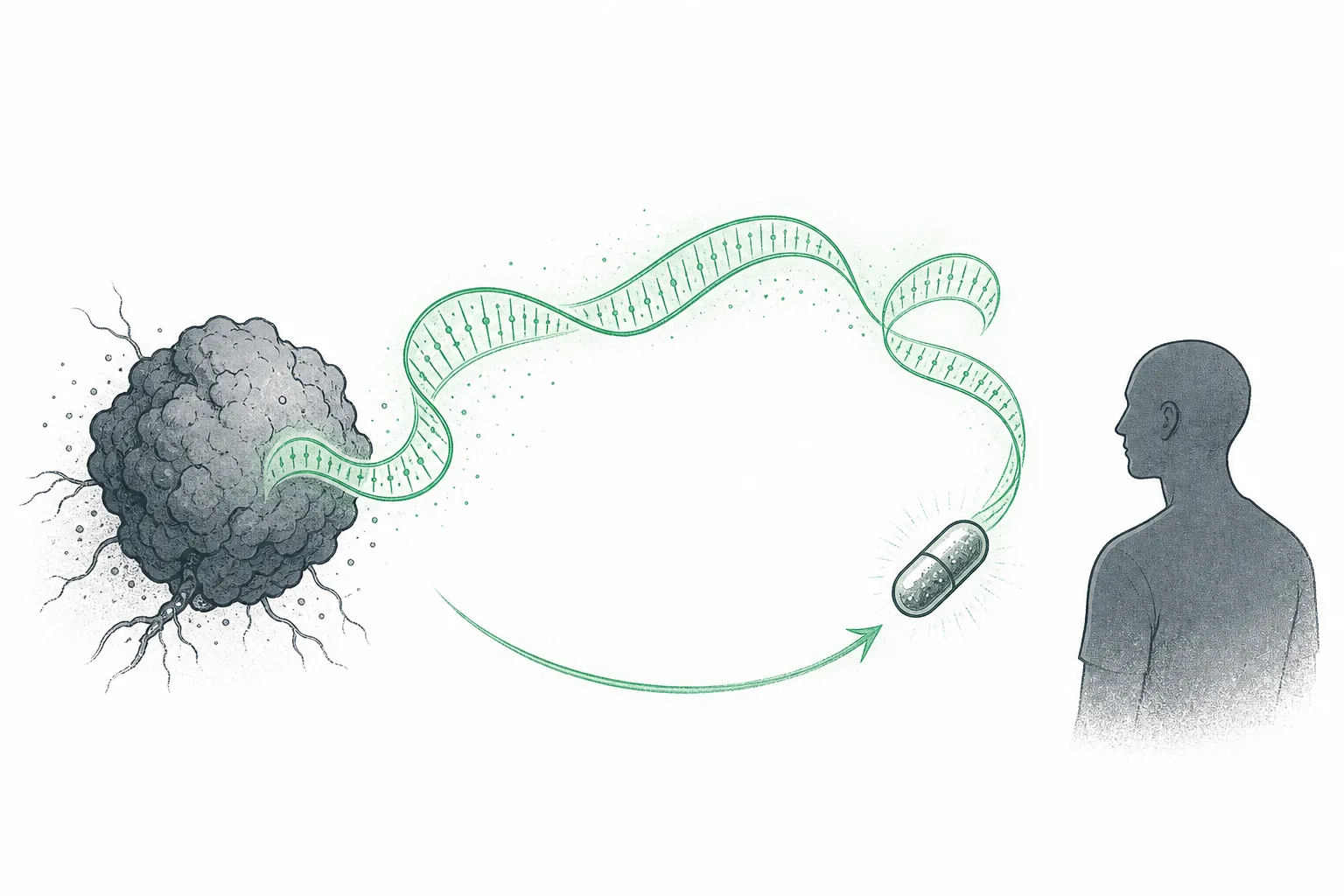
The second direction is rare disease — instead of teaching the immune system, you use mRNA to make cells produce "a protein the patient is missing" directly. Moderna has mRNA-3927 for a disease called propionic acidemia, which has reached its target patient count in the registrational study — if it succeeds, it opens the door to hundreds more rare genetic diseases caused by "missing one specific protein." The third direction is self-amplifying mRNA (saRNA) — a new generation of mRNA that can "copy itself" inside the cell, allowing far smaller doses that last longer, cutting both cost and side effects.
07Challenges & risks
The first risk is the revenue cliff no one has yet proven they can really cross — COVID vaccine revenue that was once in the tens of billions has shrunk to a few billion, and the new products (RSV, combined flu, cancer vaccines) will still take several more years to generate replacement revenue. So a company like Moderna is "burning the cash" it stockpiled during COVID, waiting for the second leg to grow — and if the cancer or seasonal vaccines come slower than hoped, the runway may not be long enough.
The second risk is that it's hard to store and hard to ship — mRNA is fragile, and many vaccines have to be stored at -90°C to -60°C (many times colder than a home freezer), which makes shipping to countries without a ready cold chain very hard. Globally, about half of vaccines are wasted every year due to cold-chain problems — a hidden cost that limits mRNA's market, especially in developing countries.
The third risk is waning immunity and proving efficacy in cancer — immunity from mRNA vaccines wanes over time (research has found antibody levels can drop as much as 7-fold in 6 months for some strains), so boosters are needed. And more importantly, cancer vaccines still have to pass the Phase 3 proof — pretty Phase 2 data is no guarantee of passing a large trial. The history of cancer vaccines is full of hopes that fell at the final hurdle. If V940 stumbles in Phase 3, it would shake confidence across the whole field.
The fourth risk is patent wars and politics — the core technology (especially LNP and nucleotide modification) is held in scattered patents, so companies sue each other heavily (BioNTech buying CureVac and paying settlements is part of clearing this battlefield). And in some countries, mRNA still faces political headwinds after COVID, hitting both public research budgets and market acceptance.
In short: mRNA proved in COVID that it's "fast and works" — but the real proof of the word platform is only just beginning. The question isn't whether the technology works (it does), but whether it can produce a "second, third, fourth product" that makes steady money beyond a pandemic crisis — and that answer will be decided mainly on the cancer battlefield.