Megatrend · Smart City
The power grid has been "blind" for a century — and it's opening its eyes for the first time
For a hundred years, the utility barely knew what was happening on the wires at the far end — only how many units you used this month. When the power went out, it had to wait for you to call. But once rooftops started carrying solar, EVs, and batteries, electricity stopped flowing in just one direction. The old grid, designed to send power "one way only," can't keep up. This lesson is about the technology layer that lets the grid start to "see" and "control" itself in real time — from the meter on your house to the sensors on the poles.
01What it is
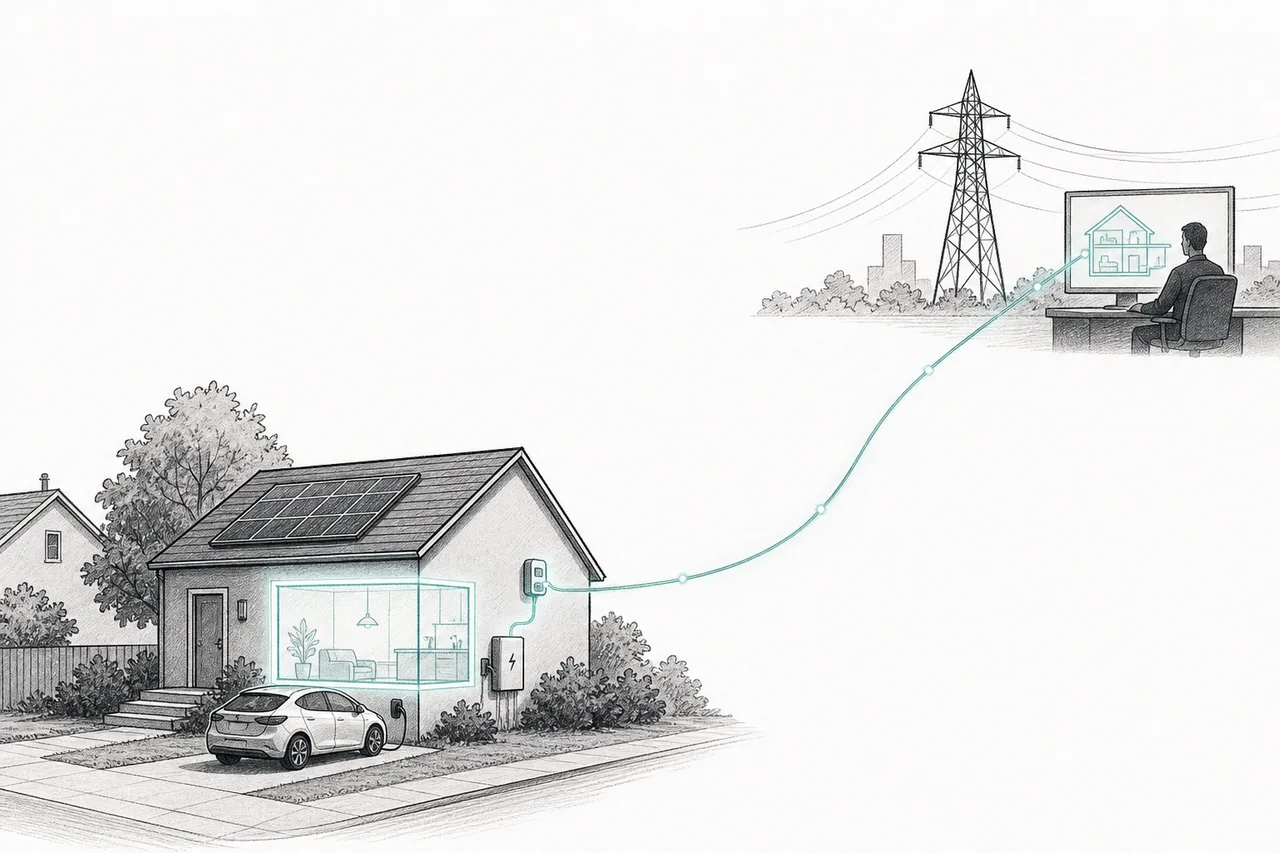
Picture the old meter on the front of your house — the spinning dial that someone walks over to read every month. That's all the utility "knows" about your home: one number, once a month. It doesn't know when the power goes out until you call to tell it. A voltage dip at 3 a.m.? No one sees it.
Smart Metering & Grid Edge is about turning that dumb meter into a smart sensor, then spreading that intelligence across the whole network. It's a sub-field under the megatrend Smart City / Autonomous Infrastructure — and it's the "sensing layer" that lets a whole city's infrastructure see itself. It splits into two parts that work together:
- Smart Meter (AMI): an electricity-water-gas meter that measures usage every few minutes, then talks two ways with the utility over a wireless network — sending data back and receiving commands (like cutting or restoring power remotely). The industry term is AMI
- Grid Edge: sensors on poles and transformers, plus the software that reads all of this data and "balances" the electricity flowing chaotically back and forth from rooftop solar, EVs, and batteries. The word "edge" means the very end of the network — where it meets your house
Not just a "digital meter," but the whole system: the meter + a two-way communication network + the back-end system that stores and processes the data. The earlier generation was called AMR, which could only read values (one-way), while AMI can send commands back (two-way) — and this "two-way" difference is the whole heart of this lesson.
Put simply, if the smart city is the body, Smart Metering & Grid Edge is the nervous system of the energy and water networks — the fibers that let the brain (the utility) sense and reach all the way out to the fingertips.
02Why it matters — the grid can't go "green" without going digital first
This is the heart of the whole story. The grid we use every day was designed a century ago, for a world where power flowed "one way" — from a big power plant, down the transmission lines, to homes, and done. No one sent power back.
But the world is changing three things at once: houses with solar start to generate power and push it back up the grid, EVs become huge chunks of load that plug in to charge at random hours, and renewables like wind and sun generate unevenly with the weather. The old one-way grid simply wasn't built to handle this kind of two-way chaos.
This is the thesis of the trend: electrification + renewables + EVs are "forcing" the grid to digitize. It's not a choice, it's a requirement. And because it's regulated infrastructure, demand is fairly durable and predictable — a long upgrade cycle, not a passing fad.
The size of the market reflects this push. The whole smart grid market was valued at about $66.7 billion in 2025 and is projected to grow past $228 billion by 2033 (CAGR ~17%), with AMI the single biggest slice (~26%).
03How it works
The heart of the mechanism is one word: "two-way." Let's put two eras of the grid side by side.
The old grid was like a single river flowing one way from upstream (the power plant) down to downstream (the home). The utility could see only the "upstream"; downstream was pitch dark. Once homes started carrying solar that pushes power back up, and EVs that draw a lot at random times, the single river turns into a tangled, two-way whirlpool — and without smart meters watching, the utility can barely see what's happening at all.
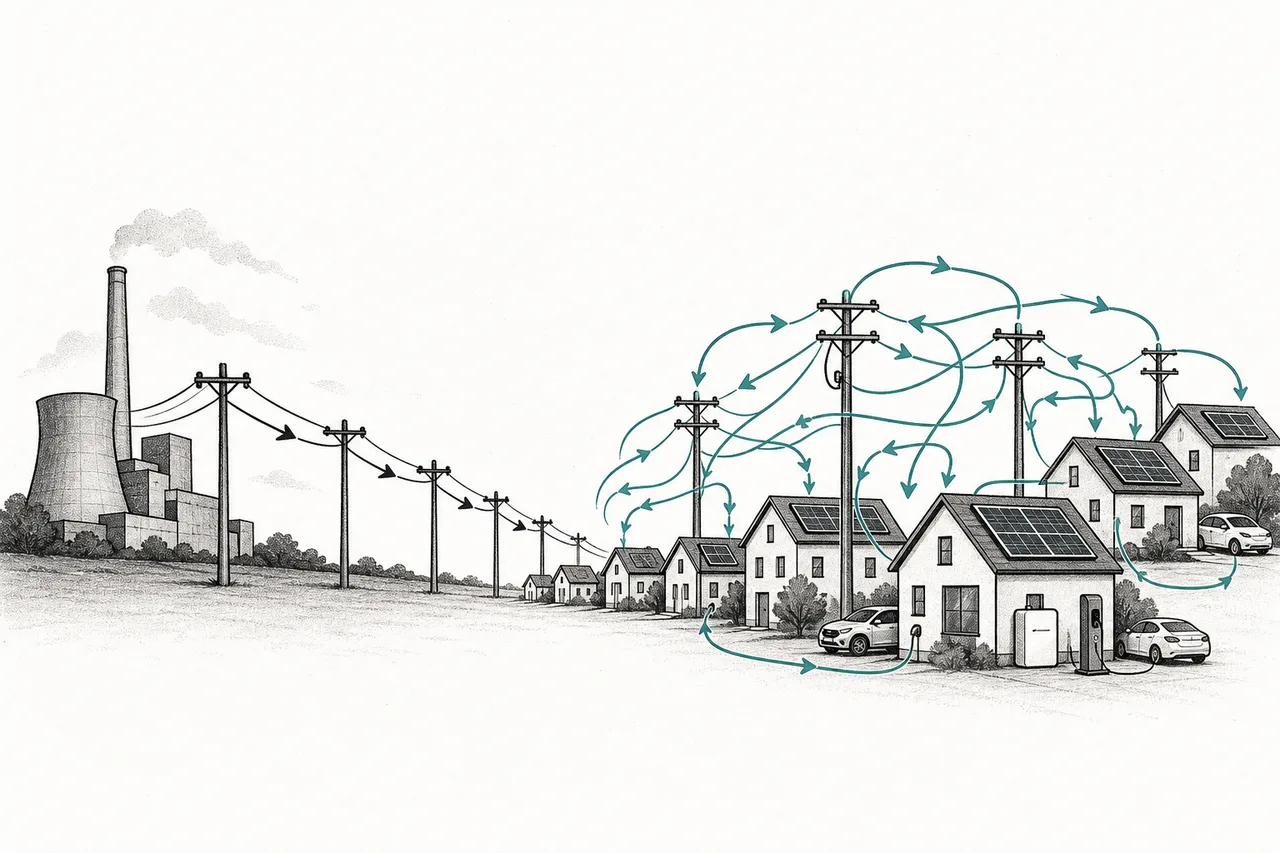
Smart meters solve this with a simple but powerful mechanism: they measure every few minutes, then talk two ways with the utility over a wireless network. That capability instantly unlocks three real things — and Grid Edge takes this data to balance the grid in real time. See the diagram below.
DER = distributed energy resources, like rooftop solar, home batteries, EVs — a huge number of small things scattered at the edge of the grid · DERMS (DER Management System) = the software "conductor" that tells these things to work in concert, like ordering a thousand home batteries to discharge all at once when the grid is tight — this is the upper brain of Grid Edge, sitting above the meter.
A concrete example: time-of-use pricing — the old meter charged one price all day, but a smart meter knows when you use power, so the utility can price it high during peak hours and cheap late at night, nudging you to shift your EV charging to 2 a.m. and reducing the need to build backup plants for the peak. And outage detection — instead of waiting for customers to call, several meters that "go silent" at once tell the utility right away where the outage is and how big it is.
04Where it sits in the smart city
Smart Metering & Grid Edge is one of the pillars of Smart City / Autonomous Infrastructure — specifically, it's the "digital layer of the power grid" in a smart city. It stands alongside siblings like smart traffic systems, connected buildings, and city security cameras, all using the same idea: install sensors → collect data → let the infrastructure see and command itself.
But the tightest connections are to the energy and water trends:
- The limbs of Energy Transition & Power Demand: this is the most important relationship. Clean energy generates unevenly and pushes power back two ways — without the Grid Edge layer to see and balance it, the energy transition can't move forward. You could say it's the "nervous system" that makes the green-energy plan real
- Extends into Smart Buildings & Connected Lighting: the smart meter is where the grid meets the building — a building that knows the time-of-use price will automatically adjust its AC, lighting, and load to save money
- Covers Water Utilities & Treatment: smart meters aren't just for electricity — smart water meters detect leaks by sound, alerting the repair team within minutes (the U.S. loses about 6 billion gallons of water a day). This is why a company like Xylem makes both water and electricity meters
- Depends on AI and Cybersecurity: the frequent data from millions of meters needs AI to analyze, and because the grid is critical infrastructure, cybersecurity is a non-negotiable requirement
From an economic angle: it's the "edge" layer that produces raw data, then feeds it up to the software-cloud-AI layers to do their work. Whoever controls the meter layer + the software that reads it controls the gateway to the whole system.
05Where it stands now
In the U.S., the first wave of smart-meter installation has already come a long way — covering over 78% of electricity customers (North America as a whole at ~82%), and expected to reach ~91% by 2030. But this doesn't mean the job is done. On the contrary, a new wave is coming: the first-generation meters installed 10–15 years ago are reaching end of life and being replaced with smarter second-generation ones — plus the real value is gradually shifting from the "meter itself" to the faster-growing "software and analytics."
As the first install wave nears saturation, the new battlefield everyone is fighting over is software-level "grid edge" — the grid edge solutions market was valued at about $25 billion in 2025 and is projected to grow to around $100 billion by 2030, while the "Edge AI" piece for the grid grows especially fast (CAGR ~26%).
On the company side, the picture is clear: the old leaders in "selling the meter box" are racing to turn themselves into software, recurring-revenue companies. The clearest example is Itron — total revenue in 2025 was ~$2.4 billion (down slightly), but the "Outcomes" segment, which is grid edge software, hit a record ~$360 million, up 23%, with recurring revenue (ARR) of ~$368 million, up 20% — this is the direction the whole industry is heading.
06The road ahead
The first direction is meters that can "think for themselves" (distributed/edge intelligence). Instead of sending all the raw data back to a central place to process, the new generation of meters has chips and AI built in, able to analyze right at the edge of the grid — for example, detecting that the transformer down the alley is about to fail before it actually does. This is why Itron talks about over 16 million smart endpoints and keeps acquiring AI software companies to bolster itself.
The second direction is value shifting from hardware to software-recurring-revenue. You sell a meter once and you're done, but you can sell DERMS software and analytics every month forever. This is why every company is trying to grow its ARR (annual recurring revenue) — the business model is shifting from "selling a box" to "selling a service."
The third direction is EVs and batteries becoming grid resources. Once there are enough EVs and home batteries, DERMS can order millions of cars to discharge power back to the grid at peak (vehicle-to-grid), turning what used to be a "load burden" into distributed "virtual power plants" — and none of this can happen without the meter + grid edge layer to see and command it.
07Challenges & risks
This trend has durable demand, but it also has particular risks you have to look at straight on.
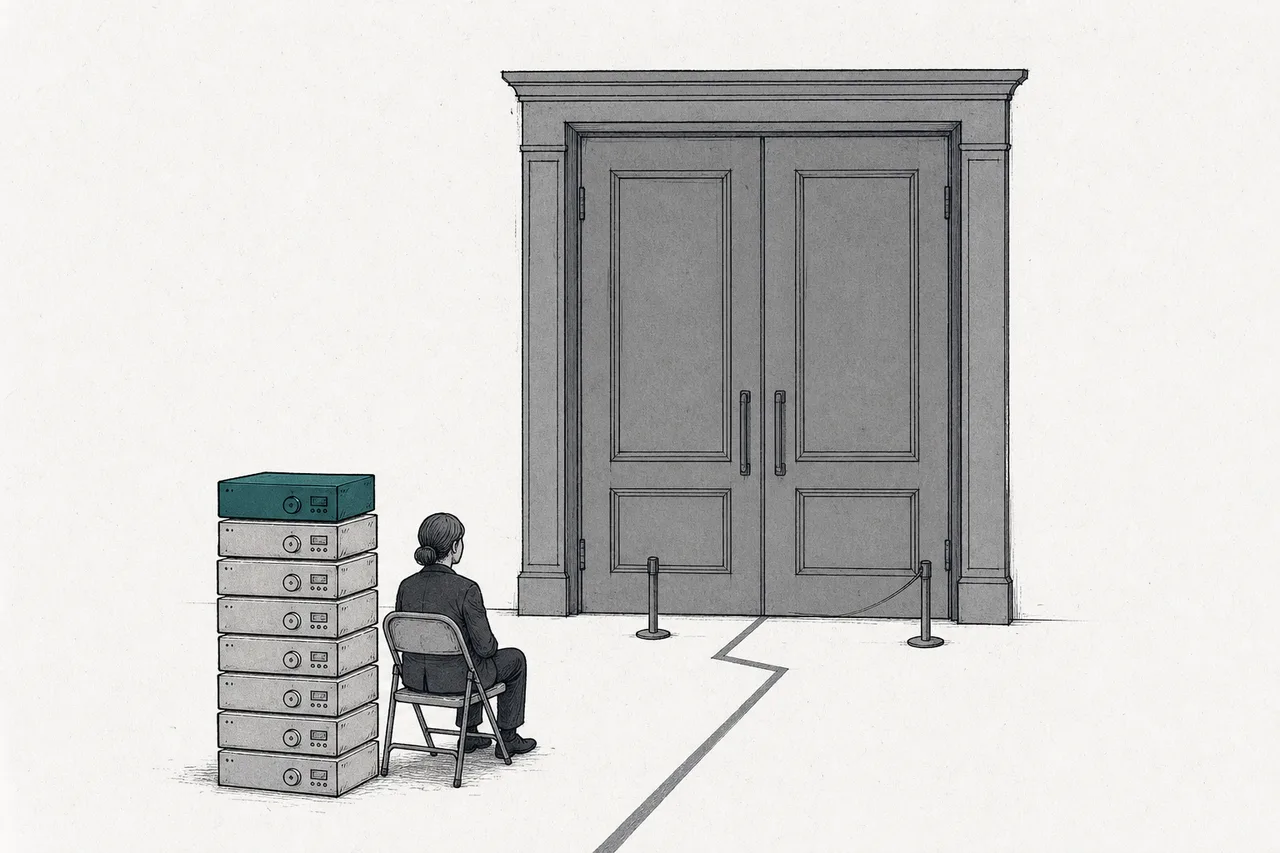
The first risk is a slow, heavily regulated sales cycle. The utility is a conservative, state-controlled organization; big investments have to pass a regulatory commission. Regulators in several states (like Kentucky and Massachusetts) have rejected smart-meter installation proposals because they felt the utility hadn't proven the value clearly enough — one project proposed installing 1.3 million meters on a $350 million budget, and deals this big take years to get a green light.
The second risk is the debate over privacy and cost recovery. Power-use data every 15 minutes can tell in fine detail when you're home, what time you wake up, and which appliances you use. There have been court rulings in the U.S. that viewed this kind of data collection as a "search without a warrant," giving rise to opt-out programs (PG&E, for example, charges $75 + $10 a month not to install one). And the question that always follows is "who pays for this upgrade" — which usually ends up pushed onto users' electricity bills.
The third risk is the promised benefits haven't broadly materialized yet. There are critical reports that most smart meters already installed haven't delivered the benefits as advertised — the meter is installed, but the data isn't actually used for time-of-use pricing or real load management. So installation doesn't equal value, and the cost-effectiveness is still uneven from place to place.
In short: the power grid that's been blind for a century is opening its eyes, because a world full of solar, EVs, and renewables has made the old one-way grid unworkable. Smart Metering & Grid Edge is the technology layer that lets the grid "see and command" two ways — a necessary, durable, regulated upgrade, but one that moves slowly at the pace of utilities and regulators. Whoever understands that the real value is shifting from the "meter box" to the "software that reads it" understands why this small, boring-looking node is the backbone of both the energy transition and the smart city.