Megatrend · Smart City / Autonomous Infrastructure
The building that "knows it's there" — and looks after itself
Buildings worldwide eat nearly a third of all the energy on Earth, yet most of them are still "dumb" — running the AC for a whole floor when three people are sitting there, leaving the lights on in empty rooms. This lesson is about giving a building "senses" and a "brain": sensors all over the ceiling plus a building management system (BMS) that tells the lights and AC to adjust themselves to people and sunlight — cutting the power bill in half, and turning every light bulb into a data point for the building.
01What it is
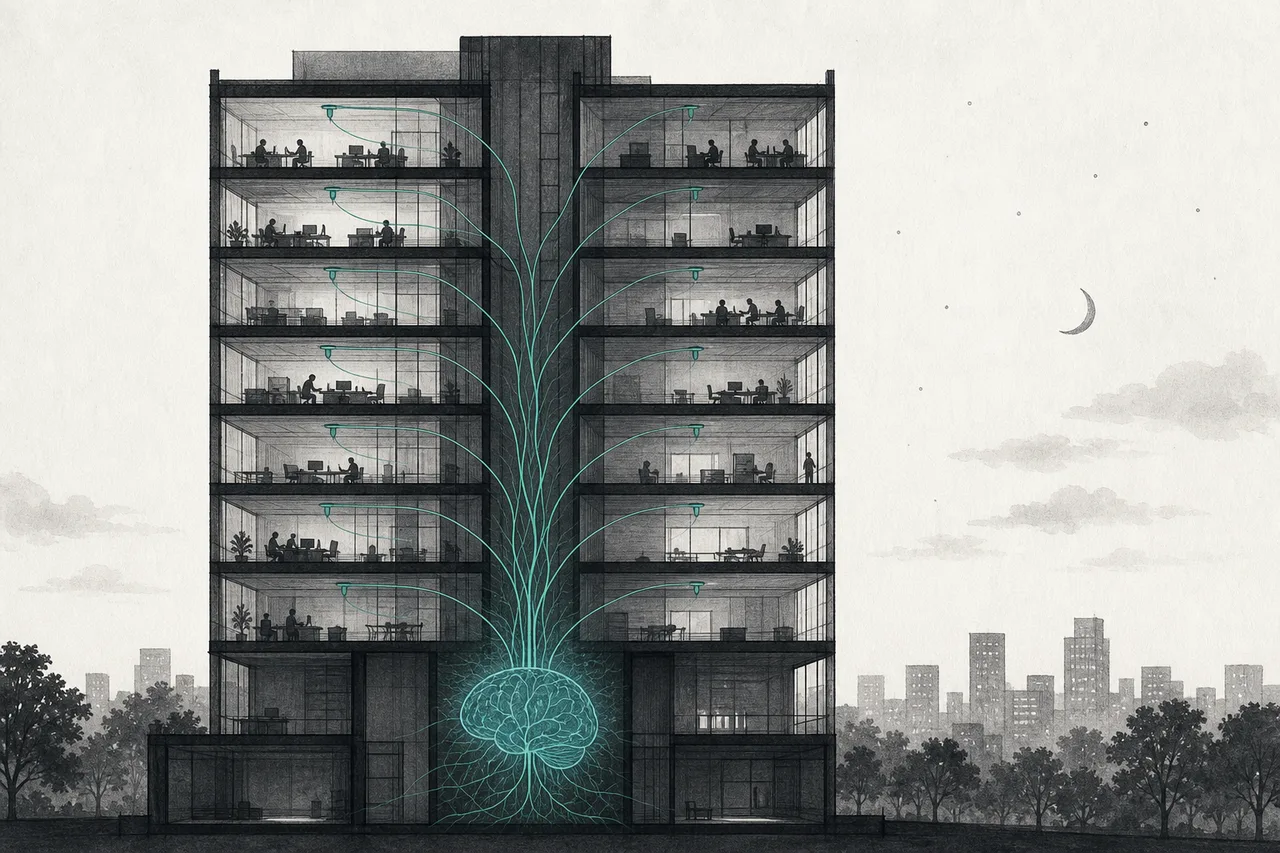
Think of an office building you've worked in — almost all of them are big "dumb boxes." The lights run on a timer, the AC is set to one temperature for the whole floor, and no one knows which meeting room is free or which corner goes unused all day. This node is about turning that "dumb box" into a "building that knows it's there" — fitting it with senses and a brain.
There are two parts at its core. The first is the building management system, or BMS (Building Management System) — the software that acts as the "brain," taking in data from sensors all over the building and commanding its systems, especially HVAC (the air conditioning, heating, and ventilation) which eats the most power in any building. The second is connected lighting — networked LED lighting that doesn't just light the space, but dims, switches on, and switches off by itself based on people and sunlight, and along the way becomes the densest sensor network in the building.
BMS (Building Management System), sometimes called BAS (Building Automation System), is the central system that pulls a whole building's control of lighting, AC, elevators, security, and energy into one place · HVAC = Heating, Ventilation, Air Conditioning, the system that conditions and ventilates the air — the single biggest energy eater in a building. So whoever controls HVAC smartly controls the power bill.
On the megatrend map, this node is a sub-branch under Smart City / Autonomous Infrastructure. Its definition: "the building management, controls, and networked lighting that turn buildings and streets into manageable data assets." Put simply, it's the "building automation layer" of the smart city.
02Why it matters — the building is the real energy eater
Here's the statistic that makes everything click: operating buildings eats about 30% of the world's energy and emits about 26% of all greenhouse gases (counting construction too, it reaches ~40%). So a building isn't just where we work — it's one of civilization's biggest energy-eating machines, and most of them run very "wastefully."
This is why the market is growing fast, with three forces pushing at once: (1) rising energy costs make saving worth real money · (2) ESG rules and energy-efficiency standards force building owners to report and cut their energy use · and (3) the post-COVID era of half-empty offices makes owners want to know which space is actually used, so they can downsize or reallocate.
And here's what matters for the business: this isn't a one-and-done sale. BMS and control software are "sticky" — hard to swap once installed, tied to annual service and maintenance contracts — which gives market leaders predictable recurring revenue, not just hardware sales.
03How it works — the building's nervous system
The best way to understand it is to see the building as a body. It needs three things: senses (sensors), a brain (BMS), and muscles (lights and AC that can adjust). This loop runs all the time.
Sensors spread throughout the building measure four main things: is anyone here (occupancy), temperature, CO₂ (how stuffy the air is — how many people are in the room), and light level (is enough sunlight coming in). All the data flows into the BMS, the "brain," which decides and sends commands back to the lights and AC to adjust to reality — not to a fixed, preset schedule.
A vivid real example: a meeting room sits empty in the afternoon. The sensor detects no one, and the BMS instantly dims that room's lights and eases off its AC. When the bright afternoon sun pours through the window, the light sensor tells the lights by the window to dim down (this is called daylight harvesting — "harvesting" sunlight to use instead of electric light). All of it happens by itself, with no one touching a switch.
The effect of "adjusting to reality" instead of "leaving it on" is enormous — LED lighting with occupancy sensors and daylight harvesting cuts lighting energy use by about 50–80% versus an older system.
04The light bulb that becomes a sensor
Here's the insight people outside the industry usually miss, and the heart of what makes connected lighting special: lighting is the only thing in a building that already exists "everywhere, in every room, in every square meter" — and it already has power running to it. If you want to lay a dense sensor network across the whole building, the most logical place to put the sensors is… inside every single light fixture.
When each LED bulb becomes a "connection point (node)" in the network, with built-in sensors for people, motion, and light, the entire ceiling becomes the finest-grained sensor grid in the building. This is why Signify (formerly Philips Lighting) calls its platform Interact and talks about selling "data," not just "light."
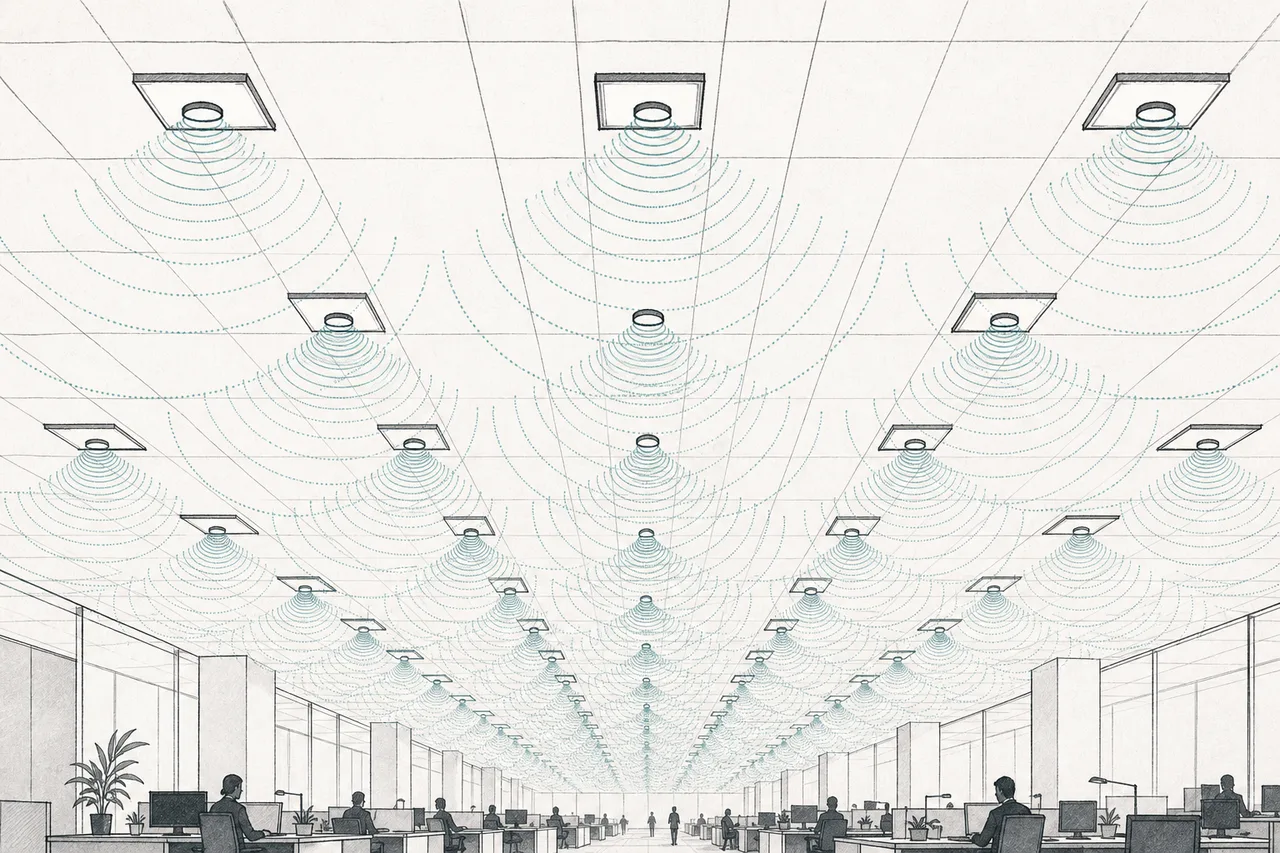
This data is hugely valuable to building owners, because it answers questions worth real money: which floor is packed and which is empty? What percent of desks actually get used each day? If only 60% of the space is really used, the company might cut back on its office lease — and in an era of expensive office rent and hybrid work, this saving is often bigger than the saving on electricity.
Many modern light fixtures use PoE (Power over Ethernet) — pulling both power and data through a single LAN cable, which makes installation easy and lets them talk directly to the IT network · some systems use wireless like Zigbee or Bluetooth Mesh instead, but the idea is the same: make each fixture a "smart device on the network," not just a light bulb.
05Where it sits in the Smart City
If Smart City is about turning "physical infrastructure" into "data assets," then this node is the "building layer" of that story — where people actually live and work. It connects tightly with its siblings and other trends:
- Pairs with Smart Metering & Grid Edge: smart meters measure "how much energy comes into the building," while the BMS controls "how the building uses it." The two connect directly, letting a building respond to time-of-day electricity prices (e.g. shedding load when power is expensive)
- Relies on AI and Cloud: data from millions of sensor points needs AI to find patterns and predict (e.g. "this AC unit is about to fail"), and the cloud to handle the processing
- Needs Cybersecurity: a building with every system online = a new attack surface. A hacked HVAC system or elevator is a real risk
- Ties to Cooling & Heat and energy: the heart of a building's savings is controlling HVAC smartly — and the hot new demand is "cooling systems for AI data centers"
And don't confuse it with its near neighbor: Resilient Buildings & Retrofit is about making "the building itself disaster-resilient" (the surviving-the-climate angle), while this node is about making "the systems inside the building smart." They often work on the same building, but on different layers of the problem.
06Where it stands now
This field isn't led by flashy startups, but by venerable industrial giants that reinvented themselves as software-and-service companies. The real leaders are hardware owners (AC, lighting, control systems) who came first, then layered a digital platform on top.
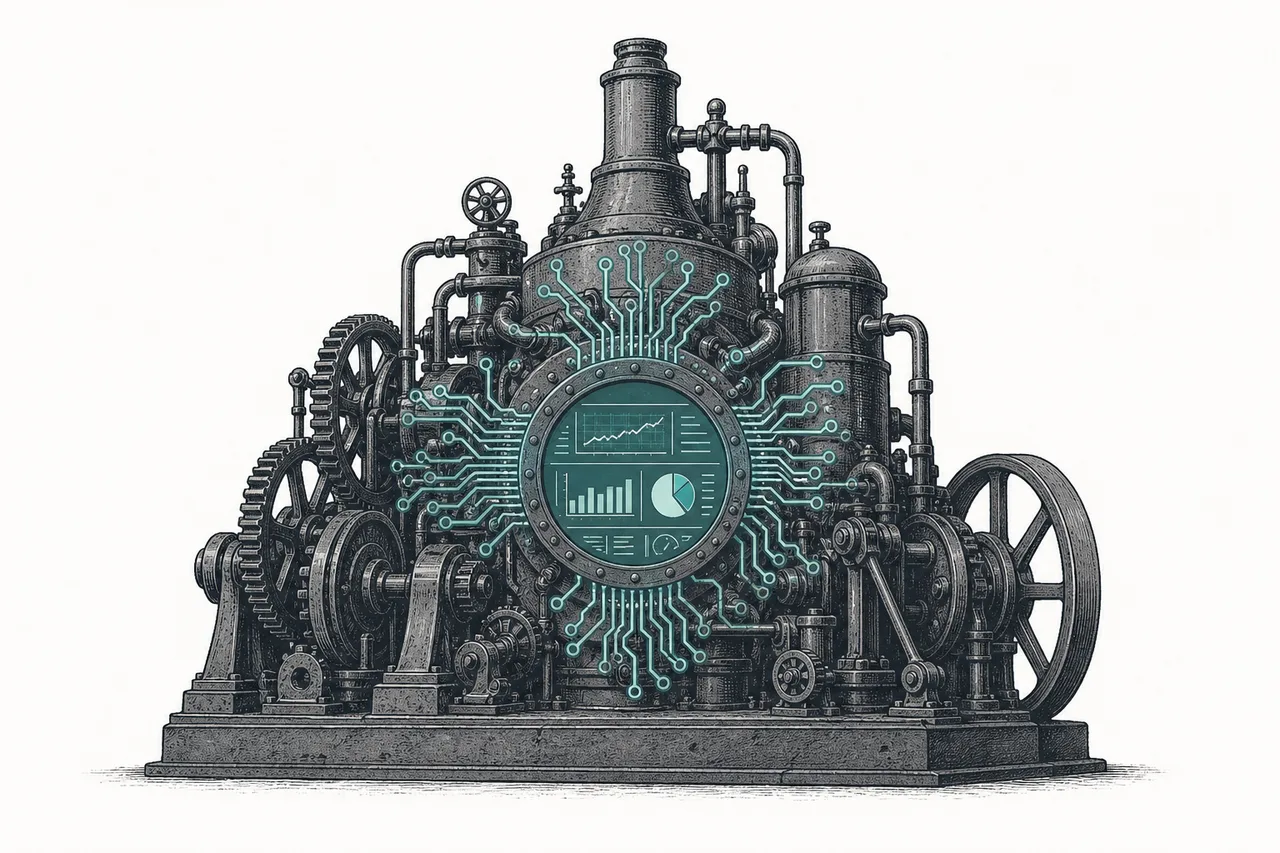
The purest play in this story is Johnson Controls (JCI) — a 140-year-old company that "rebooted" itself into a full-blown smart-building company. In fiscal 2025 it made ~$23.6 billion in revenue, grew 6% organically, and crucially holds a record-high backlog of ~$14.9 billion — reflecting real demand that turns into recurring revenue. JCI's OpenBlue platform is the brain, and its hottest growth accelerator right now is cooling systems for AI data centers (revenue in that group reached ~$4 billion in 2024).
On the connected-lighting side, the world leader is Signify (Netherlands, formerly Philips Lighting), with about €6.1 billion in 2024 revenue, owner of the Philips Hue brand and the IoT platform Interact. But it's also an example of "the not-so-pretty whole truth" — in 2025 Signify had to cut its profit target and saw profit fall in the first quarter, because the lighting market is still growing slowly and price competition is fierce. Lighting getting "smarter" doesn't mean every light seller earns a pretty profit.
There are also the AC-HVAC players like Trane Technologies and Carrier, who sell the building's "muscles" (the air-conditioning systems) along with their own smart control layer, and Asian players like Delta Electronics, Hitachi, and Mitsubishi Electric, who are strong in both building-system hardware and control systems.
07The road ahead
The first direction is AI becoming more of a "brain that can think for itself". From a BMS that just follows rules ("no one here → turn off the lights") toward a system that can predict — for instance, knowing tomorrow will be scorching and the building will be packed, so it starts pre-cooling during cheap-power hours, or detecting that a pump is about to fail before it actually does (predictive maintenance).
The second direction is demand from AI data centers, becoming a growth engine no one expected three years ago. AI data centers throw off enormous heat and need complex cooling and energy management — JCI itself points to this group as its clearest growth vector. Part of the hottest "smart" building right now isn't an office for people, but an "office for chips."
The third direction is turning into a data asset. When every building has desk-level detail on how it's used, value shifts more and more from "selling hardware once" to "software and annual services" — and the long-term winner is likely whoever controls the building's "data and software layer," not just whoever sells the light fixtures or compressors.
08Challenges & risks
The dream of a "smart building" sounds lovely, but in reality there are big rocks in the road we need to talk about plainly.
The first problem is the cost of the retrofit. A new building can be fitted with smart systems from the start without much trouble, but old buildings (which are most of the world's buildings) require putting in sensors, running wiring, and replacing control systems — which is expensive and disruptive to use. So many owners do the math and conclude it's "not worth it yet" — the market grows slower than the headlines make it feel.
The second problem is fragmented standards. This is the field's fiercest enemy. Even within a single building, the systems may speak different languages: HVAC uses BACnet (which holds ~80% of the North American market), lighting might use KNX (popular in Europe), and new IoT devices use Matter/Zigbee. Making them all "understand each other" still requires bolting on gateways and mapping data by hand, which is expensive and brittle — the dream of "a building where everything connects seamlessly" is, in reality, still full of seams.
These are different sets of "common languages" that devices in a building use to talk · BACnet = the main standard for commercial building systems (especially HVAC) · KNX = popular in Europe for lighting and building systems · Matter = a new standard on the IoT / smart-home device side. The fact that several standards exist at once is exactly why "making everything talk to each other" is still hard and expensive.
The third problem is the building cycle is very long, and "smart" is often oversold. Buildings are designed and used for decades, so swapping systems is slow to match. Meanwhile the term "smart building" gets thrown around loosely in marketing — sometimes "smart" just means there's an app to control the lights, with no serious energy-saving system at all. So investors and owners have to separate "genuinely smart, measurably cuts the bill" from "smart on the brochure."
And don't forget cyber risk — the more a building is connected, the wider the attack surface. A hacked HVAC system, elevator, or access-control system isn't just a data leak; it affects the physical safety of the people inside the building.
In short: this is about giving "senses and a brain" to something that eats nearly a third of the world's energy. Sensors + BMS + lights that are sensors themselves let a building dim its own lights, adjust its own AC, and tell the owner how much the space is really used. It isn't as sexy as robots or AI chips, and it's full of real obstacles (expensive retrofits, messy standards, overselling) — but when every percent of a building's energy means enormous money and carbon emissions, this seemingly boring node is one of the most important quiet mechanisms of the smart city.