Megatrend · Defense & Geopolitical Fragmentation
When armies start treating a single soldier as a piece of "equipment" to upgrade
Fighter jets and submarines always grab the headlines. But there's a quieter market that grows more steadily — the stuff a soldier actually wears: ballistic helmets, body armor, chemical-protection masks, night-vision goggles, all the way up to cutting-edge heads-up displays. This is the story of an industry that turned "one soldier" into a platform that has to be kitted out and re-equipped, over and over, without end.
01What is it?
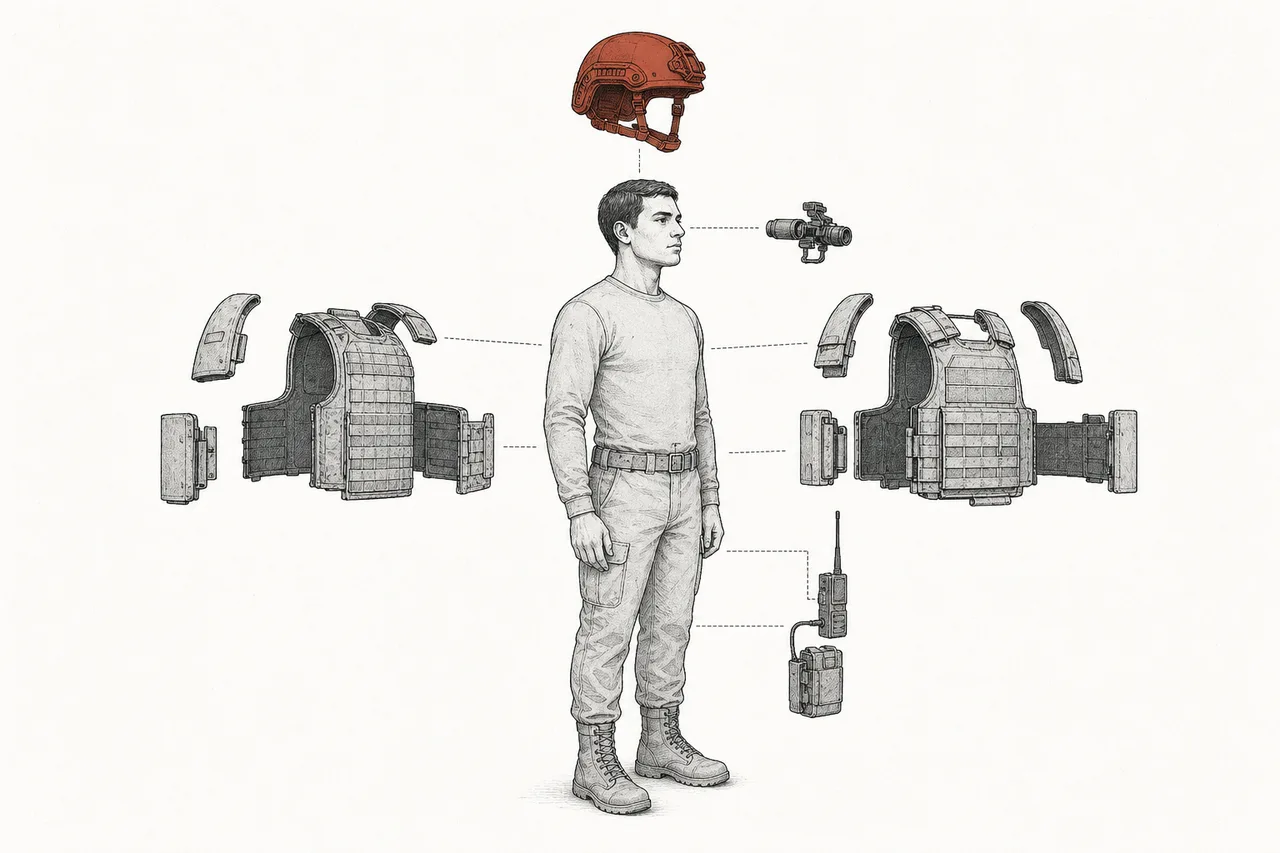
When we think "defense industry," we usually picture the big stuff — fighter jets, aircraft carriers, tanks. But there's another corner that's far smaller, closest to the human body, and easy to overlook: "the things one soldier wears into battle" — ballistic helmets, body armor, chemical-protection masks, night-vision goggles, radios, and the batteries that power all of it. This node is about all of that gear.
The industry calls this group "soldier systems," and the key thing to get straight from the start: this lesson focuses on protective & survivability gear, not the weapons themselves — we're talking about what keeps a person alive and able to do their job, not what they use to attack. The gear breaks roughly into three layers:
- Protection: ballistic helmets, body armor, and masks/respirators that guard against chemical, biological, radiological, and nuclear (CBRN) threats — the oldest layer, and still the biggest share
- Sensing: night-vision goggles, weapon sights, and thermal cameras — letting a soldier "see" where the naked eye can't
- Connection: body-worn radios, positioning systems, batteries and power management, and at the high-tech end, the heads-up display that projects information straight into the soldier's field of view
CBRN = Chemical, Biological, Radiological, Nuclear — the family of threats from chemical agents, biological agents, radiation, and nuclear material. CBRN gear means the masks and respirators that let people work in a contaminated area · Dismounted soldier = an infantryman "off the vehicle," moving on foot with nothing but what they carry — a uniquely hard problem, because every extra gram is weight the person has to haul themselves.
On the megatrend map, Soldier Systems & Protective Equipment is a sub-theme under Defense & Geopolitical Fragmentation, and it has a character that's clearly different from the rest of defense — it's not one hugely expensive item, but "lots of units per head" that have to be made for every soldier, and replaced again and again as gear wears out and the technology moves on.
02Why it's an interesting market
The global soldier-systems market is worth around $11 billion in 2025 and is expected to grow to ~$20 billion by 2034 (roughly 6–7% a year). That doesn't sound as flashy as rockets or chips. But the appeal here is the "steadiness" — it compounds quietly, driven by forces that rarely go away.
The first driver is soldier survivability. Every army in the world wants its people to come home, and will pay for it even when budgets are tight. So protective gear is the hardest line item to cut in a defense budget. That's exactly why personal protection holds the biggest share of the soldier-systems market, around 31% — and it's the fastest-growing segment too.
The second driver is a tenser world. The war in Ukraine and conflicts in the Middle East have pushed NATO countries to grow their ground forces, raise gear specs, and worry more about CBRN threats — Avon Protection, the UK maker of masks and helmets, says outright that the geopolitical situation is fueling demand for both. By the end of fiscal 2025, its order book hit a record $263 million (up from $225 million the year before).
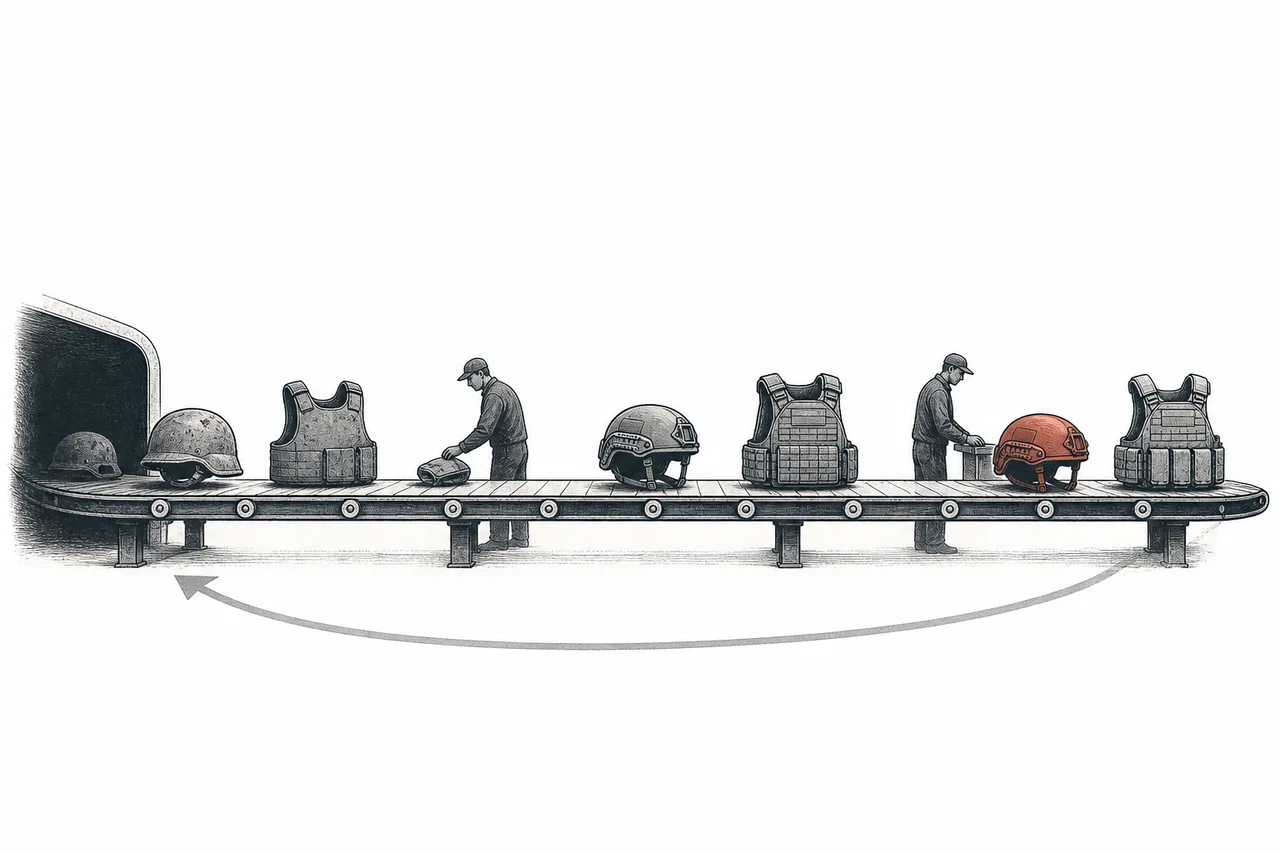
The third driver is what makes this market truly "never saturated": it's replacement-driven. Helmets and body armor have a limited service life, chemical masks need filter changes, old night-vision goggles get upgraded to newer ones — unlike a jet that's sold once and used for 30 years, this gear has a "replacement cycle" built in. That creates a stream of revenue that keeps coming back.
03The soldier as a "platform" to be kitted out
The key to understanding this whole node is one idea: a modern army sees a single soldier as a "platform" — just as it sees a jet or a tank as a platform to bolt systems onto, the same goes for a soldier. One body becomes a frame onto which gear is "assembled" layer by layer. The industry calls this effort "modernizing the dismounted soldier."
Picture assembling one soldier as three stacked layers — each layer a sub-market with its own set of specialist companies:
The mechanism that keeps this market running sits in the dashed arrow beneath the diagram — the "replacement cycle." A helmet that's taken a hit or aged out needs replacing. Mask filters expire. Old night-vision goggles get swapped for newer ones that see better. And when one army raises its specs, every soldier in it (hundreds of thousands, even millions) has to get a new set — so demand doesn't arrive as one lump, it rolls in wave after wave, on the replacement cycle.
There's one physical constraint that shapes the whole industry: weight and power. The more gear you strap on, the more the soldier has to carry and the more battery they need — sometimes the very thing that boosts survivability cuts down on mobility. That's why most innovation here runs toward "lighter, tougher, lower-power" rather than just piling on raw features.
04Where it sits in the defense ecosystem
This node is the "layer closest to the person" in the defense industry. It connects upward to the big picture, and sideways to the fields that make a soldier's gear smarter:
- A sub-layer of Defense & Geopolitical Fragmentation: as the world splits into blocs and every nation grows its defense budget, part of that money flows straight down to "the soldier's personal gear" — this node is the most tangible endpoint of the global rearmament wave
- Different from the US defense primes: primes build huge, hugely expensive platforms, but most of a soldier's personal gear comes from smaller specialist companies — a different business model, a different cast of players
- Depends on Defense Electronics, EW & Sensors: night-vision goggles and thermal cameras are the "brain and eyes" that let a soldier see in the dark — this node's sensing layer overlaps directly with defense electronics
- Depends on AI and connects to Spatial Computing: the high-tech endpoint of this node is the heads-up display that overlays data on the field of view — a battlefield version of AR / spatial computing. Civilian and military gear share the same base technology
- Depends on Critical Materials: body armor and helmets are made from special fibers (like aramid, UHMWPE) and ceramics, and sensors need rare earths — so the materials supply chain is a sensitive weak point too
05Where it stands now
The 2025–2026 picture is strong demand across every layer. Protection gets a tailwind from NATO's force buildup, while night vision is booming as armies in many countries rush to switch to newer models — the global night-vision market is around $8.5–9.3 billion in 2025 and is expected to reach ~$13 billion by 2030 (roughly 8–10% a year, faster than the soldier-systems average).
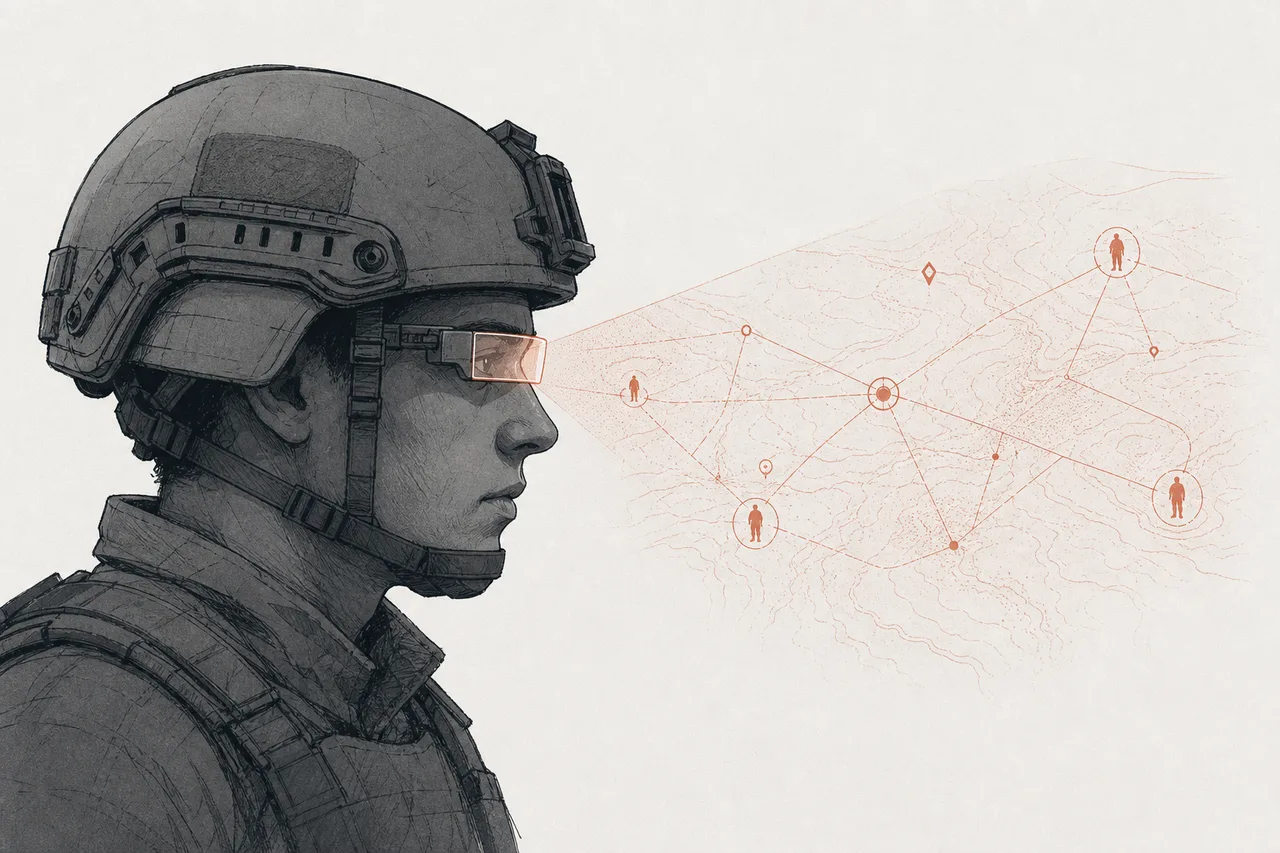
But the biggest story of the year is at the high-tech end — the US Army's IVAS program: a heads-up display that projects maps and data into a soldier's field of view, a contract worth as much as $22 billion. The program was once led by Microsoft, but ran into hardware problems and complaints from users in the field — so on February 11, 2025, Microsoft announced it was handing the program to Anduril, a new-generation defense-tech company (the Army formally approved the transfer in April 2025) — a sign of both the enormous potential and the difficulty of making battlefield-grade AR actually work.
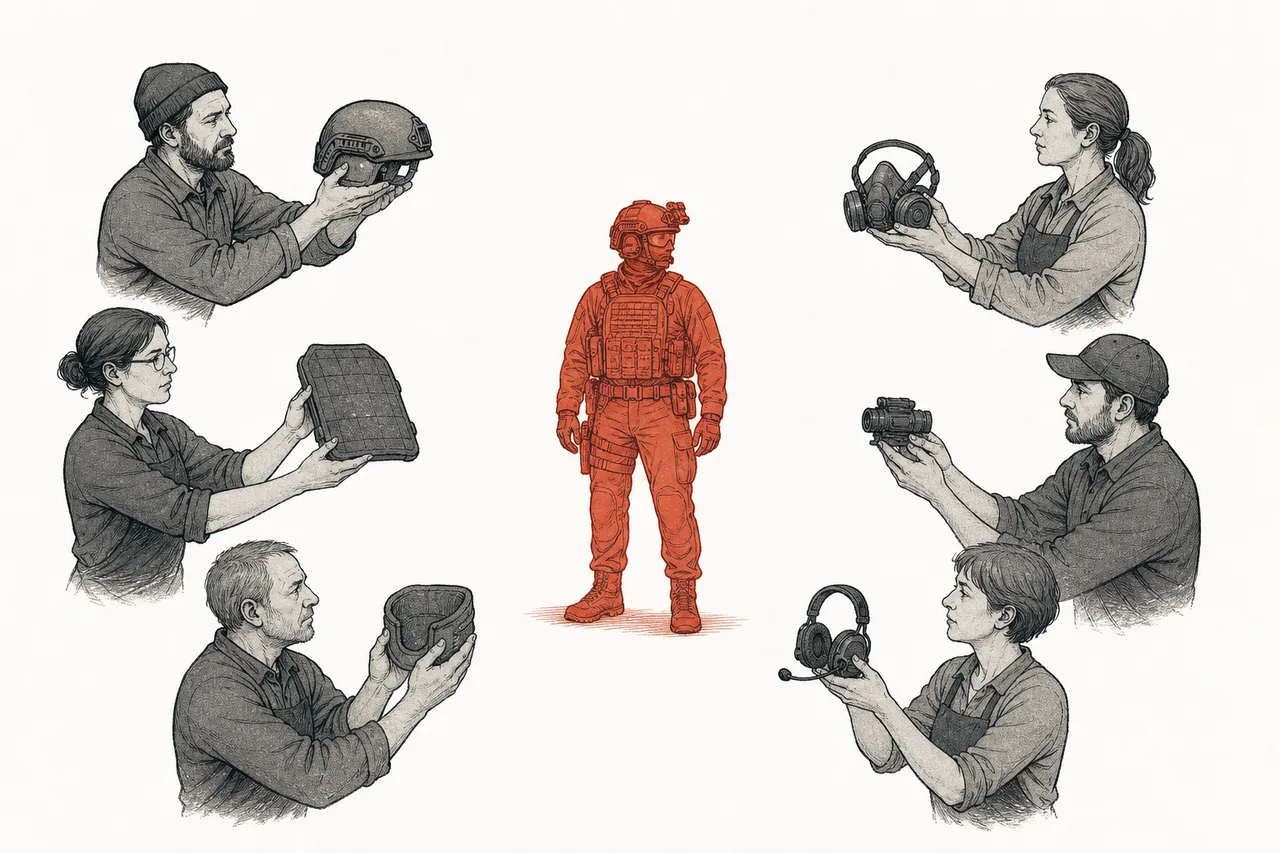
Looking across the players, what stands out is that this node is spread across specialist companies, not held by a single defense giant. And many of the real players, especially on the helmet side, are still private companies not listed on the stock market (like Gentex/Ops-Core and Galvion — Galvion just won a $130 million US Marine Corps helmet contract in 2025). That leaves only a handful of public companies in this group, so each one is worth watching closely.
06The road ahead
The first direction is "the soldier as a node in the network." The long-term goal of modernizing the dismounted soldier is to make every soldier both a sensor and a data send/receive point on the same network — what they see, and where, gets sent straight back into the system. That's why a heads-up display like IVAS matters. It isn't just "fancy goggles" — it turns the soldier into a connection to the army's whole data and sensor system.
The second direction is "lighter and smarter." Because the weight-and-power limit is a real ceiling, innovation runs toward new materials that are lighter but protect better, tougher batteries, and using AI to filter information so the soldier doesn't "drown in data" — the aim is more capability without adding to the load on the person carrying it.
The third direction is "demand wider than the military." A lot of this gear — CBRN masks, body armor, night-vision goggles — is also used by police, rescue teams, and emergency responders (which is why companies like MSA and Cadre have both military and civilian customers). This "public safety" market keeps demand from being tied purely to the war cycle.
07Challenges & risks
This sturdy-looking trend has its shadows too, and you should see them all.
The first risk is "tied to the defense budget." Most demand comes from governments. If defense budgets get cut or delayed, orders slow with them. Protection gear may be "harder to cut" than other items, but it's not immune to political and budget cycles — some items can be pushed back if they have to be.
The second risk is "the double edge of the replacement cycle." The cycle that brings revenue back again and again also means the big revenue tends to be tied to a few large procurement programs. When one program ends or slips, revenue can come in fits and starts — Avon Protection itself once warned about the uncertainty in its body-armor revenue mix during certain stretches. So this market is "steady in the big picture, but bumpy in the short run."
The third risk is "competition and technical difficulty." The high-tech side (helmet displays / AR) has proven genuinely hard — IVAS had to change hands from Microsoft to Anduril precisely because making it actually usable wasn't easy. Gear that's "too advanced" — heavy, power-hungry, or nausea-inducing — can get rejected by soldiers. Meanwhile the basics (helmets/body armor) have plenty of competitors, public and private, which keeps price and bidding pressure high.
In short, this node is a lesson that defense isn't all expensive big-ticket gear. Sometimes the most durable investment story hides in "the small things every soldier has to wear" — and a tenser world is now making armies see a single soldier as a platform worth kitting out and upgrading for a long time to come.