Megatrend · Critical Materials
The business that sells air — and profits like a utility
Oxygen, nitrogen, helium, and thousands of specialty chemicals are the “invisible ingredients” of the modern economy — inside every chip, car, drug, and piece of steel, yet almost never carrying a logo. The remarkable part: some of it is one of the “best businesses in the world.” It sells things floating in the air, on 15-20 year contracts that customers pay even when they don't use the product — which gives it utility-like steady revenue plus a rare kind of pricing power.
01What is it? (Two worlds in one node)
Think about the things around you — your phone, your car, a pill bottle, the steel in a building, a window. None of them could exist without some gas or specialty chemical somewhere in the manufacturing. But those inputs never show up as a brand name on the final product. They're the “invisible ingredients” of the economy — and this node is their story.
Actually, this node bundles together two very different worlds:
- Industrial Gases: oxygen, nitrogen, hydrogen, argon, helium, plus the ultra-high-purity “electronic gases” used to make chips. These look like ordinary commodities (air is free, after all) — yet the business behind them is one of the best in the world. We'll explain why in Chapter 3
- Specialty Chemicals: high-value chemicals sold by “function,” not by volume — catalysts, coatings, additives, electronic chemicals. They command a premium because they “do a job better than anyone else,” not because they weigh a lot
Commodity chemicals — like ethylene and methanol — sell by the “ton” and compete purely on price; margins are thin and swing with the oil cycle · Specialty chemicals sell by “function” — customers pay because the chemical makes paint last longer, chips cleaner, or a reaction faster. Raw-material cost is a fraction of the value sold, so margins are fatter and far more cycle-resistant.
On the megatrend map, this node is a sub-theme under Critical Materials & Supply Chain — the most “upstream” layer, because raw materials and basic inputs are born here before they're sent off to become real products in the other trends that consume them.
02Why the “invisible ingredients” matter
Start with size. The global industrial-gas market sat at roughly $99B in 2025 and is expected to reach about $127B by 2030 (around 5% a year). The specialty-chemicals market is far bigger — the midpoint across research firms is roughly $900B to over $1 trillion in 2025. Together, that's the base of the whole world's manufacturing economy.
But the market-size number doesn't tell the most important part. The real story is “who pays, and what they're paying for.” Look at where these gases show up:
- Steel and metals: mills blow pure oxygen into the furnace to speed up the reaction — you can't make steel without huge volumes of it
- Hospitals: medical oxygen, plus the liquid helium that cools every MRI machine in the world
- Chips: fabs need ultra-high-purity nitrogen and specialty gases at every step — etching, coating, cleaning the wafer
- Clean energy: hydrogen is both a chemical feedstock and the hope of clean energy
That's why this business is so durable — it doesn't lean on any single industry. When any part of the economy grows, gas sells. And here's the key: the new wave of demand is coming from three fast-growing forces — chips (AI), hydrogen (clean energy), and healthcare.
03How it works (the model that prints money like a utility)
This is the heart of the lesson, and the reason investors love the industrial-gas business even though it “just sells air.” The key is the “on-site / take-or-pay” model.
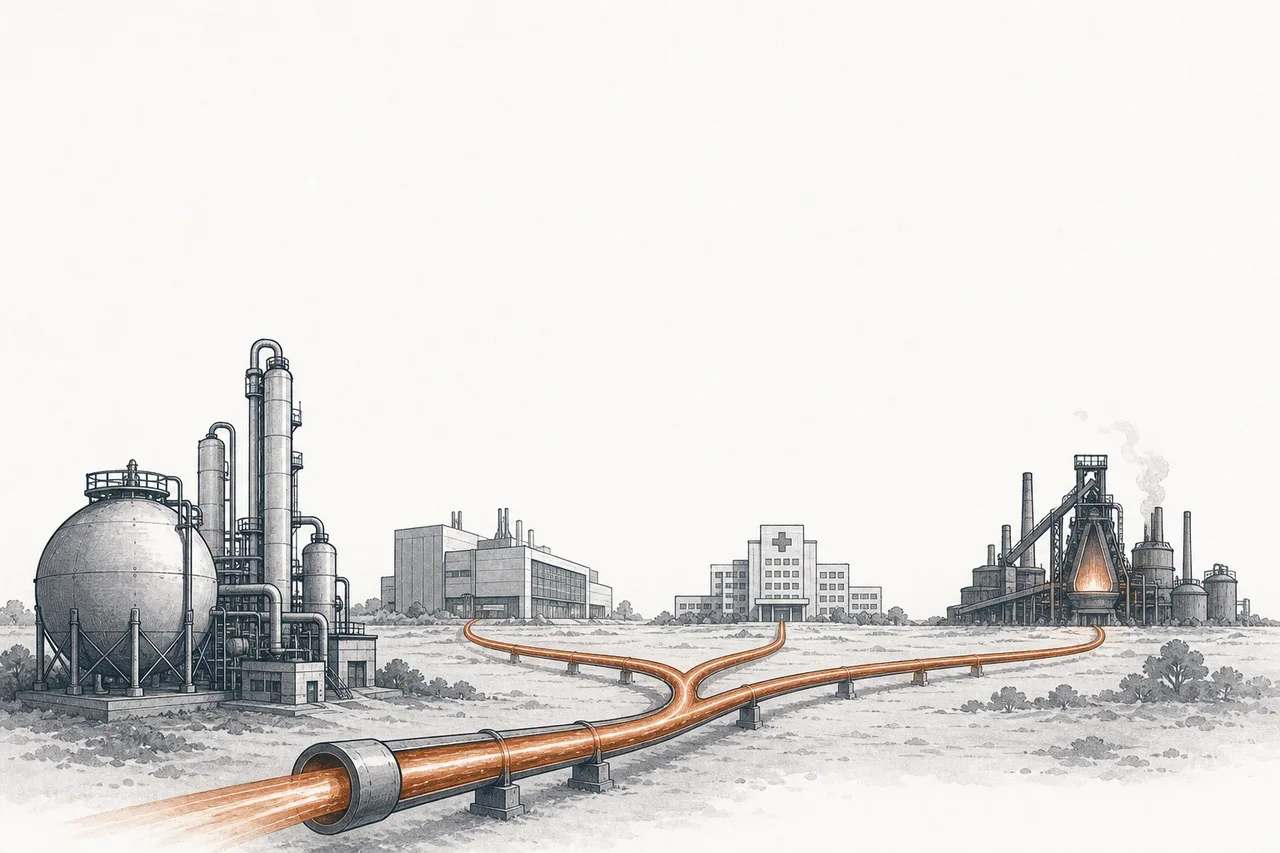
Picture this. You're a gas company, and a big steel mill wants to buy oxygen. The smartest move isn't trucking tanks in every day — it's to build an air-separation plant right against the customer's fence and pipe the oxygen straight in. Then you sign a 15-20 year contract where the customer agrees to pay a monthly minimum even in a month they use less gas than agreed — that's what take-or-pay means.
The effect of this model is powerful:
- Predictable revenue: Linde, the world's biggest player, locks in about 70% of sales with take-or-pay contracts — so most of its revenue arrives no matter how the economy moves
- Pricing power: contracts often tie prices to inflation and pass energy costs through to the customer — so the company keeps its margin even when costs spike
- A deep moat (lock-in): once the air-separation plant is built against the customer's fence, switching suppliers is extremely hard — which leaves almost no room for new competitors
The profit numbers prove it. In 2025, Linde did $33.99B in sales at an adjusted operating margin of ~29.8% — a level you rarely see in a business that sells “basic stuff.” And US-based Air Products runs an adjusted EBITDA margin of about 40%.
04Specialty chemicals — sold by “function,” not by the ton
The other half of this node is specialty chemicals. They play a different game from gases, but with the same core idea: sell value, not weight.
Here's a comparison to make it concrete. A commodity chemical like ethylene sells for a few hundred dollars a ton and competes purely on price. But a specialty chemical like photoresist — used to “draw the pattern” onto a chip wafer — or a catalyst that keeps a refinery running, sells for dozens of times more per kilogram, because the customer is paying for the “function” it performs — not because it's heavy.
The moat of specialty chemicals isn't just the “secret formula.” It's the formulation know-how to tune a chemical to each customer's specific process — a coating that works on one automaker's line has to be reformulated entirely for another. Once it's dialed in and certified, the customer doesn't want to switch, because switching means re-qualifying the whole process again — that's another form of lock-in.
This market is broad and fragmented — from paints and coatings (the biggest group, ~28% of the specialty-chemicals market) to catalysts, additives, and electronic chemicals. And the fastest-growing part right now is the group tied to chips and clean energy.
A good example of the “specialty chemical + on-site moat” model is Ecolab, the world's leader in water-treatment and hygiene chemistry (about $16B in sales in 2025), which manages water systems right inside the customer's plant — just like industrial gas, embedding itself in the customer's process gives it pricing power and makes customers hard to lose.
The chip-linked electronic-chemicals market is the star. The ultra-high-purity gases and materials for semiconductors market alone is around $11.9B in 2025 and is expected to grow to ~$24.8B by 2032 (about 11% a year) — twice as fast as the gas market overall, because every new generation of chips demands more process steps and ever-higher purity.
05How it connects in the ecosystem
This node sits “upstream” in the economy, so it feeds almost every other trend. Look at the most important connections:
- Paired with Semiconductor Materials: close cousins under the same Critical Materials umbrella — the line is that Semiconductor Materials focuses on “chip-only” materials (wafers, photoresist), while this node is gases and chemicals used more broadly. But the two meet at “electronic gases,” feeding the same fabs together
- Core of Hydrogen & Fuel Cells: hydrogen is one of the industrial gases — so the giant gas companies are among the world's biggest producers and infrastructure-builders of hydrogen. Clean energy is a direct new growth engine for them
- Feeds Climate Adaptation & Water: water-treatment chemistry (like Ecolab's) is the heart of clean-water and wastewater management worldwide. As water gets scarcer, demand for it grows
- Driven by AI and Energy Transition: these two are the biggest new sources of demand — AI chip fabs devour specialty gases, and the energy transition needs much more hydrogen and specialized gas
The interesting part is that this node is the “picks and shovels” seller of the other megatrends — no matter who wins the AI chip war or who dominates the hydrogen market, the gas companies sell to every side anyway. That makes it a way to invest in hot trends with a built-in “it doesn't matter who wins” kind of risk.
06Where it stands now + the players
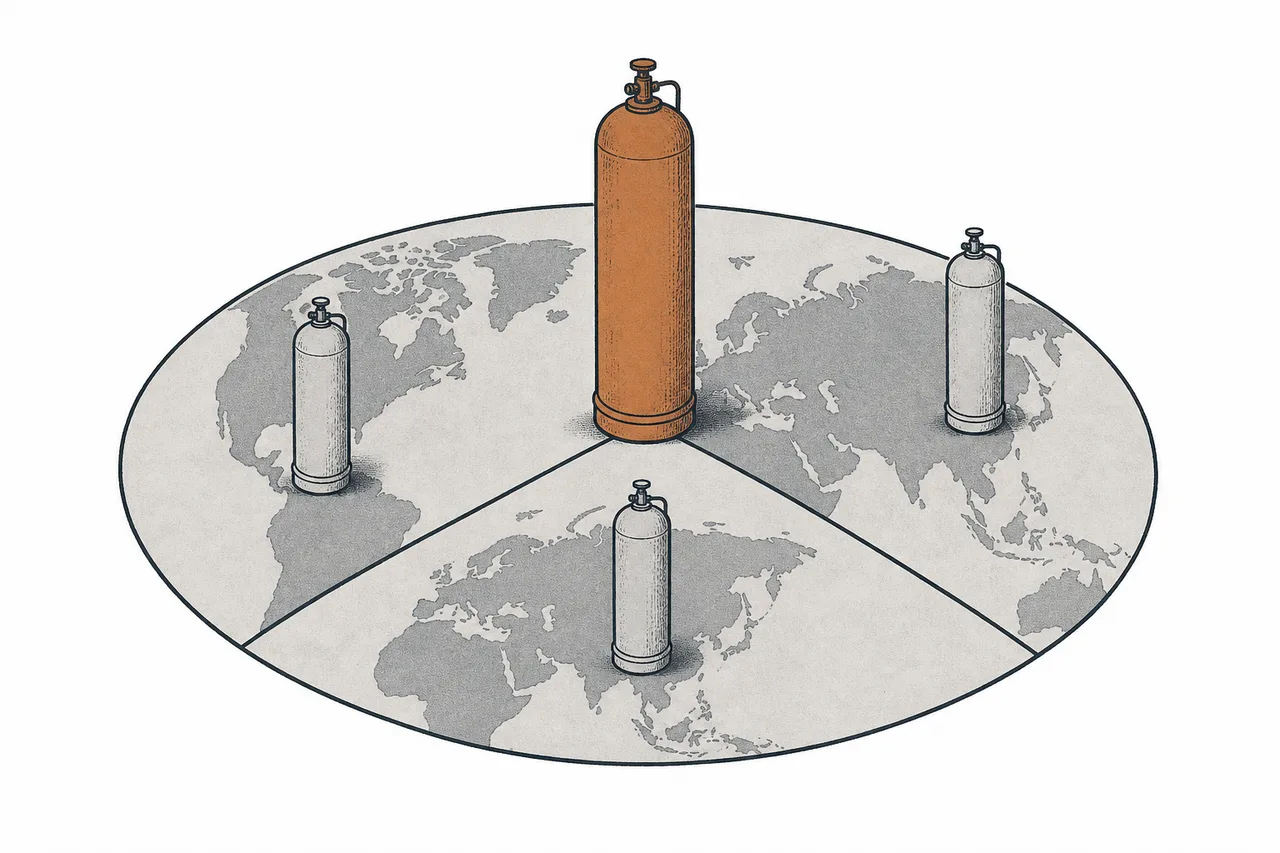
The current picture of industrial gases is a near-perfect oligopoly — the world is held by a handful of players, led by the three giants Linde, Air Liquide, and Air Products, plus Japan's Nippon Sanso and Germany's Messer. Decades of consolidation have left fewer and fewer players — and the fewer there are, the more pricing discipline holds, and the fatter the profits.
In 2025 the whole group kept moving forward. Linde grew both sales and margins, with a backlog of contracted gas sales not yet flowing of about $7.1B — a marker of future revenue already locked in. Air Liquide pushed its margin above 20% for the first time, targeting another 200 basis points over 2025-2026. Meanwhile, demand from chips and hydrogen is becoming the new growth engine everyone is fighting to invest in.
07The road ahead
The first direction is clean hydrogen. This is the industry's biggest bet. Gas companies already have the know-how, the pipes, and the plants needed to produce and move hydrogen. If the hydrogen economy really takes off, they're among the first to benefit — but these mega-projects cost enormous amounts of money and still lean on government subsidies, so they're an opportunity and a risk at the same time (Air Products, which bet the hardest, has already faced investor pressure over this).
The second direction is the wave of chip-fab construction. Every new chip fab in the world (US, Europe, Japan) needs ultra-high-purity electronic gases piped in, and usually signs long on-site contracts. This is fast-growing, high-margin demand — which is why everyone is racing to build gas-separation plants next to the new chip towns.
The third direction is continued consolidation and pricing discipline. As long as the players stay few and keep the discipline not to undercut each other, the take-or-pay model keeps printing steady profits — the charm of this business is that it's “boring in a good way”: slow, but steady and predictable.
08Challenges & risks
The stability of this business comes with its own specific risks worth understanding.
The first risk is the industrial cycle. Even though take-or-pay contracts support most of the revenue base, the rest of sales (like cylinder gas sold to small customers, or some specialty chemicals) is tied to the health of manufacturing and construction. When the economy slows, volumes drop — this business is cycle-resistant, but not fully immune.
The second risk is energy cost. Separating gases from air (especially oxygen and nitrogen) burns enormous amounts of electricity — gas companies are very large power users. Most contracts can pass energy costs through to customers, but on the part that can't be passed through, a spike in energy prices squeezes the margin. And the big hydrogen bet makes the energy-cost and government-subsidy risk even more pronounced.
The third risk is helium and strategic scarcity. Unlike oxygen and nitrogen, helium “can't be separated from air” — it has to be extracted from a few natural-gas sources in the world (Qatar, the US, Russia, Algeria), which makes it extremely fragile to geopolitics. In recent years helium prices have surged over 400%, and a single event in the Middle East can cut a third of global supply in an instant — helium has no substitute in MRI machines or chipmaking, making it the real weak point of this chain.
In short: this node is the story of the “invisible ingredients” hidden inside almost everything around us. The remarkable part is that half of it — the industrial-gas business — is one of the most beautifully designed businesses in the world: selling things that float in the air, on long contracts that lock in customers and lock in profits. Understanding this node means understanding why the “most basic stuff” can build one of the deepest moats in modern capitalism.