Megatrend · Biotech & Genomic Medicine
Train the body to fight the enemy — before the enemy ever arrives
A vaccine shows your body the “face” of a pathogen ahead of time, so it can remember the enemy and have an army ready and waiting — without you ever actually getting sick. It used to be a dull, thin-margin business. Today it has turned into a “trillion-dollar franchise” — Shingrix, Gardasil and Prevnar each earn billions a year. Meanwhile the COVID wave is fading, and the politics of vaccines is coming back as the single biggest risk.
01What a vaccine really is
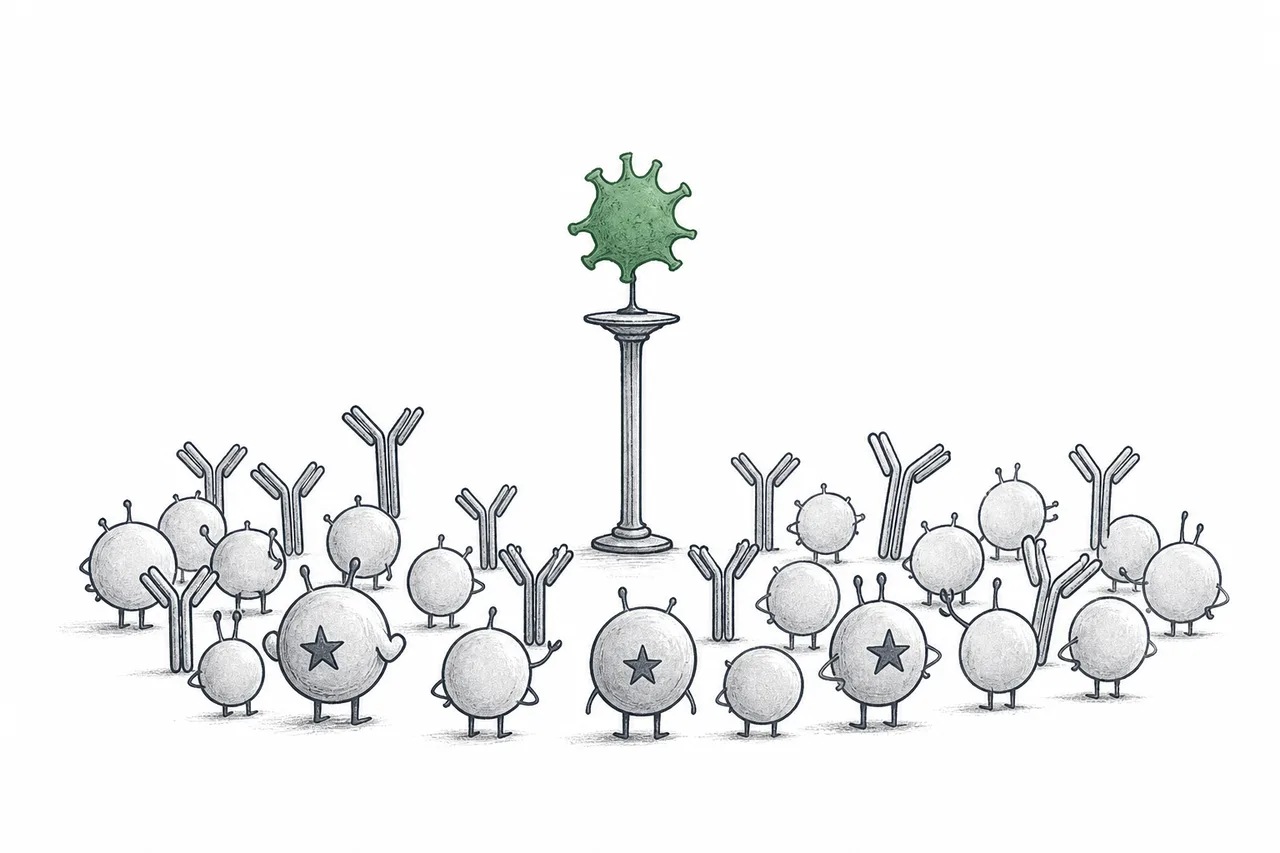
Think of our immune system as a brilliant army with just one weakness: it learns slowly. The first time a pathogen invades, the body needs several days to “recognize” the enemy, build the right weapons and mobilize — and it's in those very days that we fall ill, and sometimes die. A vaccine solves this with a beautifully simple trick: it shows your body the “face” of the pathogen ahead of time, in a safe form that won't make you sick, so the army can rehearse and memorize the enemy first.
That “face” has a scientific name: the antigen — a small piece of the pathogen (usually a protein on its surface) that the immune system uses as a “name tag” to identify the enemy. When the body sees the antigen through a vaccine, it makes and stores memory cells and antibodies. So when the real pathogen invades later, the army recognizes it instantly and finishes the job before we ever feel sick.
A piece of a pathogen — usually a surface protein — that the immune system “reads” to identify it as an enemy. The heart of every vaccine is delivering this antigen (or instructions for the body to make it itself) in a safe form, so the body builds a “memory” without an actual infection.
On our megatrend map, this node is a sub-theme under Biotech & Genomic Medicine, focused on “traditional and protein” vaccines — the ones made from killed pathogens (inactivated), weakened live pathogens (live), or protein pieces made by genetic engineering (recombinant/subunit). The newer mRNA vaccines we keep separate under RNA Therapeutics, because they're a completely different technology platform — but the end goal is exactly the same: show the antigen to the immune system.
02Why the “boring” stuff became gold
For a long time, vaccines were a business investors ignored. The reason is the economics of “prevention” — one shot (or a few in childhood) protects you for years, sold to governments in big cheap lots, with thin margins per dose, and hard to manufacture. That's the opposite of a chronic-disease drug you take every day for life. So classic childhood vaccines like measles-mumps-rubella were a “commodity” — essential to the world, but not much of a money-maker.
So what changed? The answer is blockbuster adult vaccines. Drugmakers discovered that if they targeted diseases of adults and the elderly in rich countries — shingles, cervical cancer, pneumonia, RSV — they could charge far more, and the market was enormous. The result: a handful of vaccines became “franchises” that earn as much as cancer drugs:
Consider this — Merck's Gardasil (the HPV vaccine that prevents cervical cancer) earned $8.6 billion in 2024, more than the entire annual revenue of many countries. This isn't just “preventing disease” — it's one of the first vaccines in history that genuinely “prevents cancer.” And GSK's shingles vaccine Shingrix hit £3.4 billion ($4.2 billion) in 2023 — with GSK aiming to push it past £4 billion by 2026.
This matters to the world economy in two ways. One: it's the cheapest piece of protective equipment humanity has ever built — every dollar spent on a vaccine saves several in healthcare costs and economic losses. COVID taught us that an epidemic can stop the whole world. Two: it has become a high-margin revenue pillar for the big drug companies, not a charity anymore — and that's why investors are starting to take it seriously again.
03How it works — training the immune system
Every vaccine has the same core mechanism — they differ only in the “format” in which they show the antigen. Look at these three beats; they're the whole story:
The difference between vaccine “platforms” is what format you show the antigen in — and this is what separates this node from mRNA vaccines:
- Inactivated: take the whole pathogen and “kill” it completely so it can't cause disease, then inject it — like showing a full photo of the enemy. Very safe, but the immunity is often weaker, so it needs booster shots (e.g. the injectable polio vaccine, hepatitis A vaccine)
- Live attenuated: use a pathogen that's still alive but “weakened” so it can't cause disease. It mimics a real infection most closely, so immunity is strong and very long-lasting (e.g. measles-mumps-rubella) — but it can't be used in people with weak immune systems
- Protein / Recombinant (Subunit): don't use the whole pathogen, but manufacture “only the key protein piece” by genetic engineering (grown in cells, like a biologic) and inject just that piece — the safest, with the best quality control. But immunity tends to be weak, so you add an adjuvant to boost it (e.g. Shingrix, Gardasil, Novavax)
- Viral vector: use a harmless virus as a “truck” to carry the antigen's gene into your cells, letting the cells make the antigen themselves (e.g. AstraZeneca's COVID vaccine)
A substance added to a vaccine to “wake up” the immune system and make its response to the antigen stronger. Many modern protein vaccines are powerful because of their adjuvant — Shingrix, for instance, uses GSK's AS01 adjuvant system, which makes immunity strong enough to prevent shingles in over 90% of older adults. So adjuvant technology is a “trade secret” that builds a wall competitors struggle to climb.
Notice that all four types — plus the mRNA we keep separate under RNA Therapeutics — end up at exactly the same place: getting the immune system to “see the antigen” and build memory. They differ only in safety, strength of immunity, speed of development and cost of manufacturing — which is the battlefield where each company places a different bet.
04How it connects in the ecosystem
Vaccines don't sit alone — they're a crossing point for several fascinating trends:
- Sibling to the RNA Therapeutics platform: this is the most important relationship. mRNA vaccines (Comirnaty, Spikevax) are a new “way to show the antigen” that COVID made famous overnight — faster and easier to reformulate, but still less proven on durability and trust than traditional protein vaccines. These two platforms are competing and complementing each other in the same market — and many companies play both sides
- A “protective shield” paired with antivirals: a vaccine is prevention before infection; an antiviral is treatment after — two sides of the same battlefield. Companies like Pfizer and GSK play both
- Growing with the aging society: this is the big engine of the trend. Almost all the top-earning vaccines — shingles, pneumonia, RSV — are for the elderly, because immunity weakens with age. The older the world gets, the bigger the adult-vaccine market
- Supporting longer lifespans: preventing infectious disease in old age is one of the most effective and cost-efficient ways to “buy time” for people to live longer and healthier
- Relying more and more on AI: designing antigens, picking which flu strain will spread next year, and racing to develop a vaccine when an outbreak hits — all are starting to use AI to cut the time
05Where it stands now
Today's big picture is “a post-COVID world finding a new balance.” During the pandemic, COVID vaccines were an unprecedented financial phenomenon — Pfizer's Comirnaty hit a peak of $37.8 billion in 2022 alone, more than several of the world's best-selling drugs combined. But once the pandemic passed, governments stopped stockpiling and people stopped getting frequent shots, and sales fell off a cliff:
The drop from $56 billion in 2022 to roughly $8.4 billion in 2024 was a “return to normal” that reset the whole industry. But beneath the falling COVID numbers, the core vaccine business actually got stronger — in 2024 the major vaccine companies posted remarkable total vaccine revenues: Merck around $12.1 billion, Pfizer around $11.9 billion, GSK around $9.8 billion, and Sanofi around €8.3 billion.

But the most tense story of 2024–2025 was the freshly, grandly launched RSV vaccines stumbling because of policy. RSV is a respiratory disease dangerous to the elderly and infants, and new vaccines like Arexvy (GSK) and Abrysvo (Pfizer) launched in 2023 with high hopes — but the moment US authorities narrowed their recommendation to high-risk groups only, sales plunged. GSK's Arexvy fell more than 50% in 2024, while Pfizer's Abrysvo dropped 62% year-over-year in the final quarter of 2024. It's a live lesson that in the vaccine business, “the recommendation of a government body” carries as much power as sales themselves.
There were only a few bright spots — Sanofi's Beyfortus (an antibody that protects infants from RSV, not a full vaccine) earned about €1.7 billion in 2024 on strong infant demand — the opposite of the stumbling elderly side.
06The road ahead
The next big battlefield is new-generation pneumococcal (pneumonia) vaccines. Pfizer's Prevnar has long dominated this market, but rivals are catching up — Vaxcyte and Sanofi (with SK bioscience) are each developing vaccines that cover more than 20 strains, a first in history. Whoever wins here lands a multi-billion-dollar-a-year franchise.
The second trend is combination vaccines — instead of one flu shot and one COVID shot, companies are trying to merge them into a single jab. Sanofi is testing a formula that pairs its own flu vaccine with Novavax's protein COVID vaccine — this kind of convenience is the key to drawing people back to an annual shot.
The third trend is competition between platforms. mRNA proved its speed in the COVID era — reformulated in weeks — but after COVID, trust and durability of immunity are still open questions, giving traditional protein vaccines (like Novavax) the edge again in some people's minds. The future probably isn't “one platform wins it all,” but choosing each type to fit the disease and the group of people.
And the biggest dream is vaccines for diseases we've never had one for — personalized cancer vaccines, better RSV vaccines, all the way to a “universal vaccine” that protects against every flu strain in a single shot. If it works, it will push the economics of prevention up another level entirely.
07Challenges & risks
The biggest risk of this trend isn't science — it's policy and politics. We saw it clearly in the RSV case: the moment US authorities narrowed the recommendation, sales of Arexvy and Abrysvo fell by more than half within a year. In the vaccine business, a government advisory committee (like ACIP in the US) holds more power over revenue than clinical trial results do, because their recommendation decides who gets the shot and who pays.
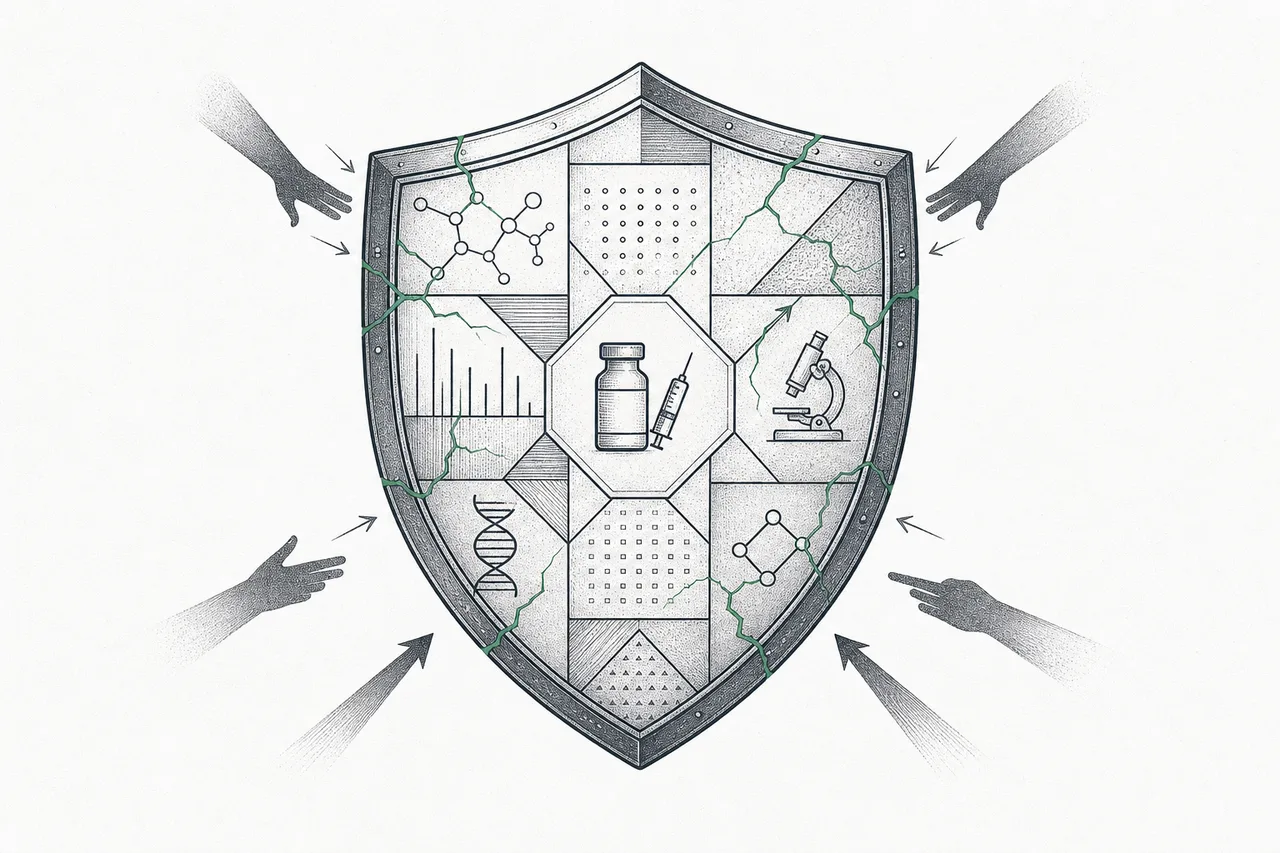
This is tangled up with vaccine hesitancy, which came roaring back after COVID. In 2025–2026, the US heavily reshuffled its national vaccine committee and loosened the recommendation for COVID shots in children and pregnant women. For vaccine companies, this is a hard-to-price uncertainty — because revenue is tied to a public trust that's now wobbling.
The second risk — the flip side of the success story — is leaning too hard on “a few pillars.” Each company's profitable vaccine revenue is concentrated in just a handful of franchises. If Gardasil hits trouble in the China market (which actually happened in 2024, shrinking sales), or Shingrix gets cut into by rivals or generics, the hit to the company lands hard and fast — because there's no new franchise of the same size to easily replace it.
The third risk is manufacturing that's hard and fragile. Many vaccines have to be “grown” in living cells or chicken eggs, taking months, and they're slow to scale capacity up or down with demand. COVID exposed that when the world needs vast amounts of vaccine at once, capacity is the bottleneck — and in normal times, overbuilding turns into sunk cost.
In short: vaccines are one of the most “cost-effective” innovations humanity has ever had — training the body to fight the enemy before it arrives, at a fraction of the cost of treatment. As a business, it has transformed from boring stuff into a huge franchise. But the key to seeing through this trend is to understand that — unlike ordinary drugs — its most dangerous enemy isn't in the lab, but in people's beliefs and policies.