Megatrend · Biotech & Genomic Medicine
Drugs that don't kill the virus — they just stop it from copying itself
A virus isn't even alive on its own. It just hijacks the machinery inside our cells to churn out copies of itself. The entire antiviral field is one question: where do you jam a wrench into that assembly line? And it just flipped — from a daily HIV pill to a twice-a-year shot — with a market worth roughly $66 billion.
01What is an antiviral?
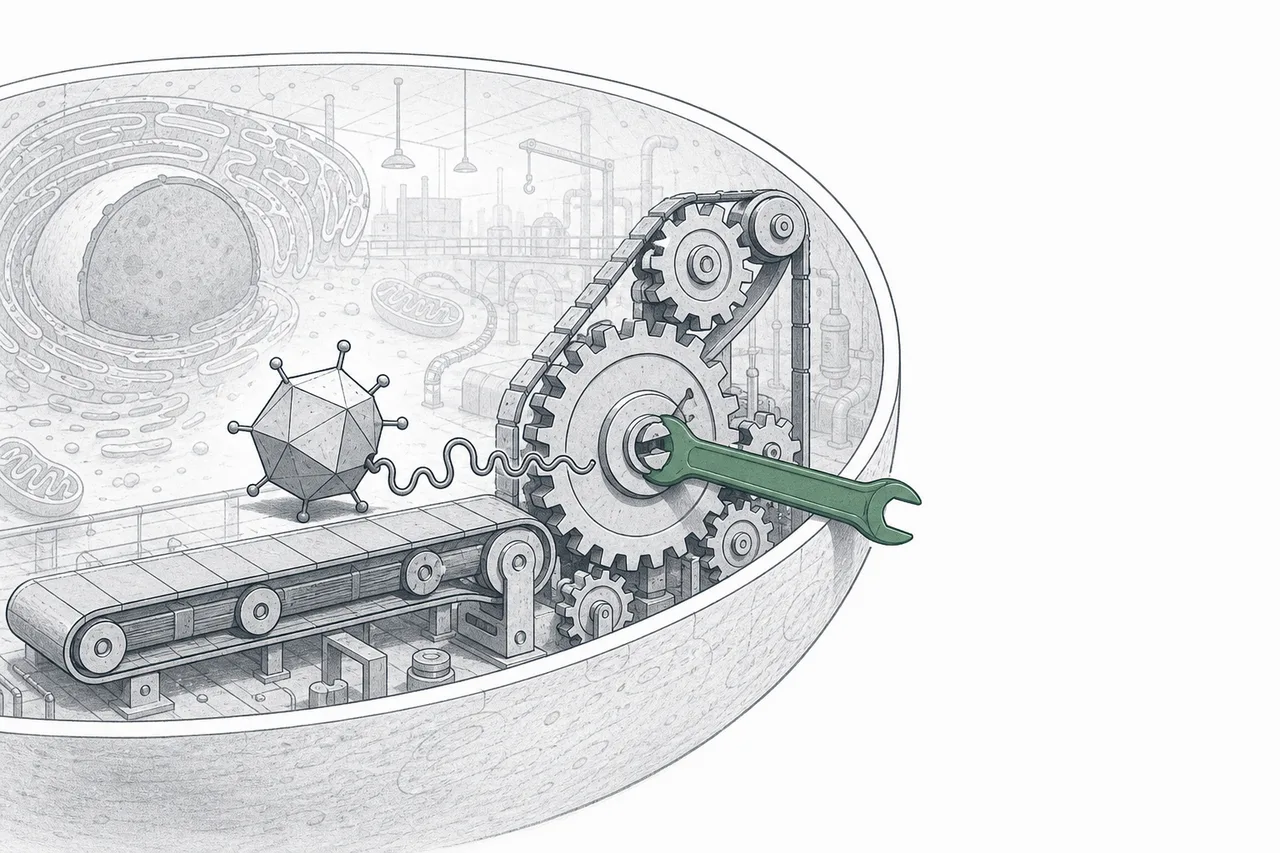
Start with a fact that's stranger than it sounds: a virus isn't alive on its own. It doesn't eat, breathe, or make energy. It's just a tiny protein box wrapped around some genetic code. Its one goal in life is to sneak into our cells, borrow the factory inside, and print millions of copies of itself — until the cell bursts and it moves on to the next one.
That's why antibacterial drugs (antibiotics) do nothing against a virus. Bacteria are living things with their own factory, so you can target that factory. But a virus uses the same factory we do — hit it too hard and you wreck your own cells too. So the whole challenge of antivirals lives right here: find a step that belongs to the virus alone, and jam it without touching the host cell.
A drug that "treats" someone already infected, by blocking one step in the virus's replication cycle (enter the cell → copy its genes → assemble → exit to infect new cells). That's different from a vaccine, which "prevents" infection by teaching the immune system to recognize the virus ahead of time. This field is specifically the "treat / suppress" side — covering HIV, hepatitis B and C, influenza, RSV, COVID, even smallpox.
On our megatrend map, this field is one of the "applications" of Biotech & Genomic Medicine. It's one of the oldest drug groups around (HIV has had drugs since the '80s), yet it just went through a massive reinvention over the past two years — making it both a "steady cash cow" and a "hot innovation battleground" at the same time.
02Why it matters to the world
The first reason: it turned diseases that were once a "death sentence" into something manageable. HIV meant death in the '80s and '90s. Today, someone who takes their antivirals consistently has a near-normal life expectancy, with virus levels so low they're undetectable and can't be passed on. These aren't small drugs — Gilead alone booked $19.6 billion in HIV-drug sales in 2024, with Biktarvy by itself bringing in $13.4 billion.
The second reason hits harder: some diseases went from "chronic for life" to "cured." Hepatitis C used to slowly destroy the liver until you needed a transplant or got cancer. Then in 2013, Gilead's Sovaldi (sofosbuvir) arrived — and it actually cured it, at a 95–97% rate in just 12 weeks. It's one of the greatest wins in modern medicine — but it came with a price that set off a global drug-pricing war (a 12-week Harvoni course in the US was once listed at around $94,500).
The third reason is one the world was reminded of in 2020: pandemic preparedness. COVID turned antivirals into a matter of national security. Pfizer's Paxlovid made roughly $18.9 billion in a single year at its 2022 peak, before falling off a cliff as COVID became endemic. But the lesson stuck — governments worldwide now treat "a stockpile of broad-spectrum antivirals" as infrastructure, like an army, not just another item on the pharmacy shelf.
Put simply, this field matters in three ways at once: it saves lives (HIV/HCV), it makes huge, steady money (HIV drugs), and it's the shield against the next pandemic that the world will pay a premium for peace of mind.
03How it works — jamming the wheels of the viral assembly line
Understand how a virus copies itself, and you understand every antiviral at once — because every drug in this field does the same thing, it just jams a different step. Think of the virus as a thief breaking into a factory (our cell). There are 4 moves:
- Entry — the virus latches onto the cell's door and slips inside
- Copy — it orders the machinery (the enzyme polymerase) to print thousands of copies of its genetic code
- Assemble — a cut-and-paste enzyme (protease) snips and assembles proteins into a complete new virus
- Release — the new virus breaks out of the cell to invade the next one
An antiviral is the "wrench" you jam into one of those moves. Most HIV drugs jam the Copy move (the reverse transcriptase and integrase inhibitor groups), while Paxlovid and many HCV drugs jam the Assemble move (protease inhibitors). And a newer drug like Gilead's lenacapavir plays a stranger angle — it breaks the virus's "shell" (the capsid) so it can't assemble at all.
The two drug groups you'll hear about most. Polymerase inhibitors jam the "Copy" move by fooling the enzyme that prints the genes (like HCV's sofosbuvir and HIV's reverse-transcriptase drugs). Protease inhibitors jam the "Assemble" move by shutting down the scissors that cut proteins into a finished virus (like nirmatrelvir, the key ingredient in Paxlovid) — same goal either way: stop the virus from finishing its own copy.
Why know this? Because it instantly explains "why viruses become drug-resistant." Every time a virus copies itself, it copies sloppily, and mutations happen — some of them, by chance, make the drug's wrench no longer fit. That's why HIV drugs are usually given as a "3-drug cocktail" — jamming 3 moves at once, since it's nearly impossible for a virus to mutate past all three simultaneously.
04Where it sits in Biotech
This field is one of the "end applications" of Biotech & Genomic Medicine — it turns molecular-biology knowledge into drugs you can actually sell. And it's tangled up with its neighbors in ways you can't pull apart:
- Two sides of the same coin as Vaccines: vaccines = prevent before infection, antivirals = treat after. The same disease often needs both — COVID has both a vaccine (prevent) and Paxlovid (treat) as a set. Companies like Pfizer and Shionogi play both sides
- Merging with RNA Therapeutics: many newer antivirals target the virus's RNA directly, and the mRNA tech made famous by COVID vaccines is now being turned into treatments, not just prevention. The line between the two fields is fading
- A tool of the Aging Population: chronic infections like HIV and hepatitis B have become diseases you "live with for life." As people live longer, the base of patients who need antivirals long-term keeps growing — into predictable, long-duration revenue
- Leaning more on AI: designing a molecule that fits a viral enzyme just right, and predicting how a virus will mutate to escape a drug, are exactly the jobs AI and computer simulation can speed up a lot — especially when you need to race a drug out for a new pandemic
05Where it stands now
If you had to sum up where this field stands in 2025–2026 in one line, it's this: "from a daily pill to a twice-a-year shot." And that's no small thing.
The biggest event was the FDA's approval of lenacapavir on June 18, 2025 (brand name Yeztugo, from Gilead) as an HIV prevention drug (PrEP) you inject once every 6 months — two shots a year, versus the old way of taking a daily pill you can't forget. The trial results shook the field: in the PURPOSE 1 study of women in Africa, 0 infections out of 2,134 people, and PURPOSE 2 prevented 99.9%. This is "almost like a vaccine" — achieved with an antiviral.
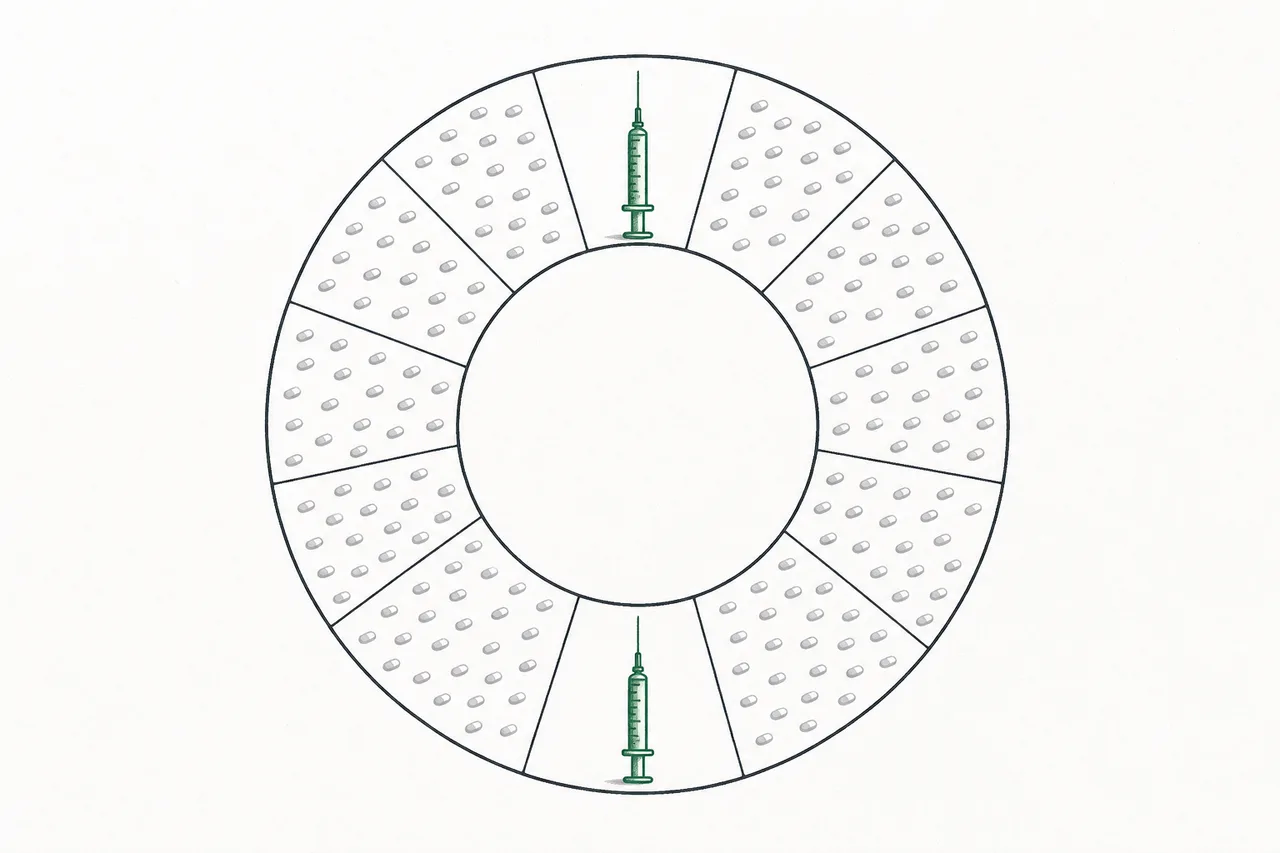
Why is this so big? Because the biggest obstacle to PrEP is that people forget to take their pill. A twice-a-year shot all but erases that problem. Wall Street analysts peg lenacapavir's peak sales at around $4 billion (some firms see $5.7 billion) and view it as the next growth wave after Biktarvy. The overall PrEP market is expected to grow from ~$2 billion in 2024 to $5–6 billion by 2030.
Other corners are moving too: Pfizer's Paxlovid has passed its COVID peak (once ~$18.9 billion in 2022) into "normal" mode as a seasonal COVID treatment. GSK/ViiV is pushing its own long-acting injectables (Cabenuva to treat, Apretude to prevent), aiming to push its whole injectable portfolio past £2 billion in 2026. And hepatitis C — now "curable" — has turned into a double-edged sword: patients get cured too fast, the patient base shrinks, and Gilead's HCV revenue slowly fades by its own success.
These are the key players steering the direction of this field:
06The road ahead
The clearest trend is "longer and longer acting." Today it's an HIV shot every 6 months; tomorrow the goal is once a year. And the same tech is spreading to other viruses — a company like Cidara was building a flu drug where "one shot covers the whole season" (so promising that Merck bought it in early 2026). Imagine a day when flu prevention isn't an annual vaccine but a single long-acting antiviral shot, and you'll see just how blurry the line between "drug" and "vaccine" is getting.
The second trend is the chase for the next "cure." After HCV was cracked, the next holy grails are hepatitis B (which can only be "suppressed," not "cured" today, with hundreds of millions infected worldwide) and a functional cure for HIV. Whoever gets there first unlocks an enormous market — but they'll hit the same double-edged sword as HCV: cure it, and the patient base shrinks.
The third trend is the pandemic as a government "asset class." After the COVID lesson, governments worldwide now pay to keep "a stockpile of broad-spectrum antivirals" ready for the next fight — bird flu, a new virus family, or an unknown "Disease X." A business like SIGA (smallpox drugs) is the template — revenue comes from government contracts, not pharmacy sales — and it'll be the quiet but steady-growth part of this field.
07Challenges & risks
The first risk is baked into the biology of the virus itself: resistance. Every time a virus copies itself, it risks mutating until the drug no longer fits. This is a war you "never fully win" — you have to keep developing new drugs to chase it, especially against fast-mutating viruses like HIV and influenza. A drug that works 99% today might not hold the line ten years from now.
The second risk is price and access, which can ignite at any time. The Sovaldi pricing drama ($84,000 a course) once set health-insurance systems worldwide ablaze, and with lenacapavir the same question is back — prices in rich countries may run sky-high while the infections cluster in poorer ones. The pressure to price cheaply in emerging markets (and the arrival of generics, like a generic sofosbuvir now down to a few hundred dollars) always pushes margins down.
When a drug's patent expires, cheap generics move in and the original's sales collapse overnight. For antivirals this risk is very real, because the hugely profitable HIV drugs are all chemical compounds that are easy to copy once the patent's gone — so Gilead has to keep outrunning the cliff with new innovations like lenacapavir, all the time.
The third risk is specific to this field: pandemic uncertainty. Pandemic-drug revenue swings to extremes — Paxlovid leapt from zero to $18.9 billion in one year, then nearly vanished the next. A business that leans on government contracts and outbreaks is very hard to predict. Investing in research for a "Disease X" that might not come for ten years is a bet pure private players rarely dare to make — it needs government money behind it.
In short: antivirals are one of the clearest "good for the world" stories in pharma — they turned HIV from a death sentence into a manageable disease, made hepatitis C curable, and serve as humanity's shield against the next pandemic. But as a business, it's a race with no finish line: chasing resistance, chasing the patent cliff, and guessing where the next pandemic comes from.