Megatrend · Electrification & Mobility
The Western side of the EV war: the early mover, the holders of old money, and the ones burning cash
As China floods the world with cheap EVs, the West is fighting back with three wildly different armies — Tesla, the pure-play that proved EVs can actually turn a profit but is now growing more slowly; legacy giants like VW, GM, Ford and Toyota, whose profits still come from gas cars and who have to burn enormous sums to transform; and startups like Rivian and Lucid, burning billions in cash each year just to survive. 2025 was the year this army openly began to "retreat" — America's Big 3 booked a combined $52 billion in losses from their EV pivot.
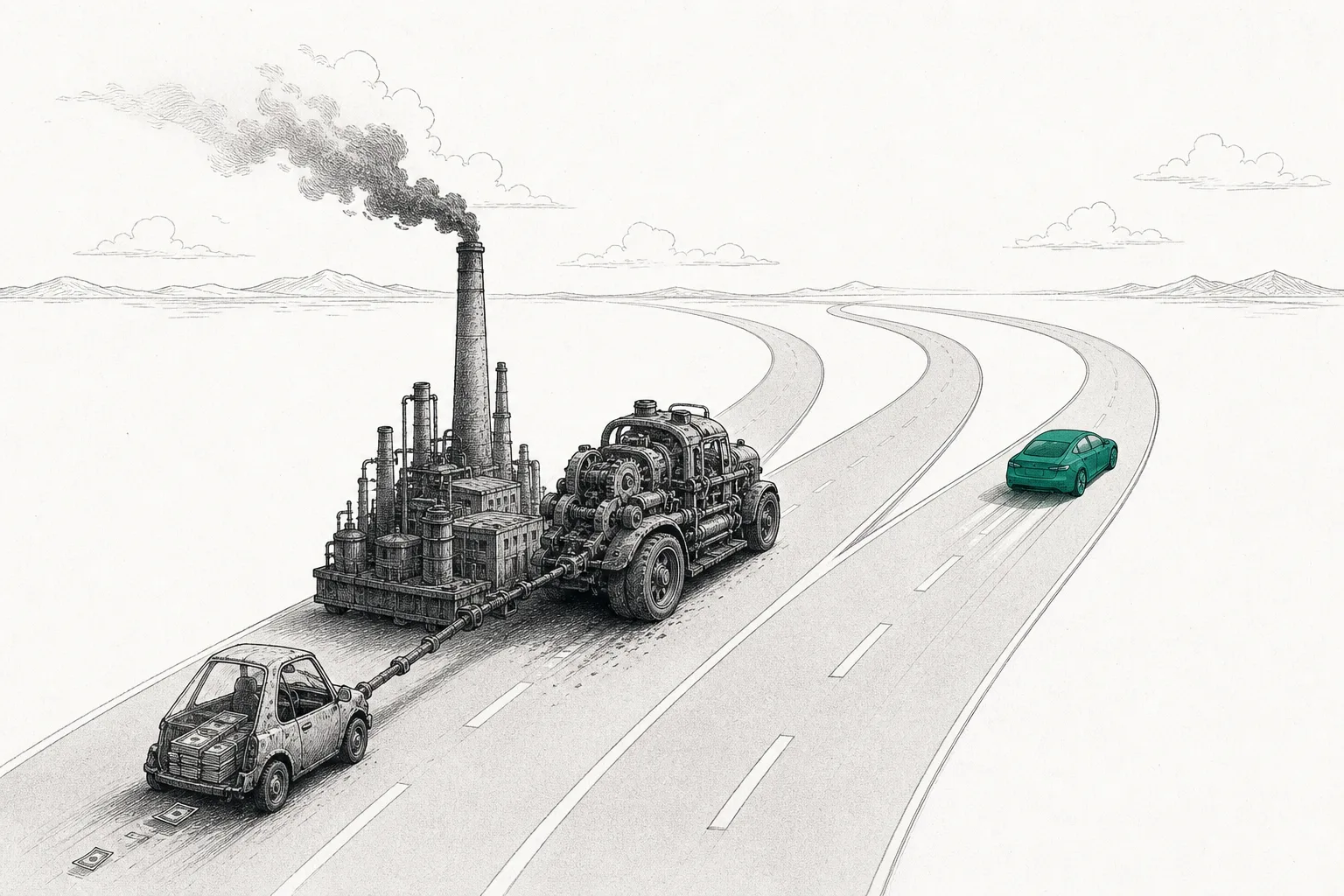
01What it is — the West's three armies
This node is the "non-China" side of the electric-car war — the carmakers of the US, Europe, Japan and Korea trying to remake themselves from a world of gasoline into a world of electricity. It's a sub-branch under Passenger EV OEMs within the Electrification & Mobility megatrend, with a sibling on the other side — its direct rival, China NEV Leaders. The story of this chapter: how the West copes with the wave of cheap Chinese cars.
What makes this node interesting is that it isn't one uniform group doing the same thing — it's three armies with strengths and weaknesses at opposite extremes. And that's the backbone of the whole lesson:
- The pioneering pure-play (Tesla): a company born to build only EVs — no engine factories, no legacy dealers to carry — and the first to prove that EVs can actually turn a profit, though it's now growing more slowly
- The legacy giants (VW, GM, Ford, Toyota, Hyundai, Mercedes, Stellantis): century-old carmakers whose profits still come from gas cars, who have to take that gas-car money to prop up an EV business that's still losing money. It's a risky, expensive "transformation in mid-air"
- The pure-play startups (Rivian, Lucid): newcomers who want to be the next Tesla, but are still too small to break even. They have to burn billions in cash a year and find a "lifeline" of capital to stay alive
Pure-play = a company in a single business — here, building EVs only, with no gas-car business weighing it down (Tesla, Rivian, Lucid) · Legacy OEM = an "old guard" carmaker with gas-car production lines going back decades (OEM = Original Equipment Manufacturer, a company that builds the whole car and sells it under its own brand) · ICE (Internal Combustion Engine) = the old-fashioned "gas car"
02Why it matters — the trillion-dollar transformation game
The Western auto industry is the backbone of several national economies — Germany, Japan, the US and Korea all lean on it to support millions of people, and it has created enormous value for a hundred years. So what's happening isn't just a "fuel swap" — it's rebuilding an entire industry from scratch, while new rivals from China push in from every direction.
Here's the heart of the pain: Western legacy makers lose more money the more EVs they sell, because battery costs are still high and their scale is still small compared with China's. So 2025 became the year many of them openly "retreated" and booked big losses all at once — America's Big 3 alone (GM, Ford, Stellantis) booked roughly $52 billion in losses from their EV pivot.
Why does this shake the whole world? Because if the Western old guard fails to transform, the empty seat gets taken by Chinese brands immediately — the center of gravity of the world's auto industry, once in Detroit, Wolfsburg and Nagoya, is being pulled east. So this node is about "who survives the biggest transition in the history of the auto industry," not just which model looks nicer.
03How it works — pure-play vs old guard
To understand why the old guard hurts while the pure-plays turned a profit first, we have to look at the business structure of both sides. They differ at the root — not just "building a different kind of car."
A pure-play like Tesla was born in the electric era, so it designed everything from zero to suit EVs — an all-electric platform (a "skateboard" chassis with the battery laid in as the floor) · direct sales to customers, bypassing the dealer network · and high-margin software revenue (driver assistance, over-the-air updates). All of this means low cost and good profit per car.
The old guard does nearly the opposite on every count — most still retrofit existing engine factories to build EVs (retrofit), which isn't suited to laying in a battery · they have to rely on a dealer network that's costly and reluctant to stop selling gas cars · and most important, profits still come from gas cars, which they have to use to prop up a money-losing EV business. It's like earning money with one hand and pouring it away with the other.
04Where it sits in the ecosystem
Western carmakers are the "storefront" consumers see, but their success is tied to several siblings in the same trend — and above all to the "Chinese rivals" in the room next door:
- Relies on Battery Cells as its heart: batteries are ~30–40% of a car's cost, and the spot where the West is most at a disadvantage to China, because China controls almost the whole battery supply chain (from minerals to cells). So the old guard has to rush to build its own battery plants or partner with cell makers — otherwise it can't match China on cost
- Needs Charging Infrastructure to support it: EVs only sell once there's enough charging. In the West, where charging isn't as widespread as in China, people fear "running out of battery mid-trip" (range anxiety) and hold off buying — one reason Western EV demand stumbled
- Collides head-on with China NEV Leaders: this is the real rival. Chinese cars are cheaper because they control battery costs and produce end-to-end. So the Western old guard has to fight both at home (Europe, the US) and in China, where its share is shrinking fast
From the parent's view, this node is half of Passenger EV OEMs — the other half being the Chinese side. The two are fighting over a world auto market that's turning electric. If you want to understand why Chinese cars are cheap and advancing fast, head to the chapter on China's new-energy-vehicle leaders — this chapter focuses on "how the West transforms and defends."
05Where it stands now (2025–2026)
The big picture for the West in 2025 was "stumble and retreat" — each army faced its own problem. Start with the largest pure-play: Tesla's growth slowed for the first time. Full-year 2025 deliveries fell about 9% to ~1.64 million cars after years of nonstop growth. So Tesla turned to bet its future on robotaxis, launching its first service in Austin, Texas in mid-2025 — a sign that Tesla's story is shifting from "car seller" to "autonomous-driving software/AI company."
America's old guard openly chose to "retreat." In December 2025, Ford announced a $19.5B write-down while shifting toward hybrids and "extended-range" cars (EREV), expecting its EV business to lose ~$5–5.5B that year. GM provisioned $1.6B for EVs in mid-2025, then booked another $6B impairment in early 2026 while admitting it would fall short of producing 1 million EVs a year. A key trigger: the US government ended the $7,500/car EV subsidy as of September 30, 2025.
Europe's old guard got hurt in China. Volkswagen, which long made its core money in the Chinese market, faced a shrinking share — its 2025 China sales fell to 2.69 million cars (-8%), dragging group net profit down 44% to €6.9B, its worst result since the dieselgate scandal. VW announced plans to cut roughly 50,000 jobs in Germany by 2030 and trimmed production capacity from a planned 12 million cars to 9 million.
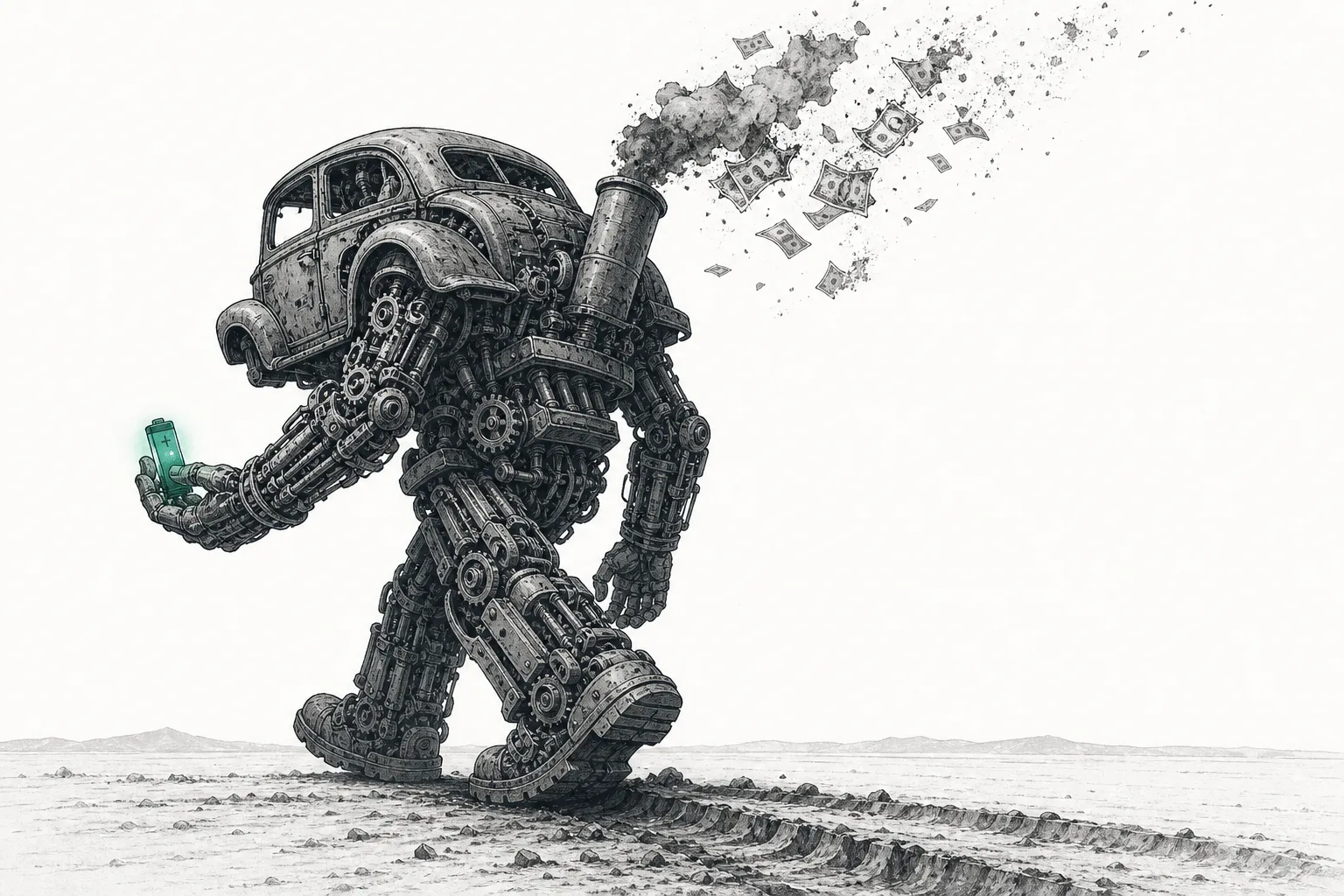
But not everyone fared badly — there are two "quiet winners." Toyota, once derided as "slow" for stubbornly building hybrids instead of going all-in on BEVs, turned out to be right when the BEV wave stumbled and hybrids came back (hybrids make up nearly half of its North American sales). And Hyundai and Kia posted record US sales of 1.63 million cars combined (+7.4%) with a "have it all" strategy — hybrids, plug-ins and BEVs (Ioniq 5) — growing for real in a year when others retreated.
As for the pure-play startups, it's about "who can secure a lifeline of capital." Rivian turned a full-year gross profit for the first time in 2025 and got a lifeline from a joint-venture deal with Volkswagen worth up to $5.8B. Meanwhile Lucid, backed by Saudi Arabia's PIF fund, is still burning cash hard — about $3.8B in 2025, roughly $18B cumulatively — showing how risky a small pure-play that hasn't reached break-even scale really is.
06The road ahead — hybrids return, prices fall, walls against China
The clearest first direction is a "slower transition" in the West. After subsidies were cut, the US EV share — which had climbed to ~10% in 2025 — is expected to pull back to around 8% in 2026, with hybrids and gas cars winning share back. This is why Toyota suddenly looks smart, and why Ford and GM are rushing to shift plans back toward hybrids — the lesson being "the transition isn't a straight line racing to all-BEV, but a winding road where hybrids are an important rest stop."
The second direction is making EVs cheaper. Once subsidies are gone, EVs only sell if they're affordable without leaning on the state. So the West is rushing to cut costs — some partner with battery-cell makers, some (like Rivian) sell platform/software technology to others to add revenue and spread R&D costs. The goal is to build EVs under $30,000 that can genuinely compete with Chinese cars.
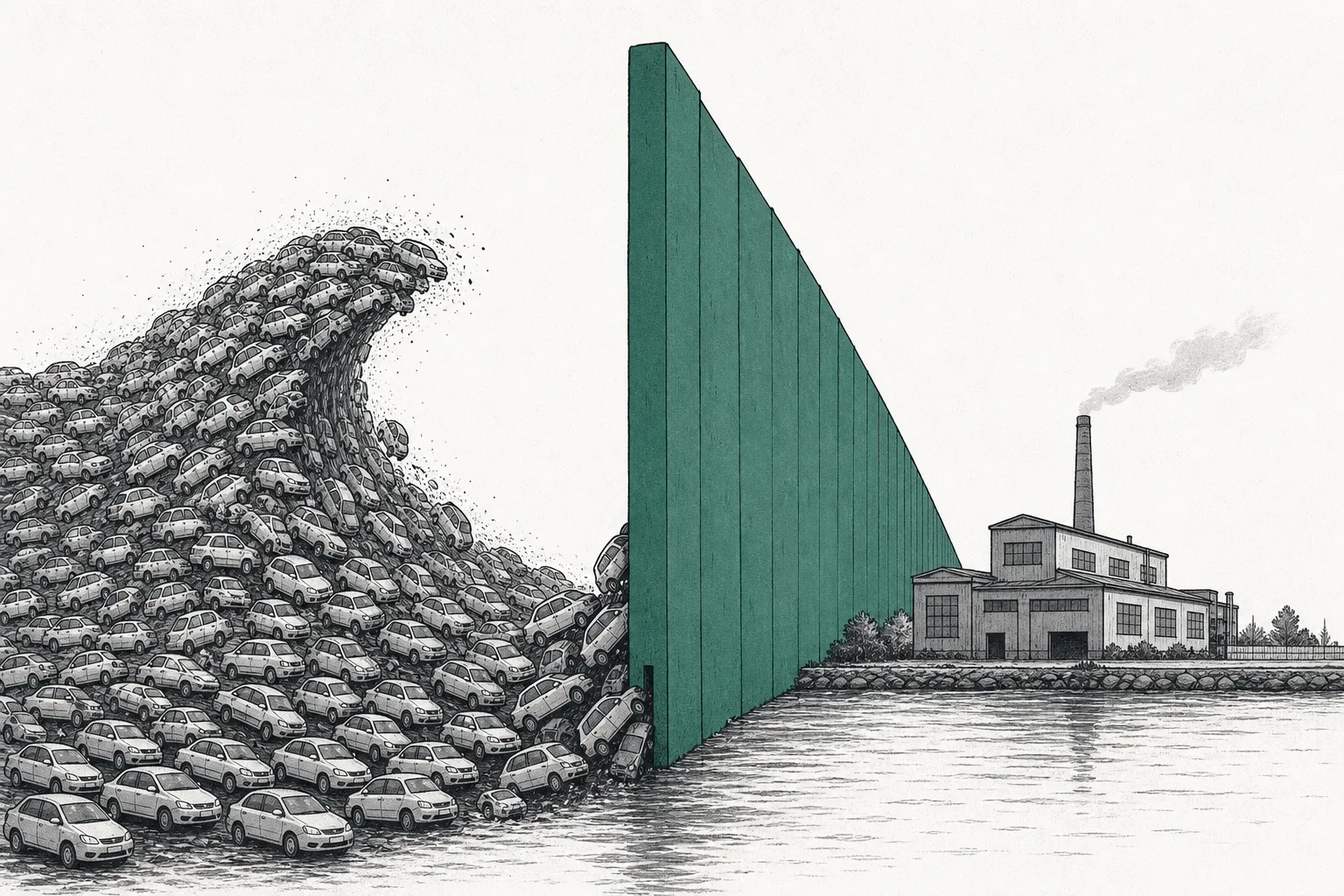
The third direction is tariff walls against Chinese cars. With Chinese cars cheap and advancing hard, Europe imposed import tariffs on Chinese EVs of up to ~35% (while Tesla, which builds in China, faces only ~8%, seen as receiving fewer subsidies). It's both an opportunity and a trap — it buys the Western old guard time to adapt, but doesn't fix the root cost problem, and may make them "too comfortable" and slower than before.
Looking further out, this game enters a phase of brutal selection — small pure-plays that can't secure a lifeline of capital will disappear, while old-guard makers that transform too slowly will gradually lose share. The survivors are those who can build EVs that "actually make a profit when sold," without leaning on either subsidies or gas-car profits.
07Challenges & risks
The old guard's first risk is burning cash during the transformation. As long as EVs lose money per car, every car sold is blood flowing out. The old guard has gas-car profits to prop it up for a while, but if the transition drags on and battery costs fall slowly, that cash flow may not be enough — and the big losses booked in 2025 ($52B for the Big 3) are a warning sign of how fast the money is flowing out.
The second risk is capital dilution and the collapse of startups. A small pure-play like Lucid, which has burned roughly $18B cumulatively, has to keep raising more capital, which "dilutes" existing shareholders' stakes each round. And if it can't secure fresh capital when capital markets tighten, it risks real bankruptcy — many EV startups this decade have ended exactly that way.
The third risk is policy and subsidies that flip back and forth. The Western EV business still "doesn't pay off without government help" in many markets. The US cutting the $7,500 subsidy and some European countries trimming their subsidy budgets made demand stumble immediately — a reminder that this trend doesn't yet fully stand on its own feet, and that political uncertainty may decide its fate more than the quality of the cars.
The fourth risk is structurally cheaper Chinese rivals. The cost gap of Chinese cars doesn't come mainly from subsidies, but from end-to-end production and controlling their own battery supply chain (for example, the ~$4,700 per-car cost gap between the Chinese leader and Tesla mostly comes from scale and domestic production, not state subsidies). Tariff walls can only hold temporarily — but if the West can't cut costs in time, the day the wall opens, Chinese cars will still be cheaper.
In short: the Western side of the EV war is a story of three armies at opposite extremes — the pure-play that moved early but is growing slowly, the old guard that holds old money but has to burn cash to transform, and the startups burning cash to survive. 2025 was the year all three stumbled and retreated, while Chinese cars keep advancing. The big question of this decade isn't "will EVs arrive" — they already have — but "will the West transform in time before it's overtaken, or become an old guard left behind by history."