Megatrend · Advanced Air Mobility
Flying taxis are about to be real — if they clear certification before the money runs out
For ten years, "flying taxis" were a sci-fi movie plot. But 2025–2026 is when it starts to actually happen — EHang already sells flight tickets in China, while Joby and Archer are closing in on certification from the FAA. But this lesson will tell you honestly that nearly the whole industry still has no revenue and is burning enormous amounts of cash, and a few have already gone bankrupt. It's a bet on whether "an electric aircraft that carries people" can clear aviation's hardest gate of all.
01What it is (and why there are two species)
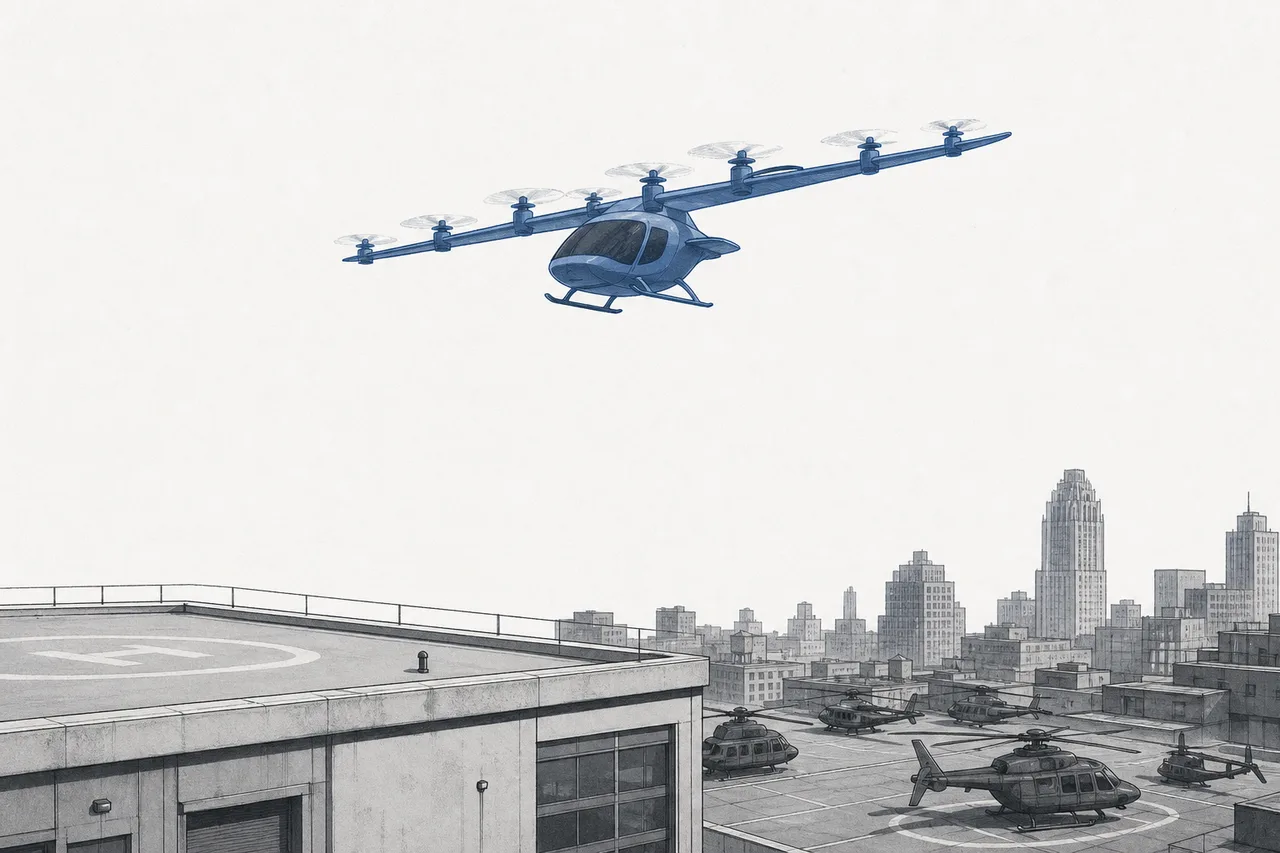
Picture a helicopter, but instead of one giant rotor driven by fuel, swap in many small rotors driven by electric motors and batteries. That's the heart of eVTOL (electric Vertical Take-Off and Landing — an electric aircraft that takes off and lands vertically). This lesson digs into the companies that build the aircraft itself to carry people — the "OEMs" (Original Equipment Manufacturers, the real makers, not the ones building parts or airports).
On the megatrend map, this node is one of the five sub-categories of Advanced Air Mobility (a new kind of electric aviation) — it's the "star of the show," the aircraft itself, while the others are the parts, the landing pads, and the delivery drones. Its definition is simple but brutal: "companies developing flying taxis, with no revenue yet, whose share prices move to the rhythm of getting certified by the FAA / EASA / CAAC."
What makes this fun is that the market splits into two species that think in opposite extremes — and they're the two sub-branches of this node we'll follow throughout the chapter:
- The West, still with pilots — Joby, Archer, Vertical, and Eve in the U.S./Europe/Brazil chose to keep a "pilot" on board first, to pass FAA/EASA safety rules more easily
- China, going pilotless — EHang leapt straight to "fully autonomous flight," no pilot from the start, and became the first in the world to actually earn this kind of certification
These two paths aren't just different designs — they're two different philosophies of how to clear the legal gate and how fast to reach revenue, and that's the main storyline of this whole chapter.
02Why it matters — a market that could be trillion-dollar scale
The reason investors pour money into companies with not a single dollar of revenue yet is the size of the prize at the end. If it works, eVTOL solves one of the city's oldest problems — traffic — by lifting travel into the sky. A trip from the airport to downtown that normally takes an hour on the road might take 10 minutes in the air, at a price aimed closer to a luxury taxi than a private helicopter.
But you have to separate the "dream" from "now." The eVTOL market today is still tiny — about $1.2 billion in 2023, expected to grow to ~$23 billion by 2030. The trillion-dollar number is the long-range, 15–25-year picture that has to clear several more gates to get there.
And the money already burned is no small thing — about $13 billion has been invested in eVTOL projects worldwide since 2019, with almost no one earning it back yet. This is a business that truly means "invest first, revenue years later."
03How it flies — and why you have to pick a side
The heart of every eVTOL is something called "distributed electric propulsion" — instead of one big engine, you use many small electric motors driving many rotors. The advantages: if one fails, the rest can still hold the aircraft up (safer), it's quieter than a single giant rotor, and there's no combustion engine that needs heavy maintenance.
But once you want to fly forward (not just hover), the designer has to pick one of two paths — and the path chosen decides everything: speed, range, safety, and how hard it is to get certified:
The stretch of time when the rotors slowly tilt from the "hover" position to the "forward" position — the most dangerous and challenging seconds of a vectored-thrust eVTOL. We dig into this mechanism in the child lesson → ?node=40010100
There's also a third type — the multicopter — many fixed rotors, no wings, like a giant drone. It flies slow and close, but it's the simplest and safest because there's no transition at all. And this is exactly the path China chose, which we'll cover in the next chapter.
04Two branches: the West with pilots vs. China pilotless
This is the heart of this node — two branches taking different roads to the sky. Each is its own sub-node, and each reflects a different way of thinking about "how to clear the legal gate."
Branch 1 — the West, still with pilots: Joby, Archer, Vertical, and Eve chose to put a pilot on board (at least in the first models), because FAA and EASA safety rules were built from an aviation world where "a human has to be in control." Having a pilot makes regulators more comfortable, even at the cost of a higher per-flight cost (you have to pay the pilot). The plan is to start piloted, then quietly remove the pilot later. Most chose a vectored-thrust or lift+cruise design to get enough range to run between the airport and downtown.
Branch 2 — China, going pilotless: EHang flipped the logic — instead of gradually removing the pilot, it went pilotless from the start, using the simplest possible multicopter design (the EH216-S seats two and flies short loops around a landing pad). The advantages: no pilot to pay, and no risky transition. Crucially, China's regulator (CAAC) cleared the way — making EHang the first company in the world to certify a pilotless passenger-carrying eVTOL for real.
Removing the pilot isn't just for show — it's pure economics. The pilot accounts for about 30–40% of per-flight cost, and removing them also "returns" a seat to sell. Meanwhile China's "low-altitude economy" policy is a national tailwind the West doesn't have (dig deeper → ?node=40010200).
This difference isn't just technical — it's a race over who reaches revenue first. EHang chose the "small but truly achievable fast" path (sightseeing flights looping a landing pad), while the West chose the "bigger but slower" path (a real taxi from airport to city). We'll see in the next chapter who's gotten how far — and the result might surprise you.
05The one gate that makes or breaks it: type certification
To understand this node deeply, you only need to understand one thing — type certification, the stamp from the aviation authority that says "this model is safe enough to carry passengers." It's the single door between these companies and their first dollar of revenue. Before clearing this gate, every company is worth only "a prototype and a promise."
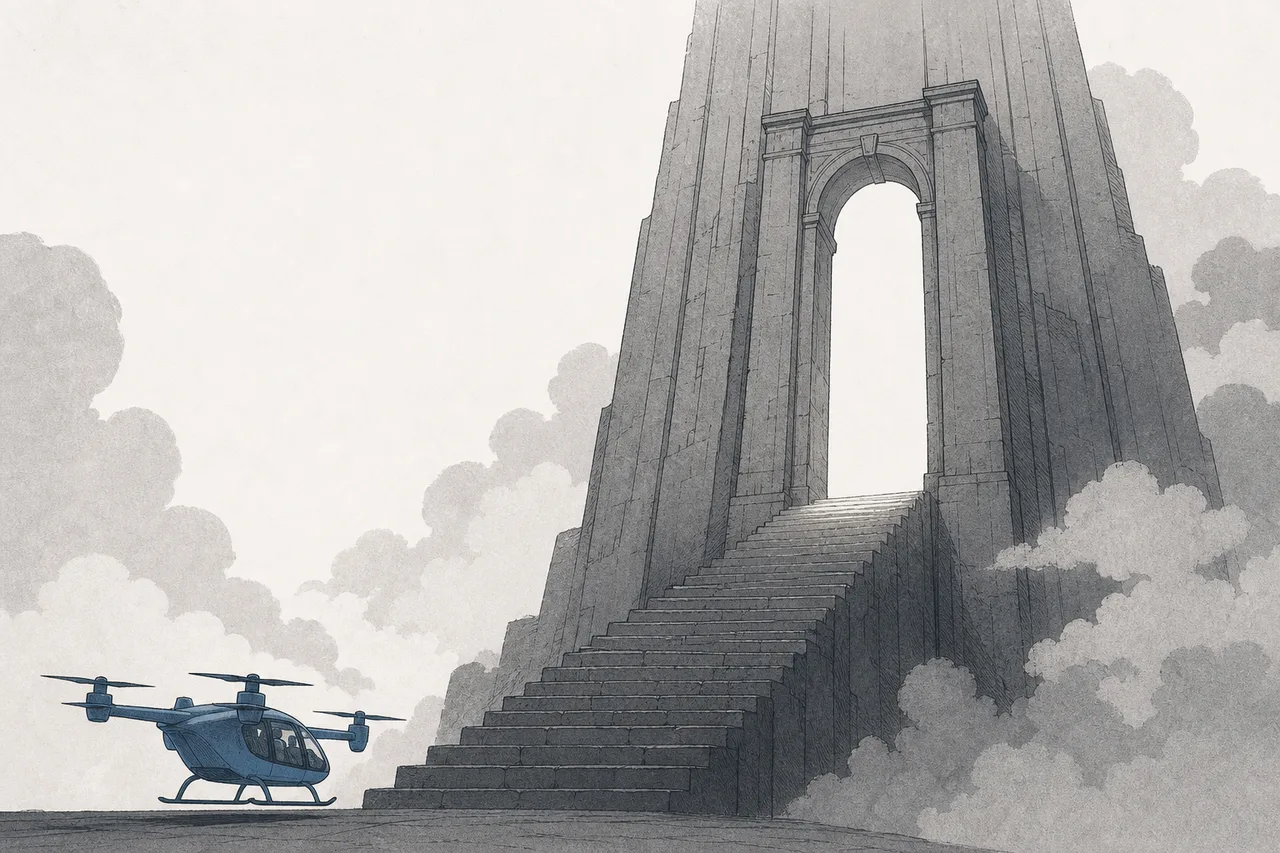
The FAA's type-certification process for eVTOL is split into four phases, and every phase always takes longer than anyone expects. This delay is why Morgan Stanley cut its 2040 market estimate — "certification risk" is the phrase that shows up again and again in every analysis.
As of mid-2026, the certification-race picture has become much clearer, as follows:
What's striking is that the company that cleared this gate fully before anyone else wasn't the priciest American stock, but China's EHang — it assembled type certification + production license + airworthiness certificate + operating license, and started actually selling flight tickets in March 2025 — becoming the first passenger eVTOL in the world with real revenue from passengers (even if it's just short sightseeing loops).
06Where things stand now — and who will survive
This is the part that has to be the most honest. 2025–2026 is the "prove-yourself" period for the whole industry — some are near the finish line, some have already fallen. The gap between these two groups teaches an important lesson: in this game, cash in hand matters as much as technology.
On the U.S. side, Joby leads — it has closed FAA Phase 3, with only the final phase left (test flights under the FAA's direct supervision). The first commercial market about to open is Dubai — Joby won a 6-year exclusive operating right from the RTA and is building a network of landing pads (vertiports), including at DXB airport. In the U.S., it's targeting New York and Los Angeles as the next markets in late 2026. Crucially, Joby has a long runway — $2.5 billion in cash and short-term investments as of March 2026 (backed by Toyota and Delta), giving it a "long breath" to wait out the gate.
Archer comes second — but was the first to successfully close FAA Phase 3 (Apr 2026). It has strong partners in United Airlines (a $1 billion pre-order) and Stellantis (helping manufacture), and its financing is solid too — about $1.8 billion in liquidity, with a loss of about $172.5 million per quarter (Q1 2026). Its runway is a bit shorter than Joby's ($2.5B vs. $1.8B), but it can still wait out the gate, which keeps "speed of certification" a real priority for Archer.
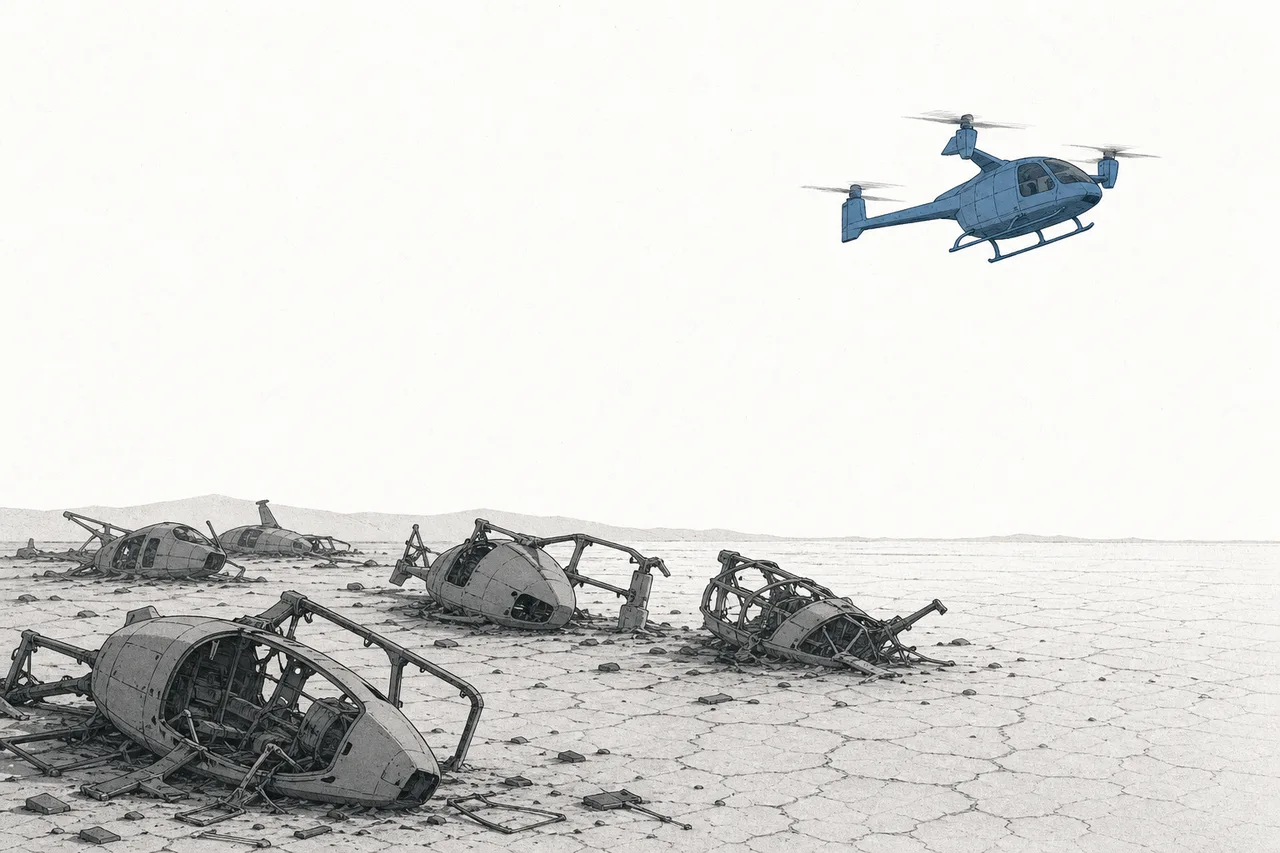
But the heaviest lesson came from Europe — Lilium (Germany), once a star, went bankrupt twice (Oct 2024 and Feb 2025) after funding deals collapsed, and Volocopter (also Germany) filed for bankruptcy in Dec 2024. Both had good technology, but the money ran out before they reached the certification finish line. This is the reminder that this node isn't "if you can build it, you win" — it's "who's tough enough to survive."
On the China side, EHang is the only one already earning real revenue from passengers. It began selling tickets for short sightseeing flights in Guangzhou and Hefei in March 2025, and the Hefei city government pledged to buy at least 100 EH216s or back it with up to $100 million — showing the role of China's government in "cradling" this industry, an advantage Europe doesn't have (one reason Lilium fell was that Germany's government wouldn't guarantee its loans).
07Future & risks — really take off, or keep burning cash
There aren't many things to watch on the road ahead, and every one of them is a double-edged sword.
The first is certification getting close to unlocking. If Joby passes the final phase and starts flying for real as planned — with the first market opening in Dubai first, then New York/Los Angeles in the U.S. in late 2026 — it'll be the proof that the West's "pilot first" model really works. But if it slips again (which has happened over and over), companies with a short runway will get hurt badly.
The second is the battery wall. Today's battery energy density limits both the range and the weight you can carry — which is why most eVTOLs only fly ~100–150 miles and seat just a few people. So this node ties its fate inseparably to aviation motor and battery technology and the trend of replacing fuel with electricity. If batteries get better, the game changes instantly.
The third is infrastructure. Even with a certified aircraft, it can't fly without landing pads (vertiports) and an airspace-management system to support it — the aircraft is just one piece of a much bigger puzzle. That's why the whole-trend overview keeps stressing that "the aircraft alone isn't enough."
In short: this node sits right on the line between science fiction and commercial reality. In 2025–2026, it started crossing that line for the first time — EHang really sells tickets, Joby is on the verge of certification. But at the same time, Lilium and Volocopter fell. Understanding this node means understanding that in cutting-edge technology, "can build it" and "can survive" are two entirely different things — and on this field, certification and cash are the two things that decide everything.