Megatrend · Advanced Air Mobility
Before flying taxis, the sky needs roads and traffic lights
Everyone talks about "flying taxis," but they forget one simple question: where does it land, and who keeps it from crashing into another one in mid-air? This lesson is the story of the parts no one talks about — the vertiport on the ground and the digital air-traffic system (UTM) — the "roads and traffic lights" of the electric-aircraft era. Without these two, you could build a thousand aircraft and not fly a single one commercially.
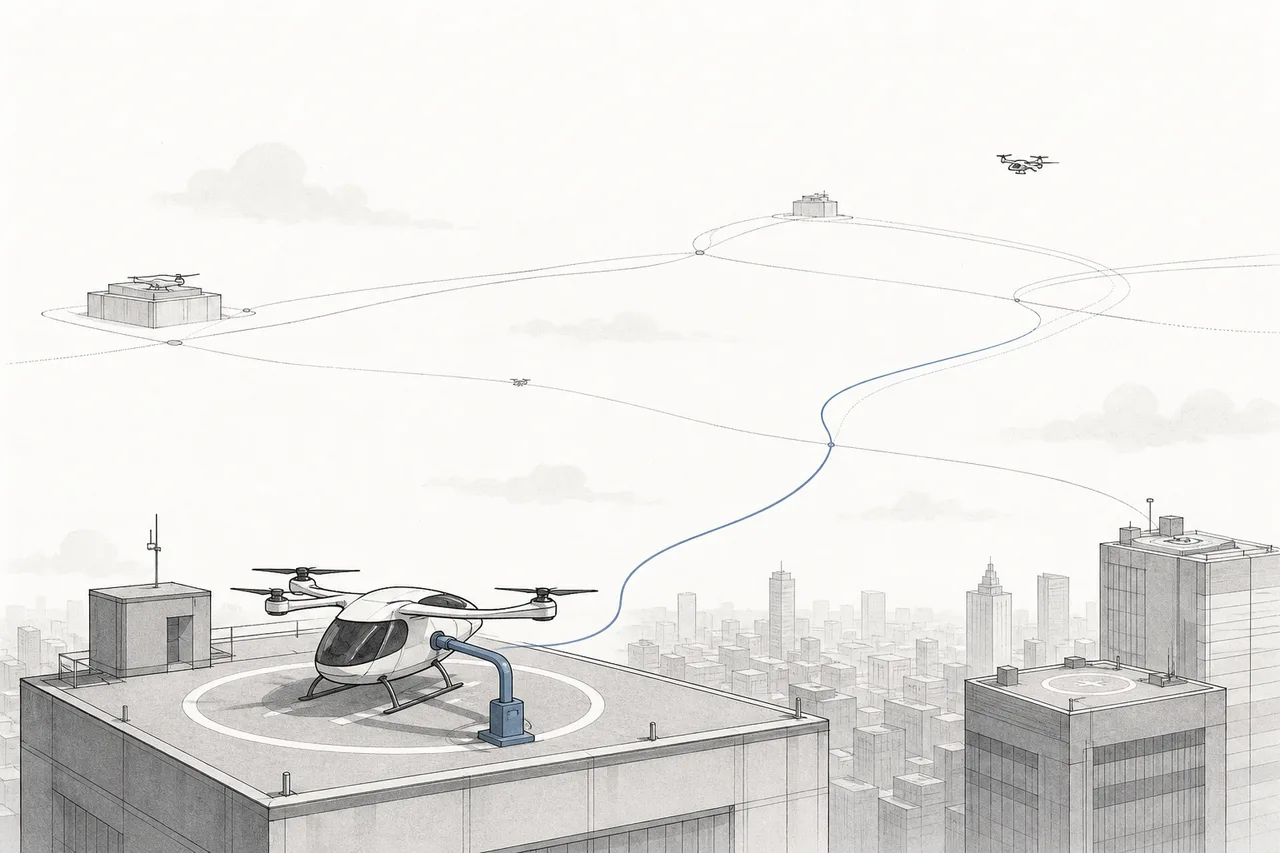
01What it is
Picture the car a hundred years ago. The earliest cars did run — but what changed the world wasn't the car itself. It was paved roads, gas stations, and traffic lights. Without those three, the car stayed an expensive toy for a handful of the rich.
This node is the "roads, stations, and traffic lights" of the electric vertical take-off and landing (eVTOL) era. It splits into two halves that always have to come as a pair:
- The "ground" half — Vertiport: land in the city or on a rooftop, turned into a take-off and landing pad for electric aircraft, with fast charging heads like an EV's (but far stronger), a terminal, and a system to queue arrivals and departures. Think of it as a "miniature airport" you can fit inside a city
- The "sky" half — UTM & Airspace Integration: the software and rules that route many aircraft flying low over the city so they don't collide with each other or get in the way of ordinary passenger planes — like an automated "digital control tower"
An air-traffic management system for unmanned aircraft and low-altitude electric aircraft. Unlike ATC (the traditional control tower), where a human talks one plane at a time over the radio, UTM is built to be digital and automated from the start — because electric aircraft will be far too numerous to direct one by one. Each provider is called a USS or PSU.
On the megatrend map, this node is the "infrastructure" branch of AAM — not the aircraft, not the motor, but the "ground and sky" every aircraft depends on. And that is the whole point of this lesson.
02Why it matters — no ground and sky, no flights
This one is easy to grasp: a $3-million electric aircraft that flies beautifully can't earn a single cent if there's nowhere to land in the city and no one will let it cross the city's airspace. The aircraft is the hero everyone sees, but the infrastructure is the stage the hero has to stand on.
And here's the core thesis of this node: infrastructure is the overlooked "unlock." Whoever owns the prime-location vertiports, the charging heads, and the UTM system collects a "toll" on every flight from every camp of aircraft — no matter which brand wins the aircraft-building war, the one who controls the ground and the sky still gets a cut. Like the owner of an airport who gets rich off every airline that lands.
The stakes aren't small, either. The global vertiport market is projected to grow from about $0.8 billion in 2025 to about $22 billion in 2035 (around 40% a year on average). Investment to build vertiports alone could top $10 billion by 2030, and if you add the UTM systems and the whole airspace overhaul, the entire ecosystem is estimated to need investment on the order of $50 billion or more.
03How it works — the "ground + sky" system
The heart of this node is that two systems have to work at the same time, like roads and traffic lights — a road with no lights means crashes, lights with no road mean nothing. Let's look at the whole system first, then dig into each half.
The "ground" half is harder than it looks — it's about electricity: what many people don't realize is that a vertiport isn't just pouring concrete and painting a circle. It's a massive electrical load. An electric aircraft has to fully charge in 15–30 minutes to fly the next leg, which takes charging heads of 300 kilowatts to 1 megawatt each (Joby has even tested a 1.2 MW charging head). A vertiport with 4–6 pads running at once can draw a peak of 2–4 megawatts — 6–7 times the normal electrical load of that same plot of land. That means upgrading the utility's transformers and power lines for the whole district.
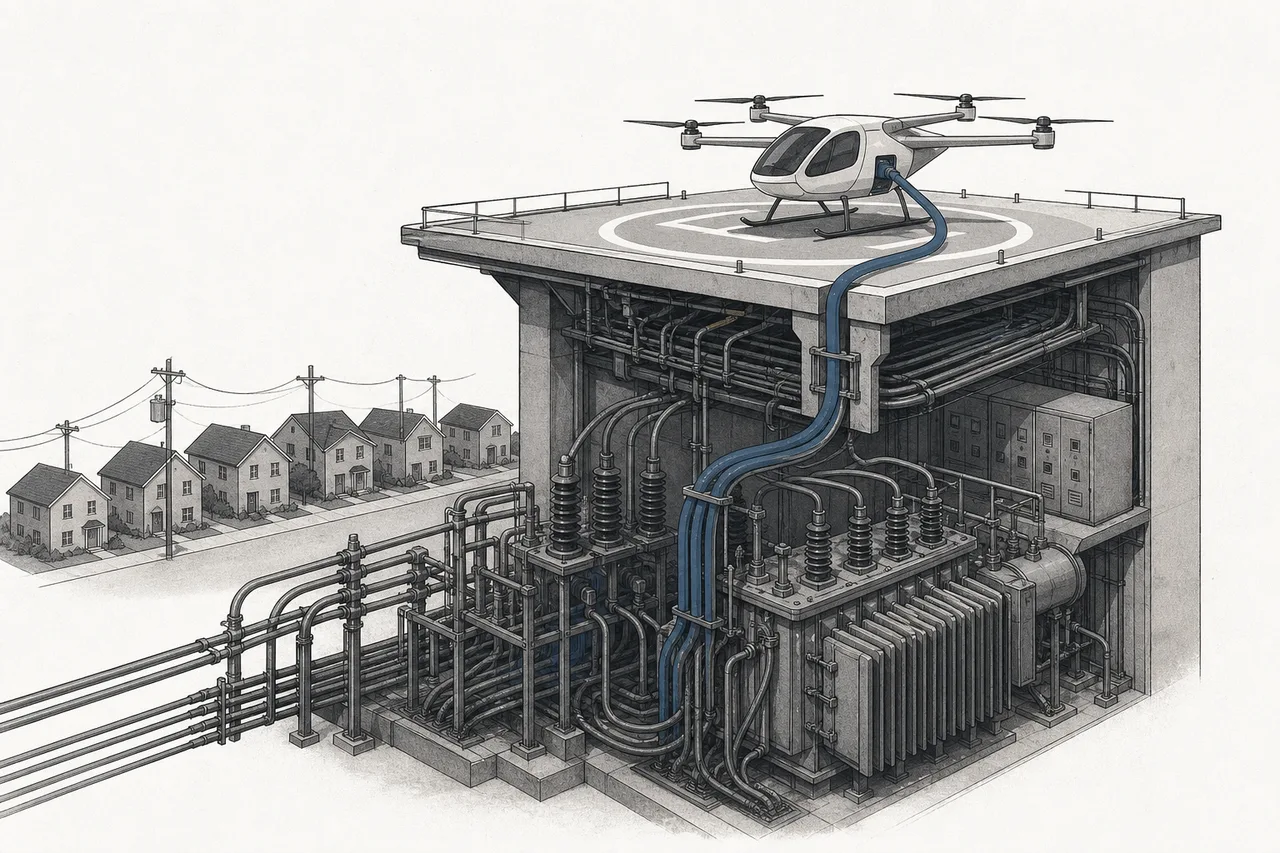
The "sky" half has to be digital: the low-altitude airspace over cities today is barely managed by anyone. Once there are dozens of electric aircraft buzzing around at the same time, the old control tower — a human on the radio one plane at a time — clearly can't keep up. The answer is UTM: computers plan routes in advance (strategic deconfliction), reserve time-and-airspace slots, and keep adjusting automatically — pure software that can charge a fee per flight.
BVLOS (Beyond Visual Line of Sight) = flying farther than the operator can see, which is essential for real commercial flight and requires prior approval from the aviation authority · Strategic deconfliction = UTM "planning to avoid collisions" before the flight even starts, by routing and timing each aircraft so they don't overlap — instead of waiting to dodge each other when they're nearly colliding in mid-air.
04Where it sits in AAM
Under the megatrend Advanced Air Mobility (eVTOL), there are sub-branches with clearly divided jobs. This node is the "infrastructure layer" that supports all the rest:
- The aircraft — Passenger eVTOL OEMs: companies that build the aircraft carrying passengers (Joby, Archer, Beta, Eve). They build the "car"; this node builds the "roads and stations" for the car to run on — each side depends on the other
- The engine inside — AAM Propulsion, Avionics & Supply Chain: the electric motors, batteries, and flight-control systems inside the aircraft — and the battery specs of these aircraft are what determine how powerful the charging heads at the vertiport need to be
- Siblings in the family: regional electric aircraft and cargo/delivery drones rely on vertiports and UTM too — and UTM especially was actually developed out of the needs of drones first, then extended to carry people
And importantly, this node is deeply entangled with other big trends:
- Depends directly on the energy transition & electricity demand: a vertiport is a new, highly concentrated electrical load that the utility has to plan for — just like when EV charging stations showed up and pressured the grid
- Uses the brain of AI: UTM, which routes many aircraft automatically, leans on AI to plan and avoid
- Competes with and complements traditional aviation (Aerospace & Aviation): squeezing new aircraft into airspace that already has passenger planes is a major challenge for aviation authorities like the FAA and EASA
05Where things stand now — and the truth that has to be said
Let me say it straight first: this node is still very early, and the money flowing in is far less than into the aircraft, because it's stuck in the classic trap of new infrastructure — the "chicken-and-egg" problem.
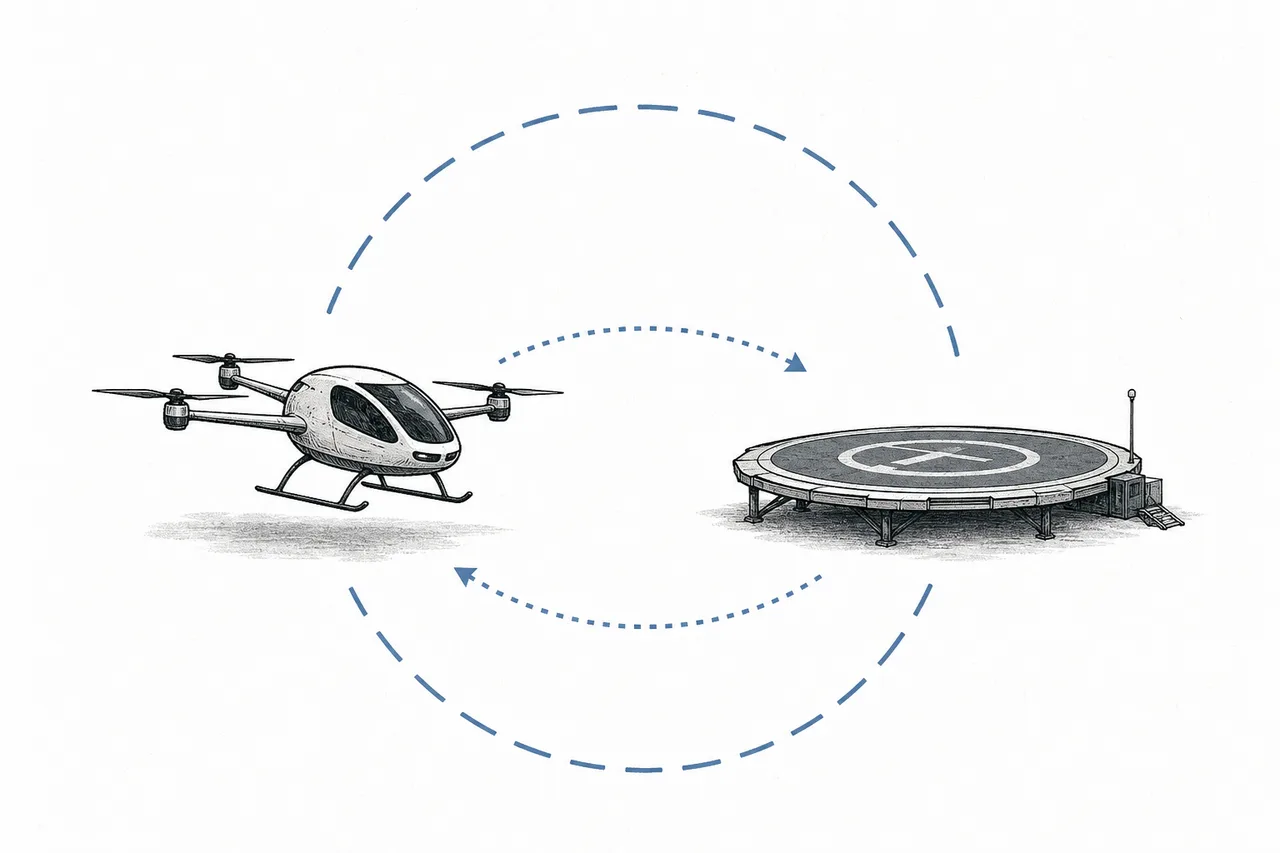
This is a loop no one escapes unless everyone moves at the same time: aircraft only pay off once they can fly commercially, but flying commercially needs vertiports and charging heads. Meanwhile the people who build vertiports are still hesitating, because right now there are almost no certified aircraft cleared to fly for real money — so revenue is still zero while the huge construction costs have to be paid upfront. There are clear reports that investors are far more interested in the "aircraft" than the "infrastructure."
Even so, the real thing is starting to happen, at the level of pilot projects — not full commercial service:
- Skyports finished the UK's first test vertiport at Bicester Motion in mid-2025 and broke ground on a vertiport network in Dubai, aiming to open its first pad around mid-2026
- The U.S. aviation authority (FAA) has started moving on the rules — the BVLOS rule that will unlock commercial beyond-line-of-sight flight is expected to take full effect around mid-2026, and the FAA just approved OneSky as a commercial UTM provider in 2025
And here's the truth to tell in full: the real players of this node are mostly still private companies, or just a small division inside a larger company. There's no easy pure-play "vertiport stock" to buy yet, and the field already shows its stumbles — the prototype Air One vertiport in Coventry (UK) was dismantled after its demo, some German UAM companies filed for bankruptcy in early 2025, and even Ferrovial, the infrastructure-construction giant, sold off its U.S. vertiport business to Atlantic Aviation in January 2025 — a sign that even the big players still can't find the right "moment to invest."
06The future
Looking ahead, this node's story will be decided by three beats:
One — the "unlock the chicken and egg" beat. The trigger is a single aircraft model actually getting certified to fly passengers commercially, plus the FAA's BVLOS rule expected to take full effect in mid-2026. The moment an "aircraft that can actually fly and earn" appears, vertiports and UTM get revenue and a reason for people to pour money in — and the loop that was stuck begins to turn.
Two — the "collect a toll" model. If the loop turns, the owners of prime vertiports and UTM providers become the ones charging a fee per flight, per landing — much like airports and air-traffic control today. It's recurring revenue that doesn't depend on which aircraft brand wins, which is the appeal of investing in "infrastructure" over the "manufacturer."
Three — the tie-in with the power grid. As vertiports expand, they become a big electrical load that has to be planned alongside the energy transition — many designs are already adding energy-storage systems (1–5 MWh batteries) at the pad to charge slowly from the grid and discharge fast when aircraft land, softening the shock to the grid. This makes the vertiport the meeting point of AAM and the energy business.
07Challenges & risks
The appeal of this node comes paired with risks you shouldn't overlook — and these have to be said plainly:
One — the chicken-and-egg trap + demand timing. This is the biggest risk. If electric aircraft are certified later than expected, or commercial service is slow to arrive, the vertiports built ahead of time end up "waiting for passengers who haven't come" — burning money with no revenue. The stumbles already seen (a prototype pad dismantled, some companies bankrupt, big players selling off the business) all come from timing that isn't ripe yet.
Two — heavy investment, slow payback (capex). A vertiport in the city means expensive land, buildings, and above all a megawatt-scale electrical upgrade that pushes the area's load up 6–7 times. These costs are paid upfront, the revenue comes later — which makes early returns thin and tests investors' patience hard.
Three — regulation, zoning, and the community. Setting up a vertiport in the city center means clearing zoning permits and the objections over noise, safety, and the privacy of surrounding residents. On the airspace side, safely squeezing many new aircraft into airspace that already has planes is a problem that authorities like the FAA/EASA still have to write the rules for, bit by bit — and every regulatory delay is a revenue delay.
In short: everyone is excited about "flying taxis," but what decides whether they actually happen is hidden in two things no one talks about — the vertiport on the ground, and the traffic system in the sky. Just as the car changed the world thanks to roads and stations, not the car alone, this node is the "roads and traffic lights" of the electric-aircraft era — not built yet, not earning yet, but whoever owns it once it's done is the one who collects the toll on the entire sky.