Megatrend · Advanced Air Mobility
Don't guess which flying taxi survives — just sell parts to all of them
Everyone argues over who'll be the "Tesla of the sky" — Joby? Archer? But there's another group that doesn't have to guess at all, because no matter who wins, they sell the motors, batteries, flight-control systems, and composite materials to every aircraft anyway. This is the "picks-and-shovels" layer of the flying-taxi era — lower risk, but still tied to a market with almost no real revenue yet.
01What it is
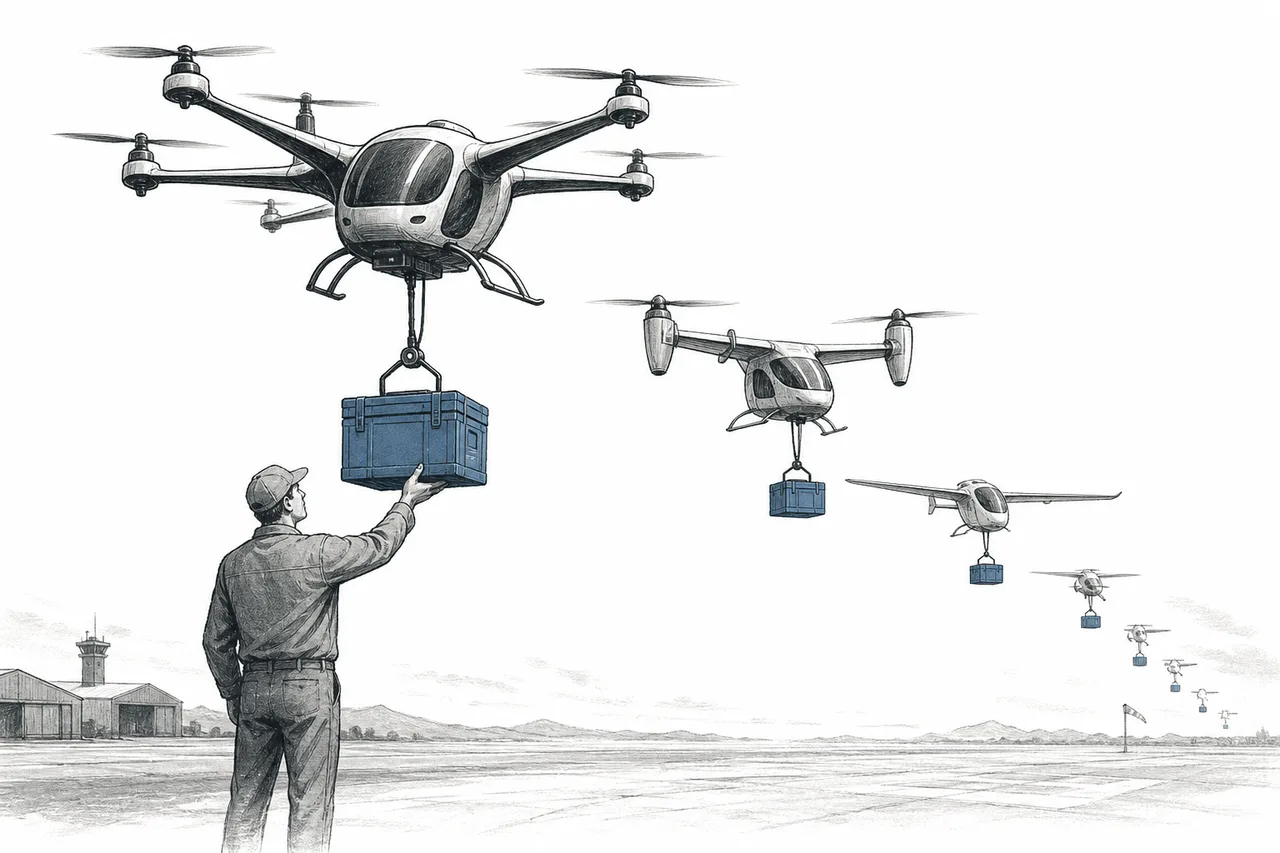
Think back to the gold rush. The ones who really got rich weren't all the gold miners — thousands of miners went bust. But the people who sold the picks, the shovels, and the jeans to the miners got paid whether or not anyone struck gold. This node is the "pick seller" of the electric flying-taxi era.
It's a sub-theme of the megatrend Advanced Air Mobility (eVTOL) — but instead of the companies that build the flying-taxi "aircraft" itself (like Joby or Archer), this node is the supplier layer: companies that make the critical parts — electric motors, aviation-grade batteries, flight-control systems (avionics), lightweight composite materials, and actuators — and sell them to every aircraft maker.
eVTOL = electric Vertical Take-Off and Landing — an electric aircraft that takes off and lands vertically like a helicopter, but is driven by several electric motors instead of an engine · picks-and-shovels = an investing strategy that buys the "equipment seller" to the whole industry, rather than betting on any single player that might collapse.
The heart of the idea is in the node's own definition: "parts sold into every aircraft." It doesn't matter that each company's aircraft looks different (some use tilting propellers, some a wing plus propellers) — because inside, they all need the same set of basic parts. So the people selling those parts don't have to guess who's going to win.
02Why "selling picks" beats digging for gold
The first reason is risk gets spread out. Flying-taxi makers (OEMs) like Joby or Archer still have almost no commercial revenue and are burning enormous amounts of cash while they wait for aviation regulators to approve passenger flights. Bet on the wrong one and the money can vanish entirely. But if you're the one selling motors to Joby and Archer and ten others, you don't have to care who survives.
The second reason is most pick sellers are companies that are already profitable. The real suppliers in this field aren't fragile startups — they're aerospace giants whose core business has made money for decades. Honeywell's aerospace business brought in about $15 billion a year (2024). The flying-taxi business is just a small "new branch" on a tree that's already bearing fruit — unlike the OEMs, which have to survive to survive.

And the end market is big enough to be worth it. Morgan Stanley estimates the eVTOL market will reach about $15 billion in 2030 before surging to the trillion-dollar range by 2040 (a far-off dream number to view with caution). Every dollar that flows into this market will always leave part of itself as parts revenue for the pick sellers.
03Pop the hood: what is a flying taxi made of?
The best way to understand this node is to take a flying taxi apart piece by piece and see who sells which piece, because each piece is the business of a different group of suppliers. Picture opening up a computer to see what's inside — each piece is the company that sells it.
Going through them one by one:
- Electric motors & inverters: the heart of propulsion. Safran (France) has its ENGINeUS motor, already EASA-certified and picked by several makers. BETA Technologies just landed a motor-supply deal with Eve Air Mobility that could be worth up to $1 billion over 10 years
- Battery packs: the make-or-break factor for range. Amprius unveiled silicon-anode cells at an energy density of 450 Wh/kg — about 80% higher than ordinary lithium-graphite batteries, which matters a lot because flying taxis need high power but can't be heavy
- Flight control (avionics + fly-by-wire): the brain of the aircraft. Honeywell sells its compact fly-by-wire system and Anthem flight deck to several makers, like Vertical Aerospace
- Lightweight composite airframes: every gram matters. Hexcel was chosen to supply the high-performance carbon fiber Archer uses to build its production aircraft
- Actuators: the muscles that move the propellers and control surfaces. Archer picked Honeywell to supply its flight-control actuation technology
Wh/kg = energy stored per kilogram of weight. The higher it is, the farther the aircraft can fly without lugging heavy batteries — this is the physical bottleneck for flying taxis across the whole industry · fly-by-wire = a system that replaces the old mechanical cables with electric/computer signals to control the aircraft — essential when an aircraft has many motors that must coordinate in real time.
04Where it sits in the AAM ecosystem
Under the megatrend Advanced Air Mobility there are 5 groups — four of them are "aircraft builders" or "infrastructure builders," and this node is the only one sitting beneath the floor of all of them: the supply-chain layer that feeds parts to everything.
- Supplying Passenger eVTOL OEMs (passenger flying taxis): the biggest customers — Joby, Archer, and Eve all buy motors / batteries / avionics from this node
- Supplying Hybrid-Electric & Regional Aircraft and Cargo & Delivery Drones: the same set of parts sells across to electric regional aircraft and delivery drones too — widening the market for the pick sellers
- Connecting with Vertiport & Airspace: the landing-and-charging pads and the air-traffic systems — another infrastructure layer that has to be ready at the same time
Looking beyond the AAM megatrend, this node is also deeply tied into other trends: it's an application of Electrification & Mobility (motors / inverters / batteries are the same technology as EVs, just lifted into the sky), it leans on Critical Materials & Supply Chain (lithium, permanent magnets, carbon fiber), and it depends on clean power from Energy Transition & Power Demand for the "electric" to actually be good for the environment.
What's interesting is that it has both a "complementary" and a "competing" relationship with traditional Aerospace & Aviation — because many of the suppliers are exactly the old aerospace giants, building on their expertise in safety certification and aviation materials. Rather than being disrupted, they've become the ones feeding parts to the new challengers.
05Where it stands now
Where things stand now (mid-2026), let's be honest: most of the supplier layer's revenue is not actual aircraft sales yet, but "development contracts" and long-term supply deals that only bear fruit once OEMs get certified and start commercial production — which hasn't happened broadly yet.
But the deal signals are starting to take concrete shape. In late 2025, Eve Air Mobility picked BETA Technologies to supply its pusher motors — a deal that could be worth up to $1 billion over 10 years, supporting Eve's backlog of about 2,800 aircraft. This is a model for how the pick sellers' revenue arrives in big, long chunks once OEMs lock in their suppliers.
Right now the makers are busy "pairing up" with suppliers — Eve uses motors from both BETA and Nidec Aerospace, with Honeywell for sensors and navigation; Archer picked Hexcel for carbon fiber and Honeywell for actuation; Vertical Aerospace uses Honeywell for fly-by-wire and the Anthem system. These pairings are the supplier layer's "advance purchase orders."
06The road ahead
The first direction is "unlocking with certification." The supplier layer's real revenue explodes when the first OEMs get certified and start delivering commercial aircraft — Archer just got 100% acceptance of its Means of Compliance from the FAA in early 2026. Once the production line starts moving, the pick sellers get orders for every aircraft built, not just development contracts anymore.
The second direction is competition at "batteries and motors." These are the parts that decide performance (range, payload) the most. Going from 250 to 450 Wh/kg instantly changes which flight routes are possible. Whoever controls high-energy battery technology that's passed aviation standards will have strong bargaining power.
The third direction is crossing into other markets. The same set of parts sells into delivery drones, electric regional aircraft, and military aviation too — so suppliers don't hang their fate on the single market of "passenger flying taxis." That helps reduce the risk around the timing of the end market.
07Challenges & risks
Let's be clear: "selling picks" is lower risk than "digging for gold," but it's not without risk.
The first and biggest risk is it's still tied to a market with almost no revenue. Even though the pick sellers don't have to guess which OEM survives, if the whole industry reaches commercial flight slower than expected (slow safety certification, high costs, people not yet trusting the aircraft), the orders all slide across the board. Most of today's revenue is still development contracts, not actual aircraft sales — that's a reality you have to accept.
The second risk is OEMs doing it "in-house" (in-housing). Big makers like Joby have chosen the vertical-integration path — developing their own motors, flight software, and batteries from the start. If everyone makes the critical parts themselves, the pick sellers' market shrinks. Parts that used to sell could get pulled back into the customers' own factories.
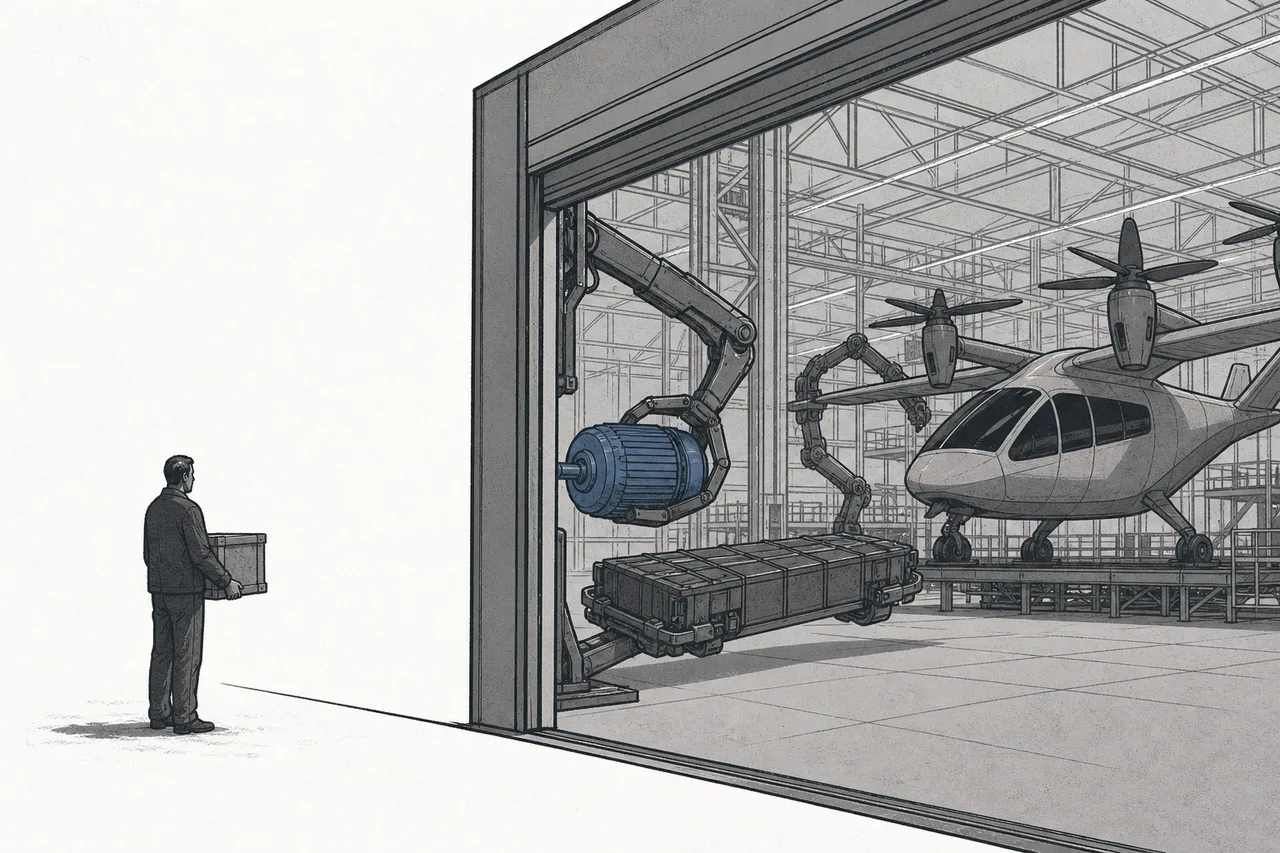
The third risk is concentration. Many critical parts have only a few players, and the big deals usually tie one supplier to one OEM. If that OEM's project stumbles or gets canceled, the deal that looked so good vanishes with it. The more revenue is concentrated in a few customers, the more this risk stands out.