Megatrend · Advanced Air Mobility
When packages no longer have to sit in traffic
Picture a bag of blood that has to reach a hospital deep in the Rwandan bush. Normally that's a 4-hour drive on muddy roads — but a drone flies straight over the mountains and gets there in 15 minutes. This isn't the future: a company called Zipline has already done it over 2 million times. This lesson is about drones that carry "things," not "people" — why it makes sense, and why the real wall isn't the technology but the "law of the skies."
01What it is
When people hear "flying drone," they tend to mix up two things — drones that carry people (flying taxis) and drones that carry things. This node is purely about the latter: uncrewed aircraft that act as "delivery vans" in the sky, carrying packages, food, medicine, blood, lab blood samples, even spare parts — everything except passengers.
The work splits into three clearly different jobs:
- Last-mile: from a nearby store or warehouse to your front door — pizza, over-the-counter meds, groceries within minutes. This is the battlefield where Amazon, Walmart, and Meituan compete
- Middle-mile: moving goods warehouse-to-warehouse or warehouse-to-store — repetitive work on fixed routes that a drone can do cheaper and more on-time than a truck
- Medical & rural: delivering blood, vaccines, and emergency medicine to places roads can't reach or reach too slowly — where a drone creates the most real value, because lives are on the line
On the megatrend map, this node is a branch of Advanced Air Mobility (eVTOL) — the world of next-generation electric aircraft. What sets it apart from its siblings in the same family (which focus on carrying people) is that cargo drones are smaller, lighter, and don't carry the risk of passenger lives onboard. That makes it the part of AAM that "launched" into real use the fastest — while flying taxis still wait for certification, delivery drones have already flown millions of real package runs around the world.
02Why it matters
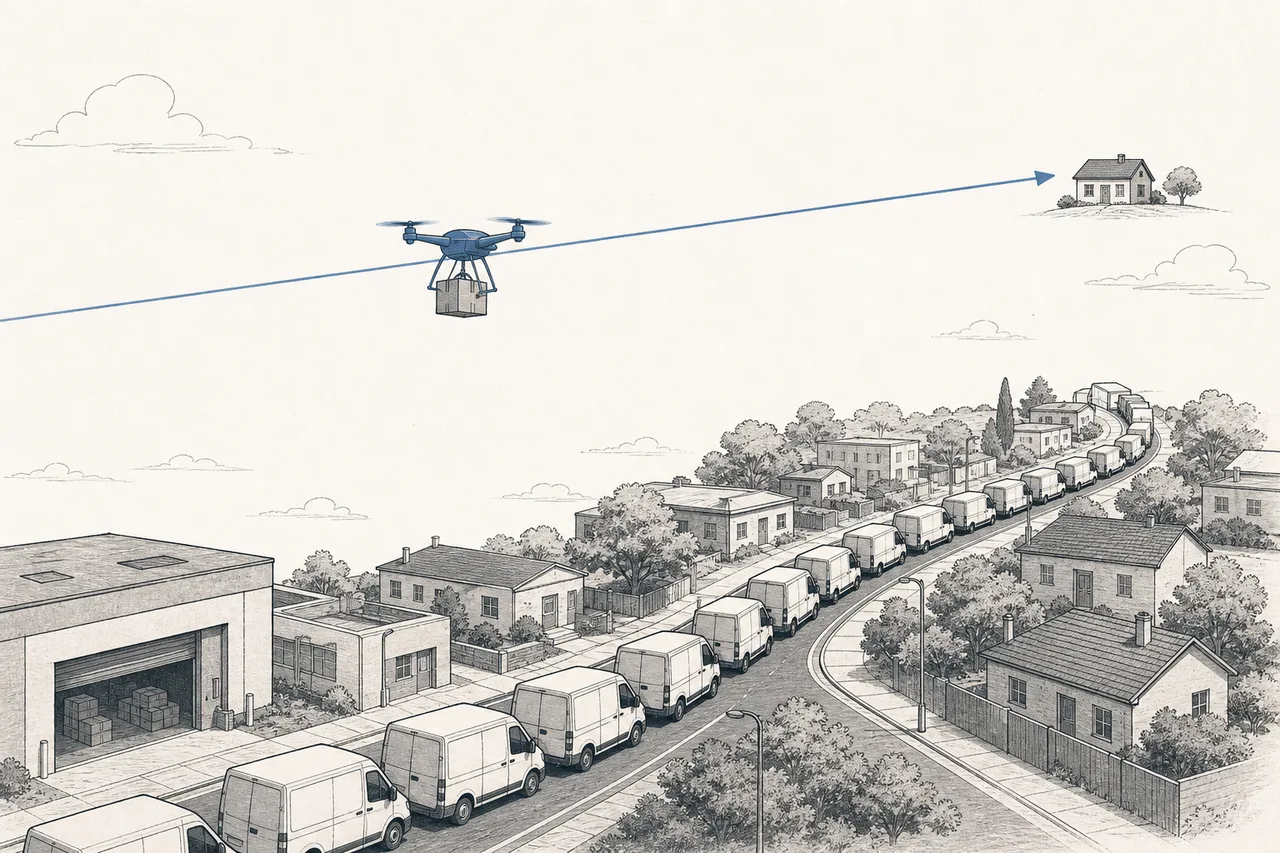
Think about where delivery is "expensive" today. The answer is the last mile — the part that eats the most of the whole shipping cost, because it takes one driver and one vehicle fighting through traffic, parking, walking the package over, and repeating it house by house. A drone cuts this down to: fly straight, drop the package, fly back — no driver, no traffic, no parking.
That's why this market is small but growing very fast. In 2026 the global delivery-drone market is still tiny, around $1.0–1.5 billion, but many research houses estimate a growth rate of about 40% a year, with the last-mile market alone possibly reaching ~$6 billion by 2035. And across all of AAM, carrying "things" is seen as nearly half of the total market over the long run — about as big as carrying "people," the part that gets more headlines.
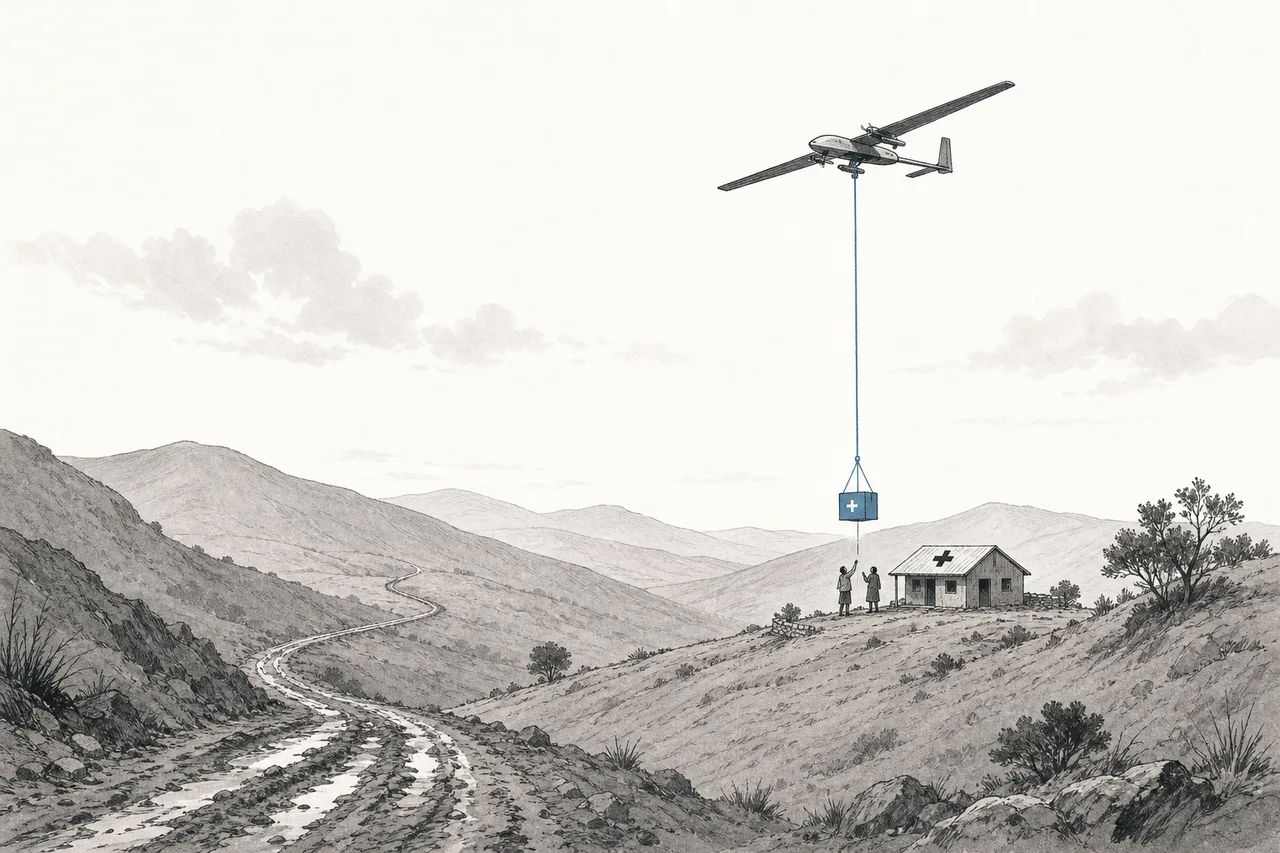
But the market numbers aren't what really gets people excited about this node. The deeper reason is access — in countries with bad roads or no roads, a drone isn't just "faster," it's the difference between things "arriving" and "not arriving." In Rwanda and Ghana, drones deliver blood to rural clinics within minutes — work that roads simply can't do in the rainy season. This is where the technology proved itself before anywhere else — not in America's big cities, but in places where the old transport system fails.
03How it works — and why "the rules" are the real wall
The mechanism is shockingly simple: the drone picks up the package at a warehouse, lifts off, flies a straight line over the traffic to the destination coordinates, and drops the package (some don't even land — they lower it on a tether). The speed comes from one thing — it flies a straight line through the air, with no road to follow. A 12-kilometer trip on a winding road might be just 6 kilometers as the drone flies. And there are no red lights, no traffic jams.
But the problem isn't "how to fly" — drones have been able to fly for ages. The problem is "who allows it to fly far without anyone watching". This is the make-or-break heart of the whole industry, and it has a name: BVLOS.
BVLOS (Beyond Visual Line Of Sight) = flying a drone "beyond the range of sight" — far enough that the operator can no longer see the aircraft. A delivery business only pays off if it can fly this way (if someone has to stand and watch every trip, it's no different from hiring a driver). But aviation authorities fear collisions or crashes, so this is the hardest and slowest approval to get · UTM (Uncrewed Traffic Management) = an "air-traffic-control system" for drones, sorting out which drone flies which route at what altitude, so they don't hit each other or a real airplane.
This is why this industry's "progress" is measured by licenses, not by the aircraft. In the U.S., getting Part 135 certification and state-by-state BVLOS approval is a bigger step than upgrading a motor. China moves faster because the state writes favorable rules — in April 2025, China went as far as giving Meituan a single nationwide flight permit, so it no longer has to seek approval route by route — a leap the West still can't make.
04Where it sits in the AAM world
Delivery drones are one piece of the bigger Advanced Air Mobility picture — and the piece that "works in the real world first." Here's how it connects to the other parts:
- Siblings in the same family: while this node carries "things," siblings like Passenger eVTOL OEMs (flying taxis) carry "people." Both share the vertiport infrastructure and airspace integration (UTM) — the air-traffic-management system built for delivery drones is the same one flying taxis will need
- Sits on top of the AAM propulsion, electronics, and supply chain: electric motors, batteries, flight-control systems — delivery drones buy parts from the same group as all electric aircraft
- Relies on artificial intelligence (AI) as the brain: flying itself without an operator, avoiding obstacles, finding a safe drop point — all of it is AI. The smarter the drone gets on its own, the cheaper each trip, because one person can manage dozens of drones at once
- Overlaps with Robotics & Physical AI: a drone is a flying robot. The navigation, sensors, and avoidance tech are shared with industrial and military drones — many makers cross over between markets
- A new alternative to Electrification & Mobility (logistics): it's a "delivery van" that's gone up into the sky — replacing part of the parcel vans we see every day
In short: if AAM is "moving travel up into the air," delivery drones are the first gate that proves the idea can really make money — because carrying goods tolerates more risk than carrying people, so it cleared the legal gate and reached real use first.
05Where it stands now
This is the part where we have to be blunt, because this industry is full of "pilot programs" that look great in the news but never actually scale. The 2025–2026 picture is that the real thing is starting to separate from the dream-sellers — there are winners delivering millions of real trips, and giants just recovering from years of stumbling.
The clear leader is Zipline — and interestingly, it didn't start by delivering pizza in America, but by delivering blood in Africa. In early 2026, Zipline announced it had hit 2 million delivery flights and raised another $600 million to expand into at least 4 U.S. states (Houston, Phoenix, Seattle). In Q3 2025 it beat its delivery target six weeks ahead of schedule. This is what sets Zipline apart — it proves this model can scale and run consistently, not just fly for show.
Second is Wing, owned by Alphabet (Google's parent), with its partnership with Walmart as its main weapon. Together they've topped 1 million deliveries and announced the biggest expansion plan in the field — growing to over 270 Walmart stores by 2027, reaching about 40 million Americans. Wing's strength is "riding on the back of a retail giant" that already has stores near where people live.
Meanwhile, Amazon Prime Air is a lesson in patience. Amazon announced this program back in 2013 but got stuck for years — cutting the team, closing some areas, missing target after target, until many mocked it as just PR. Yet by early 2026 it's coming back: about 16,000 cumulative deliveries, service in 5 states (Texas, Michigan, Arizona, Florida, Kansas), and a goal of reaching 30 million customers by the end of 2026 — far smaller than Zipline in volume, but Amazon's warehouse network and capital make it impossible to underestimate.
And don't overlook China, which may lead the world in real urban usage volume. Meituan (the food-delivery leader) topped 450,000 orders across a 53-route network by the end of 2024 and got a nationwide flight permit in 2025. Meanwhile Fengyi (a subsidiary of Chinese logistics giant SF Express) has opened 448 routes, covering everything from plains to mountains.
06The road ahead
The first direction is that regulation will be the biggest accelerator (or brake). If aviation authorities in the U.S. and Europe open up BVLOS the "do it once, use it across the whole area" way (as China already did with Meituan), flight volume will jump instantly — because the technology is already ready, just waiting for permission. This is the variable that decides the speed of the entire industry.
The second direction is that the unit economics improve with automation and scale. Today the cost per trip is still high because one person can only manage a few drones. But once AI is smart enough for one person to manage dozens, and once daily flight volume is high enough to spread out the cost of aircraft and warehouses, the cost per item will fall to where it competes with delivery vans — McKinsey sees that, at that point, drones will be "about as cheap as conventional delivery" on some routes.
The third direction is the market splitting by what fits best. Drones probably won't replace all delivery vans — they'll win at jobs that are "small, urgent, and worth a straight flight": medicine, rush groceries, emergency parts, lab samples, and healthcare in remote areas. For heavy parcels or high-volume delivery in dense cities, vehicles still have the edge. The realistic future is "a mix," not "drones replacing everything."
07Challenges & risks
Let's be clear: this node is exciting, but the road ahead is full of potholes.
The first and biggest risk is that regulation (BVLOS) is the bottleneck. The whole industry has to wait for aviation authorities to approve, which is slow and hard to predict, especially in the West. A program that looks promising can stay stuck in "pilot" status for years without really scaling — and many programs end exactly that way.
The second risk is that the unit economics are still hard. Getting the cost per trip cheap enough to break even is a problem no one has fully solved. As long as someone still has to supervise, only a few items can be carried per trip, and daily volume stays low, the profit doesn't come. Amazon's years stuck in the mud are a warning that "deep pockets alone aren't enough."
The third risk is noise and community acceptance. Drones flying over homes are loud and make people feel watched. Many communities have pushed back in concrete ways. The risk of an aircraft falling on a person or property, and the privacy concerns (cameras on drones), are all sources of resistance that have nothing to do with technology — but really do slow down expansion.
In short: delivery drones are the part of AAM that "lands" in the real world fastest, because carrying goods tolerates more risk than carrying people. Zipline has proven it can scale to millions of trips — but the real wall was never about "can it fly." It's about "who allows it to fly," and "is it worth it once it flies." Whoever solves these two at large scale gets the whole sky.