Megatrend · Aerospace & Aviation
One airplane is a "build kit" made on different continents
The wing of the Airbus A220 is made in Britain, the 787's fuselage is formed in Japan and Italy, and the 737's nose is riveted in Kansas — and only then do all the pieces fly in to meet on the assembly line. The companies that "build the body" are Aerostructures — the ones who make the fuselage, wings, tail, nacelles, fasteners, and castings that the Airframe OEM then assembles. This lesson is about why a job that looks like "just working metal and carbon" is at once the point that decides how fast the world gets new airplanes, the thinnest-margin business in the chain, and the fragile spot where one supplier's quality problem can shake all of Boeing.
01What Aerostructures is
When we say "Boeing makes the 737," the truth is that Boeing assembles the 737 — but about 70% of its frame and fuselage is built by another company called Spirit AeroSystems in Wichita, Kansas. The nose section (the cockpit) of nearly every Boeing model comes from there too. That round fuselage we walk up into — that's "Section 41," which Spirit rivets up and ships by rail to Boeing to join on. A company like Spirit is what's called Aerostructures.
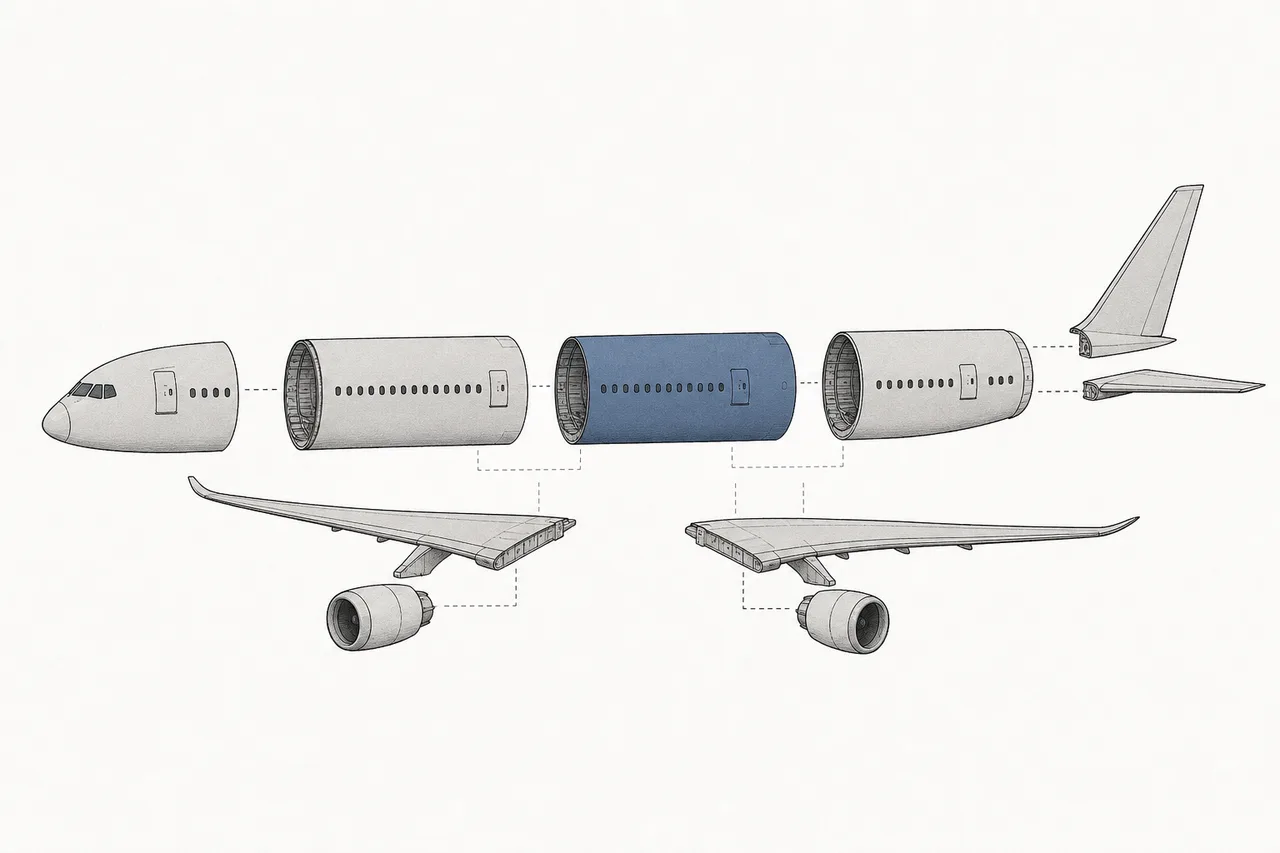
Put simply, Aerostructures is the "body and skeleton" of the airplane — the fuselage, wings, empennage (tail), and the cover that wraps the engine (nacelle), plus the parts that hold it all together: the bolts and rivets (fasteners) and the high-load castings & forgings. The only things Aerostructures doesn't make are the "brain" (electronics) and the "heart" (the engine) — everything else is the airplane's whole body.
Fuselage = the body of the airplane (the cylindrical tube that holds the passengers) · Empennage = the tail assembly (the vertical and horizontal stabilizers that keep the plane flying steady) · Nacelle = the streamlined cover that wraps the engine under the wing · Fastener = the bolts and rivets that hold the parts together — a single airplane uses hundreds of thousands to millions of them, and they have to be a special grade (often titanium)
On the megatrend map, Aerostructures is a sub-branch of Aerospace & Aviation, and it sits in the supply-chain layer — meaning it's a "subcontractor" that feeds big parts up to the Airframe OEM (Airbus, Boeing) to assemble. This relationship is so important you have to nail it down: the OEM is the one who "holds the design and assembles," while Aerostructures is the one who "builds the actual body" of the airplane.
02Why it matters to the global economy
The first reason is scale. The global Aerostructures market is worth around $75 billion in 2025, and is expected to nearly double to ~$143 billion by 2035, at a growth rate of about 6.6% a year. This is one of the biggest single "slabs of meat" in the whole aviation industry — because the body itself takes the largest share of an airplane's material cost and build work.
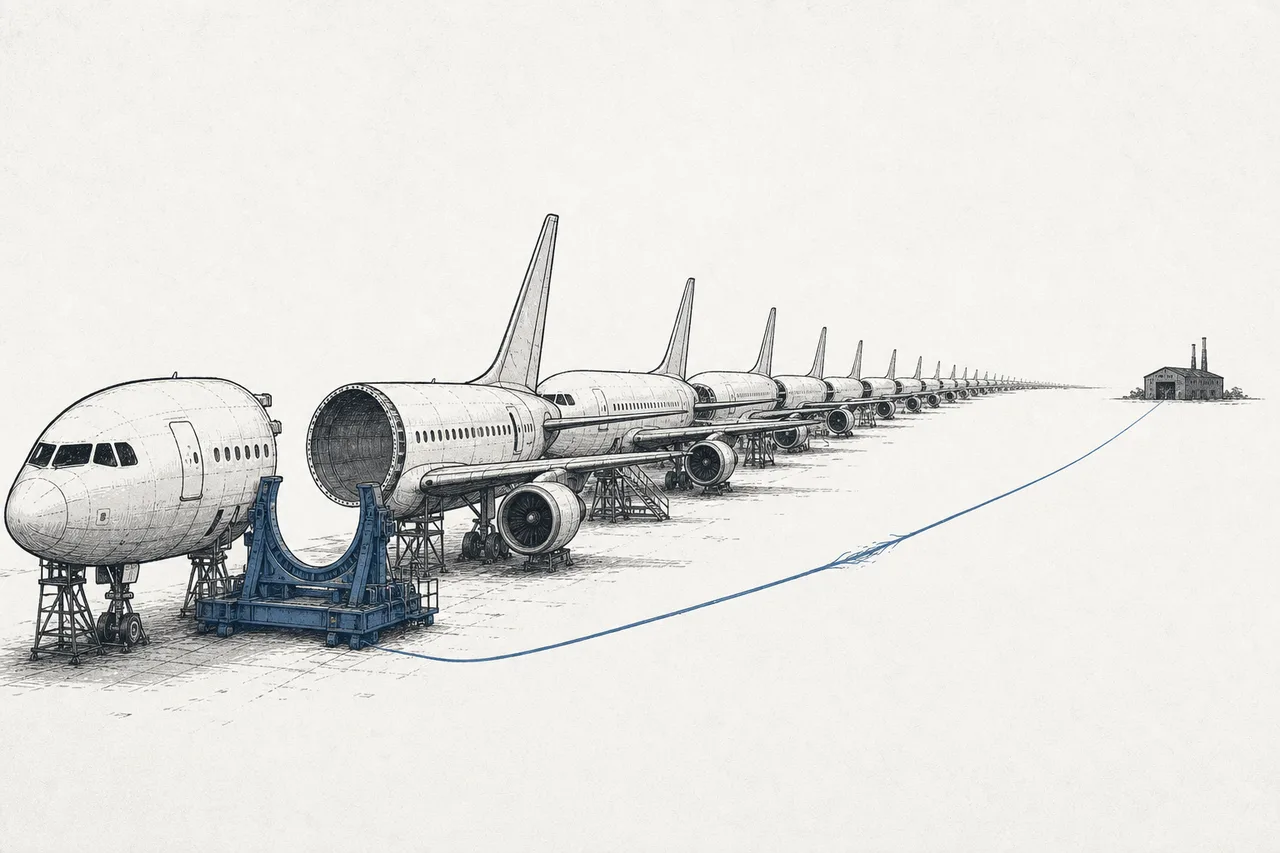
The second reason matters more than the number: the body is the "bottleneck" that decides how fast the world gets new airplanes. Right now Airbus and Boeing have combined order backlogs of more than 12 years. The problem isn't finding customers, it's ramping the production line fast enough — and the thing that's hardest to ramp is usually the big structural parts. If the factory making the fuselage can't keep up, the OEM gets stuck with it. The whole global fleet-replacement supercycle is held back at this one point.
The third reason is what beginner investors often miss: this is the thinnest-margin business in the chain. Most body work is "build to the blueprint the customer hands you" — you don't own the technology, you sell by the piece and compete on price. The result is razor-thin profit — compared with the engine side at 27%+ margins, or the specialized titanium fasteners Howmet makes at around 29% EBITDA, big structural work is heavy labor, high capital, low profit. That's why Spirit posted a $2.1 billion net loss in a single year, even with orders pouring in.
03How it works (who makes which part)
The easiest way to understand Aerostructures is to take an airplane and "break it apart," then ask who builds which part. A wide-body plane like the 787 isn't formed as one body — it's split into "big blocks" and the work is spread around the world, what the industry calls work-share. The "Japan team" (Mitsubishi, Kawasaki, Subaru) alone does about ~35% of the 787's structural work.
There's a logic to this division of work: structural parts are big and heavy, so letting each specialist do only the part they're best at (Mitsubishi, say, is great at the carbon wing box) is cheaper and faster than doing it all yourself. But it creates a "long, thin chain" — because each block usually comes from a single supplier. If any one block has a problem, the whole plane gets stuck.
Another thing you have to separate out is "build to print" versus "design it yourself", which determines who makes more money.
Build-to-print = the OEM designs everything and hands over a "blueprint" for the supplier to build exactly to spec — the supplier is just the "hands," with low bargaining power and thin profit (this is the fate of most structural work) · Design-share / Risk-sharing partner = the supplier joins in the design and invests in development itself, so it owns its own intellectual property, with higher bargaining power and profit (for example, Mitsubishi designs the 787 wing box itself, not just builds to print)
04The materials revolution: aluminum → carbon fiber
If there's one thing that changed the world of Aerostructures over the past 20 years, it's materials. Old airplanes were made from hundreds of small aluminum panels riveted together — a single Boeing 747 uses nearly 1.5 million rivets, and the 777 uses ~2.7 million. Every rivet is a hole, a fatigue point, weight, and a person who has to drive it in one at a time.
Then the 787 and A350 changed everything — the fuselage is no longer made of metal panels riveted together, but a single-piece "carbon-fiber barrel" (one-piece composite barrel), formed by winding millions of carbon fibers around a mold and baking it hard. The 787 is 50% composite by weight (and about 80% by volume), with the rest being 20% aluminum, 15% titanium, 10% steel.
Why is this an economic revolution and not just an engineering one? Because weight is a cost over the airplane's whole life. Composites make the structure about 20% lighter, which translates into up to ~25% fuel savings versus the model it replaces. For airlines, where fuel is the single biggest cost, this is the reason they'll pay more for a composite airplane, and the force pushing the whole industry to replace its fleet.
But carbon fiber has its price: it's harder and slower to form than metal. It has to be baked in a hugely expensive high-pressure oven (autoclave), inspecting for internal cracks is harder than with metal you can "see," and when you have to ramp up production, making every carbon barrel perfect is a much tougher problem than driving rivets — and that difficulty is exactly the root of the quality crisis we'll get to next.
05How it connects in the ecosystem
Aerostructures sits in the middle of the aviation chain — the OEM's "subordinate," but the "boss" of the people who make raw materials. The relationships to understand are these:
- Feeds big parts up to the Airframe OEM: this is the core relationship. The OEM designs the whole airplane, then hires Aerostructures to build the fuselage, wings, and tail. So Aerostructures' fragility (like Spirit's 737-fuselage quality crisis) hits the OEM's production rate directly
- Makes the covers for the engine: the nacelle (engine cover) and pylon (the strut that attaches the engine to the wing) are Aerostructures work too — and Howmet also makes the castings and forgings that go inside the engine itself, so the structure-makers and the engine-makers overlap
- Depends heavily on a key materials chain: aircraft structures consume vast amounts of titanium and carbon fiber. Most aviation-grade titanium comes from Russia (VSMPO-AVISMA), which makes the West sensitive to geopolitics, while carbon fiber is concentrated in a few producers like Japan's Toray
- Hands work on to MRO & Aftermarket: every structural part delivered has to be inspected, repaired, and replaced over the plane's 25–30-year life. A company like TransDigm has built an entire business out of owning proprietary parts that you can only buy spares for from it
- Challenged and extended into eVTOL and defense: the new electric flying taxis need especially lightweight composite structures, while military-aircraft structural work (like China's AVIC, Korea Aerospace) is another big market tied to surging defense budgets
06Where it stands now
2025–2026 is the period when Aerostructures is doing a "big reshuffle of the house." Three important things are happening at once.
One — Boeing pulls Spirit back in-house. This is a deal that shook the whole industry. Spirit was once part of Boeing, but was spun off and sold in 2005 to cut costs. Two decades later, after a door plug blew out mid-air from a 737 MAX in early 2024 — a plane whose fuselage came from Spirit — Boeing decided to buy Spirit back at $4.7 billion in equity value ($8.3 billion including debt). The deal closed in December 2025. The lesson: spreading structural work outside to cut costs ends up costing you control over quality — and Boeing paid dearly to get that control back.
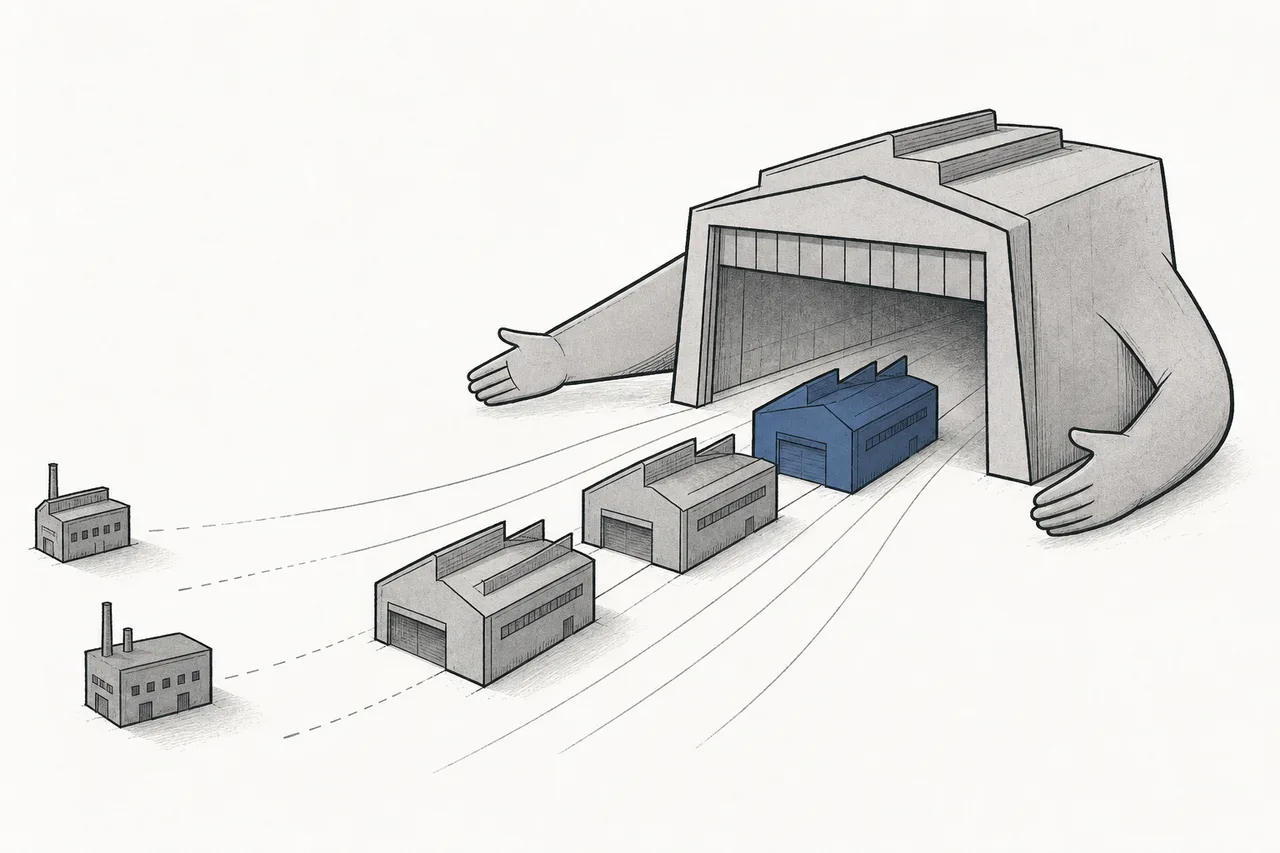
Two — Airbus carves its own part out of Spirit. Because Spirit didn't just work for Boeing — it also made the A350 fuselage and A220 wings for Airbus. When Boeing bought all of Spirit, Airbus wasn't about to let a rival control its own supplier — so it agreed to carve out the plants that work for Airbus (Kinston in the U.S., Saint-Nazaire in France, Casablanca in Morocco, and part of Belfast). Airbus even received "compensation" because those plants were losing money. This reflects the brutal truth of this business: some structural production lines are losing money enough that someone has to pay you to take them.
Three — the fragility of the structure side drags the whole industry. Through 2024–2025, Spirit took heavy losses (a $2.14 billion net loss in 2024 on $6.32 billion of revenue) because it had to ramp production while fixing quality at the same time. Italy's Leonardo also has a structures unit losing so much money that the CEO announced plans to spin off and sell at least half of it. The Grottaglie plant that makes the 787 center fuselage leaned too heavily on Boeing and had to scramble for military work to shore it up — the overall picture is that the structure-makers are struggling, even though airplane demand is overflowing.
On the side of those who can turn a profit, the bright spot is the ones who successfully escaped "build to print" — Howmet (fasteners, forgings, specialized castings), TransDigm (proprietary parts that monopolize the spares), Heico and Loar (a range of specialized parts) all have high margins because they own the technology, not just the hands.
07Future and risks
The first direction is composites taking an ever-larger share. The aviation-composites market is growing faster than the structures market overall — from around $35 billion in 2025 to ~$53–58 billion by about 2030, at double-digit growth. The next-generation single-aisle planes Airbus/Boeing will launch in the coming decade will almost certainly use even more composites, which will reshape who the winners are — whoever can make the carbon barrel fast and cheap will have the edge.
The second direction is automation and robotics. Drilling holes, driving rivets, and laying carbon fiber are increasingly being replaced by robots, alongside new techniques like out-of-autoclave that bake composites without the hugely expensive pressure oven. If this succeeds at scale, it will cut both the cost and the production bottleneck that are the main problem on the structure side today.
The third direction is friend-shoring — moving the supply chain to allied countries. Because most aviation-grade titanium relies on Russia (VSMPO-AVISMA), war and sanctions have the West racing to find new sources, like the titanium project in Bahrain and Toho Titanium's capacity expansion in Japan. Controlling raw materials is becoming a strategic matter, not just a cost one.
But this business's risks are just as heavy. The first is razor-thin margins and dependence on a single customer. Most structural work is low-profit build-to-print, and usually tied to just one OEM. When the OEM slows production (as Boeing did), the structural supplier gets hurt first and harder — Spirit and Leonardo are clear proof that an overflowing order book doesn't mean beautiful profits.
The second is quality and safety. That beautiful single-piece carbon barrel is hard to form and harder to inspect for internal cracks than metal. Ramping up the rate while holding quality at a level where a mistake costs human lives — that's a very thin line. The 737 door-plug case is a lesson in how one structural part's mistake can hold down an entire company for a year, under the increasingly strict eyes of regulators (FAA, EASA).
In short: next time you board an airplane, imagine that the fuselage you're sitting in may have been formed in Japan, the wing in Britain, and fastened with titanium bolts from California — Aerostructures is the art of making giant pieces from different continents meet perfectly to the millimeter, and the point at which the whole aviation industry can only go as fast as this one spot goes.