Megatrend · Aerospace & Aviation
Two companies control the world's skies — but the problem is they "can't build fast enough"
Nearly every large passenger jet on Earth comes from just two companies: Airbus and Boeing. The order backlog stretches more than 12 years and runs into the hundreds of billions of dollars. It sounds like a dream business — but the reality is that an Airframe OEM (the company that assembles the aircraft's "body") works on thin margins, high risk, and today its biggest problem isn't finding customers, it's ramping production fast enough to meet demand. This lesson looks at why "assembling an aircraft" is both a wall no one else can compete past and, at the same time, the most fragile point in the industry.
01What an Airframe OEM is
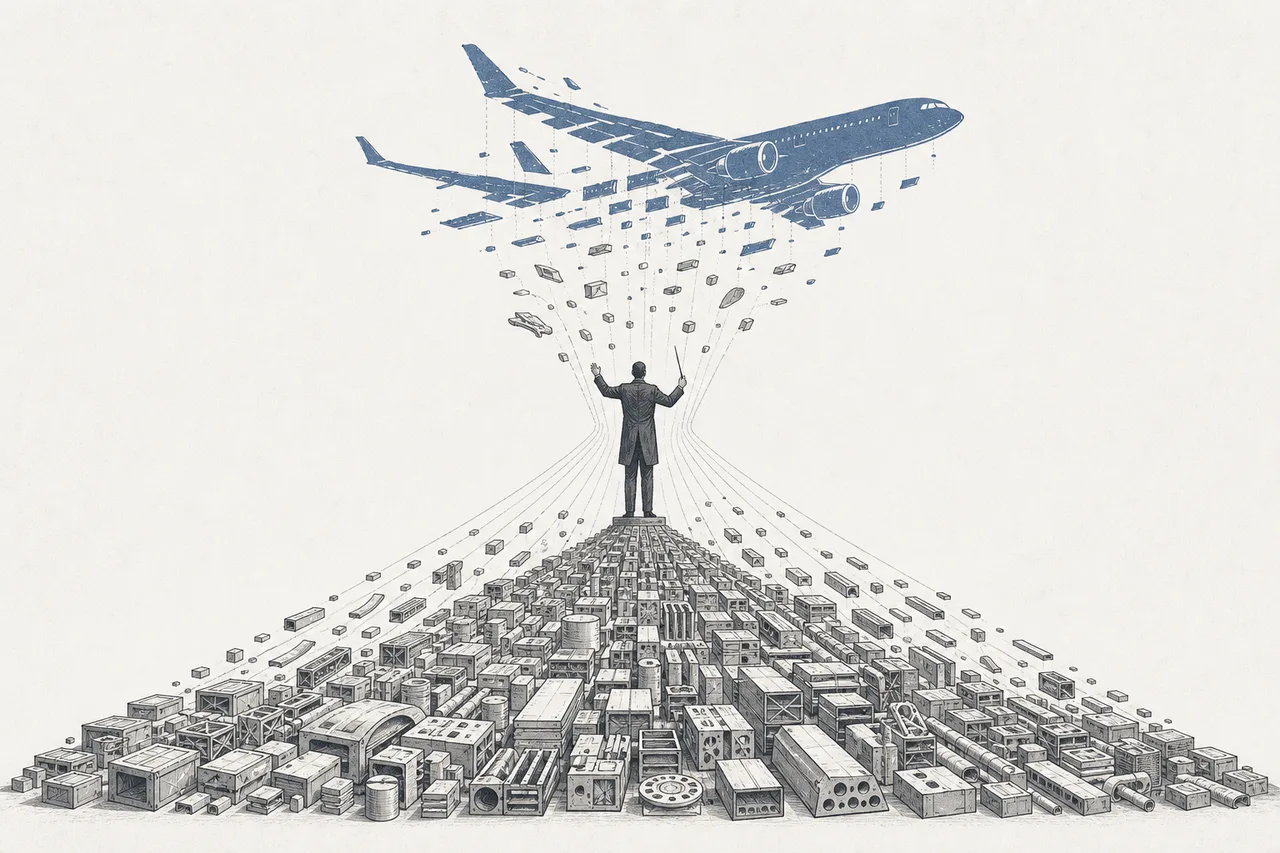
Picture the Airbus A320 you just flew on. Its wings were made in Wales, the fuselage assembled in Germany, the engines come from France and the U.S., and the navigation systems from yet another company. The fact most people don't realize is that Airbus doesn't actually "build" almost any of those parts itself — it designs the whole aircraft, orders suppliers around the world to make the parts, then assembles them into an airplane that actually flies. The company that does this job is the Airframe OEM.
OEM stands for Original Equipment Manufacturer, but in aviation it means "the prime manufacturer that designs and assembles the entire aircraft body" (the prime / the integrator). Put simply, an OEM is like a "general contractor" that designs a whole house, hires hundreds of specialist trades to build each part, and then takes responsibility that the whole house stands, is safe, and gets delivered. So an OEM's real expertise isn't "making parts" — it's the "design and integration" of millions of parts into a machine that can fly.
Airframe = the frame and body of the aircraft (fuselage, wings, tail), not the engines · OEM = the company that owns the design and assembles the whole aircraft · Prime / Integrator = the name for the OEM's role as the "general contractor" sitting at the top of the supply chain, integrating parts from every tier — it makes few parts itself, but is responsible for the entire aircraft.
On the megatrend map, the Airframe OEM is a sub-branch under Aerospace & Aviation, and it's the "upstream source" of the whole chain — because everything starts when an OEM decides to design and build a new aircraft. This market splits roughly into three arenas: large commercial passenger jets (Airbus, Boeing — and China's challenger COMAC), small regional jets (Brazil's Embraer), and private jets (Gulfstream, Bombardier, Dassault). Fighter jets are a separate world, sitting inside Defense & Geopolitical Fragmentation.
02Why it matters to the world economy
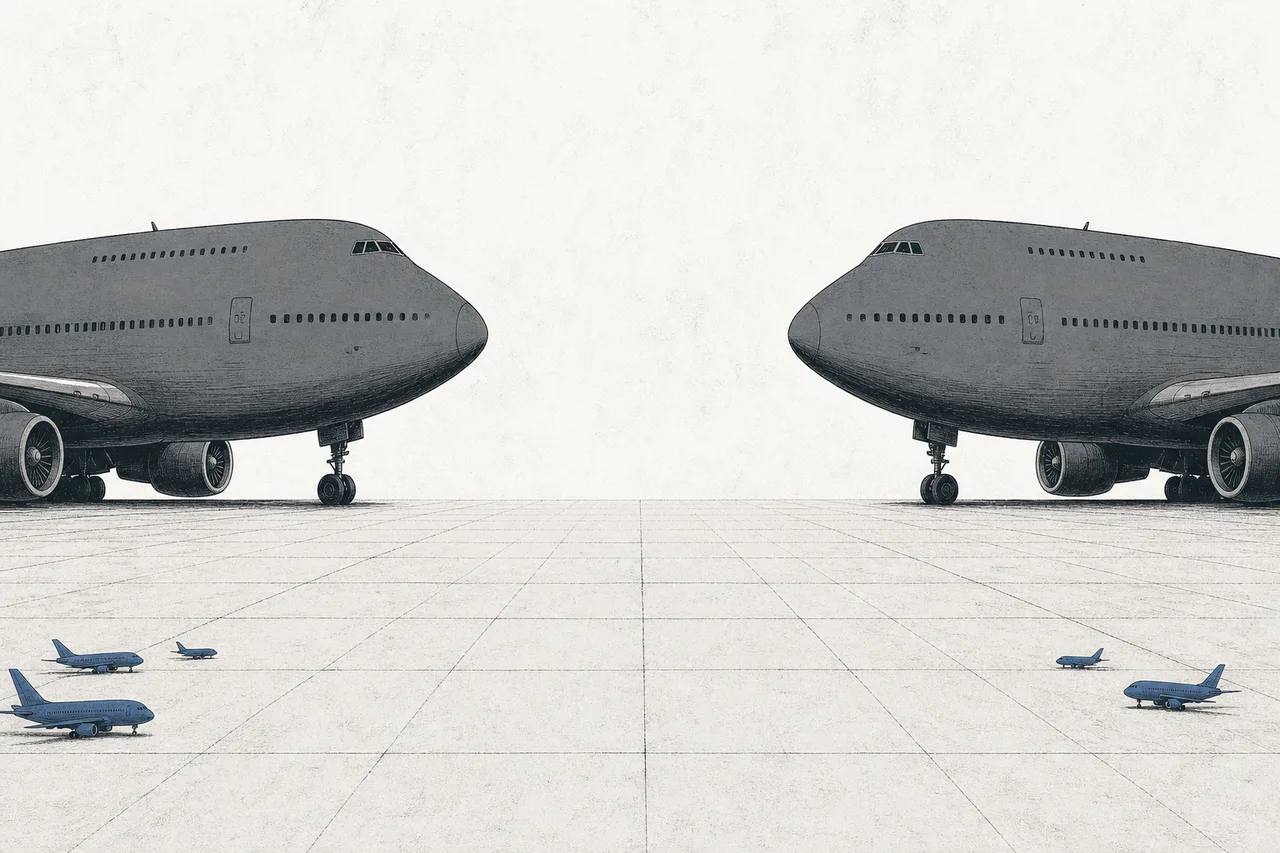
The first reason is scale and the concentration of power. The global aircraft-manufacturing market (all types combined) was worth around $415 billion in 2025 and is expected to grow to about $529 billion by 2030. But what's more striking than the numbers is that the large passenger-jet market is almost entirely controlled by just two companies — the most perfect "duopoly" in any of the world's heavy industries.
The second reason is a backlog so long it's startling. After COVID, the whole world rushed back to flying, airlines rushed to order new aircraft, and Airbus's backlog alone stood at 8,754 aircraft at the end of 2025 — worth roughly €619 billion at list prices. Add Boeing and the two companies' backlog tops 16,000 aircraft. At today's production pace, this queue runs more than 12 years — meaning that even if no one ordered another aircraft ever again, the factories would still have to build for more than a decade to clear it.
And here's what beginners absolutely need to grasp: a long queue doesn't mean fat profits. Assembling the body is a hugely capital-intensive job with thin margins and high risk (the operating margin of the airframe-assembly segment is only around ~7%, versus 27%+ on the engine side). The big money in aviation isn't in the body — it pools in the engines, spare parts, and maintenance (you can read the overview of this in the aviation-industry overview chapter). So what makes an OEM powerful isn't profit per aircraft, it's the "wall" that keeps anyone else from competing.
03How it works (the assembler at the top of the pyramid)
The heart of this business is one word — "integration". A single A320 has roughly half a million parts, and a widebody like the Boeing 777 has up to ~3 million, from suppliers all over the world. The OEM's job is to bring all those parts together at the "Final Assembly Line (FAL)" at exactly the right time, then assemble them into an aircraft that flies and passes safety certification.
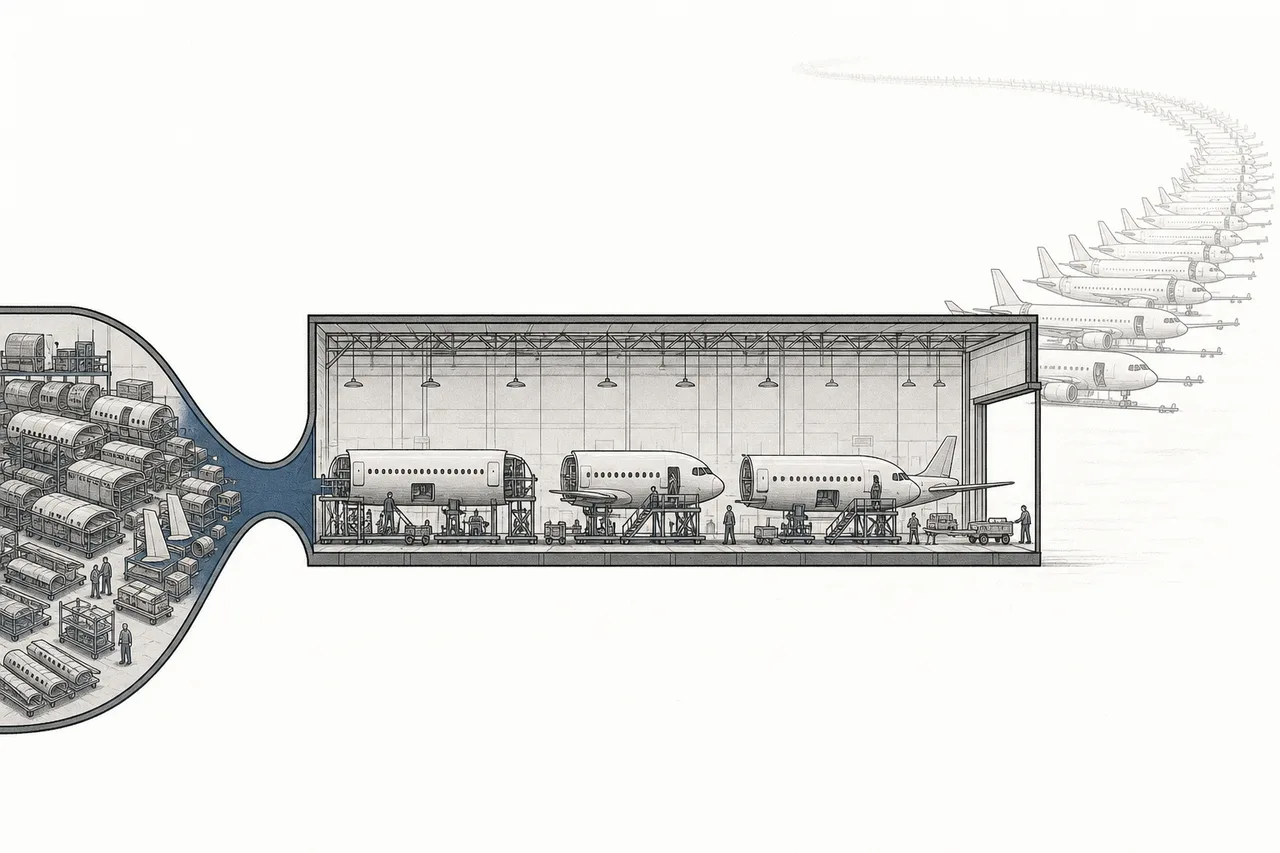
The hard part is that the whole system can only move as fast as its slowest point. The A320's final assembly line takes about 9–18 days per aircraft, but actual delivery also has to count the time waiting for parts to arrive, making the span from start of assembly to delivery about 3–6 months. If a single lower-tier supplier delivers late (say a seat, an engine, or one special bolt), the whole line stalls with it. That's why the number investors watch most closely for an OEM isn't sales, it's the "monthly production rate".
Production rate = the number of aircraft that can be built per month, e.g. "the 737 MAX at a rate of 42 a month." Climbing the rate (rate ramp) is the hardest and riskiest challenge for an OEM, because it requires pulling the entire pyramid of the supply chain up to speed at once · Book-to-bill = the ratio of new orders to deliveries. Above 1 means the backlog is still growing (Embraer, for example, hit 2.8x in 2025).
04How it connects in the ecosystem
The OEM is where the whole aviation industry converges. It's the "biggest customer" for its sibling segments, and the "upstream source" for every downstream business:
- Buys engines to install (doesn't make them): this is the most interesting relationship. The OEM designs the aircraft but buys engines from GE Aerospace, Safran, Pratt & Whitney, or Rolls-Royce to fit — and the engine is the single most profitable part of the whole aircraft. You could say the OEM carries the heaviest risk and capital, yet the juicy profits flow to whoever makes the engines
- Relies on structures and parts (aerostructures): fuselage, wings, landing gear — the OEM outsources most of them. The fragility of a major structures supplier (like the 737 fuselage quality problem that forced Boeing to slow production) hits the OEM's rate directly
- Installs avionics and systems tied to semiconductors: an aircraft's brain and nervous system lean on chips more with every new model, which makes the OEM sensitive to chip shortages too
- Feeds work to MRO & Aftermarket for the next 25–30 years: every aircraft the OEM delivers becomes an "installed base" that goes in for service for its whole life. The more the OEM delivers, the bigger the parts and maintenance market grows
- Supplies the defense side and is challenged by eVTOL: many OEMs build both civil and military aircraft, while new electric flying taxis are trying to create a "new breed of OEM" for flight within cities
05Where it stands now
2025–2026 is an era of overflowing demand, but every eye is fixed on one question: who can ramp production fastest. In this arena, three things are happening at once.
One — Airbus clearly leads Boeing. In 2025, Airbus delivered 793 aircraft (a company record), took 889 net orders, and posted €73.4 billion in revenue (+6%). The A320 family holds about 60% of the narrowbody market, and in late 2025 the A320 family overtook the 737 to become the most-delivered aircraft in history. Airbus aims to climb the A320 production rate to 70–75 a month by 2027.
Two — Boeing is "recovering from illness". After a heavy quality crisis from the door plug that blew off mid-flight in early 2024, the FAA ordered a cap on production of the 737 MAX at 38 a month. Boeing spent all of 2025 slowly proving its quality and stability, and by year-end the FAA agreed to lift the cap to 42 a month. The result: in 2025 Boeing delivered 600 aircraft (447 of them 737s) — its most since 2018 — and aims to climb to 52 a month by the end of 2026. This matters because it shows how fragile the "body" segment is: a single accident can hold a whole company down for years.
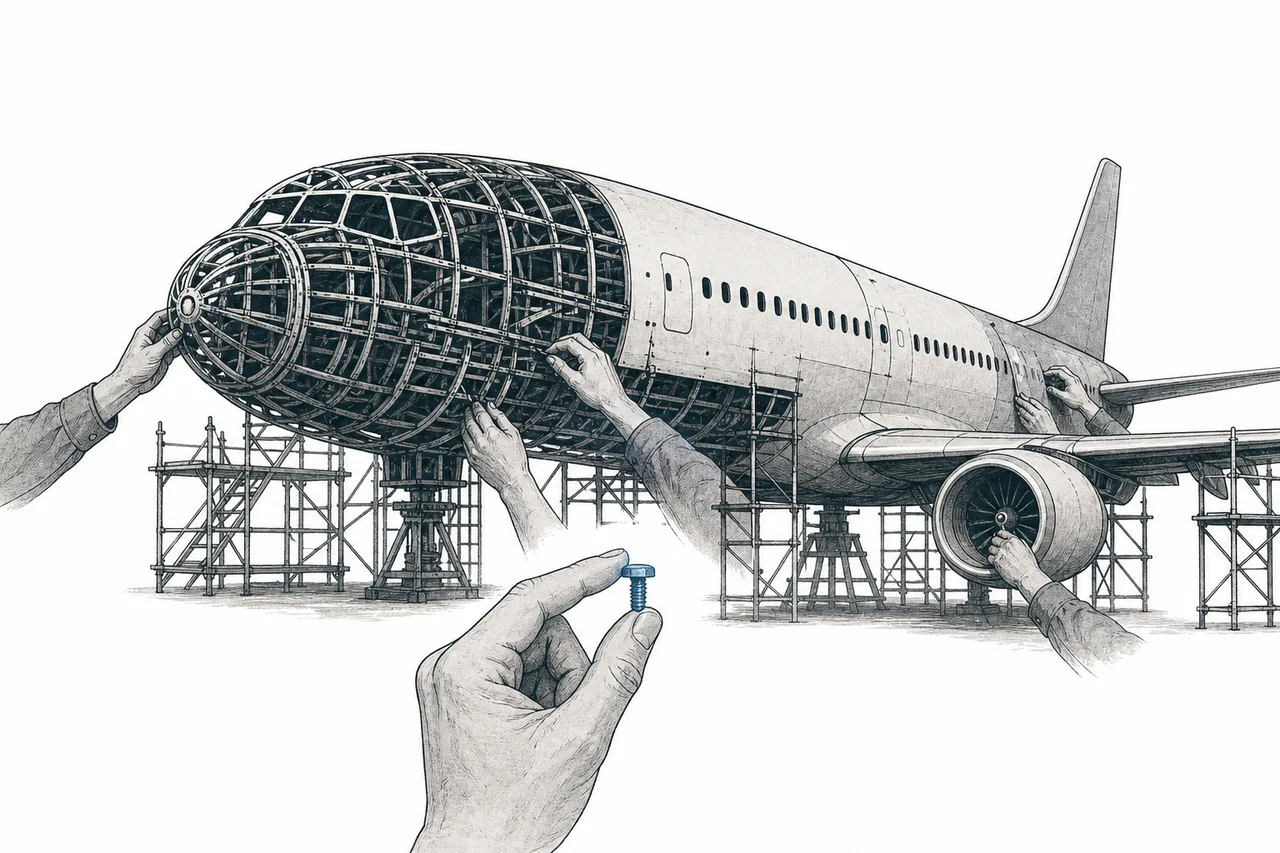
Three — COMAC is climbing slower than hoped. China's hope of breaking the duopoly is the C919, a narrowbody that already has over 1,000 orders. But in 2025 COMAC had to cut its production target from 75 to 25 aircraft and delivered only a handful. The main cause is an engine shortage — the C919 uses the LEAP-1C engine from CFM (GE-Safran), which is caught up in U.S. export licensing. There are completed bodies sitting at the Shanghai factory with no engines. The lesson: being an OEM doesn't mean controlling everything — as long as it depends on engines and systems from the Western supply chain, its production capacity stays locked.
06The road ahead
The first and biggest direction is the "narrowbody replacement super-cycle." Looking out 20 years, both Airbus and Boeing expect the world to need around 43,000–44,000 new aircraft, nearly doubling the global fleet — and over 70% of that is narrowbody, driven by an Asian middle class that's starting to have the means to fly. This is the long-term tailwind propping up both companies' backlogs.
The second direction is the question of the next-gen single-aisle. Neither Airbus nor Boeing has launched a clean-sheet new narrowbody in more than a decade. The question is who will dare to invest tens of billions to design a new model first — especially when they need to wait for a new generation of engines that are fuel-efficient enough to justify redesigning the whole aircraft. This timing decision will set the balance of power in the duopoly for the next 20–30 years.
The third direction is decarbonization and SAF. Aviation is under pressure to reach net-zero by 2050. The main near-term answer is newer aircraft that burn less fuel (good for orders, because airlines want to replace old fleets), plus SAF (sustainable aviation fuel). For an OEM, this is both a push for people to buy new aircraft and the design challenge of making the next model more efficient and cleaner.
And the final direction is the slow arrival of the challenger. COMAC will gradually ramp up C919 production (expected to reach ~90 a year toward the end of the decade) and is developing the widebody C929. In the long run, China intends to become self-sufficient in both engines and systems. If it succeeds, the duopoly could become a "trio" in the Chinese market first, then expand outward — but that's a long game measured in decades.
07Challenges & risks
The appeal of being an OEM — high walls, long queues — comes with particular risks that are every bit as heavy.
The first risk is safety and quality. This is a business where a mistake costs human lives, and it runs entirely on trust. Boeing's 737 MAX saga — both the tragic accidents of 2018–2019 and the 2024 door-plug blowout — showed that a single quality problem can hold down production, the stock price, and the reputation for years, all under the watch of regulators (FAA, EASA) that keep getting stricter.
The second risk is cyclicality and capital intensity. Designing one new aircraft model takes tens of billions of dollars and a decade of time, while demand is tightly tied to the economy and travel. COVID was the latest lesson that the whole industry can freeze overnight. An OEM carrying heavy capital and thin margins (around ~7%) is especially fragile when a downturn arrives.
The third risk is the fragility of the supply chain. Because the OEM relies on a pyramid of thousands of suppliers, a single missing piece — a seat, a special bolt, an engine, or a fuselage with a quality problem — can stop the whole line. Throughout 2025, both Airbus and Boeing had overflowing demand but got stuck on supply-chain bottlenecks, skilled labor, and waiting on engines, turning the demand they had into profit slower than it should have.
And the final risk is geopolitics and concentration. When all of the world's large passenger jets come from just two companies, trade restrictions, tariffs, or the suspension of export licenses (like COMAC's engine problem) can shake the whole chain instantly. Dependence on special raw materials like titanium also ties into the critical-materials supply chain — a domain sensitive to tensions between great powers.
In short: assembling aircraft is one of the hardest and most concentrated feats of engineering in the world. Two companies control the skies with a wall that's nearly impossible to breach — but in an era of overflowing demand, victory doesn't go to whoever can find the most customers, it goes to whoever can ramp the production line fast enough without slipping on quality.