Megatrend · Aerospace & Aviation
Sell the engine at almost no profit — to collect for the next 30 years
The jet engine is the most expensive and most profitable piece of an aircraft. But the real trick of this business is that the maker sells the engine itself at almost no profit — just to get it bolted onto a plane's wing, and then collect high-margin money from "parts and repairs" across the engine's 25–30-year life. This market has only a handful of players, uses some of the hardest engineering humans can do, and is right now in a golden age — alongside a big wound from one generation of engine that grounded nearly a thousand new aircraft.
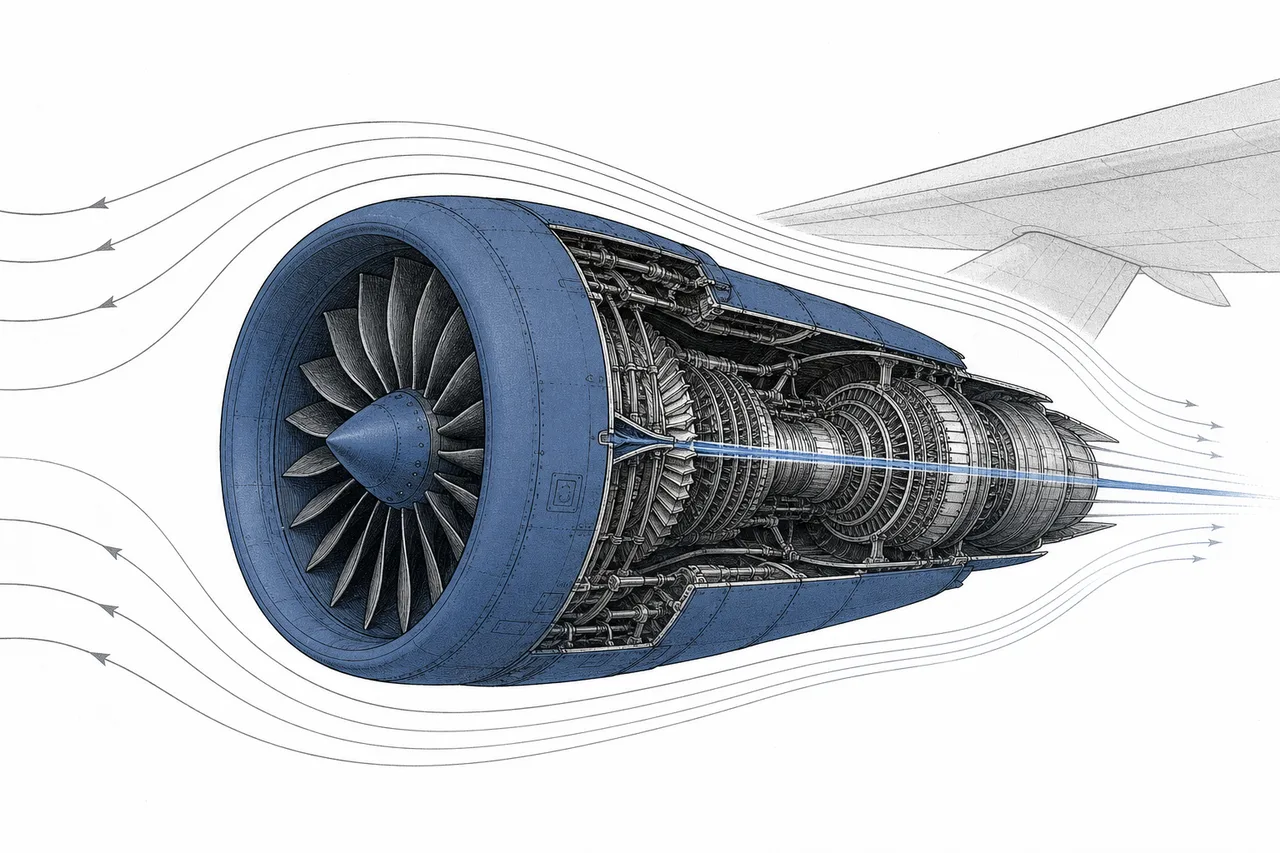
01What a jet engine is
When you look at a commercial airliner, what actually makes it fly are the two steel cylinders hanging under the wing — the jet engine. It's the most complex, most expensive, and most dangerous part if you get it wrong, because it has to spin blades at thousands of revolutions per minute, in heat higher than the melting point of the metal it's made from — and do that for tens of thousands of hours without failing.
Almost every engine on a modern passenger jet is a type called a turbofan — an engine with a giant fan up front. We'll dig into how it works in Chapter 3, but for now just remember it's an "air pump" that swallows a huge amount of air and blows it out fast to push the plane forward.
On the megatrend map, engines are a sub-branch under Aerospace & Aviation, and they're the category where profit piles up thickest in the whole chain — even more than the people who build the aircraft body. Why that's so is the most interesting part of this chapter.
OEM (Original Equipment Manufacturer) = selling new engines · Aftermarket = the "after-sale" business, meaning parts and maintenance for engines already sold · Installed base = how many of a company's engines are flying around the world — the bigger this base, the thicker and more predictable aftermarket revenue gets (Rolls-Royce and Pratt & Whitney each look after more than 13,000 engines in the air).
02Why the money piles up at the engine
The heart of this is a business model called "razor and blades" — like a razor company selling the handle cheap but collecting on the blades you have to keep buying. Engine makers play the same game: they're willing to sell the engine at almost no profit, or even at a loss, just to get their engine onto a plane's wing that will fly for another 25–30 years.
Because over those 30 years, the engine has to go in for overhaul periodically, replace worn turbine blades, and buy genuine parts — and it's these parts and repairs that carry sky-high margins, in the 40–60%+ range. The real numbers tell this most clearly: in 2025, about 70% of GE Aerospace's revenue came from the aftermarket, not from selling new engines.
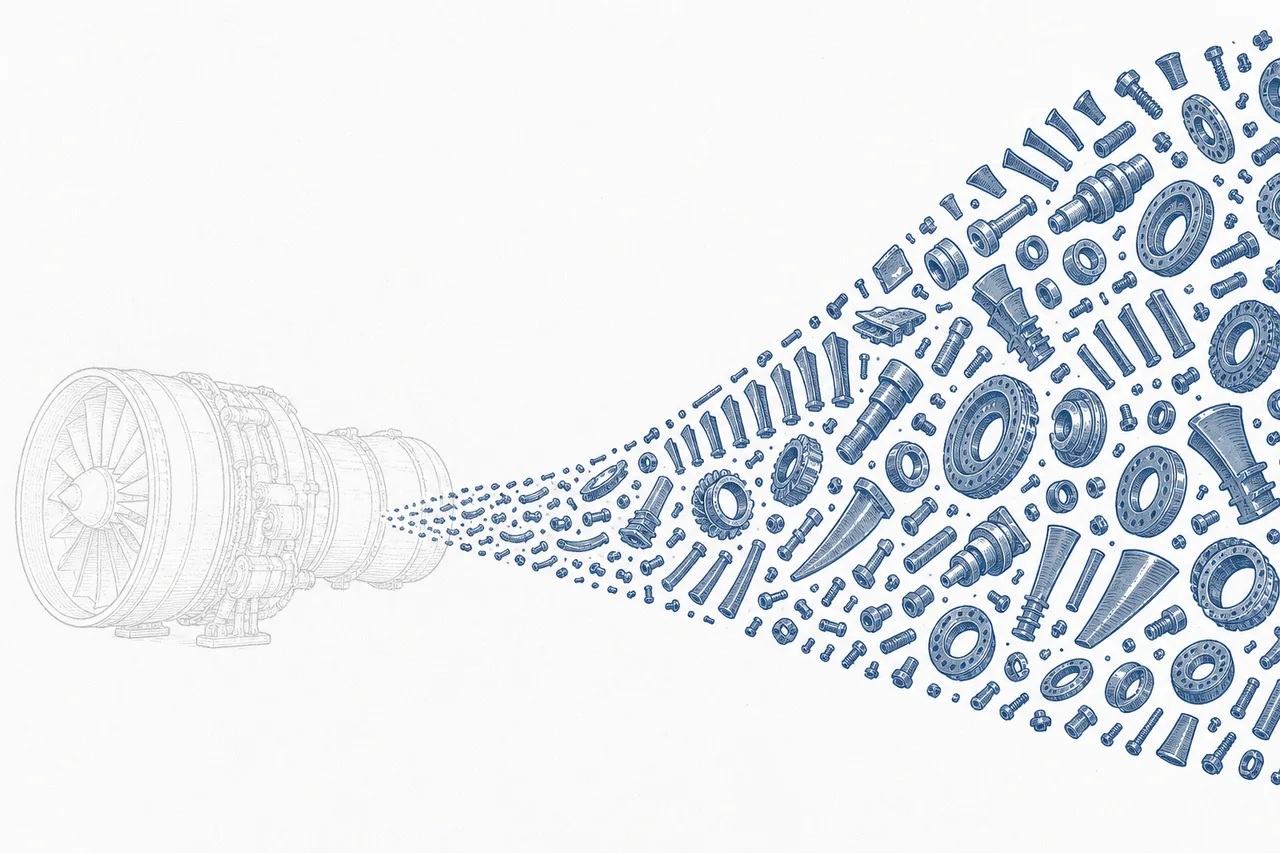
The result is a quality of profit that differs like heaven and earth from the companies that build the aircraft "body." Airframe assembly (dominated by Airbus and Boeing) is heavy, capital-intensive work but with thin margins around 7%, while GE Aerospace's commercial-engine division runs margins around 27% — nearly 4 times higher.
And this market is big and keeps growing. The commercial aircraft engine market is worth around $95–100 billion in 2025, and it grows as the world fleet roughly doubles over 20 years — every engine delivered today is a stream of aftermarket revenue that will flow back for the next 30 years.
03How it works (turbofan)
The principle of a jet engine is shockingly simple. Mechanics like to sum it up in four beats — "suck, squeeze, burn, blow". Let's walk through it step by step:
The key is the "air around the outside," or bypass — modern engines don't make their main thrust from combustion. A giant fan blows a huge amount of cool air around the outside of the central core. This outside air alone produces about 80% of the total thrust, while the central core (where the actual burning happens) just spins the shaft to drive the fan.
The ratio of "air flowing around the core" to "air entering the core to be burned." The higher it is, the more fuel-efficient and quieter the engine. Early jet engines (1960s) had a bypass ratio of only about 1–2 to 1, but modern engines like LEAP and GE9X have pushed it up to about 10–11 to 1 — which is why the front fans of modern engines keep getting bigger (the GE9X fan is 134 inches wide, wider than the fuselage of some Boeing 737 models).
So why can only a handful of companies make these? Because it's brutally hard engineering. The turbine blades in the central core have to spin in hot gas hotter than the melting point of the metal they're made from. The fix is to cast the blade as a "single crystal" from a special heat-resistant alloy (superalloy), then drill tiny cooling-air holes all over it — one of the hardest and most expensive parts to make in the industry. That's why only a few companies in the entire world can build engines at this level.
04What it connects to
The engine is where several trends meet. It takes raw materials from upstream, passes power downstream, and is inseparably entangled with its siblings in the aviation industry:
- Feeds MRO & Aftermarket directly: this is the most important relationship. Every engine sold becomes a "lifetime customer" of the maintenance business — the aftermarket money we talked about in Chapter 2 circulates in this loop. That's why engine makers fight to "control" as much of their own engines' repair work as possible
- Supplies Airframe OEMs: Airbus and Boeing design the aircraft, but the engines come from engine makers. The choice of which engine goes on which model is the decision that sets an engine maker's revenue for the next 30 years
- Depends on Aerostructures & Components: turbine blades, disks, and heat-resistant cast and forged parts come from specialist suppliers (such as Howmet Aerospace), which are a key bottleneck for ramping up production
- Tied to key raw materials: titanium and rare metals for superalloys make engines sensitive to strains in the global supply chain and geopolitics
- Overlaps with Defense and competes with eVTOL: the big engine makers do both civil and military, while electric air taxis (eVTOL) are a new rival using electric motors instead of combustion engines — though still limited to short urban routes
05Where it stands now
2025–2026 is a golden age for engine makers. The world fleet is flying more than before COVID (Rolls-Royce's flying hours hit 109% of 2019 levels), pushing demand for parts and repairs sharply higher. GE Aerospace posted 2025 revenue of $45.9 billion (+18%), with a backlog past ~$190 billion, and delivered 28% more LEAP engines. Meanwhile Rolls-Royce, which nearly collapsed after COVID, has turned around until its Civil division margin reached 20.5%.
Battleground 1: narrowbody — LEAP vs. GTF
The biggest and fiercest battleground is engines for narrowbody aircraft like the A320neo and 737 MAX — the best-selling planes in the world. Here two players clash:
- CFM LEAP (from CFM International — a 50:50 joint venture between GE Aerospace and Safran) — holds over 60% of the narrowbody market. The LEAP-1B is the only engine on the 737 MAX, and the LEAP-1A competes on the A320neo
- Pratt & Whitney GTF (PW1000G — from RTX) — a "geared turbofan" that uses a gear to slow the fan down for fuel efficiency. It competes on the A320neo, taking about 45–50% of this family's engine selections
In 2025, CFM accelerated LEAP deliveries to a record pace and overtook Pratt & Whitney in the second half. CFM is targeting around 1,600–1,700 LEAP engines produced in 2025 (15–20% more than the year before), even as the GTF side swept up over 1,100 new orders in the first half.
GTF's big wound: when metal powder grounded new aircraft
But the thing that shook the industry most was the GTF problem. In 2023, Pratt & Whitney found that some metal parts in the PW1100G engine had a defect from the powder-metal manufacturing process that could cause premature cracks. The result: all 3,000 engines had to be called back for inspection, and large numbers of brand-new aircraft were left grounded, waiting for service.
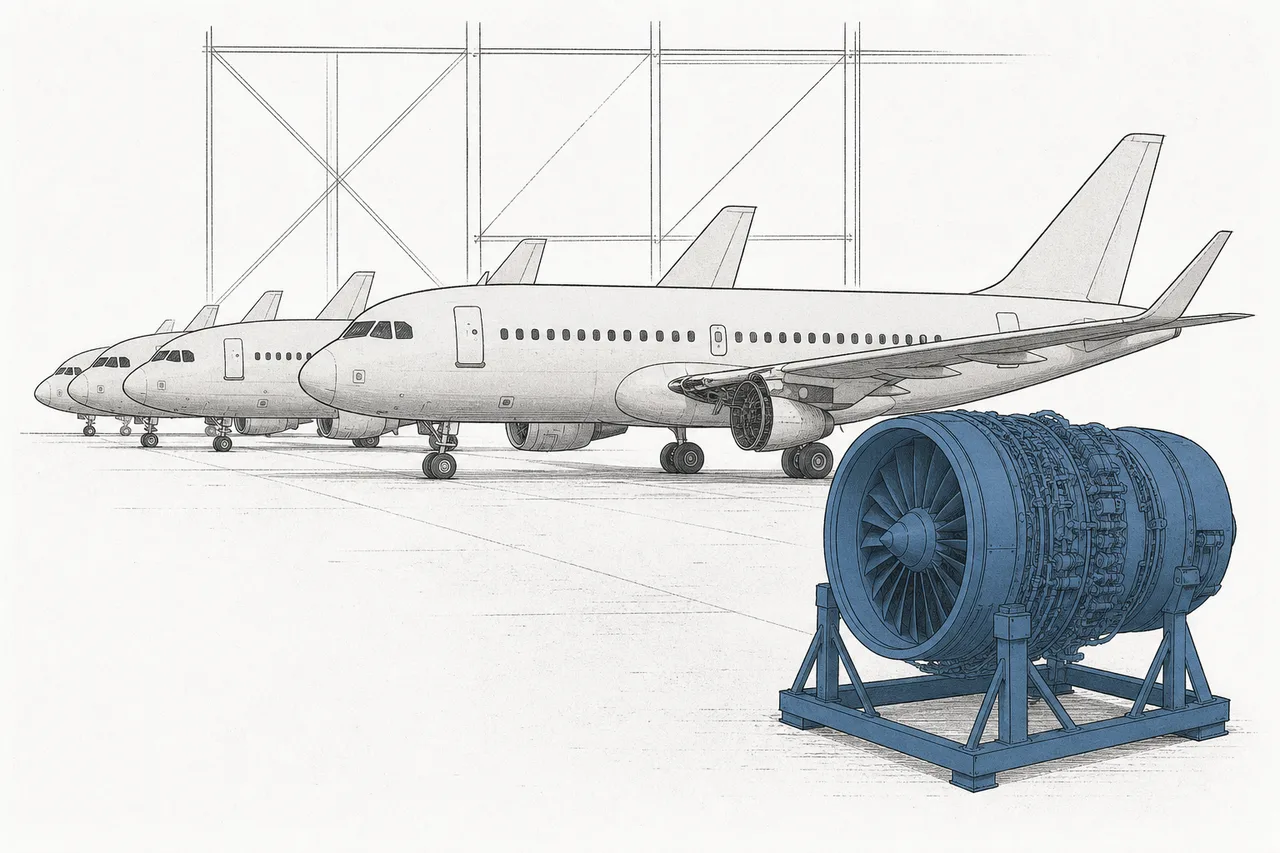
The severity is told clearly by the numbers: at the end of October 2025, 835 aircraft using GTF engines were grounded worldwide, because each overhaul takes 300–360 days. Pratt & Whitney estimates the whole thing will cost around $6–7 billion, with 80% being compensation to customers — a painful lesson that in this business, a small manufacturing mistake in a single part can balloon into a billion-dollar crisis.
Battleground 2: widebody — the giant engines
The other battleground is engines for widebody aircraft that cross continents. This is mainly a contest between GE Aerospace and Rolls-Royce — GE's GE9X is the largest and most powerful commercial aircraft engine in the world (110,000 pounds of thrust, a 134-inch fan), set to go on the Boeing 777X. Meanwhile Rolls-Royce monopolizes the Trent engines on the Airbus A350 and A330neo — and has just recovered from a major restructuring back to healthy profits.
06The road ahead
The first and nearest direction is the "bare blades," or open-fan. The most-watched project is CFM RISE (a GE + Safran joint venture), which removes the "cowling" around the fan and lets the bare blades touch the air directly, pushing the bypass ratio even higher. The goal is 20% better fuel efficiency than current engines, with ground tests planned for 2027 and a flight test on an Airbus A380 in 2029 before entering service in the mid-2030s.
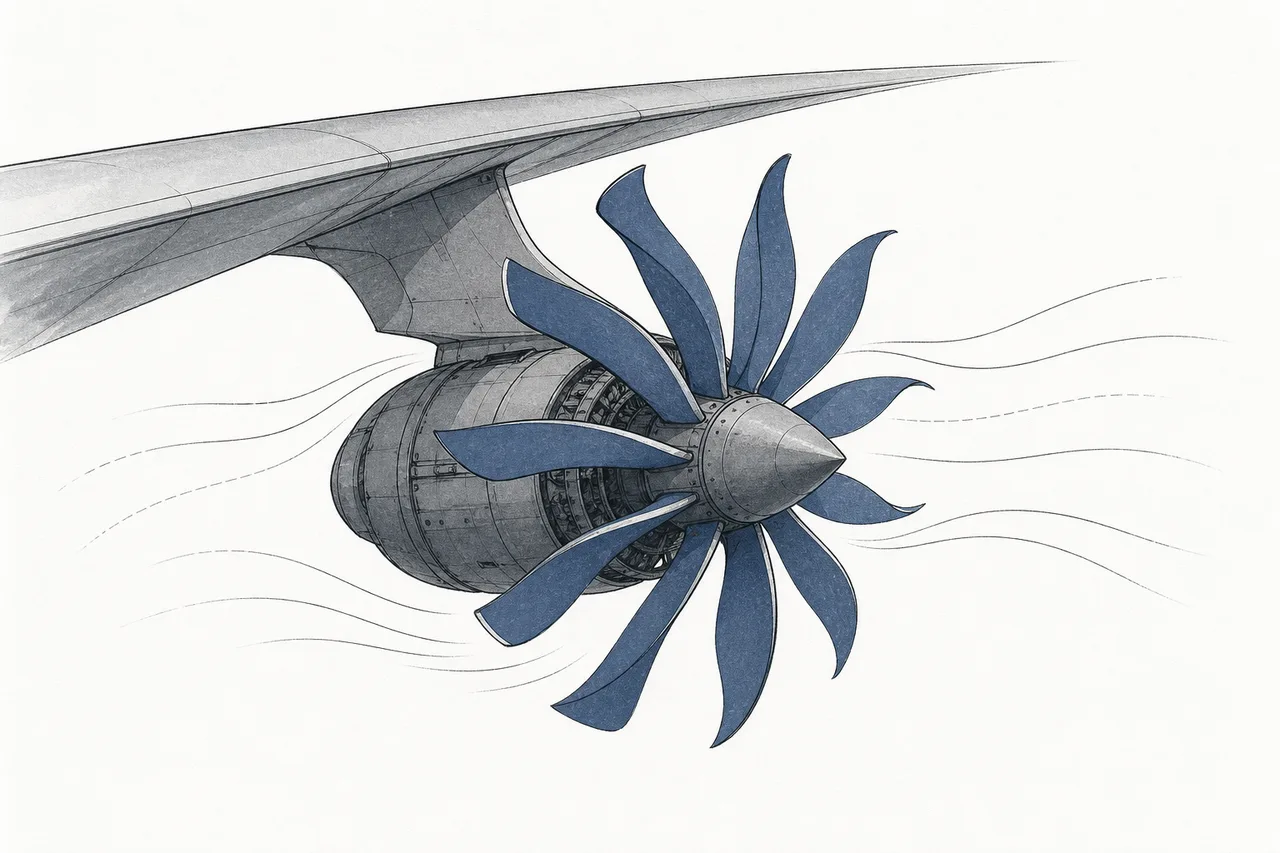
The second direction is the next generation of giant engines. Rolls-Royce is developing the UltraFan, which it claims is 25% more fuel-efficient than the older Trent engines, with a 140-inch fan (even bigger than the GE9X), designed to scale to both narrowbody and widebody — a long-term play to win back a field Rolls-Royce withdrew from long ago.
The third direction is alternative fuels and energy. In the near term there's SAF (sustainable aviation fuel), which modern engines can already handle. The far term — hydrogen and electric — is still a long way off: Airbus just delayed its ZEROe hydrogen aircraft plan to the late 2040s, because the technology and infrastructure aren't ready. Electric motors are still limited to small, short-range aircraft (see eVTOL). So for the next 20 years, the turbofan burning liquid fuel still owns the skies — just getting more efficient all the time.
07Challenges & risks
The appeal of the engine business — fat margins, long-lasting recurring revenue, few players — comes with its own heavy, particular risks.
The first risk is "single-point failure". The GTF crisis is the freshest example — a defect in the powder-metal process of a small part ballooned into a recall of 3,000 engines, 835 new aircraft grounded, and $6–7 billion in costs. In a business that bets on the safety of human lives, even the smallest mistake costs an enormous amount and can damage trust for a long time.
The second risk is supply-chain and capacity bottlenecks. Engine demand right now overflows faster than they can produce. Critical parts like turbine blades, disks, and cast and forged components require advanced metallurgy and have only a few suppliers, so ramping up production is slow. IATA estimates the gap between demand and supply for aircraft and engines will drag on until around 2031–2034 — good for parts prices, but it means some of the opportunity is locked inside the bottleneck.
The third risk is the technology transition and decarbonization. Next-generation engines (open-fan, UltraFan) take enormous R&D money and carry high engineering risk. One wrong bet can cost a decade of leadership (Rolls-Royce and Boeing have proven just how badly you can slip). At the same time, the pressure to reach net-zero by 2050 forces every camp to bet on a technology no one yet knows will win.
In short: the jet engine is the most beautiful piece of aviation engineering — burning hotter than the melting point of its own metal, yet flying for tens of thousands of hours, and the place where profit piles up thickest in the whole industry. Understanding why "selling at almost a loss" is the smartest strategy is understanding why these few companies can control the main artery of global aviation — and why a single mistake in metal powder can shake the entire sky.