Megatrend · Aerospace & Aviation
An airplane sells once — but you keep fixing it for 30 more years
Every time a plane takes off, the maintenance clock starts ticking — engines have to come off for overhaul every few years, the airframe goes in for major checks on a cycle, and every flight hour is money flowing back into the "maintenance" business. MRO is the side where aviation actually makes its money — recurring revenue, high margins, tied to the entire global fleet. And right now it's the hottest it's ever been, because the fleet is aging, parts are scarce, and new planes are arriving late, so airlines have to "stretch" their old jets to keep flying.
01What MRO is
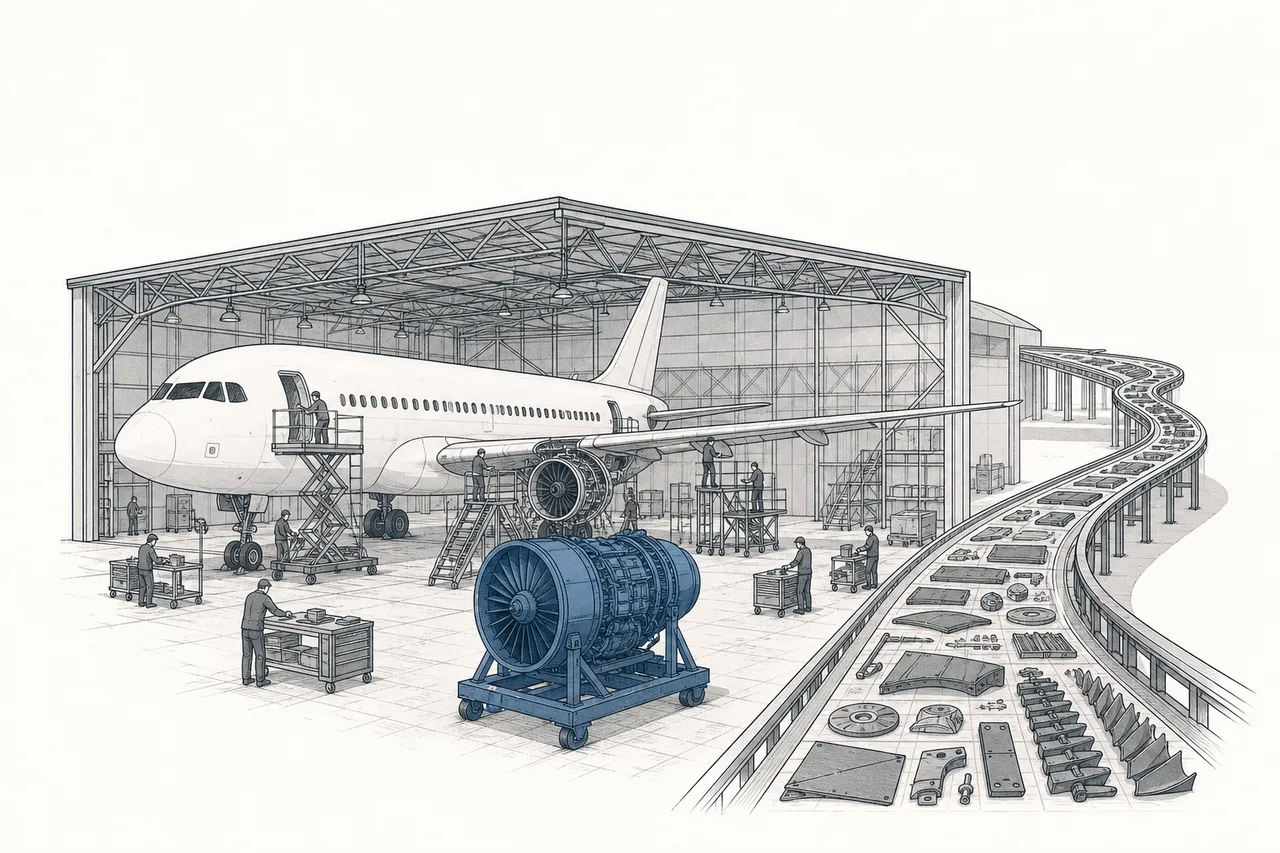
A plane isn't something you buy and use straight through until it breaks and you throw it away. It's a machine that has to be opened up, inspected, repaired, and reassembled on a cycle across its 25–30 year life — and all of this work goes by one name: MRO.
MRO = Maintenance, Repair & Overhaul — every piece of work that keeps a plane safely flying after it's been sold · Aftermarket = everything sold to a plane after it leaves the factory, both parts and repair services — the opposite of the OEM that sells the "new thing" just once.
MRO isn't one single job — it breaks into 4 main parts that differ in difficulty, money in motion, and who can do them:
- Engine MRO: the biggest and most profitable chunk — pull the whole engine into an "overhaul shop" (shop visit) and replace worn turbine blades, at millions of dollars a time
- Component MRO: repair/replace tens of thousands of smaller parts — pumps, valves, wheels, brakes, displays, and so on
- Airframe heavy maintenance: bring the whole aircraft into the hangar, strip it down to inspect the structure, check for corrosion and cracks — one round takes weeks to months
- Line maintenance & modifications: small check work between flights at the departure gate, plus modifications like swapping seats, installing Wi-Fi, or converting to a freighter
On the megatrend map, MRO is a sub-branch under Aerospace & Aviation, and it's the "end of the line" that takes over from everything that gets manufactured — especially the engine, which this chapter will show is the main artery of profit for the whole industry.
02Why the money is in the "aftermarket"
Think of a printer — the machine is cheap, but the ink is wildly expensive. Aviation plays the same game, called "razor and blades". The engine makers are willing to sell the engine itself at almost no profit, just to get it onto the wing of a plane that will fly for another 30 years — because across those 30 years, the engine has to go in for overhaul on a schedule, buy genuine parts, and pay for repairs, and that's exactly where the margins go sky-high.

The numbers tell this most clearly: about 70% of GE Aerospace's revenue comes from the aftermarket, not from selling new engines, and engine-repair work earns margins in the 40–60% range — compared to "assembling the airplane," where Airbus and Boeing manage only about 7%. This is why people in the industry say, "Aviation doesn't make its money selling planes — it makes it fixing them."
And among the 4 parts of MRO, Engine MRO is the biggest chunk — it takes about 40%+ of the market's revenue share, because the engine is the most expensive, most complex part, and the one that must be maintained under the strictest safety rules. The rest is the airframe, components, and line work.
The overall market is big and keeps growing, too: in 2025 the global commercial-aviation MRO market sat at about $119 billion (12% above the pre-COVID 2019 peak), and it's expected to grow to ~$156 billion by 2035, as the global fleet rises from about 29,000 to over 38,000 aircraft.
03How it works (the repair lifecycle)
The heart of MRO is the phrase "on a cycle" — repair work isn't done when the plane breaks, it's done on a schedule set in advance by the number of flight hours and flights (cycles). The more a plane flies, the sooner the cycle comes due. Airframe checks split into grades A, C, and D by how heavy the work is, and the engine has its own "cycle" that's heavier than anything else.
A-check = a light check, every 2–3 months, done in one night · C-check = a heavier check, every ~1.5–2 years, taking 1–3 weeks · D-check (or heavy/base maintenance) = "stripping the whole aircraft" to inspect the structure down to the bone, every ~6–10 years, lasting months — the most expensive airframe job · Engine shop visit = pulling the whole engine off and sending it to the overhaul shop, at millions of dollars a time — the single biggest chunk of MRO cost for an airline.
The companies that take on this work split into two big camps. The first is OEM-aligned — the makers themselves (GE Aerospace, Safran, RTX/Pratt & Whitney, Rolls-Royce) who want to control as much of their own engine repair as they can. They mostly sell it as "power-by-the-hour" contracts — the airline pays per flight hour and the maker takes care of everything (Rolls-Royce calls it TotalCare). The second camp is the independents — independent shops like Lufthansa Technik, ST Engineering, AAR, HAECO, and SIA Engineering that can service many brands and are usually cheaper.
And there's a third market growing fast: alternative parts — both USM (used serviceable material, secondhand parts pulled from retired aircraft and inspected/repaired to be usable again) and PMA (FAA-approved equivalent parts, made by someone other than the OEM, 30–50% cheaper) — the ways airlines dodge the sky-high price of genuine parts.
04What it connects to
MRO is the "end of the line" that takes over from everything in the aviation industry. It's the point where every part comes back together again across the aircraft's life:
- Takes over directly from the engine: this is the most important relationship — every engine that's sold is a "customer for life" of MRO. The 40–60%-margin aftermarket money we talked about in Chapter 2 circulates inside this cycle, and it's why engine makers want to do the repairs themselves
- Cares for the airframe from Airframe OEMs and Aerostructures & Components: D-checks and component repairs are caring for what Airbus/Boeing and parts suppliers built — MRO is the one that keeps it flying after the factory hands it over
- Feeds Defense: military aircraft, helicopters, and military engines need MRO too — many of the big players do both civil and defense, which makes MRO a business that holds up well against the economic cycle
- Relies on critical raw materials and semiconductors: replacement parts need titanium and specialty metals, while modification/avionics-upgrade work needs chips — which makes MRO sensitive to parts shortages
- Competes indirectly with eVTOL: electric air taxis use electric motors with far fewer moving parts than a jet engine; in the long run, "something easier to fix" could eat into some MRO work — but that's still far off
05Where it stands now
2025–2026 is a squeezed golden age for the MRO business — demand overflows faster than it can be served. The reason is three storms blowing in at once: (1) the global fleet is flying harder than before COVID, (2) new planes are arriving late because Airbus/Boeing can't deliver fast enough (the backlog tops 17,000 aircraft), and (3) new engines like the GTF have been called in for inspection, forcing airlines to "stretch" their old jets to keep flying.
The result is that planes keep getting older. The average age of the global fleet ticked up to 13.4 years in 2025, and the average age at retirement jumped to ~24 years — only ~300 aircraft were retired in 2024 (down from 500 in 2023). Every plane that's stretched is more repair work added on.
The heaviest wave is in the engine. The CFM56 family alone (the best-selling engine in history) is expected to have ~2,300 shop visits in 2025, while the newer LEAP is starting to hit its cycle at ~2,000, and the V2500 + PW1100G group another ~3,500 — overhaul shops worldwide have waitlists running into years.
In this arena, OEM giants and independent shops clash. What's interesting is that independents still hold about 58% of the market in 2025, because they can take on many brands and are more flexible. But the OEMs are trying to pull their own engine work back home. These are the real players in the field:
06The road ahead
The first direction is "know-in-advance" repair (predictive maintenance). Instead of waiting for the cycle to come due or for something to break, thousands of sensors on new-generation engines send real-time data for AI to predict which part is about to have a problem — Lufthansa Technik and every OEM are launching competing digital platforms. The MRO software market alone is expected to grow from ~$7.6B to ~$9.8B by 2031. The goal is to cut a plane's "ground time," the cost airlines hate most.
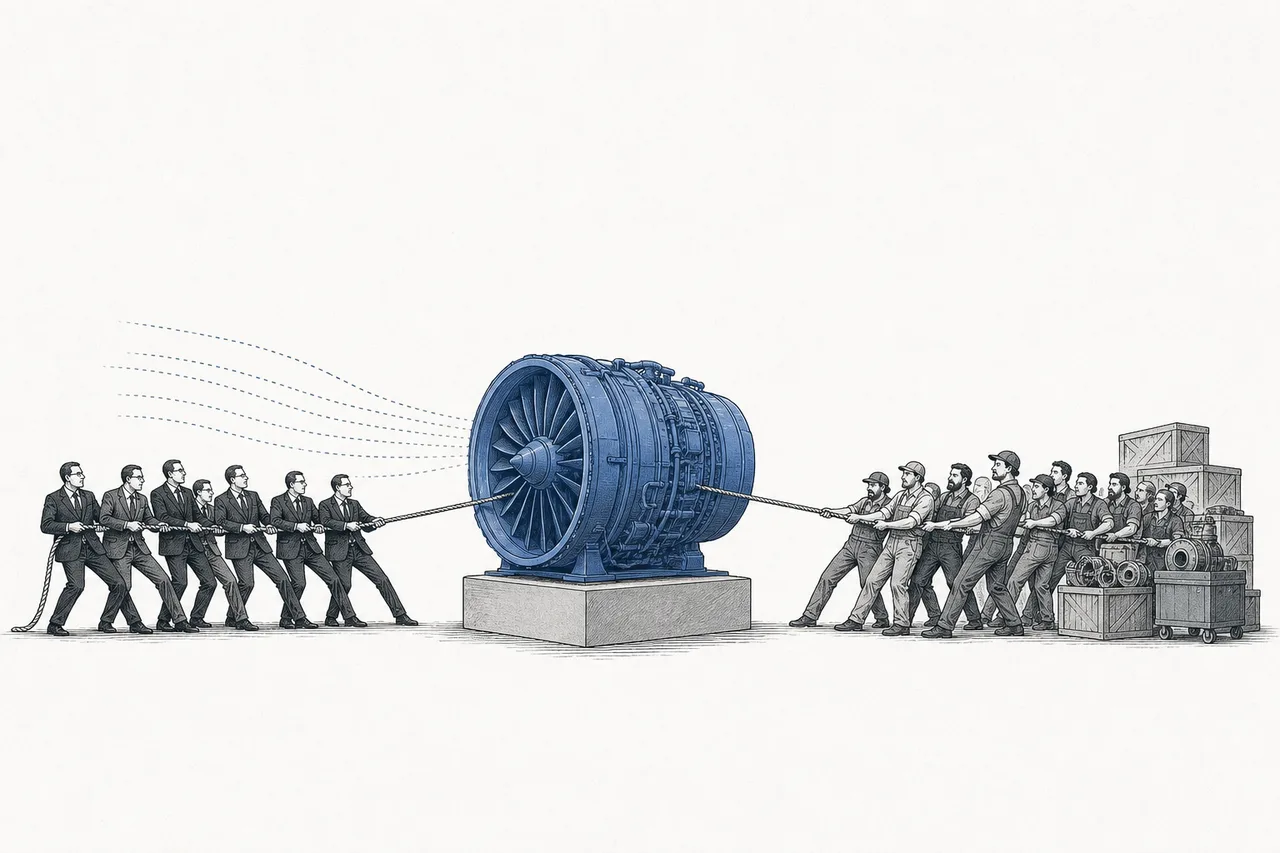
The second direction is the "who gets to fix it" fight between OEMs and independents, which keeps getting fiercer. OEMs use power-by-the-hour contracts and control of sensor data as weapons to pull their own engine work back home, while the independents fight with speed, price, and alternative parts (USM/PMA) — and what's worth watching is that some big airlines are starting to do more "in-house" to keep the margin for themselves (the airline group is the fastest-growing customer segment in the market).
The third direction is a retirement wave that will unlock a trove of secondhand parts. Many of the older jets being stretched today will eventually retire — in Europe alone, an estimated ~2,300 CFM56 engines are expected to retire over 2024–2033. Every one is a warehouse of USM parts feeding the repair market, which gives players like FTAI and AAR an edge.
07Challenges & risks
The appeal of MRO — recurring revenue, handsome margins, tied to a fleet that keeps growing — comes with its own heavy, particular risks.
The first risk is the parts-and-labor bottleneck. Repair demand now overflows faster than it can be served. Critical parts like turbine blades require advanced metallurgy and have only a few suppliers, while certified technicians are short worldwide. IATA estimates that supply-chain problems will add more than $11 billion in costs to airlines in 2025 alone — a vast opportunity locked inside a bottleneck.
The second risk is the OEM "market capture". As engine makers use power-by-the-hour contracts and control of data/parts patents to pull repair work back home, independent shops and PMA-parts makers could get squeezed — work that was once wide open may slowly get locked to the OEMs, especially on new engines designed to be hard to fix outside their own shops.
The third risk is the aviation cycle and next-generation technology. MRO is tied to flight hours, so if the economy cools or another COVID-style crisis hits, repair demand shrinks instantly (we saw it in 2020). And in the long run, new engines/aircraft designed to be "easier to fix, with longer intervals between part changes," plus electric systems like eVTOL with fewer moving parts, may slowly reduce the "frequency" of repair work per plane.
In short: if you want to understand why aviation is worth investing in, don't just look at the moment a plane lifts into the sky — look at the moment it comes back to the shop, because that's where the real money flows back every year, every flight hour, across thirty years. And right now is when that cycle is spinning faster than it ever has.