Megatrend · whole-trend overview
The money isn't in the airplane — it's in the engine
After COVID, the whole world rushed back to flying, and airline orders piled up into a 12-year backlog — more than Airbus and Boeing can even build in time. This is the "super-cycle" of commercial aviation. But the rookie trap is thinking the profit comes from each plane sold. The reality: the airframe itself is a thin-margin business, while the big money flows to engines, parts, and maintenance — and that keeps paying every year for decades. This lesson is the map that strings the industry's 5 categories together — who does what, and where the real power actually sits (each category has its own deep-dive chapter).
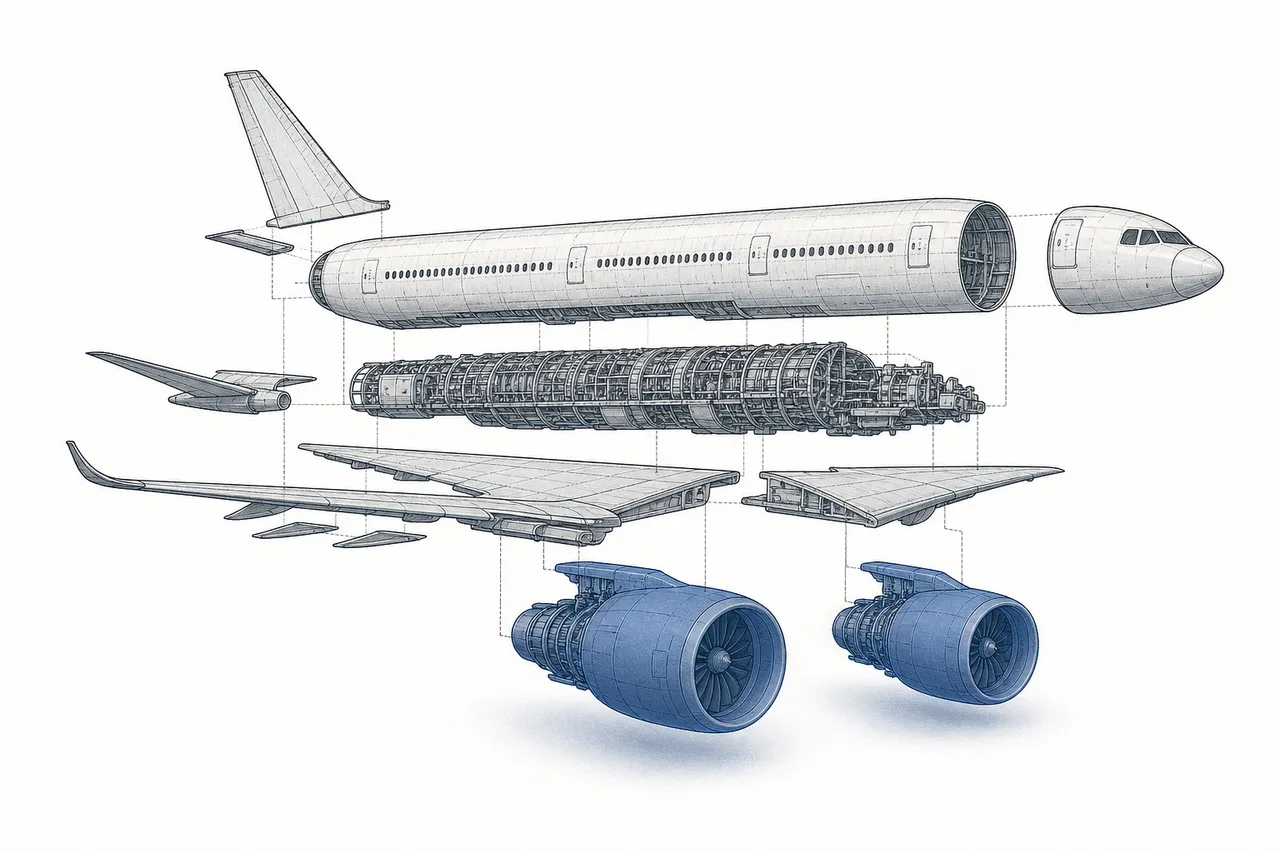
01The big picture: aviation's super-cycle
During COVID, the world's planes sat parked in the desert, and everyone assumed commercial aviation would stay depressed for years. The opposite happened — the moment borders reopened, people flooded back to flying harder than before. In 2025, global air travel (measured in RPK — total passenger-distance) grew another 5.3%, and the seat-fill rate (load factor) hit a record 83.6%. Almost every flight is full, with Asia-Pacific leading at 10.9%.
The result is what the industry calls a "super-cycle" — airlines rushing to order new planes until Airbus and Boeing's combined order backlog blew past 16,000 aircraft in 2026, an all-time record. At today's production rate, that queue runs more than 12 years long. Put simply, even if no one placed another order, the factories would still have to keep building for over a decade to clear it.
And this isn't just a short-term bubble. Looking 20 years out, both Airbus and Boeing expect the world to need roughly 43,000–44,000 new aircraft through 2044 — nearly doubling the global fleet from about 27,000 to nearly 50,000 planes. Over 70% are narrowbodies (the A320 / 737 type) that fly regional routes. So aviation isn't a dying industry — it's a long-term growth engine tied to the global middle class, especially in Asia, gaining the means to fly.
But none of that is the most important point yet. What a beginner needs to grasp first is that "one airplane" doesn't come from one company — it's an assembly of specialists in many layers, and the profit at each layer differs like night and day. That's the map we're about to lay out.
02The map: what are the 5 sub-categories?
The aviation industry splits into 5 categories, ordered the way one airplane gets built — from the people who design and assemble the airframe to the people who care for it across its whole life. Each category has its own deep-dive chapter (tap to read):
The heart — the builders and the movers
- Airframe OEMs: The makers who build and assemble the plane's "airframe" — the field Airbus and Boeing rule as a global duopoly. It's the source of the 12-year backlog, and also the thinnest-margin category
- Aircraft Engines & Propulsion: Jet engines — the most expensive and most profitable part of the plane. Only a handful of players (GE Aerospace, Safran, Pratt & Whitney, Rolls-Royce), who sell engines at almost no profit to collect on parts and service for 30 years after
The supply chain — parts and systems
- Aerostructures & Components: Structures and parts — fuselage, wings, landing gear, fasteners, turbine blades. Some are commodity parts, but some are "only one maker can make it" parts with serious pricing power
- Avionics & Aircraft Systems: The plane's brain and nervous system — flight computers, radar, navigation, control systems, increasingly tied to semiconductors
Services — care across the whole life
- MRO & Aftermarket Services: Maintenance, overhaul, and parts (Maintenance, Repair & Overhaul) — a plane flies for 25–30 years and is in the shop the whole time. This is the "recurring revenue" category — fat-margin and not swinging with the new-build sales cycle
03How it connects (value chain)
Follow the birth of one airplane. Parts makers (aerostructures) and systems makers (avionics) feed the engine makers and the airframe assemblers (OEMs) — Airbus and Boeing put it all together into a finished plane and hand it to the airline. But the story doesn't end there. From its very first flight, that plane flows back into the maintenance cycle (MRO) for decades — and that's where the money circles back to the engine and parts makers:
The key to this map is that "standout-colored loop" — the new-plane sale happens once, but maintenance and parts sales happen for the plane's whole life. Engine makers understand this so well they set the game from the start: sell the engine at almost no profit so their engine gets bolted onto the wing, then collect on parts and service for the next 30 years.
04Where the value and the power sit
This is the most important chapter of the whole map. The iron rule of aviation is that the value isn't in the "airplane" itself. Assembling the airframe is heavy work — huge investment, capital-intensive — yet thin-margin and high-risk (Boeing just proved how badly it can go wrong). The fat profits pile up in three other spots:
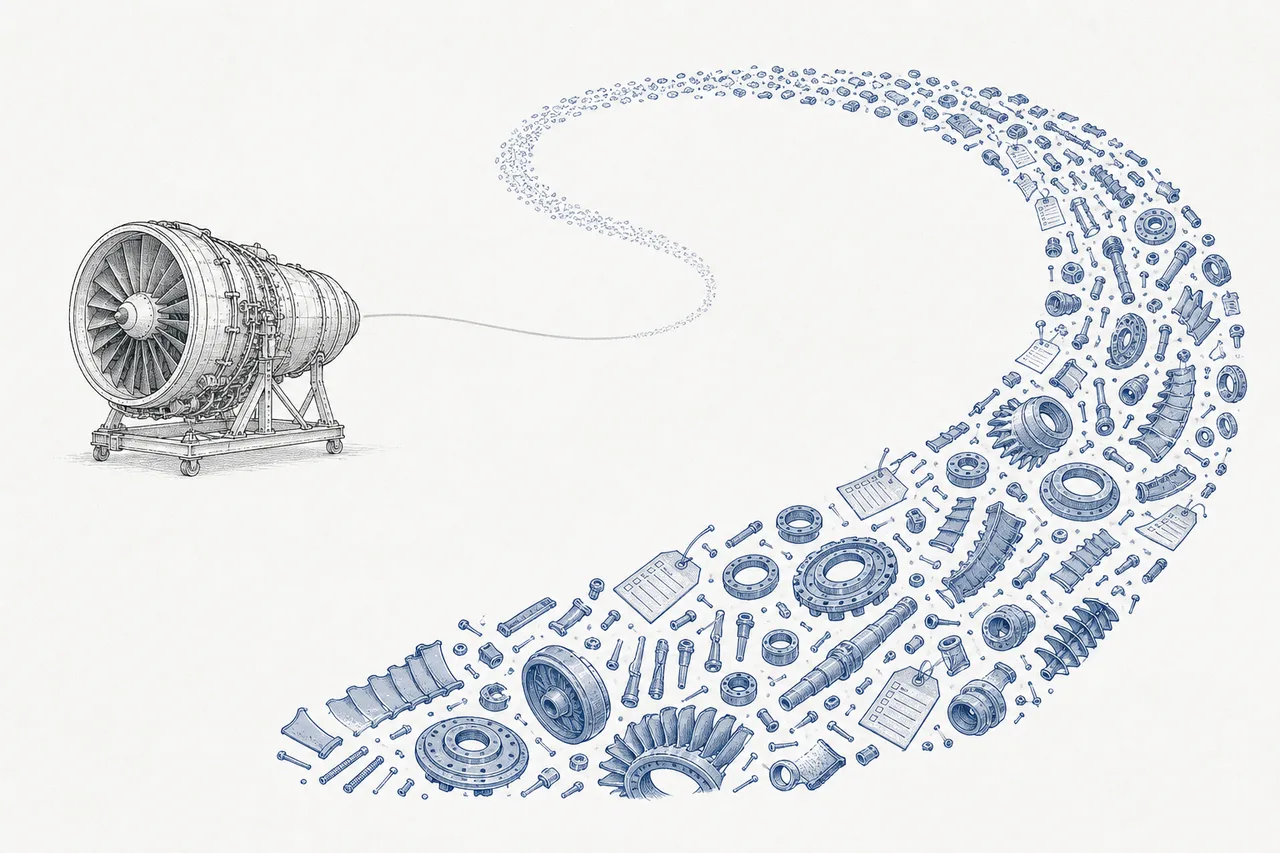
1. Engines + parts (the razor & blades): This is the best business in the industry. Engine makers sell the engine at almost no profit, sometimes at a loss, but collect on parts and service (aftermarket) at 40–60%+ margins for the engine's whole life. GE Aerospace's real numbers tell the story plainly — in 2025, roughly 70% of revenue came from aftermarket, not new engine sales, and the commercial-engine division's margin was 27.4%.
2. MRO & aftermarket services: The maintenance-services category is recurring revenue — it doesn't swing with the new-build cycle and grows with the number of planes in the air. The global MRO market was about $119 billion in 2025 and keeps growing because the fleet is about to double.
3. "Only one maker can make it" parts (sole-source components): Some parts are certified for a given aircraft from a single supplier only. You can't swap suppliers easily, because it would require fresh safety re-certification. The clearest example is TransDigm — about 80% of revenue from sole-source parts and 90% proprietary designs, giving it pricing power so strong its EBITDA margin reaches about 54% (on par with a software company).
The lesson for reading this trend: don't just ask "does this company make planes," ask "where is it in the chain — selling once, or collecting across the plane's whole life". Two companies building the same plane can have wildly different profit quality.
05Forces that move the whole trend
Even though the categories differ, four big forces move the whole industry at once:
1. The travel-demand super-cycle — the most fundamental force. The whole world flies more and more, especially Asia's middle class, pushing airlines to buy and maintain more planes. It's a long-term tailwind that props up the entire chain.
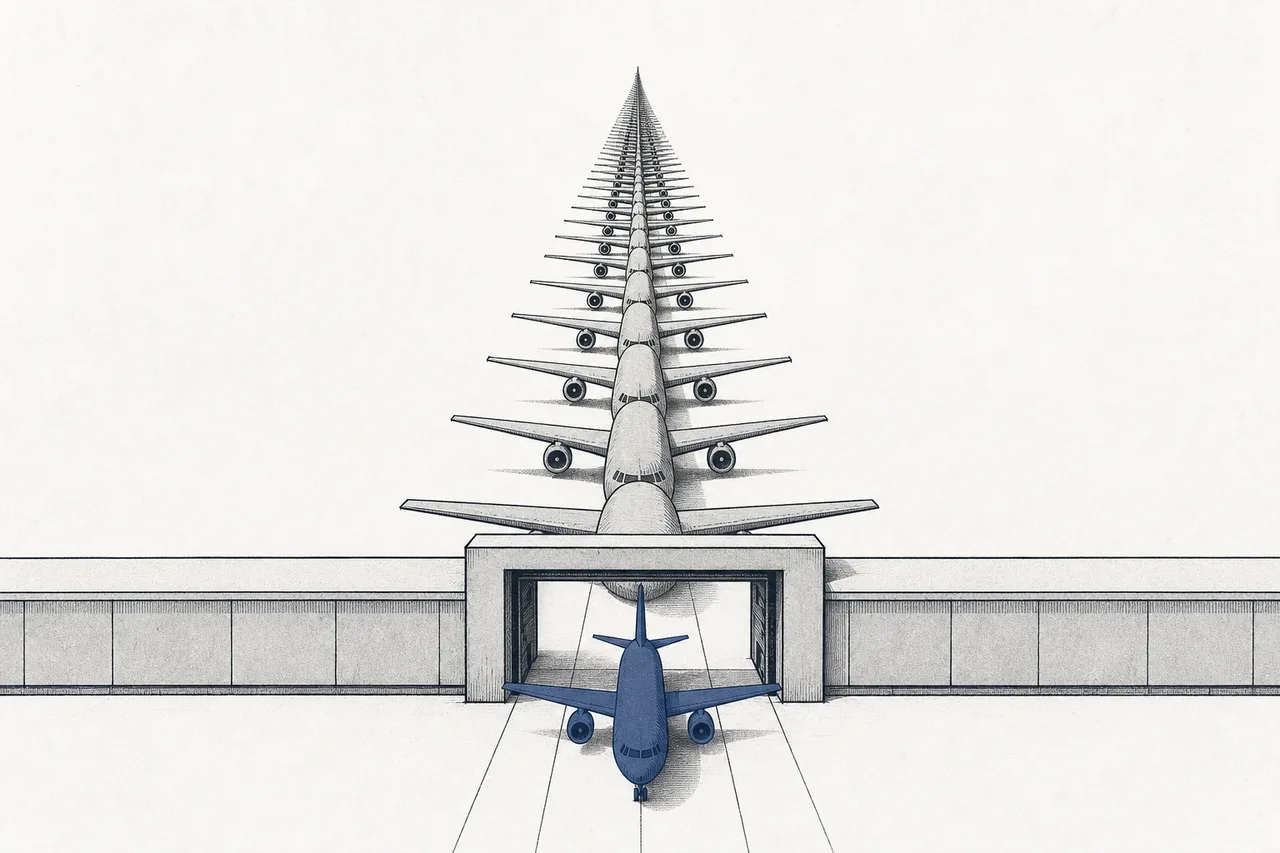
2. The duopoly and the production bottleneck — every large passenger airframe in the world comes from just two makers, Airbus and Boeing, a very high wall against new entrants (China is trying with the COMAC C919, but it's still small). But in this super-cycle the problem flips to not being able to build fast enough — both are stuck on supply-chain, labor, and quality bottlenecks, turning existing demand into profit slower than it should.
3. Decarbonization and SAF — aviation produces about 2–3% of the world's CO2 and is under pressure to reach net-zero by 2050. The main answer is SAF (sustainable aviation fuel) and newer, more fuel-efficient planes. But SAF still costs about 3× regular fuel, and in 2025 it covered only ~0.6% of all fuel used. It's both a cost burden and a push to replace old fleets with newer models (good for orders).
Jet fuel made from biomass, used oil, or synthesized from hydrogen. It drops in as a straight replacement for fossil fuel with no engine changes and cuts CO2 sharply — but today it costs about 3× regular fuel. The EU mandates a 2% minimum in 2025, ramping to 70% by 2050.
4. Supply-chain fragility — one airplane has millions of parts from suppliers worldwide. A single missing part (like the fire at Boeing's fastener plant) can halt the whole production line. The reliance on special raw materials like titanium and heat-resistant alloys also ties into the critical-materials chain — and so do the semiconductors for avionics.
06Where things stand now + each category's champion
2025–2026 is a golden age for the engine and services side — GE Aerospace reported 2025 revenue of $45.9B (+18%), a backlog over $190B, and a record 1,802 LEAP engines delivered · Safran posted revenue of €31.3B (+14.7%) at a 16.6% operating margin · Boeing is recovering from its quality crisis, slowly pushing 737 MAX output up toward 42 a month. Below are each category's "champions," showing how the power splits across the US and Europe (and crucially — concentrates on the engine side):
07The future and the risks
Looking ahead, the aviation industry has both long-term tailwinds and specific risks that have to be watched together.
On the opportunity side: travel demand keeps growing, and the global fleet will nearly double in 20 years (needing ~43,000 new planes). Every plane delivered becomes part of the "installed base" that generates MRO and parts revenue for 25–30 years. The bigger the fleet, the thicker the aftermarket revenue stream — whoever controls the engine and services side holds a long, predictable cash flow.
On the risk side, there are three layers to watch:
- Cyclicality: Aviation is tightly tied to the economy and travel. A recession, a pandemic, or a war can stop people flying overnight — COVID was the latest lesson that the whole industry can freeze in a heartbeat (though MRO/aftermarket holds up better than new-build sales)
- Boeing-specific risk: Half the duopoly is still recovering from a quality and trust crisis. Production not fully back to normal ripples through the supply chain that feeds it, and is a reminder that the "airframe" category carries high operational risk
- Supply-chain bottlenecks + SAF cost: Parts shortages, a shortage of mechanics, and decarbonization costs (SAF at 3× the price) are pressures that could turn the super-cycle into profit slower than hoped
And that's why this chapter is a "map," not a "deep-dive guide" — because the real value of seeing the whole trend is spotting where the money flows before you walk in to explore each room in detail. Tap into the deep-dive on the engines, airframe, parts, avionics, or MRO you're curious about.