Megatrend · Biotech & Genomic Medicine
The "guided missile" of cancer care — antibodies carry the bomb to the malignant cells and spare the healthy ones
Old-school chemo is like poisoning a whole city to kill a few robbers — huge numbers of healthy cells die along the way. ADC (antibody-drug conjugate) is a direct attempt to fix that: take an "antibody" that knows the face of a cancer cell, tie it to a powerful "poison" with a clever linker, and deliver the bomb only where it's needed. This chapter shows how it works at the molecular level, why it became the arena where big pharma spends tens of billions of dollars buying each other out, who the real leaders are, and what risks hide beneath the words "guided missile."
01What it is
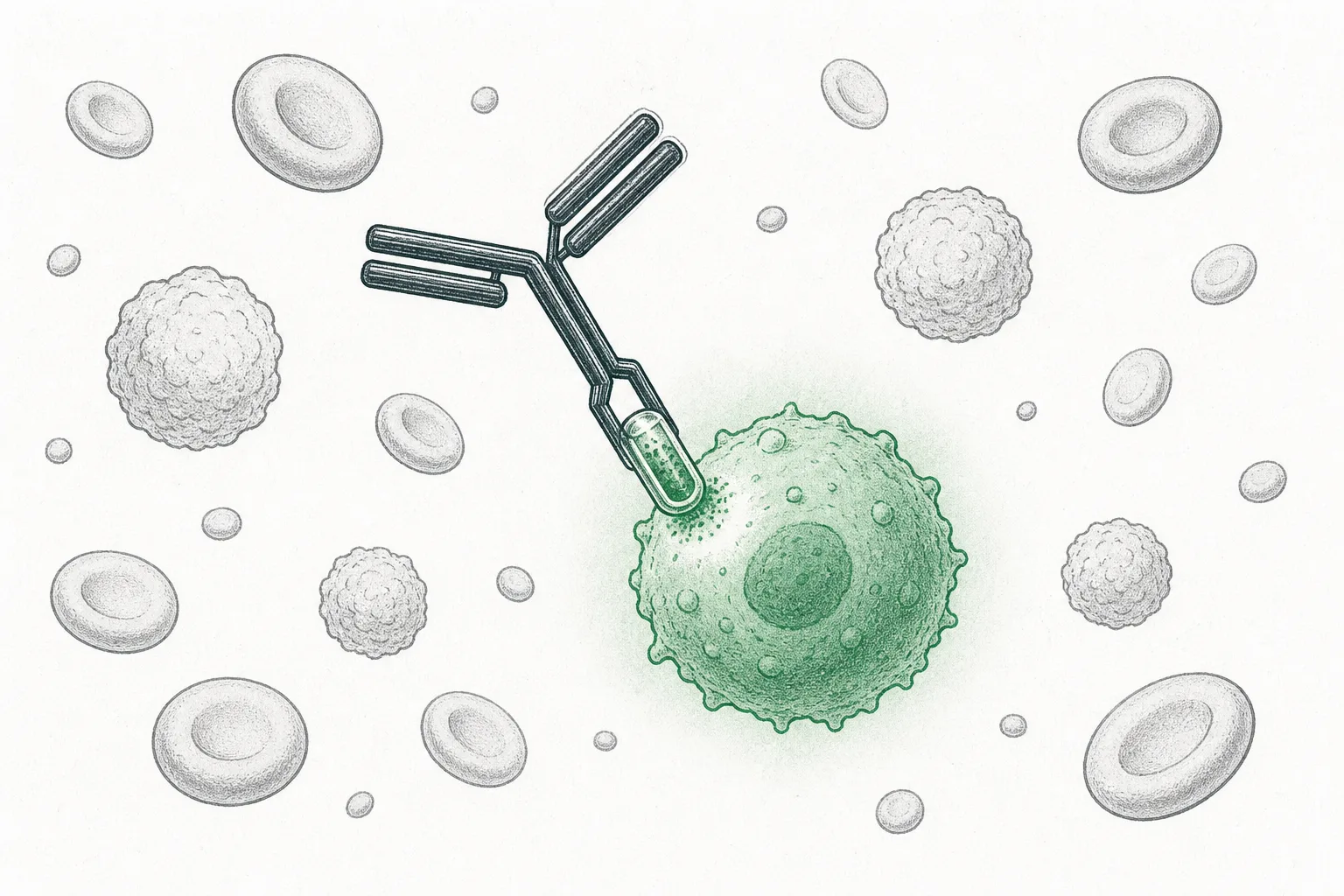
Think of traditional chemo as "carpet bombing" — scattering poison throughout the body and hoping the faster-growing cancer cells die first. The problem is that healthy cells that also grow fast (hair, gut lining, bone marrow) get hit too. That's why chemo makes people lose their hair, feel nauseous, and lose their immunity. ADC was born to answer one question: "What if we could deliver the poison only to the malignant cells?"
An Antibody-Drug Conjugate (ADC) — an "antibody carrying a drug" — is a cancer drug built from three parts joined together: (1) the antibody (mAb) acts as the "GPS," latching onto a specific marker on the cancer cell's surface · (2) the payload, the bomb that's too powerful to inject into the body on its own · and (3) the linker, which holds the two together during the journey and releases the poison only at the target. It's a sub-field under Oncology Therapeutics within the larger trend of Biotech & Genomic Medicine — and the "hottest" cancer-treatment module right now in terms of investment and dealmaking.
The metaphor cancer doctors love is that an ADC is like a "guided missile" — the missile body (the antibody) flies to the target on its own, and the warhead (the poison) goes off when it arrives. That's different from chemo, which is like firing artillery blindly across the whole battlefield. The result: ADC lets you use a poison hundreds to thousands of times stronger than ordinary chemo more safely, because it acts only at a specific spot rather than floating through the whole bloodstream.
mAb (monoclonal antibody) = an antibody designed to grab just one kind of target marker, like HER2 or TROP2 on a cancer cell's surface · Payload = the poison tied along, usually a cell-killing agent too strong to use on its own · Linker = the chemical chain holding the poison to the antibody — it must be "tight enough" not to come loose en route, but "able to release" once at the target · DAR (drug-to-antibody ratio) = the number of poison molecules per antibody — the higher it is, the more potent, but the faster the drug gets cleared from the body and the easier it becomes toxic. Finding the "just right" DAR is the art of this field.
02Why it matters — where the money flows in hardest
If you want to know what an industry sees as "the real thing," follow the money — and no cancer module has pulled in money like ADC has in the past few years. In 2023, Pfizer paid about $43 billion to buy Seagen, an ADC pioneer — one of the largest drug deals in history. That same year, AbbVie bought ImmunoGen for about $10.1 billion to get Elahere (for ovarian cancer), and that October, Merck teamed up with Daiichi Sankyo in a deal worth up to $22 billion to co-develop three ADCs — with a single $4 billion cash payment upfront.
Why does so much money flow in? Because ADC isn't just a new drug, it's a "platform" — the same technique can be aimed at any kind of cancer, just by swapping the antibody for a new marker. So it isn't a bet on a single drug, it's like buying a "factory that makes many cancer drugs" all at once. And the market is growing as fast as the hype: global ADC sales in 2025 are around $14 billion, and many research houses expect it to grow to roughly $25–30 billion by 2030 — about 15% a year on average, several times faster than the average for the whole drug industry.
The deeper structural reason is that old-school chemo is hitting its ceiling — it's only strong enough to kill cancer when it's strong enough to harm the patient too. ADC pushes the "therapeutic window" wider: it can kill more cancer while the patient can tolerate more. And that means drugs once "too strong to use" can come back into use in ADC form — turning a whole warehouse of old drugs into new weapons.
03How it works — a three-part guided missile
The journey of one ADC molecule always follows four steps: float through the blood → grab the marker on a cancer cell → get swallowed into the cell → release the poison to kill from the inside. All the cleverness is in the "linker" — it has to be tight enough not to drop the poison while floating in the bloodstream (otherwise it just becomes scattershot chemo again), but it has to release the moment it's inside the cancer cell.
There's one trick that makes the newer generation of ADCs much better, called the "bystander effect" (an effect that reaches neighboring cells) — after the poison is released inside a target cancer cell, some of it can seep out and kill the neighboring cancer cells that don't carry the right marker. It sounds like a downside, but it's actually an upside, because a real cancer mass doesn't have the same marker on every cell — it's mixed (heterogeneous). The bystander effect helps sweep up the cells that "hid from the marker." But it's a double-edged sword: spread too much and it hits healthy tissue, becoming toxic. The skill of the field is tuning the linker and DAR so the spread is "just right."
04Where it sits in the cancer world
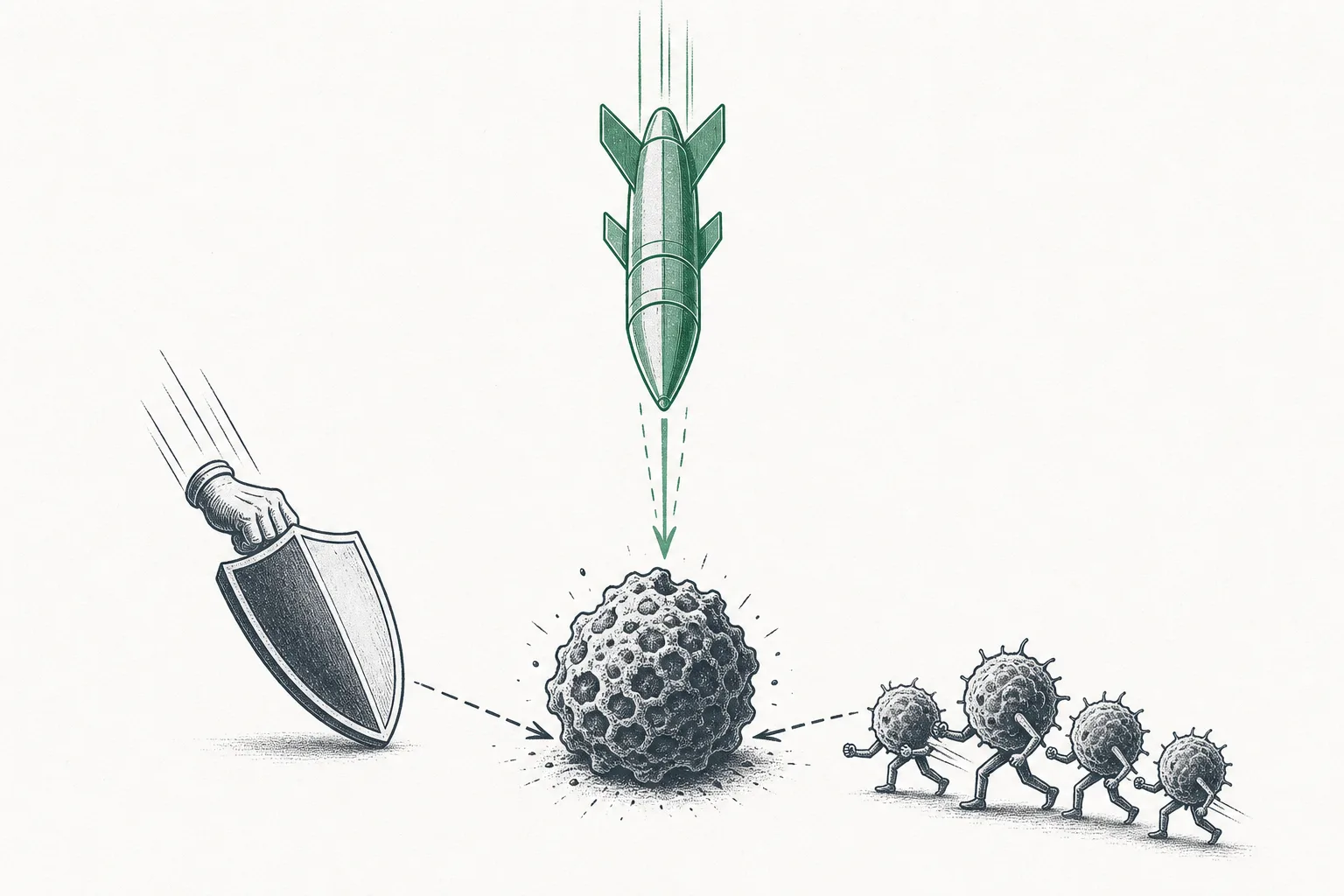
ADC doesn't fight cancer alone. It's one of the "three main weapons" of Oncology Therapeutics — each attacking cancer from a different angle, and these days they're used together more than in competition.
- ADC = "deliver the bomb to the exact spot" — kills cancer cells directly with a guided poison. Strong against cancers with clear markers, like HER2 (breast, stomach) or TROP2 (triple-negative breast cancer)
- Sibling #1: Immuno-Oncology / Checkpoint — instead of killing itself, it releases the "brakes" on the immune system so the body kills the cancer itself. Many modern regimens combine ADC + checkpoint: the ADC kills cancer cells and "exposes" them to the immune system, then the checkpoint cleans up
- Sibling #2: Cell Therapy (CAR-T) — modifies the patient's own immune cells into cancer hunters. Strong against blood cancers, while ADC is strong against "solid tumors" that CAR-T still struggles to reach — so the two complement each other more than they overlap
- Test before you treat — connects with Diagnostics & Precision Testing: ADC only works on patients who have the target marker, so before dosing you need a companion diagnostic to check whether the tumor has enough HER2 or TROP2 — without the test, you don't know who to give it to
- Who makes it — CDMO: ADCs are immensely hard to manufacture (you have to assemble three parts precisely and handle a dangerous poison), so most drug companies hire specialized factories to make them — which is why ADC contract manufacturers like WuXi XDC are growing fast
05Where it stands now
As of 2025, about 14–15 ADCs have FDA approval, and the standout that changed the game for the whole field is Enhertu (trastuzumab deruxtecan), from AstraZeneca partnered with Daiichi Sankyo — the ADC that lit the fuse on the whole wave of deals, because it showed that new-generation ADCs work well enough to "rewrite the standard of care" for several kinds of breast cancer. In Q1 2025, Enhertu posted total sales of about $1,086 million in a single quarter, and AstraZeneca once set a target for it to be a $5 billion-a-year drug.
The second star is Trodelvy (sacituzumab govitecan), from Gilead — the only ADC the NCCN guidelines recommend for both first- and second-line use in triple-negative breast cancer. Its full-year 2025 sales were about $1,397 million (up 6%). Meanwhile, the big pharma players who've invested heavily but are still awaiting results are Pfizer (from Seagen, expected to generate over $10 billion in risk-adjusted revenue by 2030) and AbbVie with Elahere in ovarian cancer.
But the most notable story of the year is the rise of Asia — especially China, which has become the world's "ADC innovation factory." Companies like Sichuan Biokin (BAILI), Kelun-Biotech, and RemeGen have developed their own ADCs to the point where Western firms rush in to buy the rights. South Korea has Legochem Biosciences and Alteogen, standouts in linker technology and drug delivery, while Japan's Daiichi Sankyo owns "DXd," one of the most powerful platforms in the world — making ADC one of the few fields where Asia isn't lagging, but leading.
06The road ahead — the second-generation missile
Every ADC the FDA has approved so far is still a "single-warhead missile" — the antibody grabs one kind of marker and carries one kind of poison. The hottest direction in the field is the "bispecific ADC" (a two-warhead missile) — a single antibody that grabs two cancer markers at once, making it more precise, harder for cancer cells to evade, and less likely to hit healthy tissue. None are approved yet, but at least four are racing to be first.
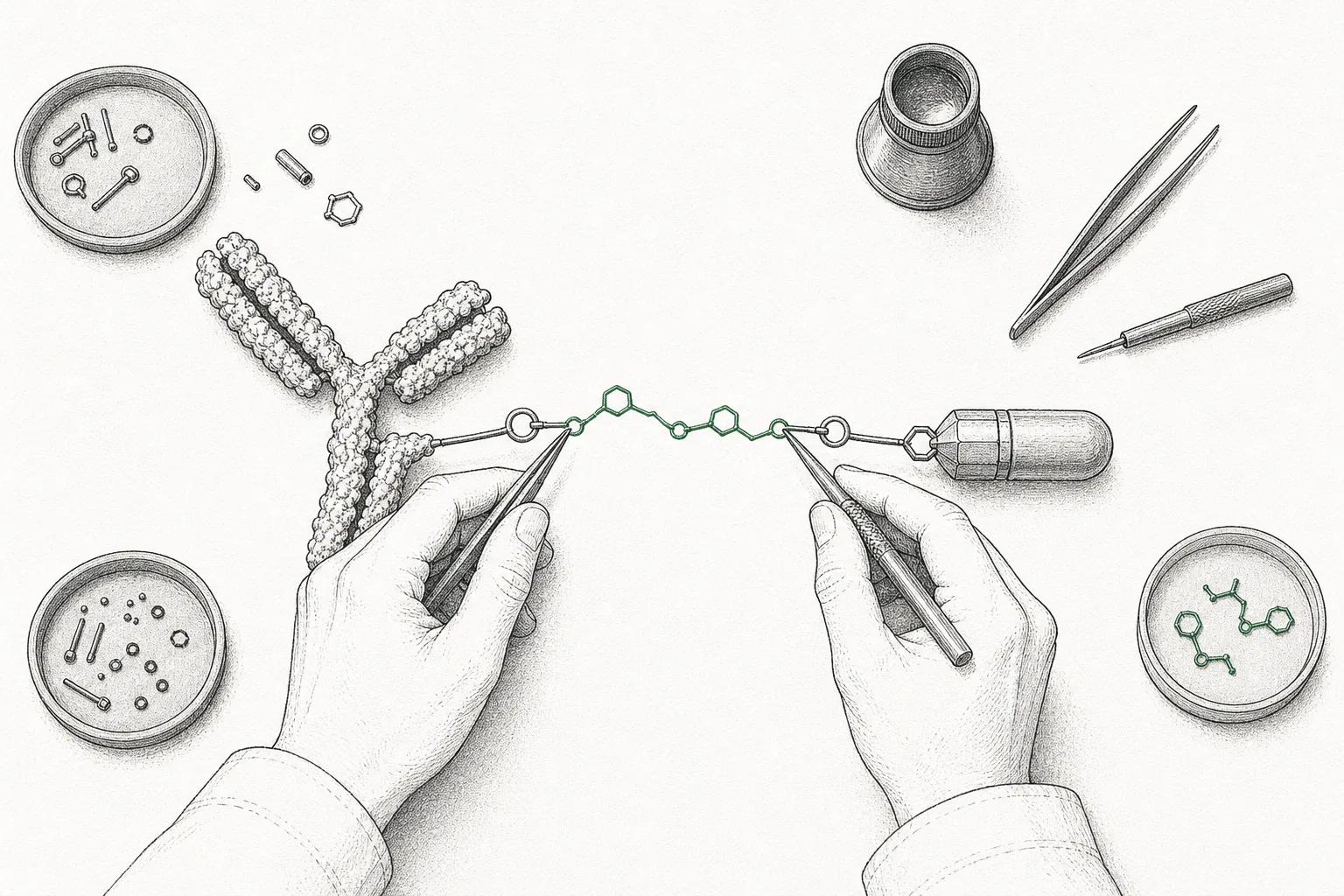
The second direction is designing a new generation of linkers and payloads — instead of reusing the same old poisons, researchers are experimenting with "dual-payload ADCs" that carry two kinds of poison in one (to prevent drug resistance), and linkers that release the drug only when they meet a certain enzyme in the tumor — the more precisely you can choose where to release, the wider the safety window. This is the field where Korean and Chinese linker-technology companies have the advantage, because it's an "engineering secret" that can't be copied easily.
The third direction is expanding beyond cancer — the principle of "delivering a strong drug only to a specific spot" isn't limited to cancer. Trials of ADCs for autoimmune and inflammatory diseases are beginning. If they succeed, the market for this technology will be several times larger than the cancer side alone, and it will pull AI into a bigger role in designing antibodies and predicting which linkers will be stable — slashing the time spent on trial and error in the lab.
07Challenges & risks
The first risk is that even a "guided missile" can miss — although ADC is more precise than chemo, some of the poison still leaks into the bloodstream, and the target markers (like HER2 and TROP2) are present in small amounts on normal cells too. As a result, ADC still has its own dangerous side effects — the most notorious being lung fibrosis (interstitial lung disease) from the deruxtecan class, which is why Enhertu requires close patient monitoring. This imperfect precision is the thin line between "it works" and "it's toxic."
The second risk is that it's hard and immensely expensive to make — assembling three parts (antibody + linker + poison) precisely in every molecule, while handling a poison dangerous to workers, makes ADC manufacturing far more costly than ordinary antibody drugs. That's why most companies have to rely on specialized contract manufacturers (CDMO) — and it makes production capacity the real bottleneck of the field. Whoever books the production line first gets to market first.
The third risk is drug resistance and fierce competition — use an ADC for long enough and the cancer cells learn to "reduce the marker" on their surface, so the missile can't find its target. And because money sloshes around this field, hundreds of companies jump in to develop ADCs against the same target — risking drugs that are "too similar" coming out to compete on price until margins go thin. Some of the billion-dollar deals paid may not be worth it if the drug in hand becomes a commodity in five years.
In short: ADC is proof that "how you deliver a drug" matters as much as "the drug itself" — take an old poison that was once too strong to use, tie it to a GPS that knows the face of cancer, and a whole warehouse turns into new weapons. That's why the whole industry is pouring money in here — and why the next round of competition won't be over "the drug itself," but over "the engineering of delivery."