Megatrend · Biotech & Genomic Medicine
If a drug is a chemical you swallow, what about a "living drug" that hunts cancer down on its own?
Cell therapy doesn't give the body a "substance" — it gives it an army. We pull a patient's own white blood cells out, fit them with new weapons that recognize the face of their cancer, and send them back in to hunt. The result: some blood-cancer patients whom every drug had failed go into remission for years from a single treatment. But this miracle has a price — both the steep $400,000–500,000 per dose and the difficulty of having to "make a new drug each time, for each individual patient." This chapter walks through how it works, why it changed the game, who owns the market, and the future trying to make the "living drug" cheaper and genuinely within reach.
01What it is — the "living drug"
Think of every drug we know — acetaminophen, blood-pressure pills, even the strongest chemotherapy (chemo). All of them are chemicals: you swallow or inject them, they take effect, and the body gradually clears them out. When the effect fades, you dose again. But cell therapy is a completely different species — it isn't a chemical, it's a living thing.
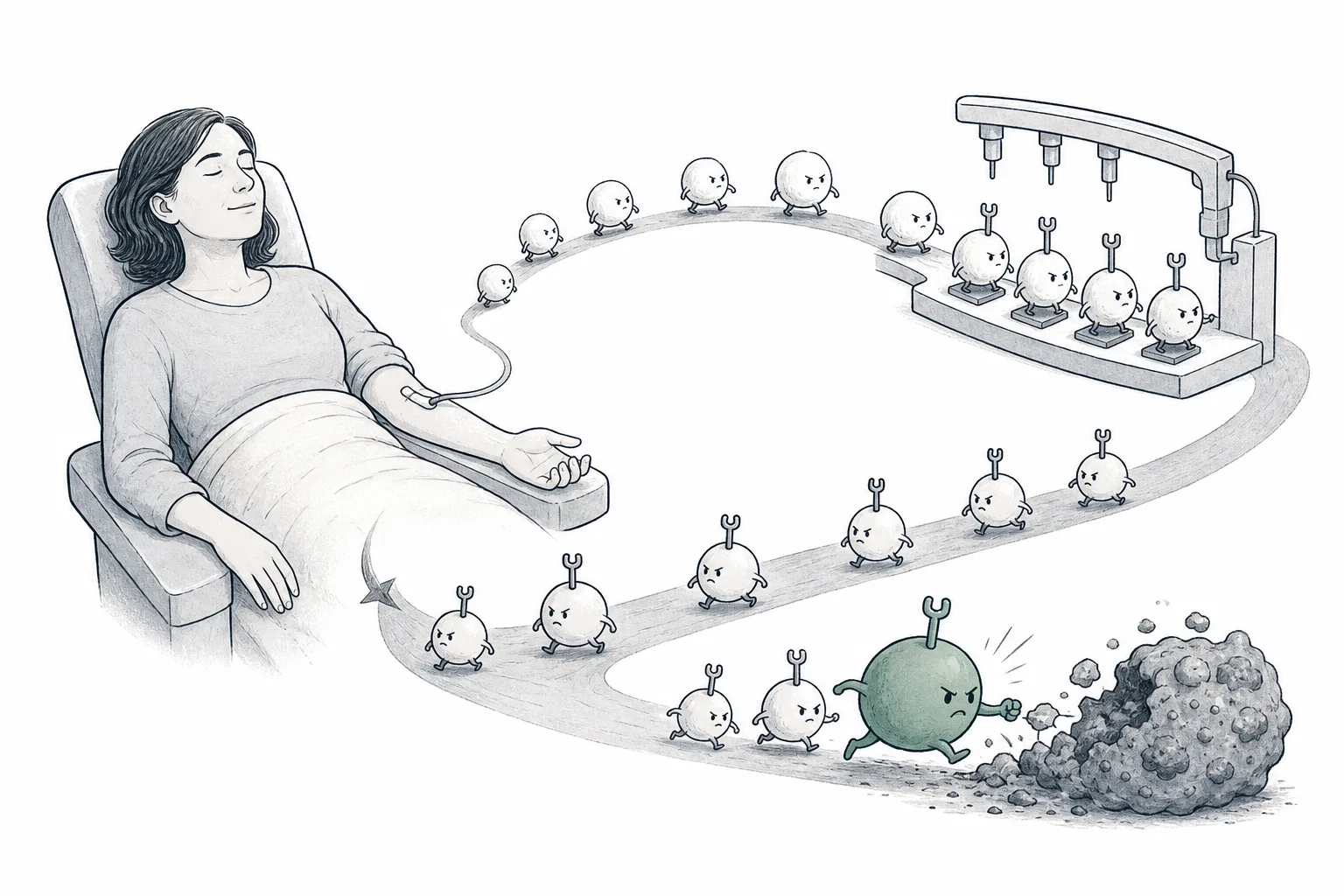
The heart of this node is a technique called CAR-T, which does something that sounds like science fiction. We draw a type of white blood cell called a T-cell (the soldiers of the immune system) out of the patient, genetically engineer it in the lab to carry a new "radar" that recognizes the face of cancer cells, grow it into millions of copies, then inject it back into the same patient. This time the T-cells aren't ordinary soldiers — they're hunters programmed to track down cancer specifically. And because they're living cells, they multiply, patrol, and remember — sometimes staying in the body for years, standing guard so the cancer can't return. This is why the field calls it a "living drug".
Cell therapy is a sub-field under Oncology Therapeutics (cancer treatment) within the megatrend Biotech & Genomic Medicine. Its siblings are two other ways to attack cancer — Antibody-Drug Conjugates (ADC), which use an antibody to carry a "bomb" and drop it right on the cancer cell, and Immuno-Oncology / Checkpoint, which "releases the brakes" so the body's existing immune system can fight again. If checkpoint is about "waking up" the soldiers you already have, cell therapy is about "building a new breed of soldier" from scratch — stronger and more targeted, but much harder and far more expensive.
CAR (Chimeric Antigen Receptor) = the "artificial radar" we fit onto an immune cell so it can see and grab a target on the surface of cancer cells (chimeric means "hybrid," because it's stitched together from parts of several sources) · T-cell = the white blood cell that acts as the immune system's killer soldier · Autologous = using the patient's own cells (the main method today — safe but hard to manufacture) · Allogeneic = using cells from a donor, made into an "off-the-shelf" product ready to use (the future many companies are chasing)
02Why it matters — treating blood cancers once given up for lost
To see why this is such a big deal, picture a patient with lymphoma or multiple myeloma who has tried every drug and none of it worked — chemo, targeted drugs, and the cancer keeps coming back. In the past that almost meant the end. But CAR-T changed that equation: among these patients out of options, a single CAR-T treatment puts some of them into remission lasting years.
The hard numbers: in a long-term study of patients with drug-resistant large B-cell lymphoma, the 5-year survival rate was about 32% — and as high as 56% in the group that responded to treatment. For patients who originally had almost no options left, that's a life-changing figure. In multiple myeloma, Carvykti data show that about 1 in 3 patients stayed free of disease progression for more than 5 years from a single treatment — in a disease once considered "incurable."
With results this good, the market follows. The global CAR-T market today is worth about $5–8 billion, and most analysts expect it to reach $13–16 billion by 2030 — growing roughly 20–25% a year, several times faster than ordinary drugs. The real driver isn't just the drug-resistant patients; it's that CAR-T is moving to be used "earlier" in the treatment path — instead of a last resort, it's starting to be used from the second or third line, which expands the patient base many times over.
03How it works (draw the cells → arm them → send them back)
The CAR-T process sounds like magic, but it really follows four easy-to-grasp steps. The heart is the middle step — where we "arm" the cell to recognize cancer. Because immune cells usually can't see cancer (cancer is good at disguising itself as a normal cell). What CAR-T does is fit the soldier with a new radar that sees through the disguise.
What makes the whole process hard hides in steps 1 and 3: because we use the patient's own cells (autologous), every dose is entirely "made to order" anew. Draw the blood, ship it to the factory, edit the genes, culture it, run quality control, then ship it back to inject — this cycle takes what the field calls "vein-to-vein time" (the time from vein to vein), which in the real world averages about 3–6 weeks. And that's a big problem — because some patients with advanced cancer can't wait that long.
The time from when blood is drawn to pull the T-cells out of the patient (leukapheresis) to when the armed cells are injected back in. Shorter is better, because patients with advancing cancer can't wait. It currently averages about 3–6 weeks, and cutting this time is a key competitive battlefield in the field — some companies have already pushed it down to about 7 days in trials.
04The ecosystem — the hardest drug in the world to make
An ordinary pill is made a million at a time in one factory, every pill exactly the same. But CAR-T flips that idea entirely — each dose is a living thing grown fresh from one person's blood. This difficulty creates an ecosystem completely unlike ordinary drugs, and it's the reason it's so expensive.

- Manufacturing is the bottleneck → a contract-manufacturing business is born (CDMO): because culturing and editing cells requires high-grade cleanrooms, specialized equipment, and skilled people, most drug companies don't build their own factories — they hire contract manufacturers (CDMOs) specialized in cells and genes, turning it into a "picks-and-shovels" business that grows with the whole cell-therapy field
- Relies on gene-editing tools from Gene & Cell Editing: "fitting the CAR radar" is gene editing — the first generation used viruses to carry the gene in, the newer generation is starting to use CRISPR for more precise edits, especially for allogeneic, where you have to "delete" certain genes so the donor cells don't attack the patient. So companies like CRISPR Therapeutics and Intellia are both rivals and partners of this field
- Driven and accelerated by AI: designing new CAR receptors, picking safe targets on the cancer, and predicting which patients will respond are all problems AI helps speed up — shortening the "trial and error in the lab"
- A pillar of Longevity: if one day we can arm the immune system to hunt down worn-out cells (senescent cells) or early-stage cancer cells, cell therapy becomes a tool for "extending life with quality" — not just treating late-stage cancer
05Where it stands now
There are currently 7 FDA-approved CAR-Ts, split into two main camps by the target they aim at. The first camp aims at the CD19 protein on lymphomas and leukemias — Yescarta and Tecartus from Gilead/Kite, Breyanzi from BMS, and Kymriah from Novartis (the world's first, in 2017). The second camp aims at the BCMA protein on multiple myeloma — Carvykti (Legend/J&J) and Abecma (BMS).
The big story right now is CAR-T "moving closer to the front line" of treatment. It used to be a last resort, but now Carvykti has a label for use from the second line, with evidence that it "helps people live longer" — in Q1 2025 it did about $369 million in sales, with more than 7,500 patients already treated with it. Another positive signal: in 2025 the FDA dropped the special-surveillance program (REMS) for every CAR-T, because doctors got much better at managing side effects — opening the way to use it more widely in hospitals.
On the solid tumor side — a much harder target — a major milestone is Iovance's Amtagvi, the first cell therapy (a TIL type) approved for skin melanoma, proving that the principle of "arming the immune cells" can really start moving beyond blood cancers. Meanwhile, Asia is becoming a second arena — China has the most CAR-T trials in the world, led by CARsgen, which has already gotten zevor-cel approved in China and is pushing into the solid-tumor market at prices far below the West.
06The future — off-the-shelf, solid tumors, in-vivo
If CAR-T today is a "made-to-order, expensive drug you wait weeks for," the entire future of the field is about fixing those three words — making it off-the-shelf, fast, and cheap. There are three big paths competing.
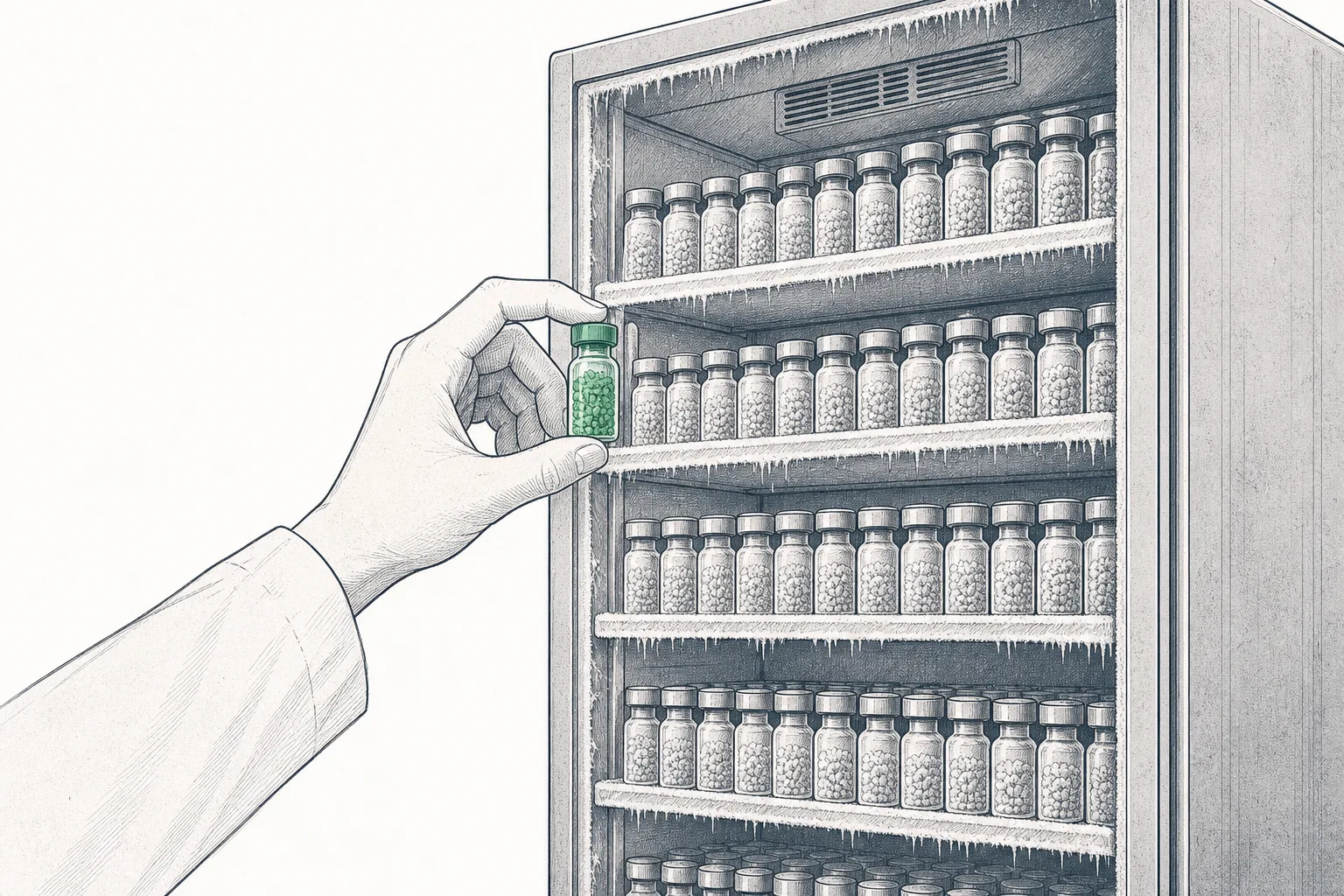
Path one: allogeneic — "an off-the-shelf product from the freezer" instead of using the patient's own cells, you use pre-edited donor cells, made in large batches and frozen for storage. When a patient needs it, you "grab it from the freezer" and inject right away — cutting weeks of waiting down to days and slashing the cost. Allogene is the spearhead of this approach. The challenge is keeping someone else's cells alive in the patient's body long enough, before the patient's immune system clears them out.
Path two: pushing into solid tumors today CAR-T is good with blood cancers because the targets float in the bloodstream, easy for the cells to chase. But solid tumors (lung, liver, pancreas — which make up over 90% of all cancers) are much harder, because they build a "wall" around themselves to keep immune cells out. The success of Amtagvi and CARsgen's pipeline are signs that this wall is starting to be breached — and if it works broadly, the market gets several times bigger.
Path three, and maybe the most game-changing: in-vivo CAR-T imagine that instead of drawing cells out to modify them outside the body, you inject "instructions" that arm the immune cells to edit themselves inside the body — using the same technique as mRNA vaccines (wrapped in lipid nanoparticles, or LNP). If it works, there's no factory, no waiting for manufacturing, no culturing — CAR-T becomes just a "shot," like any ordinary drug. It's still in the early stages of trials, but it's the direction every big company is watching, because it would smash the whole "cost and time" problem in one stroke.
07Challenges & risks
The first and biggest risk is price and manufacturing. With a list price of $373,000–465,000 per dose (and possibly over $500,000 once you add all the hospital costs), CAR-T is one of the most expensive drugs in the world. Most of that price comes from the difficulty of making it one patient at a time — the cost of manufacturing the cells alone is about $95,780 per dose. As long as it has to be "made to order" every time, it'll only reach a small slice of patients and only in wealthy countries — which is exactly why the whole field is betting on allogeneic and in-vivo.
The second risk is toxicity from the treatment itself. Because we're rousing the immune army to a full charge, a common side effect is CRS (cytokine release syndrome) — when the immune system responds so violently it causes high fever, dropping blood pressure, and organ dysfunction, along with toxicity to the nervous system. The good news is doctors got much better at managing it (with drugs like tocilizumab to suppress it), enough that the FDA dropped the special surveillance in 2025. But it's still a treatment that has to be done at specialized centers ready to handle it — not an ordinary clinic.
The third, worrying risk is secondary malignancy — there have been reports (very rare) of some patients developing a new T-cell cancer after getting CAR-T, enough that the FDA put a boxed warning about it on the label. It's a warning that "editing the genes of living cells" still holds things we don't fully understand, and that patients need long-term follow-up.
And finally — it isn't yet a magic drug that works for everyone. As the graph above shows, even in the blood cancers where CAR-T is best, about half or more of patients still relapse in the end. Making the results more durable, and expanding from blood cancers to solid tumors, is the question still open.
In short: cell therapy has proven that a "living drug" really can be made, delivering what chemical drugs can't — bringing people once given up for lost back to their lives. The next question isn't "does it work," but "how do we make it cheap and within reach of the many" — whoever answers that first is the one who turns cell therapy from a luxury for the few into the new standard of cancer treatment.