Megatrend · Biotech & Genomic Medicine
Cancer is good at one thing — it knows how to "hit the brakes" on the immune system so it won't touch it
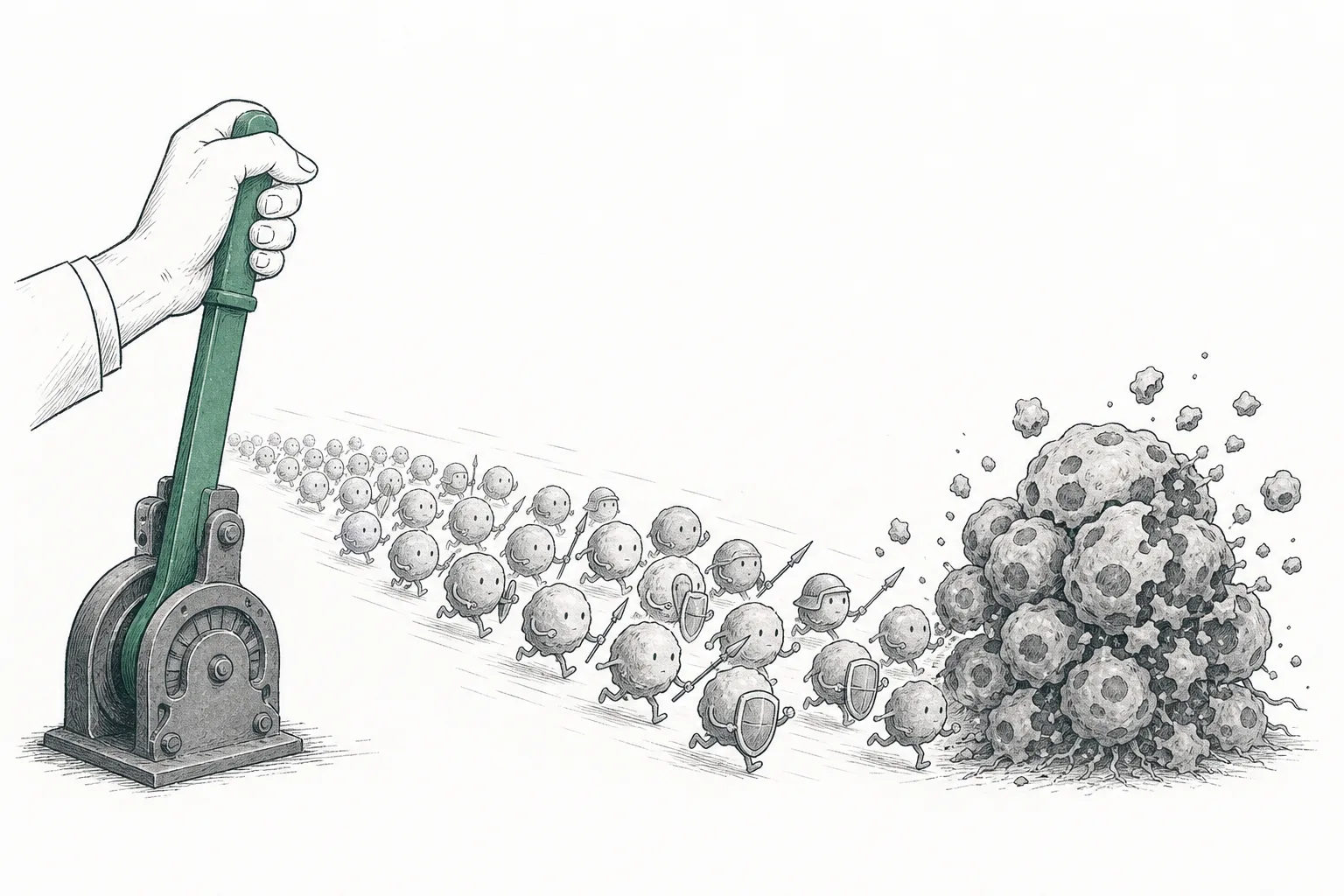
Our bodies already have soldiers that kill foreign cells — they're called T-cells. The trouble is, cancer cells are clever enough to "raise a hand and tell the soldiers we're on the same side," hitting the brakes so they don't get attacked. The class of drugs called checkpoint inhibitors does one thing — release that brake, and let the body's own soldiers go to work. This chapter is the story of how that simple idea became Keytruda, the best-selling drug in the world (~$31.7B a year), why 2028 is the deadline the whole industry is watching, and who's lining up to take the throne.
01What it is
Picture your immune system as an army, with T-cells as the combat soldiers patrolling for foreign cells — kill the infected ones, kill the cells turning cancerous. But a good army also needs "brakes," or the soldiers will fire wildly and hit the body's own healthy cells. These brakes are called immune checkpoints — stop buttons built into the T-cell to keep it from harming its own body.
The problem is that cancer cells are sly — they learn to push that "stop button" themselves, waving a fake white flag that tells the soldiers, "I'm one of you, don't shoot." So the soldiers just stand there, right next to the real enemy. Immuno-Oncology (I-O), the checkpoint kind is the drug that solves this game right at its core — it's not a poison that kills cancer like chemo, but an antibody (a Y-shaped protein that grabs a target specifically) that goes in and releases the brake, pulling away that fake white flag so the T-cell can see the cancer again and act on its own.
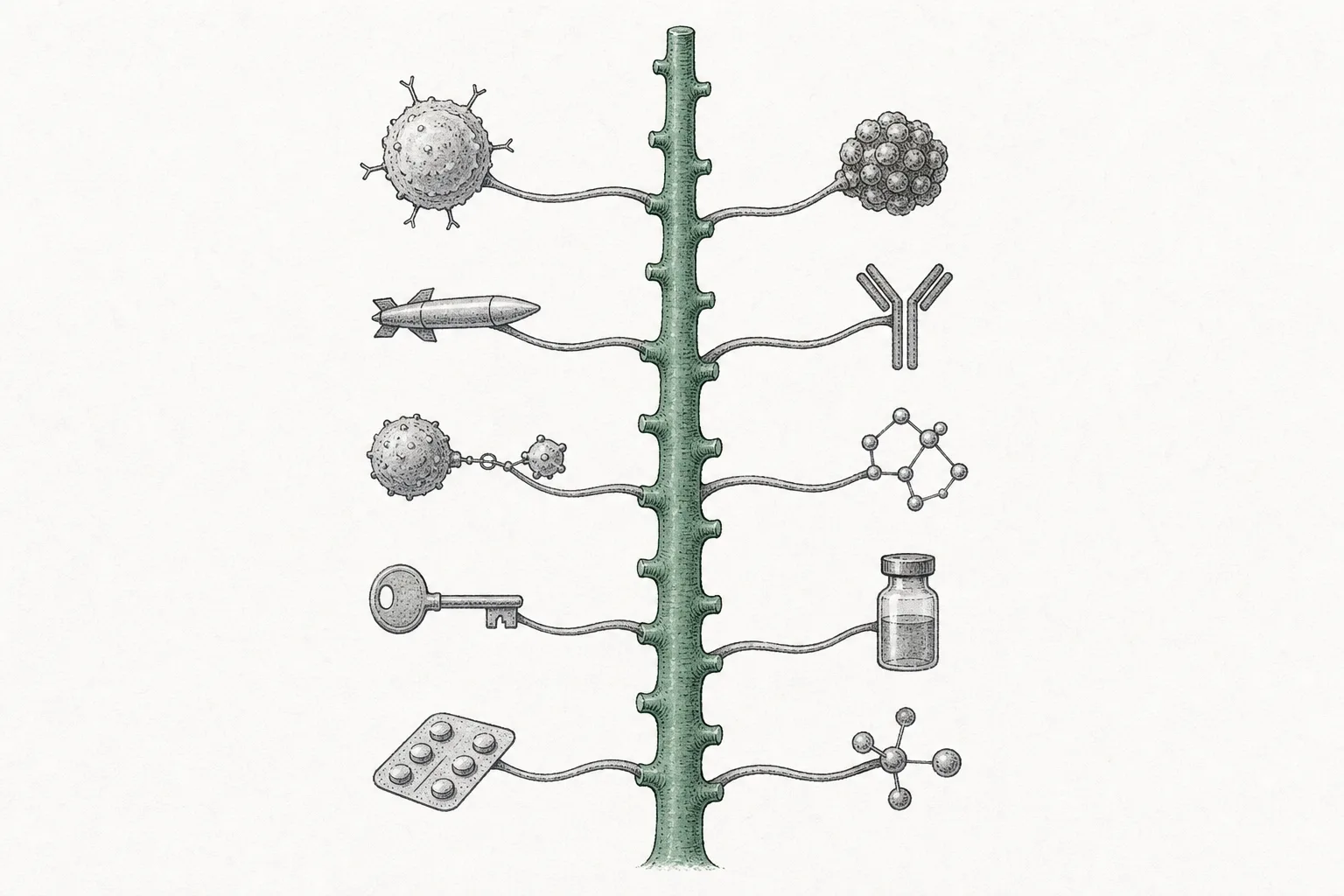
This node is one leaf under Oncology Therapeutics (cancer drugs) within the big trend Biotech & Genomic Medicine. Its siblings next door are Antibody-Drug Conjugates (ADC) — a "guided missile" that carries poison straight to the cancer cell — and Cell Therapy (CAR-T) — re-engineering a patient's own immune cells into cancer hunters. The three are three different ways of using "biological weapons" to fight cancer, with checkpoint being the way that wakes up the army we already have, rather than building a new weapon.
PD-1 = the brake button on the T-cell · PD-L1 = the "finger" the cancer cell extends to press that button (when PD-1 meets PD-L1, the soldier stops immediately) · CTLA-4 = another brake at a different point in the cycle, acting earlier. Most checkpoint drugs therefore aim to "cut the bond" between PD-1 and PD-L1 — like slipping a hand in between so the cancer's finger can't press the stop button.
02Why it matters — the best-selling drug in the world
If you want to measure how big this idea is, look at a single drug: Merck's Keytruda brought in about $31,700 million in 2025 — more than half of all of Merck's drug revenue (~$58,100 million). It is the best-selling drug in the world right now, surpassing even the legendary Humira. Picture this — a single drug earning about as much as the GDP of some countries. And it all started from the simple idea of "just release the brake."
But Keytruda is just the tip of the iceberg. The entire checkpoint inhibitor market in 2025 is estimated at around $50,000–68,000 million (the figures vary by research house), and nearly all of them agree it's still growing fast — Grand View Research projects it'll reach $154,000 million in 2030, growing about 18% a year on average. The reason it keeps growing is that these drugs work across dozens of cancers, not tied to any one organ — Keytruda alone is approved for more than 40 indications, from lung, skin, and colon cancer to certain cancers with a particular "genetic signature," regardless of which organ they start in.
In economic terms, what I-O changed is the "hope" of advanced cancer. Metastatic melanoma patients used to survive only a few months on average. Today, some patients who respond to checkpoint live for years — long enough to be called the "long tail" of survivors — and some can even say the word "cured" of a cancer that was once a death sentence. That's why patients, doctors, and payers accept the steep price, and why these drugs became the "backbone" of modern cancer treatment — nearly every newly developed drug now is designed to be used together with checkpoint, not to replace it.
03How it works (releasing the T-cell's brake)
The mechanism of a checkpoint inhibitor is beautiful in how simple it is. But before you understand it, you have to see how cancer "cheats." Normally a T-cell comes up to a cancer cell, inspects it, and is ready to kill — but cancer cells that survive usually have a trick: they extend a protein called PD-L1 and plug it into the PD-1 button on the T-cell. When those two bind, they send a signal that says "stop, don't shoot" — and the T-cell that was ready to fight goes slack and backs off, even while standing right in front of the enemy.
A checkpoint inhibitor drug is just an antibody that goes in to block the cancer's PD-L1 from plugging into the T-cell's PD-1 — like a hand getting in the way so the cancer's finger can't press the stop button. With the button unpressed, the soldiers wake back up, see the cancer again, and get on with the job they were built to do. Look at these three steps:
The beauty of this mechanism is that it explains the drug's strength and weakness in one go. The strength — because it wakes up the immune system's "memory," people who respond may keep cancer in check for a long time even after stopping the drug (this is the "long tail" that chemo can't deliver). The weakness — when you release the brake on the whole immune system, sometimes the soldiers slip up and attack normal organs too, causing autoimmune side effects like colitis, thyroid problems, or pneumonitis — the price you pay for "letting off the brake."
04Where it sits in the cancer world
A checkpoint inhibitor doesn't fight cancer alone. It became a "base" that other drugs build on top of. Let's look at how it connects to its neighbors in the ecosystem.
- It needs a "paired test" before use — Diagnostics & Precision Testing: PD-1/PD-L1 drugs don't work for everyone. Patients with more PD-L1 on their cancer cells respond better, so doctors have to run a companion diagnostic before prescribing — a classic case of "test first, then pick the right drug for the right person." Without this test, an expensive drug gets used like a shot in the dark
- Teaming up with ADC is the most powerful pairing: the hottest trend right now is combining checkpoint with ADC — in 2025, Keytruda + Trodelvy (an ADC) cut the risk of progression or death in TNBC breast cancer by 35% versus Keytruda + chemo (extending progression-free time from 7.8 to 11.2 months) — the ADC rips cancer cells open, exposing targets more clearly to the immune system, the two reinforcing each other
- Relying on AI to find "who will respond": the big problem is that most patients don't respond to checkpoint. Finding a biomarker that says who really will is a puzzle where AI steps in to read vast amounts of biopsy imaging and genetic data — raising the success rate and cutting unnecessary dosing
- A pillar of Longevity and Aging Population: cancer is a disease of getting older, and an aging society means more cancer patients. The ability to turn advanced cancer from a "death sentence" into a "chronic disease you can live with for a long time" is one of the most important tools in the dream of a long, high-quality life
05Where it stands now
This field has a clear king — Merck's Keytruda dominates the market above all others, with the broadest set of indications and marketing that locks down "lung cancer," the biggest market. The long-standing number-two rival is Bristol-Myers Squibb's (BMS) Opdivo — the IV version of Opdivo alone runs about $2,480 million a quarter, and BMS also has Yervoy (which targets another brake, CTLA-4) to pair with it. Together, Keytruda and Opdivo take over 60% of the global checkpoint market.
On the PD-L1 side (aiming at the cancer's "finger" instead of the T-cell's button) there are three big players from Europe and the U.S.: Roche's Tecentriq, AstraZeneca's Imfinzi (strong in combination with radiation and chemotherapy), and Bavencio. The most-watched challenger comes from China — BeiGene (now using the name BeOne) has pushed Tevimbra out beyond its borders, doing $171 million in Q1 2025 (up 18%) and winning approval in 45–46 markets worldwide — a sign that I-O is no longer a Western game.
The most important move of the year was Merck opening its play to extend Keytruda's life. In September 2025, the FDA approved Keytruda Qlex — a "subcutaneous" (under-the-skin) injection version that's done in about a minute, instead of an hours-long IV drip. It's convenient for patients and hospitals alike — and, importantly in business terms, it's a move to shift patients to a new formulation that still has patent protection before the old one expires. A classic textbook play for handling a patent cliff.
06The road ahead — the 2028 cliff and the new wave
There's one year the whole industry is staring at: 2028 — the year Keytruda's main U.S. patent is expected to expire, opening the door for biosimilars (cheaper biological copies) to compete. Ironically, that same year is when analysts expect Keytruda to hit its peak revenue of about $35,000 million — and then start sliding down. The disappearance of that revenue is one of the biggest "cliffs" (patent cliffs) in pharma history, and the reason Merck went so far as to spin its cancer business into a standalone unit and line up more than $70,000 million a year of new opportunities to cushion it.
Meanwhile, a new wave is forming from a place many didn't see coming — China. The most talked-about drug is Akeso's ivonescimab (partnered with Summit Therapeutics on the Western side). It's a bispecific — a single antibody that grabs two targets at once: both PD-1 and VEGF (the blood vessels that feed cancer). In the HARMONi-2 trial in China, it cut the risk of lung cancer progression by 49% head-to-head against Keytruda — the first time any drug has "beaten" Keytruda head-to-head in a large trial. If that result holds up in Western markets, it could become the next-generation backbone.

The third direction is "combo is the new rule" — the future of I-O is no longer a single drug. It's pairing checkpoint with ADC, targeted therapy, or a bispecific to pull the "non-responder" group back into responding. Formulas like Keytruda + Padcev (an ADC) in bladder cancer, or Keytruda + Trodelvy in breast cancer, are the templates — so the next war isn't "whose drug is stronger" but "who pairs drugs more cleverly."
07Challenges & risks
The first and biggest risk is the 2028 Keytruda cliff — for Merck, leaning more than half its total revenue on a single drug means that when biosimilars arrive, revenue could vanish by tens of billions of dollars within a few years. Even if Keytruda Qlex and a second round of patents buy some time, they only slow it down, not stop it — a lesson that even the best-selling drug in the world has an expiration date, and the bigger it is, the taller the cliff.
The second risk is that most people still don't respond. A truth rarely mentioned is that checkpoint inhibitors only work really well for a minority of patients — in many cancers, the response rate is only around 20–40%. The rest are people paying a steep price and taking on the risk of side effects without getting the full benefit. Finding a biomarker that can accurately predict in advance "who will respond" is a puzzle that's still unsolved, and a ceiling that keeps the market from growing any faster.
The third risk is immune-related adverse events. When you release the brake on the whole system, the soldiers sometimes attack normal organs — the gut, liver, lungs, endocrine glands — and in some cases severely enough to be life-threatening. This is the price of the mechanism, and the more you pair it in combos, the more carefully the accumulating side-effect risk has to be managed.
The fourth risk is a crowded field and competition from China. There are already seven main PD-1/PD-L1 drugs on the market, with dozens more lined up in the pipeline — especially from Chinese companies with lower costs. Once ivonescimab proves it can "beat Keytruda," competition will push down both prices and market share. The winner of the next era may not be the one with the first PD-1, but the one who pairs drugs best and controls costs.
In short: this node is one of the greatest victories of modern biomedicine — turning some cancers from a death sentence into a disease you can live with for a long time, by not killing the cancer directly but "giving back the sight" of the immune system we already have. The challenge ahead isn't whether it works — that's already proven — but how to make it work for more people at a lower price, and how to handle the old king Keytruda walking up to the edge of its own cliff.