Megatrend · Robotics & Physical AI
When the 'driver' becomes software — and rides on the roof
Self-driving cars are the hardest, highest-stakes test in all of robotics — because this is a two-ton robot moving among real people on real roads. In 2025–2026 it stopped being a promise: Waymo carried more than 500,000 paying passenger trips a week, while Cruise — into which GM poured over $10 billion — collapsed. This lesson is about the 'driving brain' — how it works, why it's so hard, and why trucks may go driverless before city taxis do.
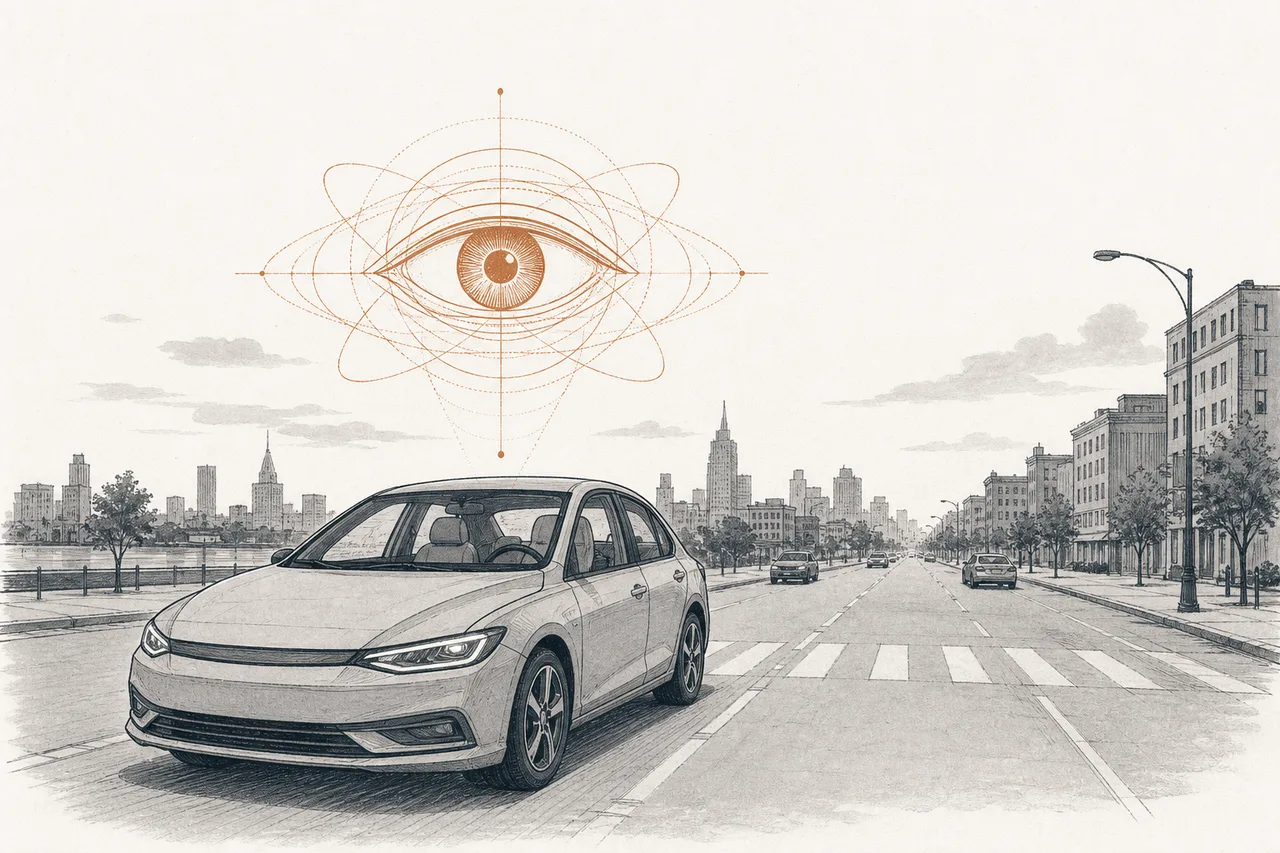
01What it is (and what it isn't)
People mix up 'electric cars' and 'self-driving cars' all the time, but they're actually two different things. An electric Tesla might not drive itself at all, while a self-driving Waymo car runs on a plain Jaguar underneath. This trend isn't about what energy the car runs on — electricity and motors belong to the Electrification & Mobility trend. This trend is about one thing only: 'who's driving' — and the new answer is, nobody.
To put it plainly, this node is about autonomy (the ability to drive itself with no human) — a car that senses its surroundings, makes decisions, and works the steering, brakes and accelerator on its own. On the megatrend map it's a sub-theme under Robotics & Physical AI, because the essence of a self-driving car is a robot — a machine with a body that sees the world and moves through it on its own. Its body just happens to be a car.
The field splits 'self-driving' into 6 levels (L0–L5) · L2 = driver assistance; a human still has to stay in control at all times (like the supervised version of Tesla FSD) · L4 = the car fully drives itself within a defined area and set of conditions, with no one in the car (this is what Waymo already does) · L5 = drives itself anywhere, in any conditions, like a human — no one has reached this yet. This trend is the climb from L2 to L4, done for real and made to pay.
This node has two faces that have to be told together, because they're two battlegrounds of the same autonomy:
- Robotaxi — the driverless city taxi: picking up and dropping off passengers in the city, the hardest battleground (pedestrians, intersections, cyclists, the unexpected). It's still a huge market and the face of the trend
- Autonomous Trucking — driverless trucks/delivery: long-haul freight on the highway and last-mile delivery. The road is straighter and more predictable, so it's easier — and may reach the commercial finish line first. This freight side splits again into two sub-arenas — long-haul trucks on the highway and last-mile delivery robots on the sidewalk — with a truck-driver shortage as an added tailwind
02Why it's the highest-stakes bet
Of all robots, the self-driving car is the one that 'can't get it wrong' the most. A factory robot breaking down just stops the production line; a vacuum robot bumping the sofa hurts no one. But a two-ton car doing 100 km/h, mixed in with millions of people on the road — one wrong decision for even a split second = a human life. That's why it's vastly harder than any other kind of robot, and why enormous money flows in: the prize is just as big.
The size of that prize is the entire industry of moving people and goods. The biggest cost in today's ride-hailing is the 'driver' — take it out, and the cost per trip changes across the board. So analysts value the robotaxi market sky-high, even as the numbers swing wildly with assumptions — Goldman Sachs sees the global market reaching about $415 billion by 2035, while others range from ~$100 billion to over $400 billion. That huge spread is itself the warning: 'no one knows for sure how fast it'll arrive.'
But what made this bet 'real' isn't the market size — it's the safety data. A peer-reviewed Waymo study published in 2025 analyzed 56.7 million miles of driving with no one in the car, and found injury crashes were 70–90% lower than human drivers on the same roads and areas, with car-to-car intersection crashes down 96% — some of the first statistical-level evidence that self-driving cars (at least Waymo's) are safer than real human drivers, not just ad copy.
03How the driving brain works
The heart of a self-driving car is a 'thinking loop' that runs dozens of times a second, split into 4 stages chained like a conveyor belt. A human does all of these unconsciously while driving — the car just has to do it faster and more accurately, without ever getting distracted, drowsy, or reaching for a phone.
The hardest stage is 'predicting the future' (prediction), because it's not just seeing that someone is standing by the road — it's guessing whether that person is about to step out to cross, or is just waiting for a friend. Humans are great at this from instinct and context; the car has to learn it from huge amounts of data. This is where the trend leans directly on artificial intelligence (AI) — an AI model trained on hundreds of millions of miles of driving is what makes the prediction accurate enough to actually put a car on the road.
A self-driving car 'sees the world' through several kinds of sensors · Cameras = see color and detail like a human eye, but struggle to judge distance · Radar = fires radio waves to measure distance and speed, and sees through fog and rain · LiDAR = fires millions of laser points a second to build a 3D map of everything around it — superb at distance, but expensive. This difference in 'which sensors to use' is the spark of the big battle in the next chapter.
04The philosophy battle: Waymo vs Tesla
The two giants leading this trend bet in opposite directions, and that difference is the deepest and most important story in the whole node — because whoever's right decides whether self-driving cars end up 'expensive but safe' or 'cheap and fast to scale.'
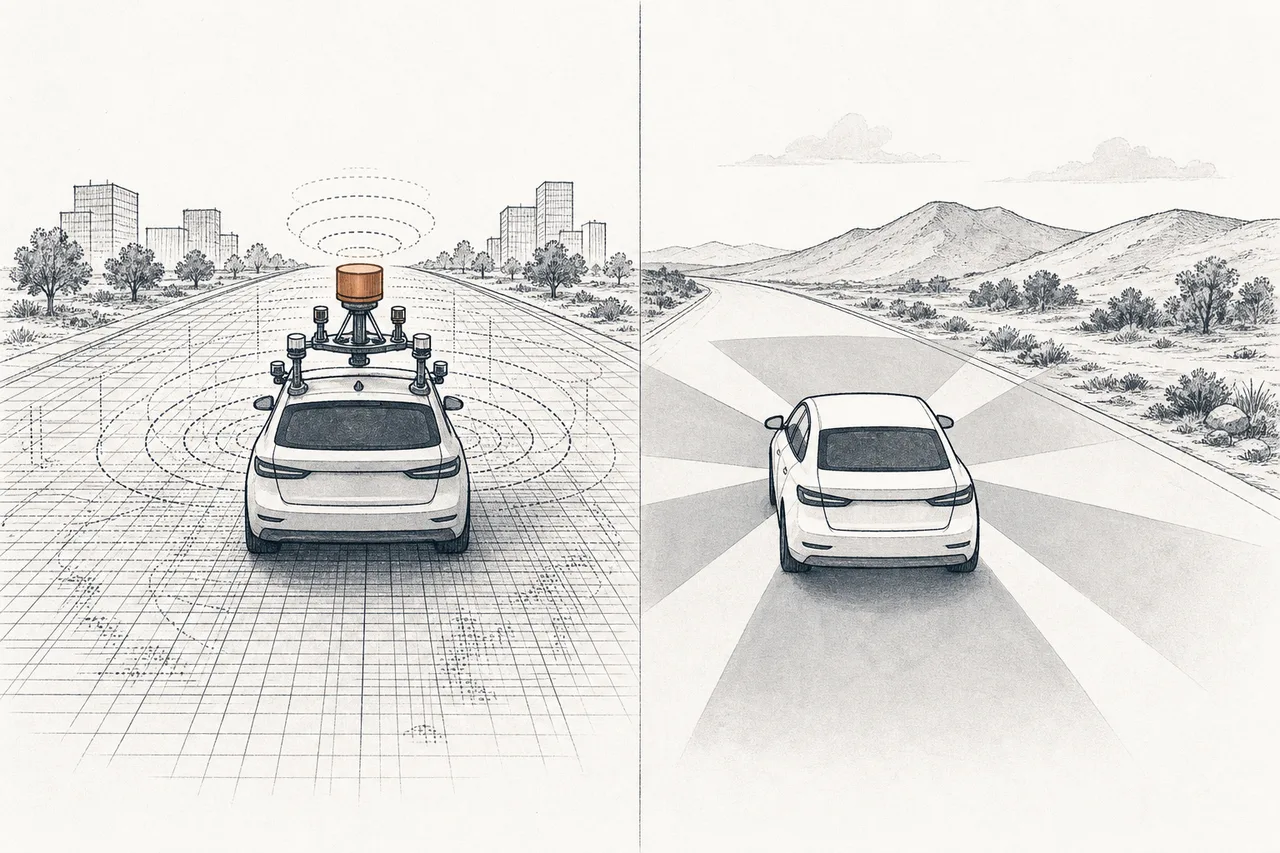
Waymo (part of Alphabet) chose the 'sensors everywhere' path: LiDAR, radar and cameras all around the car, driving only in cities where it has already built a centimeter-level HD map. The idea is 'know as much as possible, be maximally careful, expand one city at a time.' The downsides are that it's expensive, and the need to map first makes city expansion slow. But the result is — it actually works, is genuinely safe, and is already taking real money from passengers (the cost-per-car and operator economics go deeper in the child lesson → robotaxi).
Tesla chose the 'cameras only' (vision-only) path: it drops LiDAR and HD maps, using just 8 cameras around the car plus pure AI. The reasoning is 'a human can drive with two eyes, so a car should be able to drive with cameras.' The enormous advantage is a far lower cost per car, and the millions of Teslas already sold worldwide become a 'data-collection army' for the AI to learn from — if this works, Tesla can scale faster and cheaper than anyone. But that's a big 'if,' because camera-only driving is harder technically, especially judging distance and seeing in low light.
What does the state of play in 2026 tell us? Waymo clearly leads on 'real cars actually running.' Tesla is catching up fast — from early on, when safety operators still rode in the car, to June 2026, when it expanded to cover the whole Austin metro with no in-car monitor (unsupervised) — fast and cheap on hardware, though it still has to prove safety at scale (the rollout timeline and the details of removing the monitor go deeper in the child lesson → robotaxi).
05How it connects in the world of robots
Self-driving cars are the 'flagship sub-field' of Robotics & Physical AI — the robot that has stepped out of the factory and into the real world most fully. And it's woven deeply into other trends:
- Leans on AI as its brain: the power to 'predict the future' and decide comes from AI models trained on hundreds of millions of miles of driving — no AI, no driver
- A sibling of Robotics AI & Embodiment: 'a brain that controls a body to move through the real world' is the same problem as a humanoid robot. Lessons from self-driving cars flow to other robots, and back
- Uses the same hardware as the new-era cars from Electrification & Mobility: most self-driving cars are electric (electric motors can be controlled by software more precisely than an engine). The two trends complement each other but are different layers: that one is 'what the car runs on,' this one is 'who drives'
- Eats semiconductors by the ton: processing images and running AI in real time inside the car takes high-powered chips — every car is a computer on wheels
06Where it stands now
The reality of 2025–2026 has two faces in one sentence: 'It's really happening — but it's harder and more expensive than everyone thought.'
The first face is Waymo becoming the real thing. Paying trips jumped from about 10,000 a week across 10 cities to over 500,000 a week (March 2026) — up dozens of times in under two years. It's aiming for 1 million trips a week by the end of 2026, expanding from Phoenix/San Francisco to several more Sun Belt cities and preparing to test as far away as Tokyo and London.
The second face is Cruise collapsing. After GM poured over $10 billion into it, it decided to shut down its robotaxi business in late 2024. The trigger was a Cruise car dragging a pedestrian — who had been hit by another car — more than 6 meters under its body in San Francisco (October 2023), followed by incomplete reporting to regulators, until its license was suspended and the game was over — the most expensive lesson of this trend: 'enormous money doesn't guarantee success, and a single safety/trust failure can end it.'
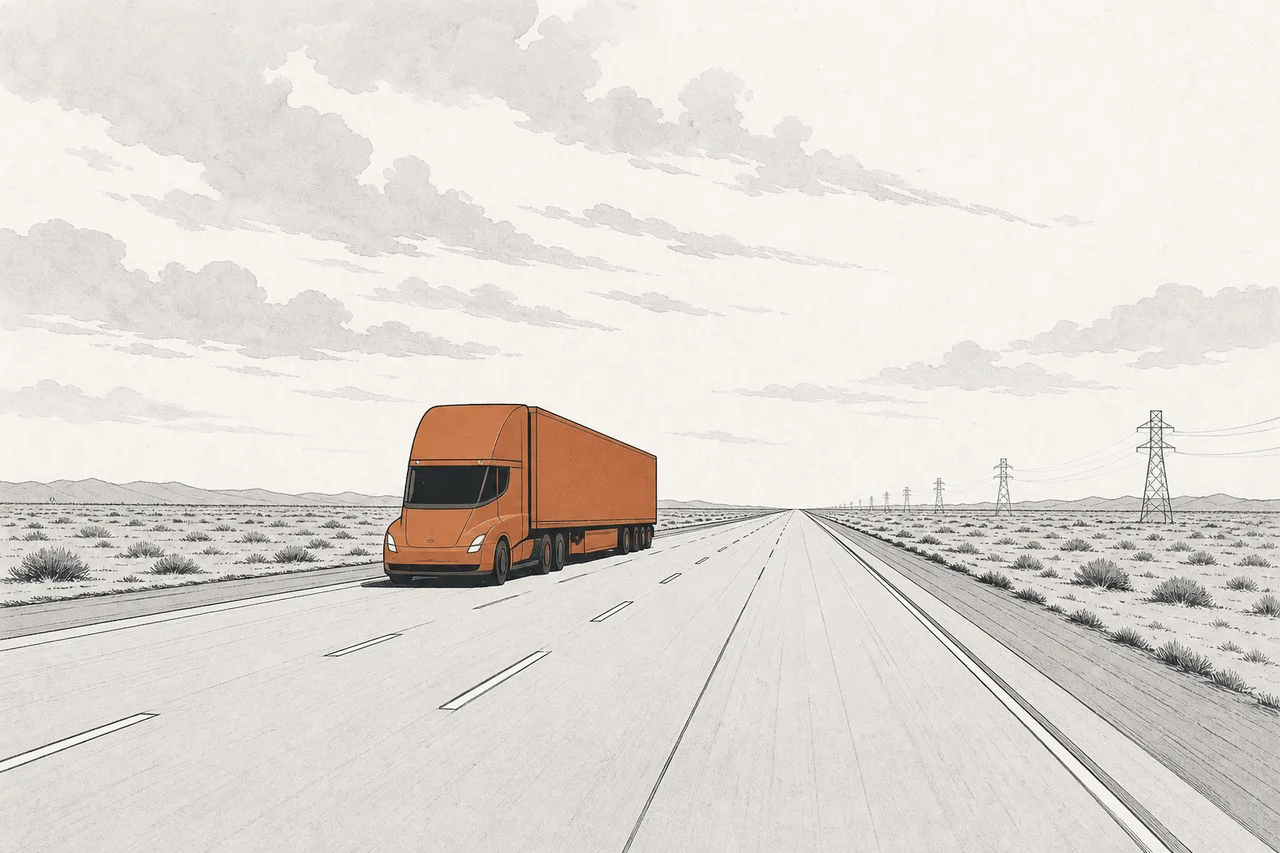
And the driverless truck arena is quietly gaining steam too. Aurora launched commercial freight with driverless heavy trucks on the Dallas–Houston route in May 2025 (a world first), expanding to 10 routes across Texas–New Mexico–Arizona, racking up over 250,000 accident-free driverless miles and targeting 200+ driverless trucks by the end of 2026 — reinforcing that straight, predictable highways may be the gate where autonomy makes money before city streets.
And don't overlook China — Baidu's Apollo Go has racked up over 17 million fully driverless trips across 22 cities, with Wuhan as its biggest base (over 1,000 driverless cars). But China just got a real lesson too, when more than 100 Apollo Go cars stalled in the street at once due to a 'system failure' in Wuhan (April 2026) — a reminder that even at large scale, the tech is still fragile.
07The road ahead
The first direction is the 'one city at a time' race. Self-driving cars don't flip a switch and work nationwide — they have to prove themselves city by city, build maps, and adapt to local road conditions and laws. So over the next 3–5 years, we'll see robotaxis as 'pockets' in the cities that have opened, not a blanket rollout all at once — and the number of cities actually opened per year is the best gauge of progress.
The second direction is trucks may reach the finish line first, because highways are a 'narrow and repetitive' problem — no pedestrians, no chaotic intersections, the same routes over and over. That makes autonomy easier to monetize on the highway than in the city. Aurora already running commercially is a signal that 'moving goods' may become autonomy's first killer app, before 'moving people.'
The third direction is the cost war. The key to profit isn't just 'being able to drive itself' but 'driving itself at a price that pays.' LiDAR, once tens of thousands of dollars, has now dropped to around $1,000 a set and keeps falling every year, while Tesla bets cameras-only is cheaper from the start. Whoever gets 'cost per mile' below a human driver's wage — for real, and broadly enough — wins.
08Challenges & risks
Self-driving is a trend that's 'close to the finish line, but the line keeps moving,' because its risks are baked into the nature of carrying human lives.
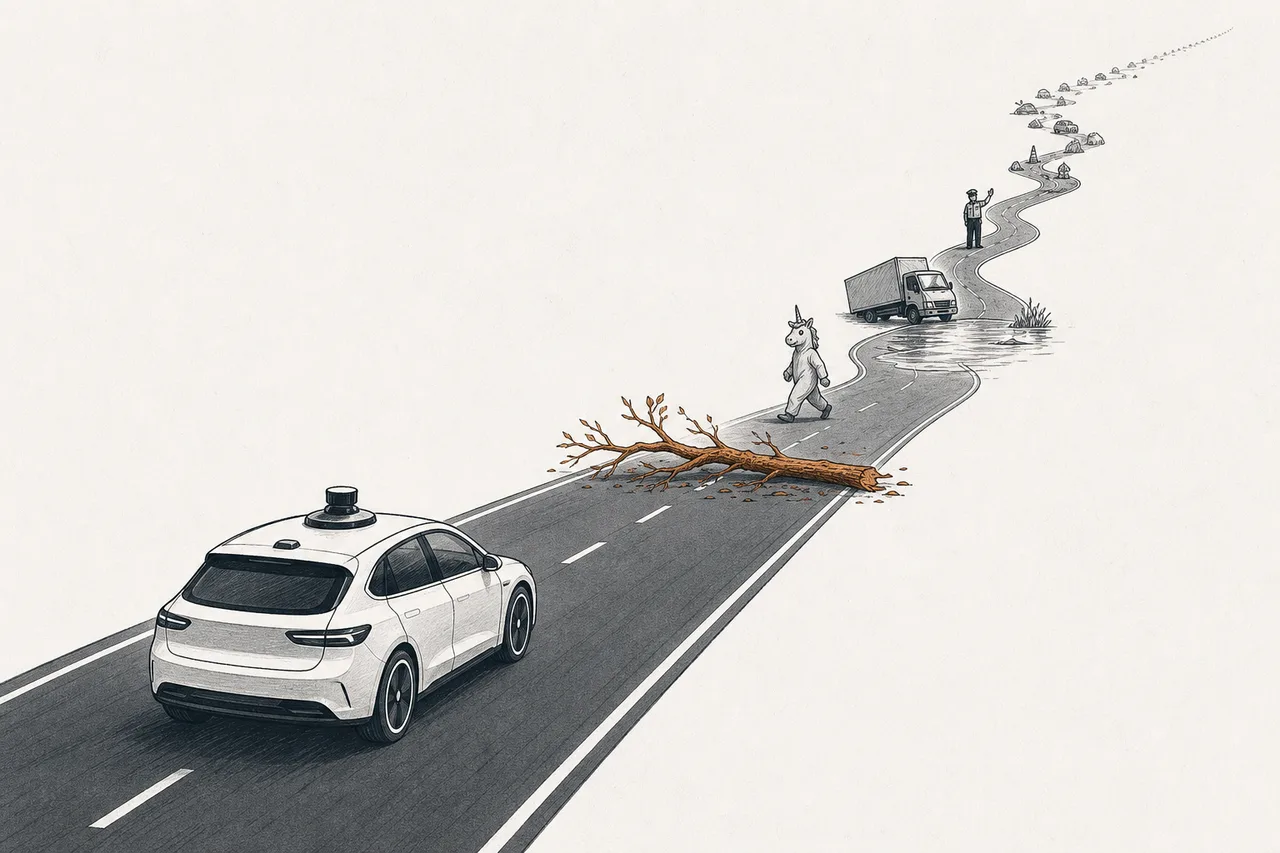
The first risk is 'the long tail of weird events' (long-tail edge cases). The car handles the 99% of routine driving with ease, but the last 1% — a child darting out, something falling on the road, a police officer waving against the signal, a flooded street, someone in an unusual outfit — is what happens rarely but endlessly, and slipping up even once makes front-page news. Climbing from 'almost good' to 'good enough to trust' across this 1% is what eats enormous time and money.
The second risk is law, trust, and liability. If a self-driving car hits someone — who's at fault? The software company, the car's owner, or the manufacturer? The legal framework for this is still unsettled in almost every country. And as Cruise taught, public trust is very fragile — one high-profile crash plus poor handling, and regulators can order the whole company to stop.
The third risk is unit economics that still isn't fully proven. A car costing $150,000+, plus mapping, a remote-monitoring team, and insurance — it has to drive a lot and for a long time to pay off. Cruise is proof you can burn tens of billions without reaching break-even. The unanswered question is when robotaxis 'actually turn a profit at scale,' not just 'can drive.'
In short: self-driving is the story of trying to remove the 'driver' from the equation — the hardest, highest-stakes test in robotics. 2025–2026 proved it's genuinely possible (Waymo runs for real, earns for real, safer than humans for real) but also genuinely hard and expensive (Cruise collapsed, Apollo Go stalled en masse, Tesla still proving itself). Understanding this node means understanding why 'the first robot you'll sit inside' has come this far — and why the last step is the hardest.