Megatrend · Energy
If the grid can't connect you for 5 years, just build your own power plant next to the building
AI companies need enormous power "right now," but applying to connect to the public grid means waiting in a queue that averages 5–7 years. The fix turning the industry upside down: stop waiting in line and install the power-generating machines right on site — gas turbines, combustion engines, and fuel cells — then feed power straight into the data center "behind the meter," without going through the utility. This is the new arena called "speed-to-power" — whoever finds power fastest wins. And in 2025 alone, more than 50 gigawatts of these projects were announced.
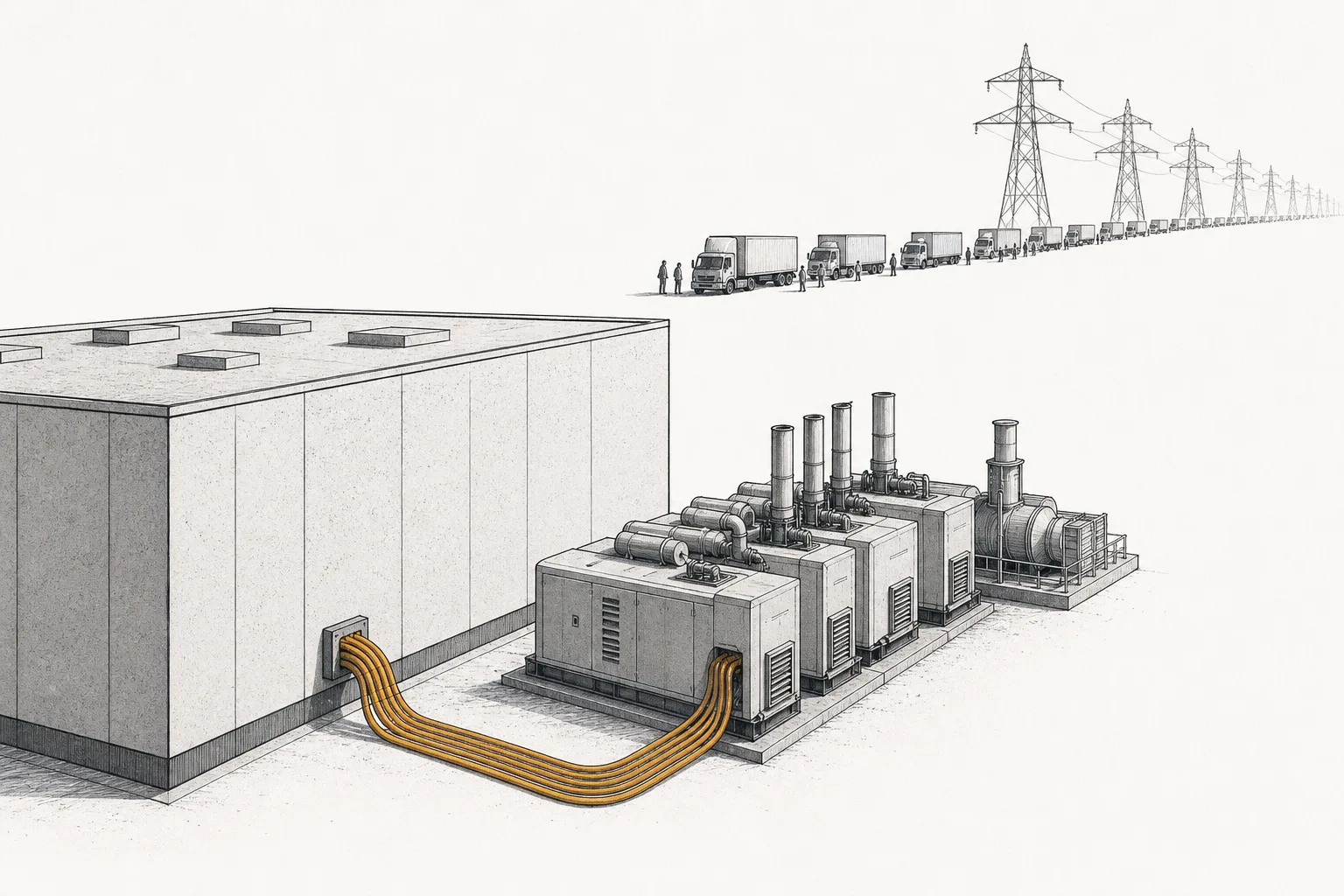
01What it is — generate power on site, skip the grid queue
Normally, when you switch on a light at home, the power comes from a power plant far away, travels hundreds of kilometers over transmission lines, through the utility's meter, and finally reaches the outlet. The whole world has run on this system for over a century — until AI arrived and broke it.
The problem: a large AI data center eats power on the scale of hundreds of megawatts per site (as much as a whole mid-sized city), and to "plug in" a load that size to the public grid, you have to get permits and wait in a queue for years. This node is the energy engineers' answer to that problem. In short: if you can't connect to the grid in time, just build your own power plant next to the data center, and run power straight into the servers without passing through the utility meter.
The phrase "behind-the-meter" comes from exactly this — power is generated and used on the customer's "behind-the-meter" side, never flowing through the utility's meter. "On-site power" means the same thing — the power plant sits on the same plot of land as the data center. Some projects even go fully off-grid, running purely on their own power with the grid only as backup.
On the megatrend map, this node is a leaf at the tip of Firm Power & Transition Fuels, under the big trend Energy Transition & Power Demand. It sits in the "infrastructure layer" — meaning it's a new way to deliver power. Its sibling right next door is the Natural Gas Value Chain — if that node tells the story of "who produces gas and ships it down the pipe," this node tells the story of "how to turn that gas (or another fuel) into power on site, as fast as possible."
Behind-the-meter = generate and use power on site, without passing through the utility meter · Speed-to-power = the industry's new yardstick — it measures how fast "power is actually usable," not just how cheap it is · Bridge-to-grid = use the on-site power plant as "temporary power" first, then switch over to the grid once the transmission line is finished years down the road
02Why it matters — the "speed-to-power" war
The heart of this story is a mismatch between two timelines — one finishes fast, the other very slow.
A single data center can be built in just 18–24 months, but applying to connect a large load to the public grid in the U.S. now means an average queue of 3–7 years — and in many markets the queue is shockingly long. In Q1 2026, the Texas power market (ERCOT) took in 198 gigawatts of large-load connection requests in a single quarter, about as much as the entire state's current peak load. The queue is completely jammed.
When the building finishes in 2 years but grid power arrives in year 6, that gap means one thing — billions of dollars of GPUs sit dark for years, waiting for power. In an AI race where every month counts, that's unacceptable. So "speed-to-power" emerged as a new arena: whoever can get power running fastest wins.
The number that tells the whole trend: in 2025 alone, behind-the-meter gas power projects totaling about 50 gigawatts were announced (and across all fuels, over 92% of identifiable behind-the-meter projects were announced after early 2025). From what used to be just a "backup generator for outages," on-site power has become the core strategy for building AI data centers in this era.
And this isn't just a temporary shortcut. McKinsey's forecast estimates that about 25–33% of new electricity demand from data centers through 2030 will be met with behind-the-meter power — roughly 33 gigawatts of on-site capacity to be installed over the next five years. So this node isn't a temporary toy, but a new permanent structure of the power industry.
03How it works (from grid queue to on-site power)
The easiest way to understand this node is to compare the "old path" and the "new path" of getting power to a data center. Look at the diagram below.
The new path has three steps: (1) bring fuel to the site — mostly natural gas piped in from the gas value chain · (2) convert the fuel into power with machines installed on the same land · (3) run the power line straight into the data center, with the grid (if any) kept as backup for when the on-site machines have to stop for maintenance.
What makes the whole system "fast" is that it cuts out the two most time-consuming things: waiting in the grid queue and building new high-voltage transmission lines — both of which require years of permitting and impact studies. Meanwhile, the on-site power machines can be "bought and installed right away" on land the customer already owns.
04The technology menu — turbines, engines, fuel cells
"On-site power" isn't one machine but three main options on a menu, which customers pick based on "how fast," "how clean," and "is it available" — and right now the later options are gaining ground because the first one is in short supply.
1) Gas turbine — the big workhorse
The original and highest-output machine, but it's become a bottleneck — large-frame gas turbines are booked out through 2028. It's exactly this long queue that pushes customers toward other options they can get faster.
2) Reciprocating gas engine — the rising option
These are giant piston engines that burn gas to generate power — like a car engine, but the size of a shipping container. Their advantage is they can be mass-produced and ganged together as small units. When the big turbines ran short, data centers pivoted to these engines instead. A clear example is the 4-gigawatt project in Utah using Caterpillar G3520K engines (~2.5 megawatts each) wired together by the thousands, with the first gigawatt starting to deliver power in 2026.
3) Fuel cell — power from a chemical reaction, no combustion
This is the game-changing rising star. Solid-oxide (SOFC) fuel cells turn natural gas into power through an electrochemical reaction, not combustion. As a result, they have three advantages combustion machines don't:
- Very fast: makers like Bloom Energy say they can deliver and run 100 megawatts of power in just 90 days
- More economical: about 15–20% more efficient than an open-cycle turbine — for a mid-sized data center (~175 megawatts), that translates to $70–100 million in fuel savings over five years
- Skips the permitting gauntlet: because there's no combustion, it emits almost no NOx → it's often exempt from the air-quality permits that bog down combustion projects
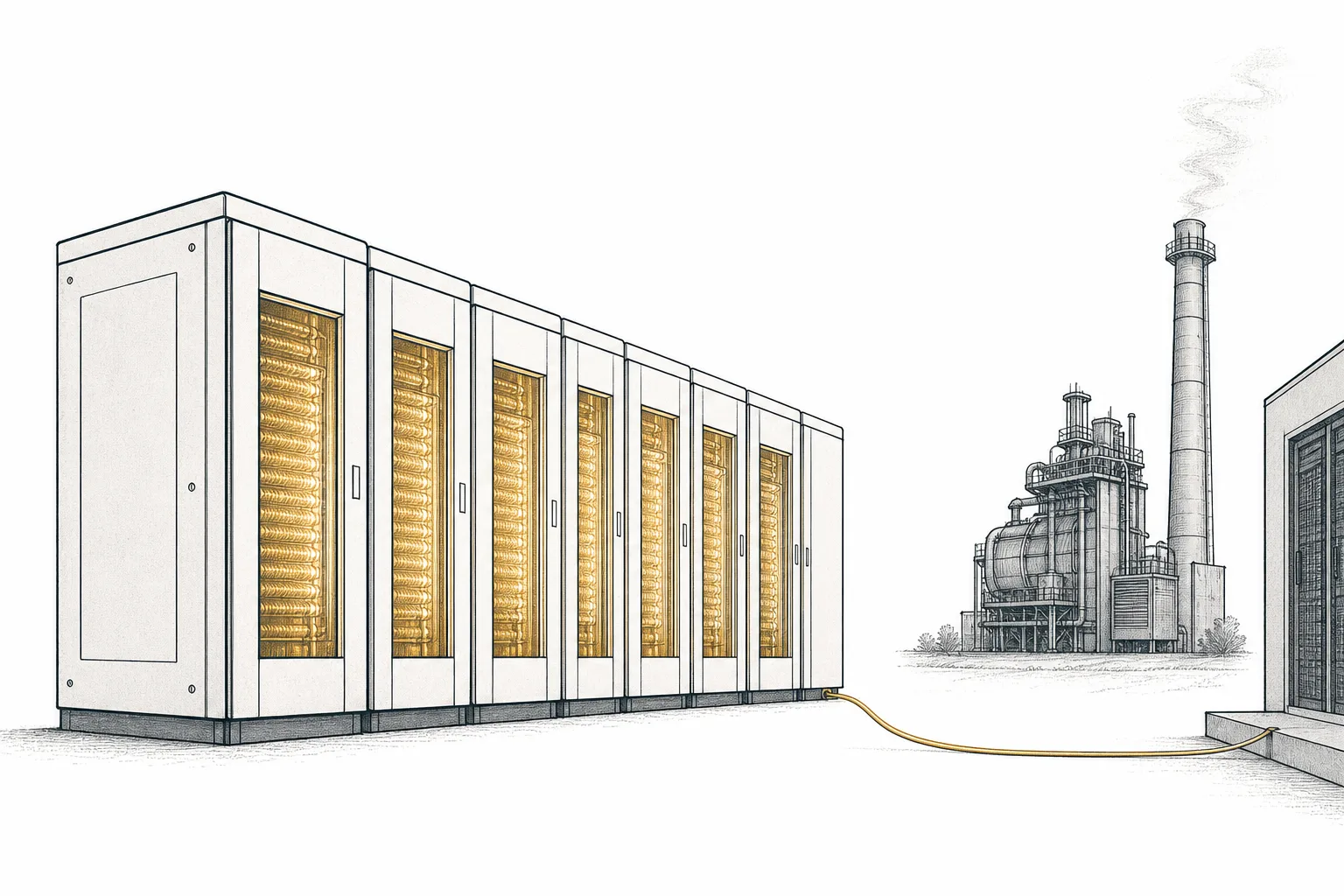
Microgrid = a small, self-contained power system — generation source, controller, and load all in one loop, able to disconnect from the big grid · SOFC (Solid-Oxide Fuel Cell) = a high-temperature fuel cell that turns gas into power chemically, without combustion · Prime power = using on-site power machines as the "main power," running all the time (unlike backup, which only kicks in during outages) — this is a big shift in the role of a generator
05Where it sits in the ecosystem
This node is a crossroads of several trends — it's "pulled" by AI demand and "fed" by fuels from the energy trends. Let's see who it connects to.
- Born from AI Power & Cooling: the enormous "need-it-now" power demand of training AI models is the only reason on-site power jumped from "backup" to "core strategy." Without AI's hunger for power, this node wouldn't exist
- Supplies power to Colocation & Data-Center REITs: the building owners who lease out data-center space use "power ready to deliver" as a selling point — a site with on-site power ready beats a site that has to wait for the grid, becoming a more valuable asset
- Uses gas from the Natural Gas Value Chain: almost all on-site machines run mainly on natural gas, so rising on-site power demand tightens gas and pipeline demand right alongside it
- Competes with and complements Grid & Transmission: on-site power exists because the grid can't connect fast enough — but in the bridge-to-grid model it's the "in the meantime" power that gets replaced by the grid once the line is built, making it both rival and complement to the grid at once
- Paves the way to Hydrogen & Fuel Cells: many new fuel cells and engines are designed to blend in or switch to hydrogen in the future — a card to play against the carbon question of the infrastructure being built today
06Where things stand now + who the players are (2025–2026)
The 2025–2026 picture in one word: big deals exploding — gigawatt-scale on-site power deals are being signed one after another, and the brightest star is fuel cells.
Bloom Energy has become the hottest name in this trend — in April 2026, the company signed a deal with Oracle to supply up to 2.8 gigawatts of SOFC fuel cells to U.S. data centers, and earlier, in January 2026, it signed a 20-year, $2.65 billion deal with American Electric Power (AEP) for up to 1 gigawatt of capacity (the first 100 megawatts feeding the data center of a customer like AWS in Ohio) — Bloom is racing to expand capacity to 2 gigawatts a year by the end of 2026 to meet these deals.
The combustion side is just as busy. Caterpillar reported that its Power & Energy backlog grew so much that the production line is sold out through 2027 — orders placed in Q1 2026 won't arrive until 2028, even though the company just opened a new factory in early 2026 to double capacity. Meanwhile Cummins is a key supplier of gas engines for data-center microgrids in Texas, and GE Vernova has sold dozens of aeroderivative turbines specifically to data-center developers.
07Future & risks
The first direction is on-site power becoming the standard, not the emergency exit. As engines and fuel cells get easier to obtain and colocation rules become clearer, "building your own power plant" will become the normal way to build a large data center. In February 2026, PJM (which manages the grid in the eastern U.S.) proposed rule changes to accommodate placing power plants next to data centers — a sign that regulators are starting to accept this as a permanent structure.
The second direction is the bridge-to-grid model and hybrid microgrids. Many projects start with on-site gas/fuel-cell power as "bridge power," then add batteries and solar and connect to the grid later, growing into a flexible microgrid — and in the long run, machines designed to handle hydrogen open a path to making on-site power "cleaner" without tearing it down.
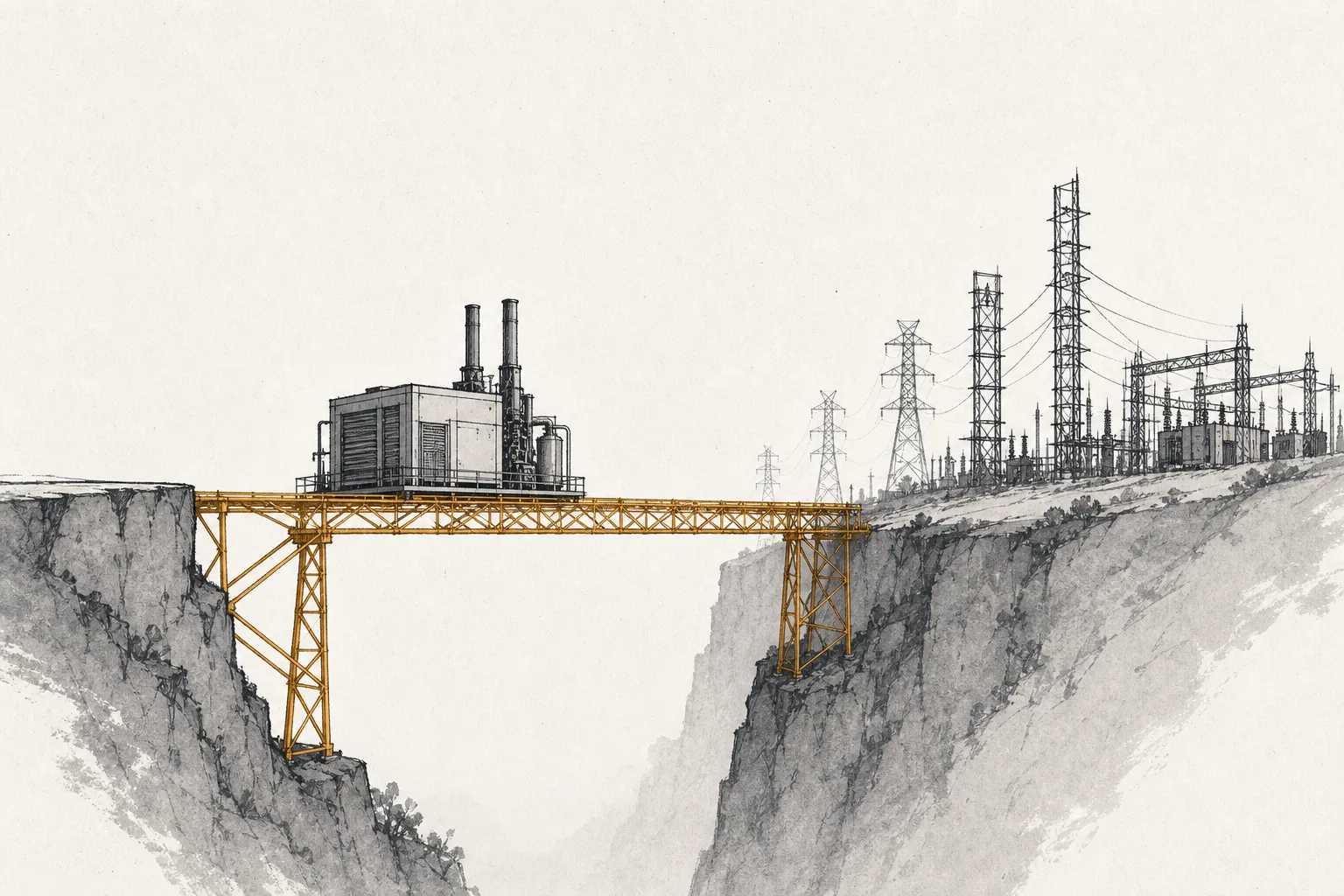
But this path has three risks worth stating plainly:
Risk one — carbon and permits. On-site gas plants are carbon-emitting fossil fuel, and pushback is starting. In January 2026, the EPA closed a loophole that used to let you install gas turbines without a full air-quality permit — now you need a permit under the Clean Air Act first. While some Texas projects are permitted to emit tens of millions of tons of greenhouse gas a year, community opposition has started to block/delay projects worth about $98 billion in 2025. Combustion machines thus risk getting drawn out in permitting — one of the advantages of non-combusting fuel cells.
Risk two — fuel and shortages. The whole system relies on natural gas. If gas prices swing or local pipelines tighten, the cost of generating power rises too. And the power machines themselves are now "in short supply" — turbines and engines have queues stretching to 2027–2028, so even if you want to build your own power, you still have to wait for the machines.
Risk three — when does the grid catch up. On-site power exists because the grid is slow. If one day transmission lines and connection queues are truly reformed and sped up (FERC is drafting a nationwide standard rule for large-load connections), the speed-based rationale for on-site power weakens — power plants built to "skip the queue" could become underused assets once the grid catches up.
In short: this node is the industry's answer to the problem of "AI needs power right now, but the grid can't connect it for years" — the answer is to stop waiting and build your own power plant next to the building. It's quietly but deeply changing how the world makes and delivers power — and the question that will decide its future is whether it stays just a "temporary bridge" while waiting for the grid, or becomes a new, permanent way to deliver power.