Megatrend · Energy
AI is starving for power right now — and gas is the fuel that "shows up today"
Nuclear is clean but takes 7–12 years to build · new grid lines are stuck in multi-year bottlenecks · but AI data centers need 24-hour power "today," not next decade. The fastest, most scalable, and most reliably dispatchable answer right now is natural gas — and it arrives as a whole chain: from the wells of EQT/Expand Energy, through the pipelines of Williams/Kinder Morgan, ending at the gas turbines of GE Vernova, whose order backlog has hit 100 gigawatts and stretches past 2030. This lesson walks the entire conveyor belt — how gas became the "electricity bridge" of the AI era, and whether it's a bridge or a carbon trap.
01What it is — the entire natural-gas chain
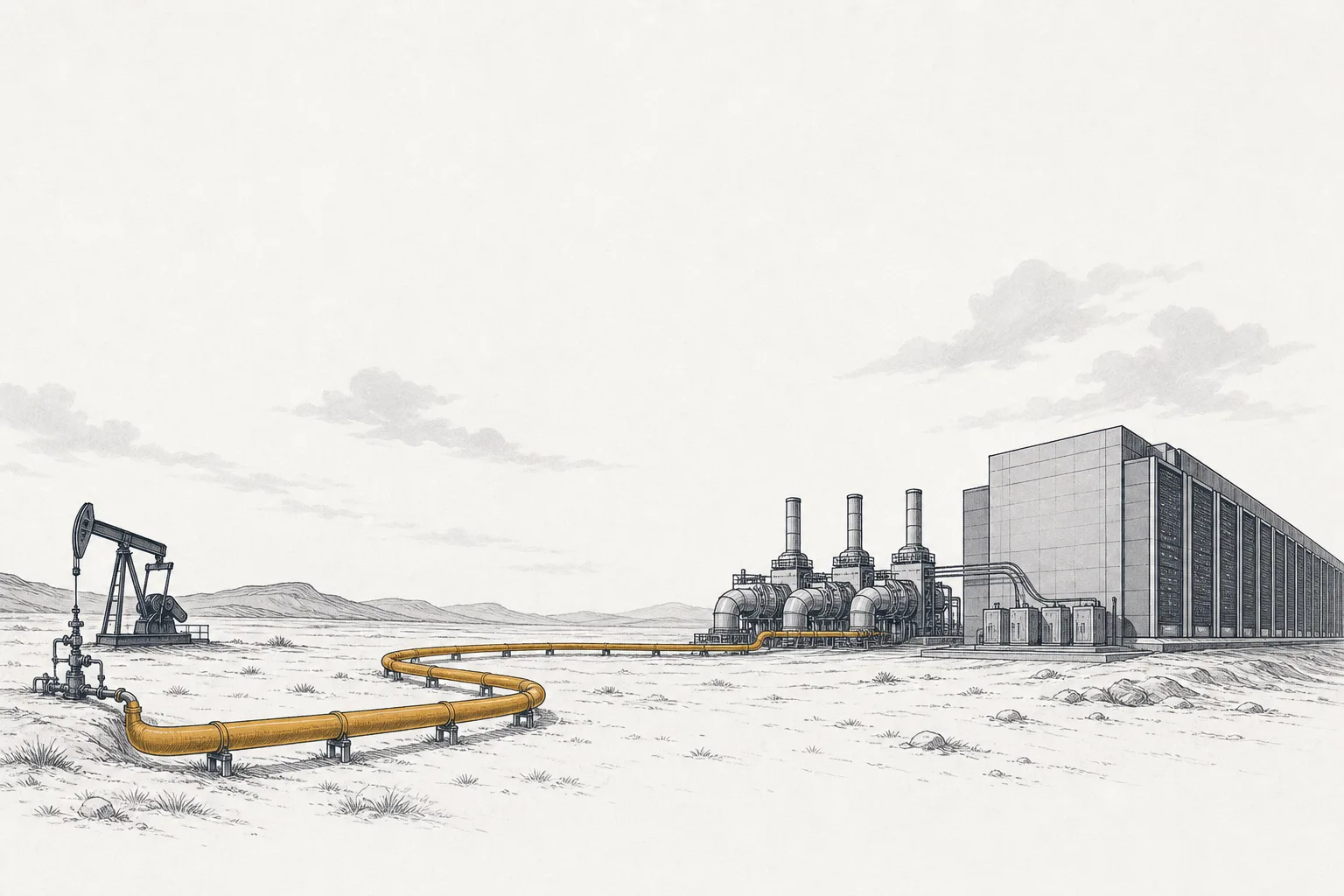
When people say "natural gas," most picture just a fuel you burn for heat. But from an investment and energy angle, it's one long conveyor belt with many businesses linked end to end — and this node is about that whole belt, from gas still underground to electricity flowing into the servers.
This chain breaks into three big segments: (1) Upstream (E&P) is the people who drill gas up from underground (like the Marcellus shale basin in Pennsylvania) · (2) Midstream is the network of pipelines, gas-processing plants, and storage that moves gas from the well to the destination · (3) Downstream (power & export) is the gas turbines that burn gas into electricity, plus the LNG plants that chill gas into a liquid to ship across oceans and sell abroad.
On the megatrend map, this node is a leaf under Firm Power & Transition Fuels, inside the big trend Energy Transition & Power Demand. It focuses on "gas as dispatchable power" — drill, ship, burn, export. Its sibling next door is Behind-the-Meter & On-site Power, which tells another angle: customers building their own power plant beside the facility. This lesson stays mainly on the gas chain.
Upstream (E&P) = explore and drill gas up (Exploration & Production) · Midstream = pipelines, processing, and storage that carry gas from the well to users, usually charging a "toll-road" fee for passage, so revenue is fairly steady and not tightly tied to gas prices · Downstream = actually using the gas — burning it into power in a turbine, or turning it into LNG for export.
02Why it matters — because gas "shows up today"
The heart of this comes down to one word: speed. AI data centers need enormous amounts of power and they need it "now," not next decade — and among dispatchable sources (firm power), gas is the one that finishes building fastest.
Compare them head-on: a combined-cycle gas plant can be finished in about 3 years, while a new nuclear plant takes 7–12 years, and connecting to the public grid sits in a multi-year queue. For tech companies racing to open AI centers ahead of rivals, this kind of speed is everything — which is why gas, which sounds "old-fashioned," became the star of the energy world in 2025–2026.
Gas's size in the power system is also market-dominating — natural gas made up about 40% of all U.S. electricity in 2025–2026 (hitting a peak of 42% in 2024), more than coal, nuclear, or any single renewable. And within data centers specifically, gas is the number-one power source at about 40% of the power used (2024).
And this demand is no small matter. Data centers are expected to pull about 130 gigawatts, or nearly 12% of all U.S. electricity, by 2030 — a huge block of load that runs 24 hours a day, never pausing for sun or wind. What can feed a load like this most reliably and on time loops right back to gas again.
03How it works (from the well to the data center)
The best way to understand this node is to follow a single molecule of gas from underground until it becomes power flowing into the AI servers. Let's walk it one station at a time.
What keeps this whole belt "tight" is station 3 — the gas turbine, because power-plant-scale turbines can only be made by a handful of companies in the world, and demand is surging far faster than capacity. The result is a "shortage" that spreads through the whole chain — you can drill plenty of gas and ship it through pipes, but without a turbine to burn it, you can't turn it into power.
Gas turbines themselves come in two main types: heavy-duty turbines (heavy-duty / combined-cycle) that are big, the most fuel-efficient, and used as the main power plant; and aeroderivative turbines, adapted from jet aircraft engines — smaller, faster to start, quick to install, and well-suited to sitting right beside a data center (this is the bridge over to the behind-the-meter power story).
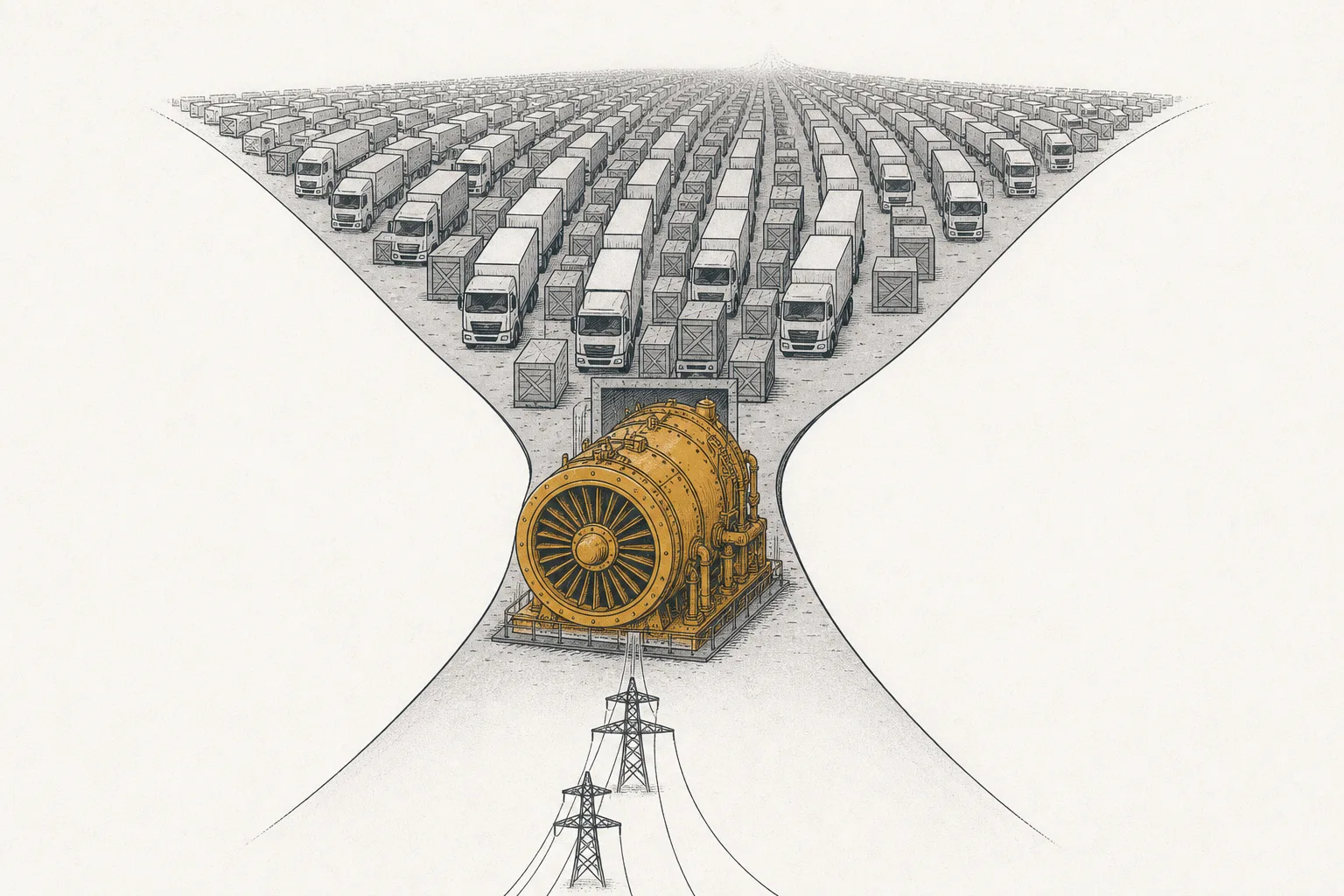
Bcf/d (billion cubic feet per day) = a unit for measuring gas volume, "billions of cubic feet per day" — big U.S. producers drill around 6–7 Bcf/d · LNG (Liquefied Natural Gas) = gas chilled until it becomes a liquid, shrinking ~600× in volume so it can be loaded onto ships and carried across oceans · Combined-cycle = a gas-turbine plant that takes the waste heat to boil water and spin a steam turbine a second time, getting the highest efficiency — the workhorse of base-load plants.
04Where it sits in the energy ecosystem
The gas chain doesn't work alone. It's the "reliability that arrives fast" piece in the big jigsaw of Energy Transition & Power Demand, and it's tangled inseparably with its neighbors:
- Always paired with Grid & Power Equipment: the power a turbine makes is useless without "transmission lines" to carry it to users — and because the queue to connect new lines runs for years, that's exactly what pushes some data centers to make their own power. Gas and the grid are both each other's partner and each other's bottleneck
- Directly feeds AI Power & Cooling: this is the real customer that lit the whole trend — power demand from AI data centers is the main reason gas came back as a star in 2025–2026
- Competes with and complements nuclear: nuclear is also "dispatchable power," clean and running 24/7. Many data-center deals have booked nuclear — but new nuclear takes 7–12 years to build, so in the short term gas wins on speed
- Different from its sibling behind-the-meter power (on-site): this node is the "public gas chain" — drill, pipe, burn in big plants, feed the grid. On-site is the same chunk of gas but burned in a small turbine right beside the data center, bypassing the grid. Both sides pull gas from the same conveyor belt
05Where it stands now
The picture of 2025–2026 sums up the same one word across the whole chain: shortage. And the tightest bottleneck is at the gas turbine.
Market leader GE Vernova closed Q1 2026 with a gas-turbine backlog hitting 100 gigawatts (up 17 GW from end of 2025), aiming to break 110 GW by the end of 2026, with about 20% of the backlog tied directly to data-center deals. Q1 orders jumped 71% year-over-year — and a turbine ordered new now won't arrive until late 2028 at the earliest. The company is racing to expand capacity from roughly 50 to 80 heavy-duty turbine units per year.
The same story is happening to everyone. The world's large-turbine market is held by just three companies — GE Vernova, Siemens Energy, and Mitsubishi Power — together over 75% of projects under construction. Siemens Energy has a record order book of €154 billion, with 60 GW of gas turbines firmly booked plus another 27 GW queued; new customers have to wait ~4 years. And Mitsubishi Power says flatly that turbines ordered now will be delivered in 2028–2030. Overall, gas-turbine wait times have stretched to 5–7 years on some models.
Moving upstream in the chain, the gas drillers are just as busy. Expand Energy (born from merging with Chesapeake) has risen to the largest U.S. gas producer at about 7.2 Bcf/d, while EQT follows close behind at about 6.2 Bcf/d and is signing deals to supply gas specifically to plants that power AI data centers — like an agreement to supply nearly 1.5 Bcf/d to two gas plants in Pennsylvania that will feed AI data centers.
In the midstream segment, the pipelines once seen as "boring" have turned hot. Energy Transfer began supplying gas to Oracle's data centers in January 2026 under a combined deal of about 900 MMcf/d to three data centers, while Williams poured $3.1 billion into two projects powering data centers, and Kinder Morgan expects power demand from gas to grow by another roughly 3 Bcf/d by 2030.
06The road ahead — LNG and gas-for-AI deals
The first direction is a long-tailed "shortage" cycle. All three turbine makers have announced 25–35% annual capacity expansion starting in 2026, but even if they hit plan, combined capacity still can't keep up with demand — meaning long backlogs and high turbine prices are likely to stay with us for years. Good news for makers' margins, but a heavy problem for data centers scrambling for supply.
The second direction is the LNG wave, the downstream of the chain. U.S. LNG exports are expected to climb to about 17.0 Bcf/d in 2026 (from a record 15.1 Bcf/d in 2025), and the EIA projects total gas exports to grow nearly 30% by 2027 as new LNG plants come online one after another — the more you export, the tighter domestic gas gets, pushing prices up and putting two-way demand on the whole chain at once: domestic power + overseas exports.
The third direction is gas-for-AI deals becoming the normal pattern, from being the exception. Upstream gas producers signing long-term contracts to supply plants that power data centers directly (like the EQT–Pennsylvania and Energy Transfer–Oracle deals) is becoming a permanent structure — and some deals are starting to fold in carbon capture (CCS) too, like the 400 MW gas plant with CCS that Google signed a power-purchase agreement for, an effort to make "gas for AI" look cleaner in the eyes of investors and regulators.
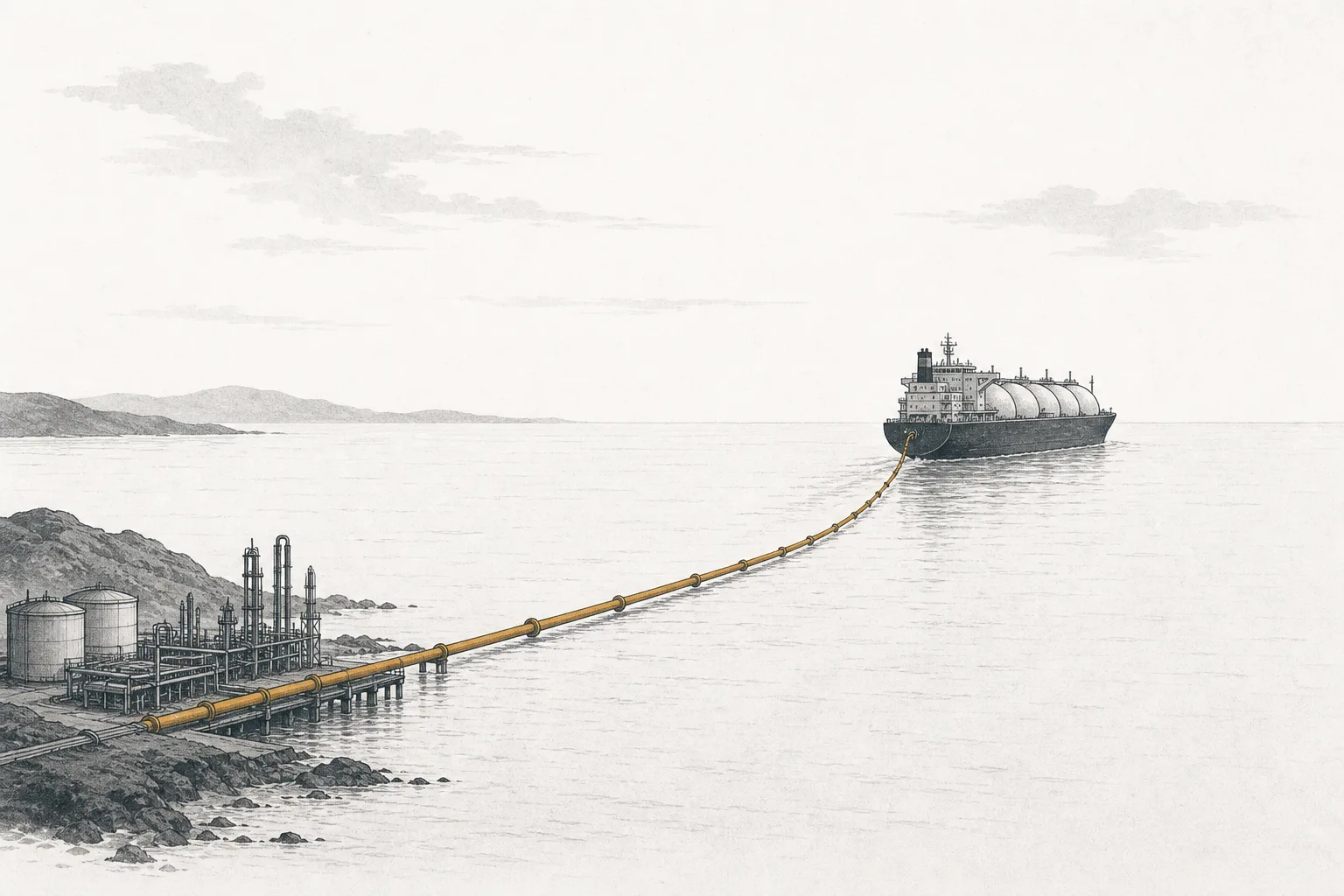
Putting the three directions together, the future picture is a gas chain whose demand is held up by two pillars at once — domestic AI power and LNG exports — both of which are structural trends that won't fade easily. So the big question isn't "is there demand" but "who controls the bottleneck," and "how long will the world accept this chunk of carbon."
07Challenges & risks
The appeal of a "bridge fuel that arrives fast" comes paired with deeply embedded risks, and they have to be spoken about straight.
The first risk is "bridge" or "carbon trap"? Gas infrastructure — wells, pipes, plants, LNG facilities — has a 30–50 year lifespan. Everything built today is carbon locked in for decades to come, what's called "carbon lock-in." Instead of a short bridge to clean energy, gas could become a path that drags us tied to fossils longer than we should. On top of that, gas has a methane-leak problem during drilling and transport, a potent greenhouse gas that shrinks its "cleaner than coal" advantage when you count the whole life cycle.
Carbon lock-in = once you invest in a huge chunk of fossil infrastructure, the economic system gets "stuck" with it for a long time, because the money already spent is too painful to waste · Stranded asset = the opposite risk — if the world shifts to clean energy faster than expected, freshly built gas plants and pipes could be forced to shut before they pay back, becoming enormous sunk capital — two exactly opposing risks.
The second risk is gas prices and the in-chain competition. The profit of the whole belt is tied to volatile gas prices, and the two demand pillars (domestic power + LNG export) compete for the same chunk of gas — if LNG exports rise so much that domestic gas gets expensive, the cost of making power for data centers rises too, becoming a pressure on both power producers and AI customers.
The third risk is a turbine bottleneck that runs too long + long-term competitors. A 5–7 year turbine wait could push some gas-plant projects to be canceled mid-way (developers can't wait). And in the long run, if battery storage gets cheap enough to "store sun and wind" for nighttime use economically, or new-generation nuclear can be built faster, the need for gas to fill the gap will fade — these are the real competitors of "dispatchable power."
In short: the natural-gas chain is a conveyor belt woken up from end to end all at once, because AI suddenly got starving for power, and gas is the answer that "shows up today" — you can drill plenty, ship it by pipe, burn it into 24-hour power, and build it far faster than nuclear. It's an indispensable "bridge" for today — but whether it's a bridge that actually carries us across, or a carbon trap that drags us stuck halfway, is the question that will decide both the investment returns and the climate future at the same time.