Megatrend · Spatial Computing / AR/VR
Where AR actually makes money — not in the metaverse, but on the factory floor
While the world argues over when "AR glasses for the home" will arrive, one group is already making money with AR today — the technician fixing a machine, the worker picking orders in a warehouse, the surgeon in the OR. They put on glasses or hold up a tablet, and see work instructions, blueprints, and the hands of a distant expert "drawn" right onto the real machine in front of them. The result: faster repairs, fewer errors, quicker training. This is the boring-but-profitable version of AR — and the only version that has actually proven itself.
01What it is
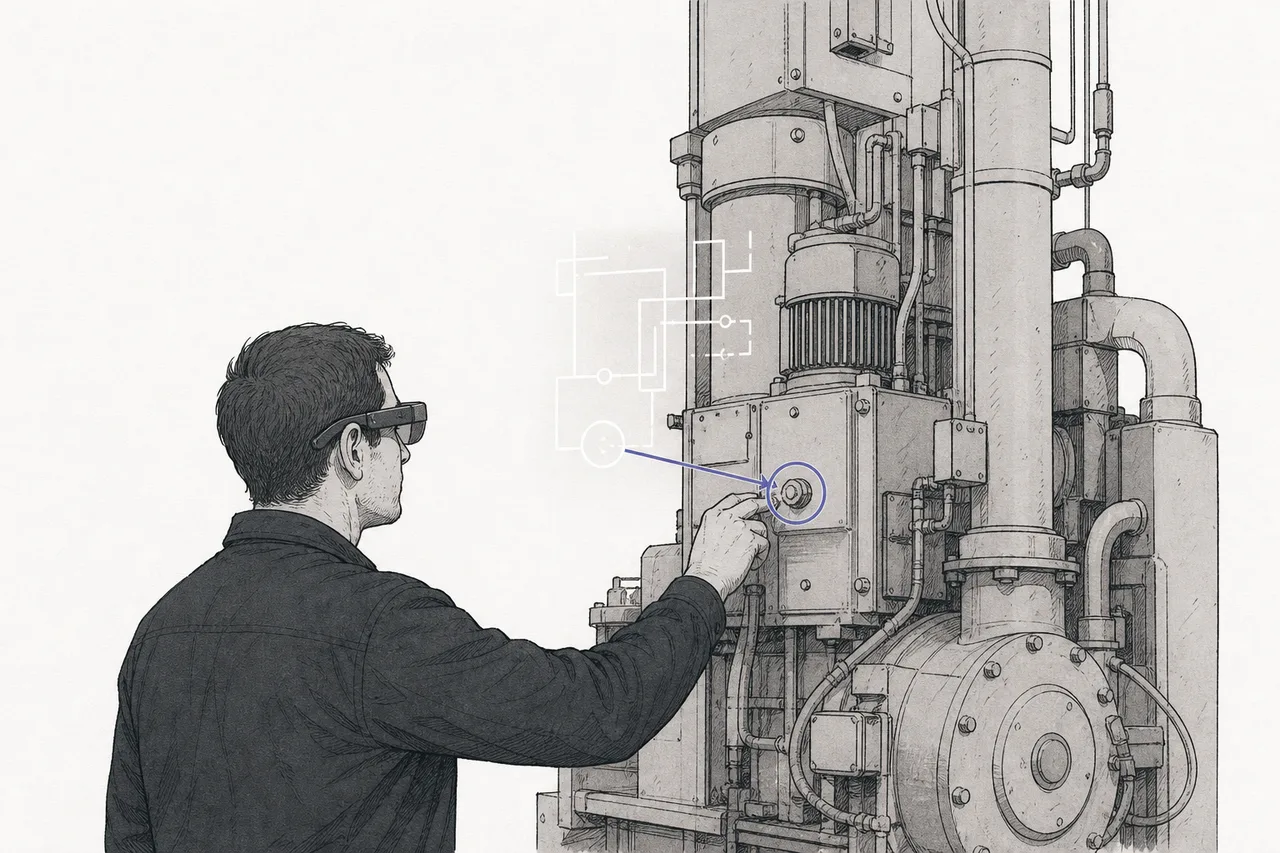
Picture a technician standing in front of a machine worth millions that just broke. He's never fixed this model before. Normally he'd open a thick manual, his eyes ping-ponging between the paper and the real machine — or he'd call an expert and try to explain over the phone, "the bolt next to the gray pipe… which one?"
Enterprise AR uses augmented reality to solve that problem head-on. The technician puts on AR glasses or holds up a tablet, and digital information — the work steps, the blueprint, a pointing arrow, or the hands of an expert on the other side of the world — "floats and lands" right onto the real equipment in front of him. Not on a separate screen, but on the real thing.
The words "Enterprise" and "Field Service" matter a lot, because they tell you this AR is not sold to ordinary consumers to watch movies or play games. It's sold to companies so that frontline workers can work faster and more accurately — in factories, warehouses, energy sites, operating rooms, or the service van that drives out to fix something at a customer's home.
VR (virtual reality) drops you into a whole "virtual world," cut off from the real one — good for training or games. AR (augmented reality) does the opposite: you still see everything in the real world, with digital information just "added" on top — which is exactly what a frontline worker needs, because he has to see the real machine and his own hands the whole time.
The heart of this node in one line: while consumer AR still can't find a reason for people to buy, enterprise AR has a clear "dollar reason" — it solves a tangible cost problem, not a dream.
02Why it matters — the only AR with real ROI
The story of AR as an industry is full of disappointment — consumer Google Glass got shelved, tens of billions poured into the metaverse still haven't paid off. But there's one corner that's quietly making real money: the enterprise side. The reason is one word: measurable ROI.
Look at the numbers real companies have reported from using AR on the job — these aren't ad slogans, they're recorded results:
The most exciting number is about "truck rolls". Every time a company has to send a technician driving out to a customer, it costs roughly $150–500 per trip. If AR lets the customer or a junior technician solve the problem themselves through a "remote expert," one telecom company cut its truck rolls by 40% within 6 months — with higher customer satisfaction too.
The classic case is Boeing. When technicians wired aircraft through glasses (Google Glass + Skylight software) instead of paper manuals, work time dropped 25% — and remarkably, the error rate fell to zero, because the technician never had to look away from the work to open a manual. At DHL, using glasses to "pick" items in the warehouse (vision picking) raised efficiency 25% and cut new-hire training from two weeks to about an hour.
This is the whole thesis: enterprise AR isn't selling magic. It solves a concrete cost problem — fewer errors, shorter machine downtime, faster training, fewer trucks rolled out.
03How it works — the "see-what-I-see" mechanism
At the heart of Enterprise AR are two modes that work together. The first is step-by-step work instructions — the system knows which part the technician is looking at and lays an arrow or highlight right onto it, telling him "loosen this bolt first, then take off this cover," one step at a time, without him taking his hands off the work.
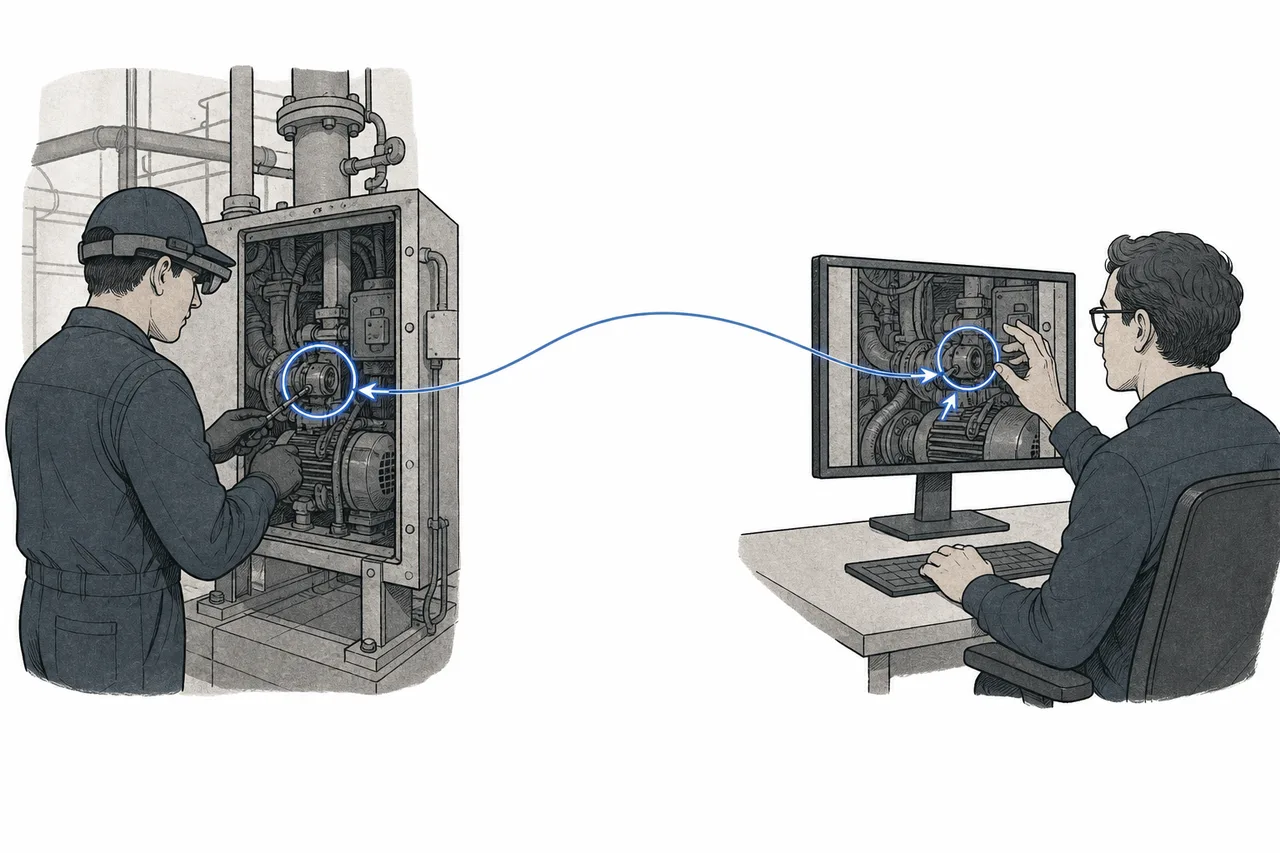
The second is the real star: "see-what-I-see" remote assist — an expert sitting on the other side of the world sees the same view the technician sees through the camera on the glasses, then "draws" a circle or arrow that appears laid right onto the real machine in front of the technician — all while the technician keeps both hands free to work.
What makes this possible is several layers of technology running at once: the camera and sensors on the glasses have to understand the real space (know where the walls, floor, and machine are) so the circle drawn on a part "sticks" to it even as the technician moves his head. AI helps recognize what the object in front of him is, and all of it has to stream high-resolution video over the network in real time.
In a warehouse, instead of carrying a paper pick-list or a scanner, the AR system floats "which bin, how many to grab" right in front of the worker through the glasses — so both hands stay free just to pick. Faster, with fewer errors. This is why DHL raised efficiency 25%.
04Where it sits in Spatial Computing
This node is the "application layer" branch under the megatrend Spatial Computing / AR/VR, which covers everything from chips and displays to glasses and software. Among all its siblings, Enterprise AR is the quickest to "actually make money" — because it doesn't have to wait for billions of consumers to adopt it; it's enough for just a few thousand companies to see the ROI.
It connects closely with its siblings in the same trend:
- Builds on Industrial Metaverse & Digital Twin: the "digital twin" of a machine or factory is the very data AR lays over what the technician sees — without a 3D model of the machine, there's nothing for AR to show
- Uses tools from XR Content, Engines & Platforms: the engines that create 3D imagery (like Unity) are the foundation used to build these work instructions and overlays
- A close cousin of AI / AR Smart Glasses: much of the glasses hardware used in enterprise work is the same family of glasses — just built for ruggedness on the job rather than good looks
And it also depends on several big outside trends: it relies on AI to recognize objects and generate guidance, on Cloud & Digital Infrastructure and high-speed networks to stream video in real time, and it pairs with Robotics & Physical AI in the modern factory — in short, Enterprise AR is the "last screen" that puts the power of AI and the cloud right in front of the person actually doing the work.
05Where things stand now — who the players are
The 2025–2026 picture is "growing, but still niche." The enterprise AR market in the broad sense is estimated at about $30 billion in 2025 (figures vary widely by definition). The narrower, more tangible market — industrial AR platforms specifically — is around $4.1 billion in 2025, projected to grow to $22.6 billion by 2035 at a CAGR of ~18.6%.
Within this market, the fastest-growing and most proven segment is remote assist, which takes about 27% of all Enterprise AR. Next come work instructions / quality control, and vision picking in warehouses. The heaviest-using sector is manufacturing (~30% of the market), followed by energy and utilities.
But the most important story of this period is the retreat of the marquee hardware — see the next chapter — which has changed hands in this field. The real players now break into three groups: the software owners (the true profit core), the specialized glasses makers, and the giants walking in.
There are also specialized players worth watching around the world — like RealWear, which makes rugged glasses for heavy-duty work, and makers and developers in Japan, Korea, and Europe focused on their own industrial markets. And the biggest of all is the shadow of Apple and Meta moving into this space, which would change the whole equation if their hardware gets cheap and good enough.
06The road ahead
The first direction is AI making remote assist no longer need a "live expert" every time. Today someone skilled has to sit waiting on the other side of the screen. But as AI gets better, it starts to become a "virtual expert" that watches the feed from the technician's glasses and can tell him what to do next on its own — cutting the cost of scarce, expensive experts one step further.
The second direction is lighter and cheaper hardware. The big pain of AR on the job is that the glasses are still heavy, the battery dies fast, and the field of view is narrow. If Apple, Meta, or new-generation waveguide-display makers can make glasses as light as eyeglasses at an affordable price, adoption jumps from "a few pilot teams" to "the whole factory wears them."
The third direction is fusion with the digital twin. When a whole factory has a digital twin updated in real time, AR becomes a "window" the technician opens to instantly see the actual status of every machine just by looking — tying Enterprise AR tightly to the Industrial Metaverse.
07Challenges & risks
Let's be straight: even though the ROI is clear, Enterprise AR is still a niche, slow-growing market — slower than many expected ten years ago. There are several layers of real barriers.
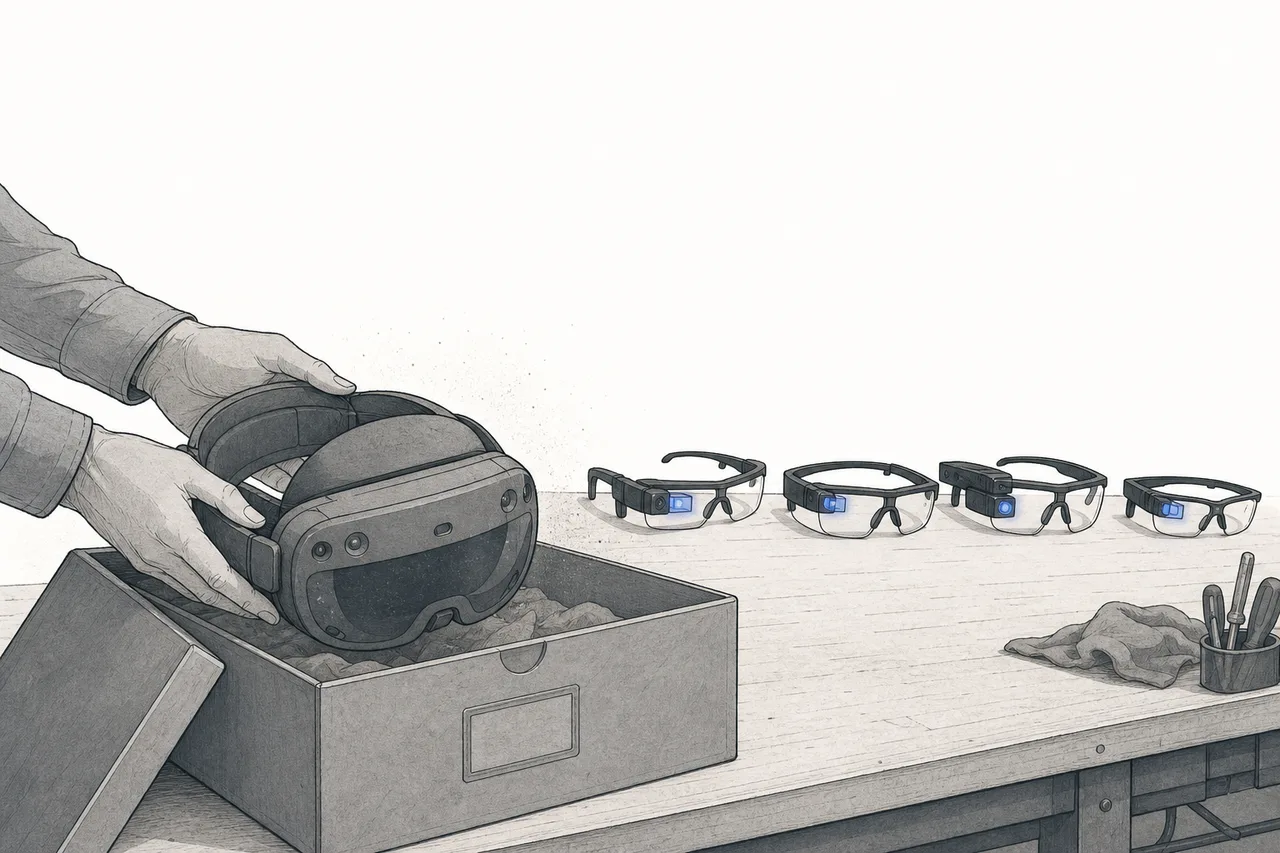
The first risk is that the hardware still isn't dialed in — a narrow field of view, a battery that doesn't last a full shift, and a weight that tires you out over long wear. This even tripped up a national-scale project: when the U.S. military tested a military version of HoloLens (IVAS), soldiers complained of eye strain, nausea, and bulky gear, until Microsoft stopped making the HoloLens 2 in late 2024 and handed the contract to Anduril — a lesson that even a giant can stumble if the hardware isn't good enough.
The second risk is the long, slow enterprise sales cycle. Changing how a whole company's technicians work has to go through pilots, training, IT integration, and proving the ROI over and over. A single deal can take a year — which is why a small company like Vuzix (revenue just ~$6M a year) grows slowly and is still losing money.
The third risk is that most of the real players are still private companies, or just a small piece of a big company — RealWear and Magic Leap aren't on the stock market yet, and Microsoft's AR is a sliver of its software empire. That makes a "pure bet" on this trend in the stock market hard, and the real value is usually hidden in the software, not the glasses themselves.