Megatrend · Spatial Computing / AR/VR
The metaverse that actually makes money is a living copy of a factory
While the consumer "metaverse" has burned tens of billions and still can't find anyone to use it, there's another version — quieter, but already turning a profit today — inside factories, jet engines, power grids, and entire cities. They build a "digital twin" (digital twin): a living 3D copy of the real thing, fed by real-time sensor data, used to simulate, monitor, optimize, and predict what will break before it breaks. This is pure B2B — boring, complex, but it pays for itself — the metaverse the grown-ups of heavy industry are betting on for real.
01What it is
The word "metaverse" makes people picture long-legged avatars sitting in a meeting room floating in the sky — the image that burned tech companies tens of billions while almost no one wanted to go in. But there's another kind of metaverse with no avatars, no games, that already turns a profit. It's called Industrial Metaverse, and at its heart is something called a "digital twin" (digital twin).
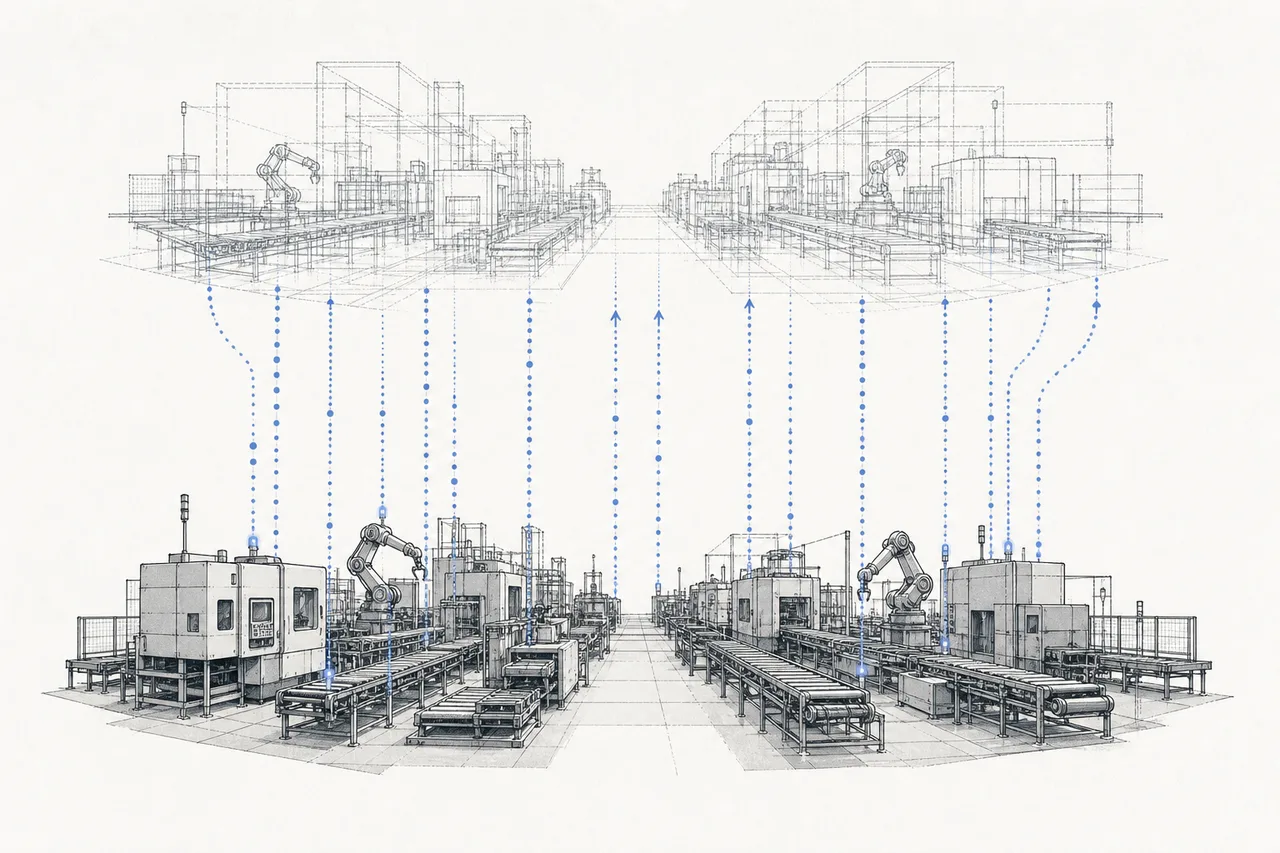
A digital twin is a living 3D copy of the real thing — a jet engine, a factory production line, a wind turbine, a power grid, or an entire city. The word "living" matters a lot, because it's not just a pretty 3D model sitting still — it's fed by real-time data from sensors on the real thing. The real thing heats up, the twin heats up too. The real thing vibrates off-rhythm, the twin sees it instantly.
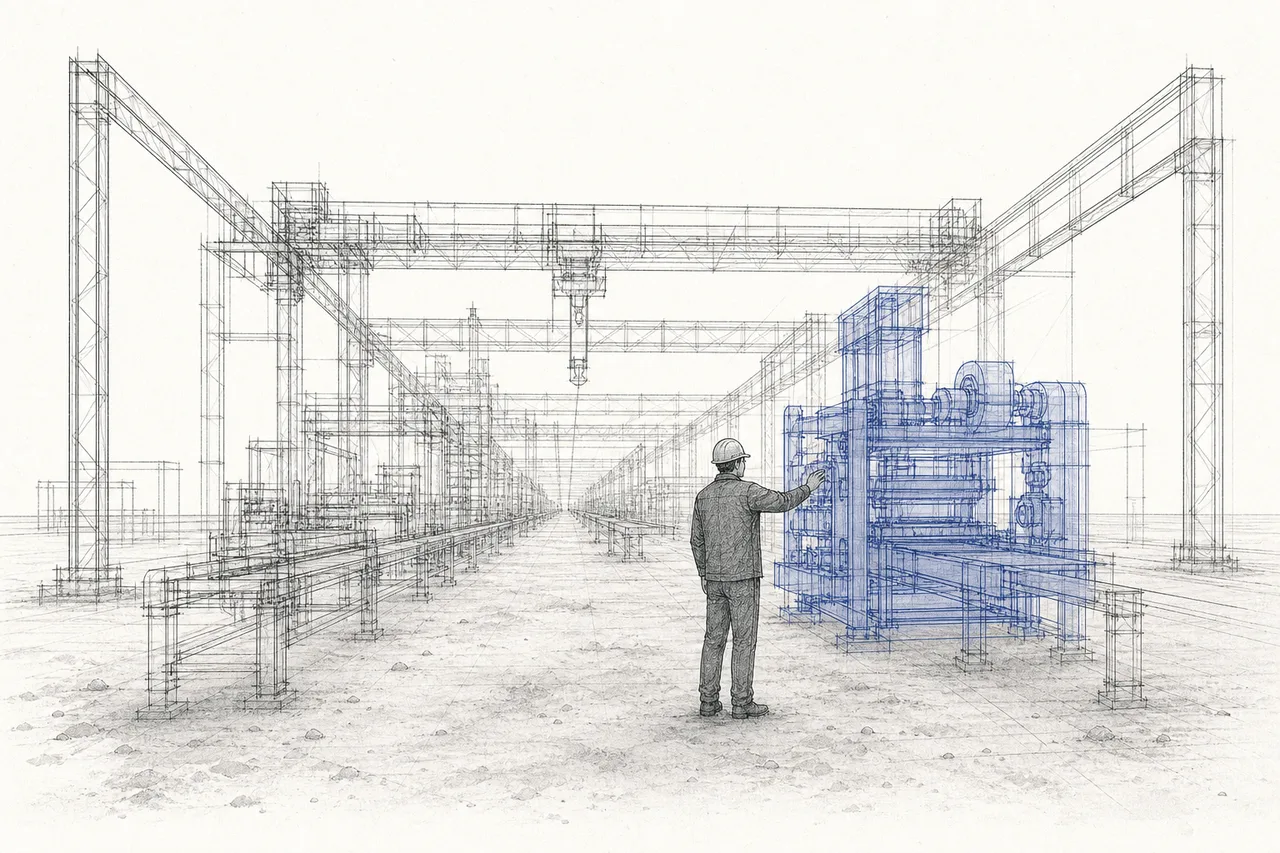
Once you have a twin that mirrors the real thing this closely, you can do what you can't do with the real thing — test anything, with zero risk. Want to know what happens if you push the production line 20% faster? Try it in the twin first. Want to know when this bearing breaks if it wears another month? Have AI simulate it in the twin and warn you ahead of time. And "industrial metaverse" is when you connect many twins together into a virtual world you can walk into and "see" the whole factory in 3D.
A typical 3D model (like in CAD) is a "still" picture of an object as designed · what makes a Digital twin different is that it's connected to the real thing all the time through sensors — the twin's state changes with the real thing every second. So you can use it to "predict the future" of that real thing, not just look at what it looks like.
This node is a sub-branch on the "use" side (application layer) under the megatrend Spatial Computing / AR/VR, and it's the answer to the most expensive question in the whole field: "all this 3D/AR/VR technology — where does it actually make money?" Most of the answer is here, in the industrial work that isn't flashy but really pays.
02Why it matters — the metaverse that actually makes money
Do the math like a factory does. A machine on the line stopping suddenly for an hour can mean hundreds of thousands to millions of baht gone. If the digital twin can predict ahead of time that "this bearing will fail in 9 days," letting you replace it on a day off instead of waiting for it to break mid-shift — that's money you can touch, not a dream.
The numbers real companies report from deploying digital twins for predictive maintenance are fairly consistent — and they're the dollars-and-cents reason this version of the metaverse sells:
In general, factories that deploy twins with a clear scope report cutting "unplanned machine downtime" by about 30–50% and maintenance costs by 25–55%. Payback is usually in the 12–36 month range — and some heavy industries, like steel mills, report ROI as high as 200–500% in the first 18 months. These are the numbers that get a board to approve the budget.
The total money is big and growing fast too. The whole digital-twin market was estimated at about $24 billion in 2025 (the figures vary a lot by definition), and many firms expect it to blow past $150 billion in 2030 — an unusually high CAGR of around 35–48%. The "industrial metaverse" market in the broad sense (including hardware, cloud, and XR) is bigger still.
More important than market size is what it replaces. The digital twin is replacing "trial and error on the real thing" — building a real prototype to test, waiting for a machine to break before fixing it, designing a factory on paper and then patching it on-site. Every time you move that work into the twin first, the cost and risk that disappear are the win.
03How it works — the closed loop of a digital twin
The mechanism of a digital twin is easiest to understand if you see it as a "closed loop" (closed loop) that keeps turning all the time, between the real thing and its digital copy. There are four consecutive steps:
Let's go step by step. Step 1, the real machine gets sensors — measuring temperature, vibration, speed, pressure, and so on. Step 2, this data is streamed up to the twin in real time, so the digital copy "moves with" the real thing every second. Step 3, engineers use the twin to simulate "what-if" scenarios (if you push the output, if the temperature rises) and let AI learn the patterns to predict which part is about to fail and when. Step 4 — the step that makes it valuable — better decisions (replace the bearing on Friday, slow this machine down) are sent back to adjust the real machine, and the loop turns again.
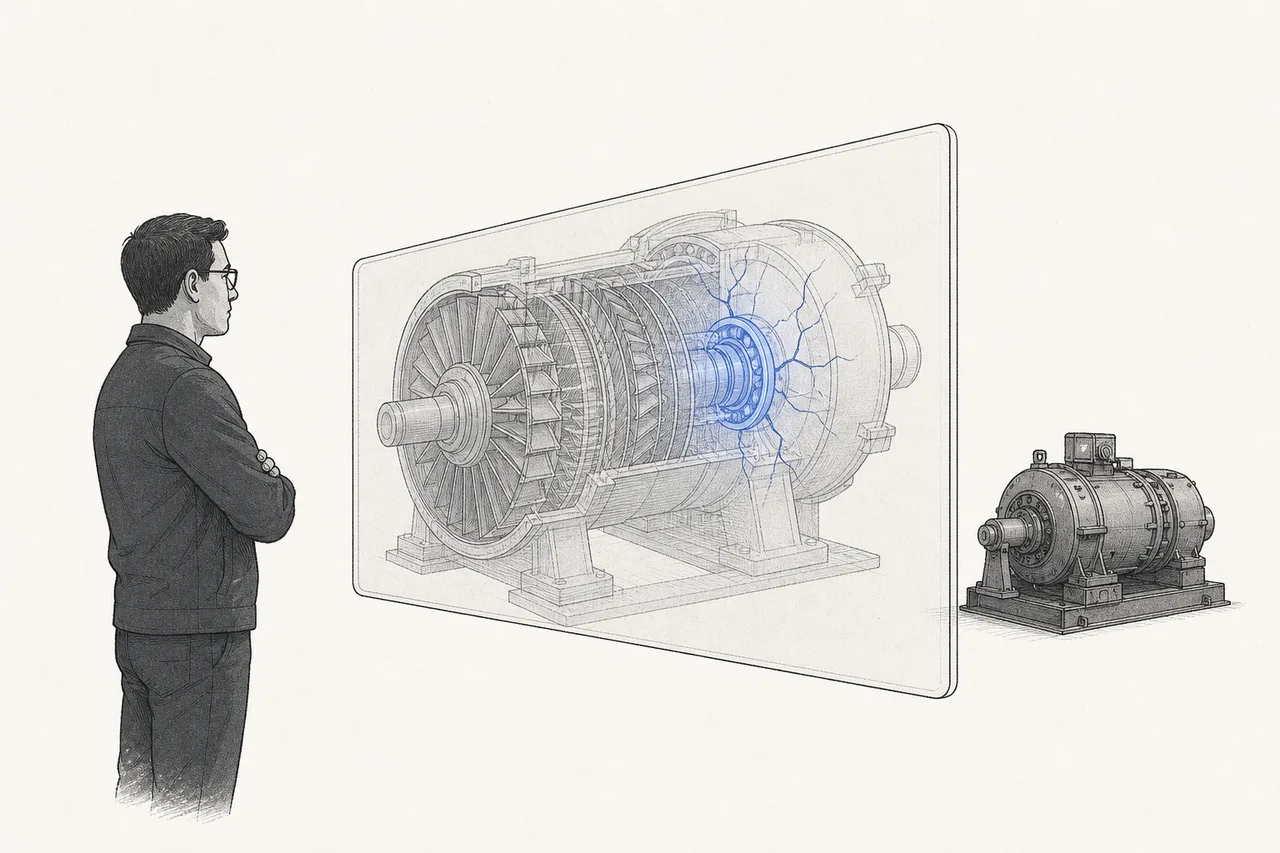
What makes Step 3 possible is physics-based simulation — a good twin doesn't just "look like" the real thing, it "behaves by the laws of physics" the same way (heat flows the same, materials fatigue the same). That's why simulation software companies are so valuable, and why a big deal like Synopsys buying Ansys ($35 billion, closed July 2025) happened — to combine multiple-physics simulation capabilities under one roof.
A factory's twin comes from many different software vendors (CAD from one, machines from another, robots from another). To combine them into a single 3D scene, you need a "common language" — OpenUSD is the open standard for describing 3D scenes that NVIDIA pushes through its platform Omniverse. Think of it as the HTML of the 3D world, the thing that lets every vendor's product connect.
04Where it sits in Spatial Computing
Among all the siblings under the megatrend Spatial Computing / AR/VR — which include XR chips, displays, VR/MR glasses, and content — Industrial Metaverse is the one that's "pure software" and the most seriously profitable. It doesn't have to wait for consumers to agree to wear glasses. As soon as an industrial company sees the ROI, it can move ahead.
It connects tightly with its siblings in the same trend:
- The partner of Enterprise AR & Field Service: the digital twin is the "data" that field AR overlays for the technician to see — without a 3D twin of the machine, AR has nothing to show. The two are two sides of the same coin
- Uses tools from XR Content, Engines & Platforms: 3D engines (like Unity, Unreal, Omniverse) are the foundation used to build and render the twin's scenes
And it also depends on several big trends outside — so much so that it's almost a crossroads:
- Leans heavily on AI: AI is the brain that reads the sensor data and predicts failures, and it's increasingly becoming the thing that "builds the twin's scenes" itself too
- Depends on Cloud & Digital Infrastructure: the twin of a whole factory is a huge amount of data to process and store in the cloud — which is why the relationship in this trend is "Cloud enables it"
- Complements Robotics & Physical AI: new-generation robots are "trained" in a virtual twin first (simulation-to-real) and only then sent out to do real work — so automated factories and twins grow together
Put simply, Industrial Metaverse is "the place where AI, cloud, and 3D meet and actually go to work in the real, physical world" — not a toy, but a software layer sitting on top of the world's factories and infrastructure.
05Where it stands now — who's playing
The big picture for 2025–2026 is that it has already "left the experiment phase and entered real production at large enterprises" — but it's still a game for big companies with the teams and budgets. The clearest example is BMW, which built its new factory in Debrecen, Hungary as a whole plant in the virtual world first and only then sank real foundations — this factory had a "virtual start of production" more than two years before it actually opened, making it the first factory planned and verified entirely through simulation. And Foxconn uses twins to run thermal simulations dozens of times faster than before.
The players in this field split into three layers: 3D simulation platforms (the base everyone builds on), industrial software owners (with twins as part of a larger portfolio), and specialized experts (twins of infrastructure or specific industries).
Beyond these, there's also Synopsys (after merging with Ansys), which controls the "physics simulation" capability at the heart of an accurate twin; Microsoft, with Azure Digital Twins as a data layer in the cloud; Hexagon, which excels at measuring and scanning the real thing into digital form; and specialized players in Asia, such as city-twin companies in China and construction software in Japan — so this field isn't concentrated in the U.S. alone.
06The road ahead
The first direction is AI "building twins" itself, more and more. Today, building an accurate twin takes skilled people and months of time. But as AI gets better, it will help assemble the 3D scene, set the physics rules, and read the sensor data more on its own — cutting the deployment cost and time that are the biggest wall today. Siemens has even launched tools like "Digital Twin Composer" to speed up this step.
The second direction is twins connecting into a real "industrial metaverse". Right now most twins are still separate islands (this machine one, that production line another). The future is stitching together every twin across the whole supply chain, so an executive can walk through and "see" everything from the raw-material mine to the store shelf in one world — and tie it tightly to Enterprise AR so a field technician can open up the real status of any machine just by looking.
The third direction is twins expanding from factories to everything — a twin of the human body to test drugs, a twin of a whole city to plan traffic and respond to disasters (connecting to Smart City), a twin of the power grid to manage renewable energy. Every complex physical system that's expensive when it breaks is the twin's next target.
07Challenges & risks
Let's be straight: even though the ROI in the case studies is pretty, Industrial Metaverse is heavy, complex enterprise software that takes a long time to deploy. Its risks are as tangible as its benefits.
The first risk is "garbage in, garbage out" — a twin is only as good as the data you feed it. If there are too few sensors, the data has gaps, or the physics model doesn't match the real thing, the twin becomes a "pretty picture that lies" — looks trustworthy on screen, but predicts wrong. Investing in sensors and cleaning up data is often more expensive and more boring than the twin software itself.
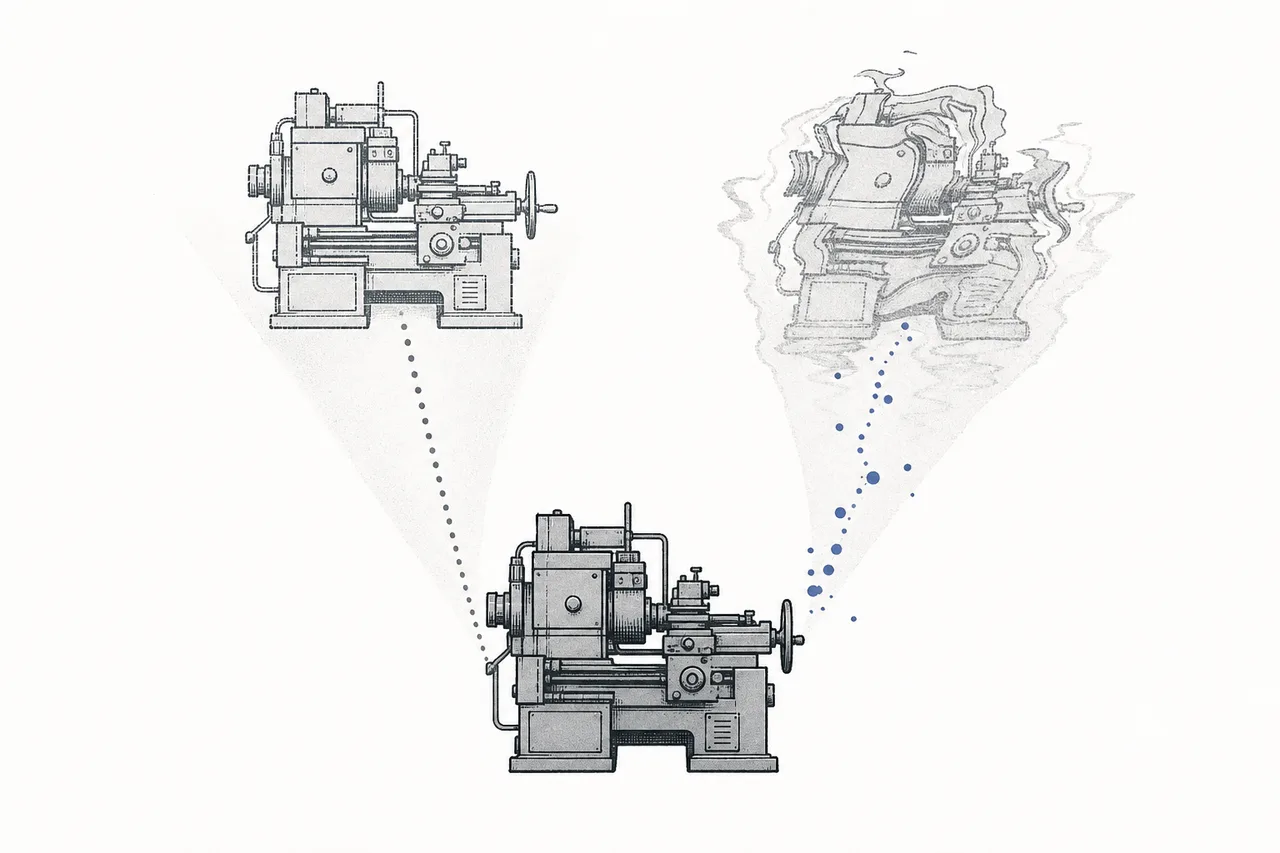
The second risk is the term "digital twin" is sometimes more marketing than reality. Many vendors call an ordinary 3D model or a data dashboard a "digital twin" when it isn't really connected in real time or capable of physics simulation. Customers have to tell the difference between a "twin that can predict the future" and a "3D picture with a cool label" — otherwise they pay a premium for the same old thing repainted.
The third risk is a very long sell-and-deploy cycle. Connecting a twin to existing IT systems, sensors, and a factory's work processes can take a year and require expensive consultants, which concentrates the value in large enterprises that have the budget while smaller factories still struggle to reach it. And the fourth, which follows, is cybersecurity — a twin connected two-way to real machinery, if hacked, could become a doorway to command the real machines.